Gila’s Got the Whole World

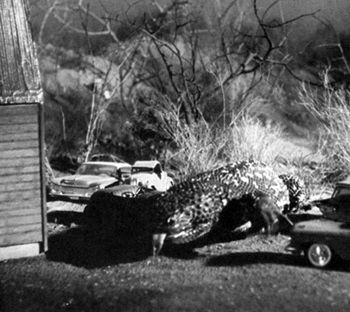
Singing pretty-boys and colossal lizards – it must be time for The Giant Gila Monster. A horror film that portrays all the innocence of the 1950s before the Beat Generation led us down the path to reality, the film has earned cult status in recent years. More accurately titled, “A Regular-Sized Gila Monster Filmed in Close-Up,” the sub-mediocrity of the movie has probably done more for preserving it in popular culture than any other aspect. The film stars the relatively unknown Don Sullivan as a great teen role model who writes and performs his own songs. The number that receives the most Internet attention, and the one that makes this movie of interest to this blog is “The Mushroom Song.” Chase Winstead (Sullivan’s character) has a young sister who is just learning to walk with leg braces. To cheer her, he picks up a ukulele and sings: “And the Lord he said I created for you/A world of joy from out of the blue/And all that is left to complete the joy–/Just the laugh of a girl and boy/And there was a garden, a beautiful garden/Held in the arms of a world without joy/Then there was laughter, wonderful laughter/For he created, a girl and a boy/And the Lord said, laugh, children, laugh/The Lord said, laugh, children, laugh” with the final line repeated numerous times.
Laugh, children, laugh

Perhaps intended to underscore the societal norms of a time when “the Lord” made frequent appearances as an unseen supporting actor in many movies, this song is oddly out of place. The disability of Missy Winstead is obviously a device to raise tension: how will a disabled girl run from a giant lizard? The song, however, provides the resolution – the Lord will take care of all good people. Their response should be to laugh. The reference to Adam and Eve, fitting for teen fantasies of all generations, also belies the evolution of this monster. The gila grows to its great size because of chemicals in the water that wash to the delta somewhere in Texas. This creature did not evolve. The Lord will take care of it. The Lord and nitroglycerin.

Respectful teenagers with predictable haircuts and a society that believes a missing teenage couple could be doing nothing but eloping fits the world of the Religious Right exceptionally well. Even though they may not be perfect, these kids know right from wrong for they live in a black-and-white world with no ambiguity or ambivalence. Children of subsequent generations have grown up with shades of gray or psychedelic colors. The older generation is frightened by new developments, claiming that the world they know is about to end. In fact, an evolution is occurring. Those who try to hold society to the norms of the 1950s would do well to move ahead a decade and at least listen to Bob Dylan. No matter how far we progress, however, it seems that Texas will always delight in producing Lord-loving, bloated threats to rational civilization.
Evolving in America

Columnist Leonard Pitts Jr. is one of the most sensible men in America right now. Witty, humble, and bright, he sees clearly and shoots straight. In an allegory entitled “A tale of a giant grown stupid” he illustrates the frustration many intelligent people feel in a country where thinking is viewed askance, and accepting empirical data is rife with suspicion. He begins his article by citing a statistic in Science that indicates some 60 percent of high school biology teachers in the United States inform their students that they don’t have to believe in evolution, they just have to know enough to get through the test. And evolution is not alone in the field of falsified information. Americans are regularly fed a high-fat, low-fiber diet of poor quality religion and told it is the only correct one.

While the remainder of the developed world has moved on to more important issues, we in America are still stuck in Fundamentalist kindergarten. The constant barrage of insipid theology from self-proclaimed doyens of the Scriptures assures the masses that the price of heaven is a healthy dose of creationism. Making matters worse, most biblical scholars choose not to engage these misguided spokespersons, choosing instead to believe they’ll eventually just go away. But why go away when you’re winning the fight?

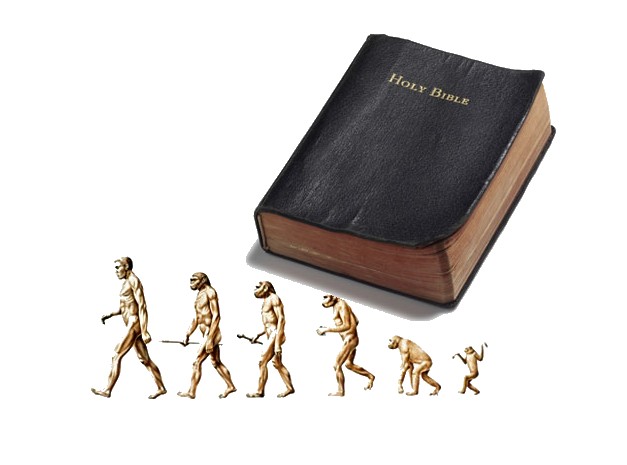
Evolution is such an odd issue over which to argue. Neither serious biologists nor serious biblical scholars have any problem with it. Only a society increasingly under the power of a jacked-up, over-eager, offensive Christianity buys the feeble creationist rhetoric. And buys it in bulk. That is the American way. For many, society’s ills may be blamed on too much thinking. The Bible requires no thought, just the ability to see in black and white. And the Bible has proven a more powerful weapon than an H-bomb in the educational curriculum of our bright young minds. America itself is evolving. Unfortunately it is evolving into a nation satisfied with simplistic solutions to complex problems. And Bible scholars do nothing and wonder why everyone ignores them. Once upon a time there was a giant. Only it was not sleeping, it was already dead.


Misjudging Dinosaurs

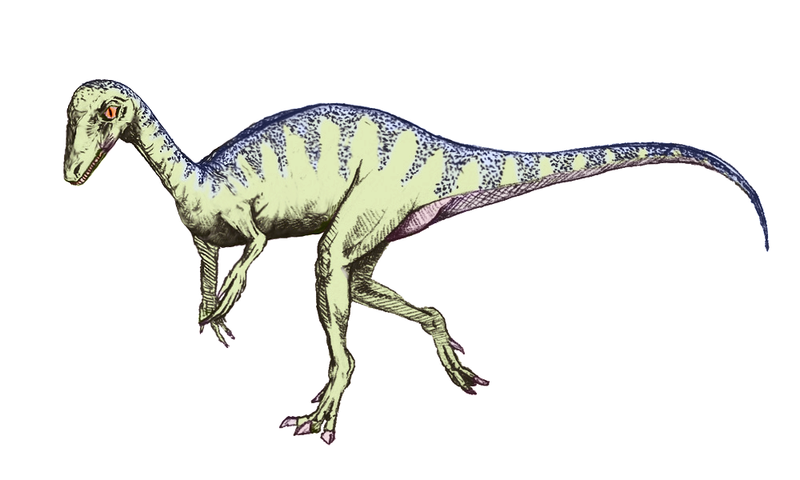
Two dinosaurs diverged in the middle of evolution, and I’m not at all sorry that they both flourished. One became an herbivore, harming no one but plants, while the other grew into a carnivore, eating its siblings. That’s the way of this evolutionary universe. The Eodromaeus and Eoraptor split took place near the very inception of the dinosaur form, with the most basic of existential options: eat or be eaten. Noted paleontologist Paul Sereno has been excavating these Argentinean Lilliputian dinosaurs and has detected that the species, while similar, had irreconcilable food preferences.

Dinosaurs are often relegated to the age of children. When we grow up, we’re supposed to take interest in more modern developments and leave the dinosaurs in the dust. Their value, however, is often underappreciated. We learn about our world by examining theirs. Identification is subtle and sometimes wrong. Little Eoraptor is now thought to have been the plant-connoisseur, despite the terrifying, Jurassic Park-sounding name. We call them what we think they might be. Further discovery often changes the complexion of the picture.

When forced into a choice of more adult occupations, perhaps I unwittingly rebelled, choosing to study ancient religions. Like dinosaurs, religions evolve. As a child it was far easier to tell the preferences of dinosaurs since their morphology often gave them away. Religions are much more subtle. We are told that some dinosaurs survived in the form of birds. Many, many millennia of evolutionary pressure reduced their size and morphed their scales into feathers. Sometimes it’s hard to recognize a carnivore even when it’s just outside your window. That’s the way it works. Some follow the herbivore track, others prefer the way of the carnivore.

It's not the Eoraptor you think you know (from WikiCommons)


The Good (Face)Book

One of the funnier books I’ve enjoyed has been Sarah Schmelling’s Ophelia Joined the Group Maidens Who Don’t Float: Classic Lit Signs on to Facebook. Its unwieldy title as well as the temporary nature of the subject ensure that this book isn’t destined to be a literary classic, but it is a nuanced and subtle treatment of the Facebook phenomenon. (My daughter found it on the bargain table at Borders, and it cost us less than two dollars.) Schmelling presents the Facebook pages of famous, departed authors, often with hilarious results. For some time I regarded YouTube, Twitter, and Facebook as passing fads, but now I’m beginning to wonder if we’ve become so connected that shutting down the networks would be tantamount to pulling the plug on the respirator. We live to be connected. Humans are social animals, and yet many of us find ourselves isolated and alienated, living apart from family and those who were significant to us in times past. It’s the Internet to the rescue.

My wife pointed out an article on CNN entitled “The theology of Facebook, an online ‘altar’” by Omar L. Gallaga. Gallaga explores the concept that Facebook is now being taken as a spiritual venue by many. Quotes from the Bible or self-righteous, self-congratulatory religious sentiments are very commonly posted. So much so, Gallaga suggests, that some clergy worry about their jobs. Facebook has developed its own “spirituality” quite apart from anything its creator may have imagined. Facebook is evolving. I joined Facebook last year, but I limit my involvement to mostly watching others. Rather like I did as a kid on the school playground.

Is there balm in Gilead? In rereading Brave New World I am reminded of the insidious nature of soma, the feel-good drug. I’ve been to churches like that. Like Bernard Marx I left feeling empty. In Facebook-world it feels the same to me. We are communal creatures by evolution, but we want to talk about our troubles more than we want to listen. We are seeking that mythical, homeopathic cure to the ills our society creates: lack of prosperity (except for the Prosperity Gospel crowd, of course), joblessness, despair. Misery loves company and Facebook loves company. It is like the confessional without the absolution. Gallaga may be right; maybe Facebook has become a religious institution for some. If Facebook had come along a little earlier there would be no lost years of Jesus for us to ponder. We would know through his posts and tweets, exactly what it was like to be the son of God.


Lions, and Politicians, and Bears


A man was eaten by a lion in Zimbabwe yesterday. A boy on his way to school in Alaska was attacked but relatively unharmed by a brown bear. Predation. Much of the way humans act is based on our long history as both predators and prey. Evolution (may not apply in Kansas or Texas) has designed us to cope with these constant stresses of finding enough food and avoiding becoming food. A great deal of religious behavior can be traced back to avoidance of predation and success in the hunt. We like to think that we are somehow not animals, but animals are smart enough to disagree. Just ask that cheeky squirrel that finds ingenious ways to circumvent all the deterrents you put in place to assure that those seeds go to needy birds, not fat rodents. We are part of the mix. Our opposable thumbs help immensely; we build our own ecosystems to keep lions and bears out.

Yesterday was a day of predation. Even within the human sphere we find that killing others is permissible, as long as it is done slowly by those in fine clothes and fancy automobiles. Depriving the less deserving is a time-honored human behavior, after all, survival of the fittest only applies to animals, not us. Right? By backing policies that protect the wealthy in their lofty sanctuaries while others shiver in November’s Tuesday chill we show human nature. Humans are predators as well as prey.

Intriguingly, many politicians who support laissez faire economics deny evolution exists. Instituting policies that ensure survival of the wealthiest, they deny up and down that evolution has anything to do with the way that we are. It’s all in the nature of the evidence. And nature itself is evidence. We may be the smartest, most well adapted of the mammal class, and yet we can be eaten. What does the evidence suggest? From the point-of-view of a lifelong observer of religion, it suggests we are still the prey. When religion stealthily crawls into bed with politics, it is evident that even religion itself may be a deadly predator.


Noah’s Newest Neighbor

This week paleontologists announced the newest dinosaur discovery: Kosmoceratops, a plant-eating, three-ton beast with an improbable arrangement of fifteen horns on its head. Any beast arising from the sea would be jealous. As Kosmoceratops jostles its way onto the ark, scientists debate the utility of all those horns – placed incorrectly for defensive purposes, they seem to have functioned to attract mates. Isolated on a fairly compact land mass, these Cretaceous ceratopsids bloomed into a distinctive species as showy as any other so far discovered. As evolution continues to stir debate in this country, its evidence keeps marching along.

Every semester, four terms per year, I have students work on a project that includes (in part) evolution and the Hebrew Bible. Every semester as I overhear discussion, I realize just how deeply the anti-evolutionary front has its claws in the American psyche. Otherwise intelligent undergraduates studying a variety of subjects: science, business, engineering, psychology, express their doubts about evolution. The reason: the Bible doesn’t affirm it. Nor does the Bible affirm atomic theory, free market economics, or microchips. Evolution hits, perhaps, a little too close to home.

The dinosaurs stomp in the face of Creationism. As much as the fundies try to embrace them, dinosaurs are just too outlandish to fit in any world other than evolution. The God of the Bible doesn’t seem to have a surfeit of humor to have wasted so much creativity on dinosaurs that no human ever got to see. We reconstruct, with amazement, species after flamboyant species, and yet the foes of science keep a finger firmly tucked in Genesis. Serious Bible scholars seldom have difficulties with letting science do its job, including evolution. The agitation arises from another quarter. And with all those horns in front of us, that quarter might be the apocalyptic sea after all.


SpongeBob’s Evolution

My daughter has, unfortunately, outgrown SpongeBob SquarePants. She was my putative excuse for watching the (literally) brainless eponymous lead character going about his inane adventures. The creator of SpongeBob, Stephen Hillenburg, is a marine biologist and much of the fun for adults watching the cartoon derived from the biologically correct remarks made by the characters about their physiological conditions. Watching the laughing yellow sponge with his inimitable voice was a pleasant escape from the constraint of my own biological existence.

Today the New Jersey Star-Ledger announced that two researchers from Princeton University may have discovered the oldest animal fossils ever recorded. It seems that for a while, some 635 million years ago, the earth was undergoing its Cryogenian Period when the planet surface was all but completely frozen. The earliest discovered animal fossils were discovered from after that period. Princeton geoscientist Adam Maloof has recovered what appear to be animal fossils from 650 million years ago, 15 million years before the big freeze. This find had been anticipated by genetic scientists who had suggested that such early animal forms likely existed prior to the appearance of the earliest sponges 520 million years ago.

For now the new finding shifts the fossil record back by about 90 million years. There will be massive gaps to be filled in by scarce traces left in inaccessible rock. Creationists will no doubt gloat that the fossil record is now even more full of holes than ever. This is frequently the quality of ambiguity that they suggest will topple the evolutionary lie. The truth, however, faces the opposite direction. The oldest creatures found are ancestors to the common sponge, pushing SpongeBob’s ancestors back many millennia before those of the Adam who discovered them. It seems to be the silly yellow sponge who will have the last laugh.

Gee, did I really cause all this?


Sobek to the Beginning

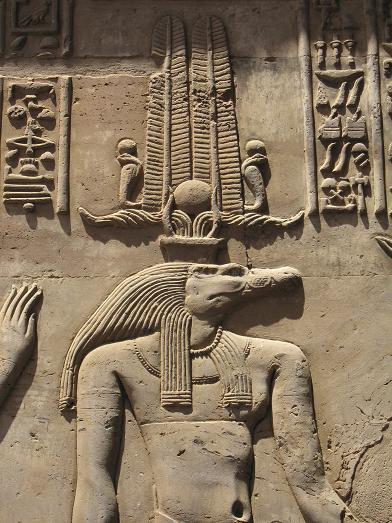
From some of my earliest reveries, Maine has been my favorite state. This strange feature had to have been gleaned from books since I never visited Maine until my early twenties. Since that time I’ve returned as frequently as possible; however, over a decade spent in Wisconsin made the trip somewhat daunting. So last night, still dealing with lingering intense emotions from the county fair, I decided to watch Lake Placid, the 1999 horro-comedy set in Maine. The movie is generally brainless escapism, and even the scenery is that of British Columbia rather than New England. It had been years since I’d seen the film, so I was surprised when Kelly Scott stated in defense of Hector Cyr that crocodiles were worshipped as gods by many ancient peoples, making them more prayed to than Jesus. This was, naturally, a healthy dose of celluloid hyperbole, yet it did bring to mind Sobek, the Egyptian deity mentioned by name in the film.

The ancient Egyptians venerated many animals as possessors of god-like qualities. Crocodiles, naturally dangerous to humans as well as to many large mammals, would suggest themselves as a form of divinity. Sobek was never a major focus of the Egyptian collective of gods, yet the mummified remains of crocodiles and the striking iconography of the deity attest his cult. The ancient Egyptians had no way of knowing that the crocodile had withstood the pressures of evolution for millions of years, a striking example of a body plan and lifestyle requiring no improvement. Few creatures have the staying power of the crocodile, an animal capable of feats more incredible than the fabricated beast in Lake Placid.

While Jesus has nothing to fear from crocodile worship (or, apparently, the Beatles), religion grasps, even unwittingly, to the unchanging. In a culture shifting so rapidly that our eyes barely have time to focus before something completely novel is thrust before them, the stable image of the crocodile may still serve as a useful symbol of something our religious forebears knew that we should continue to recollect. Stability is worthy of admiration. In a bizarre way, throwing Maine together with crocodiles may be an antidote for melancholy, but only in the right environmental conditions.


Go Fish

You are what you eat. That trite truism has been kicking around for a few decades now, and although it has been an aphorism to encourage healthy eating it does convey a deeper truth. Scientists working in Africa have determined that the hominid diet of roughly two million years ago led to rapid brain expansion (rapid on an evolutionary scale, of course), according the New Jersey Star-Ledger. Remains found in Kenya, featuring a Rutgers University archaeologist, have indicated a widely varied diet of fish, turtles, and crocodiles among ancient hominids. Apparently these animals provide valuable nutrients for brain development, a somewhat disturbing piece of information for us vegetarians.

The more I have pondered this information, the more it has become evident that the concept of God has undergone considerable evolution. As I have noted several times in the past, religious behavior emerges at the very least in the Paleolithic Era of human development. What those non-literate ancestors thought or believed about “God” is long lost, but it seems to have persisted into modern conceptions of divinity. Belief in supernatural beings is attested world-wide, and therefore is a true human universal. (There are, of course, non-theistic religions and individuals, but all cultures show some measure of belief in the supernatural.)

In those moments when I am free to ponder what this might mean, I wonder about the earliest conceptions of the divine. It seems likely that this being was like a hominid, able to respond in kind to placating gestures on the part of early humans. An abstraction simply doesn’t fit easily into minds focused on the practical aspects of survival without the guidance of professional theologians. That early God was able to, but not obligated to assist our fearful ancestors with the struggles of daily life. That aspect of the divine being has not changed in many millennia. Even today many religious individuals still consume fish, a food approved even for meat-free days, by God himself.

Early images of God?


Awaiting the Evolution

My daughter’s taking the mandatory New Jersey high school biology tests this week. Probably designed to ensure that basic health risks are factored and understood, it is one of the few bulwarks of the correct teaching of evolution in the United States. As anyone who follows my college Michael Zimmerman’s blog in the Huffington Post realizes, Creationism is a constant menace to our country. Although many simplistically assume that the threat is gone, it is, alas, sleeping but not dead. Perhaps quiescent under the administration of a moderate president, the Creationists have not gone away. I fear an imminent backlash along with popular apocalyptic hype for the year 2012. The Creationists are out there, just beyond the perimeter fence. I can feel it.

Having grown up under the umbra cast by the Creationists, I know their resiliency well. In a high school current events class, I participated in a Creationist-Evolution debate that classmates still remember some three decades later. It would be a situation laughable if it weren’t such a serious threat. While society has continued to evolve since Scopes, most Americans are still convinced that there is something insidiously evil about evolution, as if the devil generated the first simple cells and set the entire process running. In a society where Creationists daily benefit from the advances of science – as any search for evolution on the internet will demonstrate – they hold their feet firmly on the brakes nevertheless, awaiting a snow-white stallion at the parting of the literal clouds overhead.

I am not alone in foreseeing this whiplash that’s about to come. Many analysts who know the radical Evangelical camp share my fits of nerves and jitters. The educated elite suppose they’ve been eliminated, but those of us who know the world of the uneducated faithful tremble with a fear not inspired by the Maya. Sarah Palin is one of the most popular people in this country right now, and the Creationists, I assure you, are already staring at their watches and counting each passing tick.

Neo-Cons marching straight to the polls


Giving Lilith Her Due

Lilith Fair has announced its 2010 tour dates and excited fans are already purchasing tickets. Lilith Fair is a collection of women artists who share a stage to showcase the female contribution to contemporary music and donate a considerable share to charity. The event name, of course, is taken from the mythological character of Lilith. Popularized as a rare example of “Hebrew myth,” Lilith is a character who likely derives from ancient Mesopotamia, although her origins are obscure. Best known as “Adam’s first wife,” her somewhat sexy story in Judaic tradition evolved into Lilith being the original woman. Unlike Eve she was created simultaneously with Adam. Things were fine until she wanted to be on top during intercourse – males were not made to be dominated, according to patriarchal old Adam, and Lilith ships out to shack up with Satan. She is demonized (literally and figuratively) and becomes the “night hag” that snatches babies and claims the first right of intercourse with every male (an etiology for nocturnal emissions). She becomes the mother of demons.

This story shows all the traits of a late development, but the idea of a strong female figure in Eden is an appealing one. Lilith has come to represent the empowered female, and the modern trend towards accepting her as an icon of feminine independence is apt. Long ago I was intrigued by the female side of the story. Perhaps because I was raised primarily in a single-parent family for my formative years, I have always wondered about the disparity in our “advanced” culture that still considers the male as the “default” model with the female as kind of an adjunct after-thought. This fascination led me to the study of goddesses in the first place, culminating in a doctorate on Asherah. In the Bible men have Adam, Noah, Moses, David, and countless other role-models – even God himself according to standard interpretation. Why not admit the goddess?

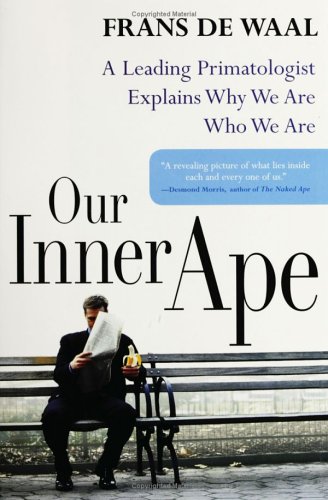
It is telling that when Lilith becomes too powerful she is presented as evil. Anthropological explanations have little to offer by way of adequate explanations for such a development. Not to blame biology (or to lay claim to an excuse), but Frans de Waal’s Inner Ape demonstrates that males are hopelessly paranoid about showing weakness. Female primates tend to express their power by group cohesiveness while males try to blunder their way to the top with brute individualism. Adam had nothing to fear from Lilith. To those who perform in Lilith Fair, I only have to say, “Rock on!”


Not My Daddy!

They spy each other across a crowded room. He sure is big: barrel-chested and even a bit brutish. She’s cultured and refined, but there’s no denying that spark…

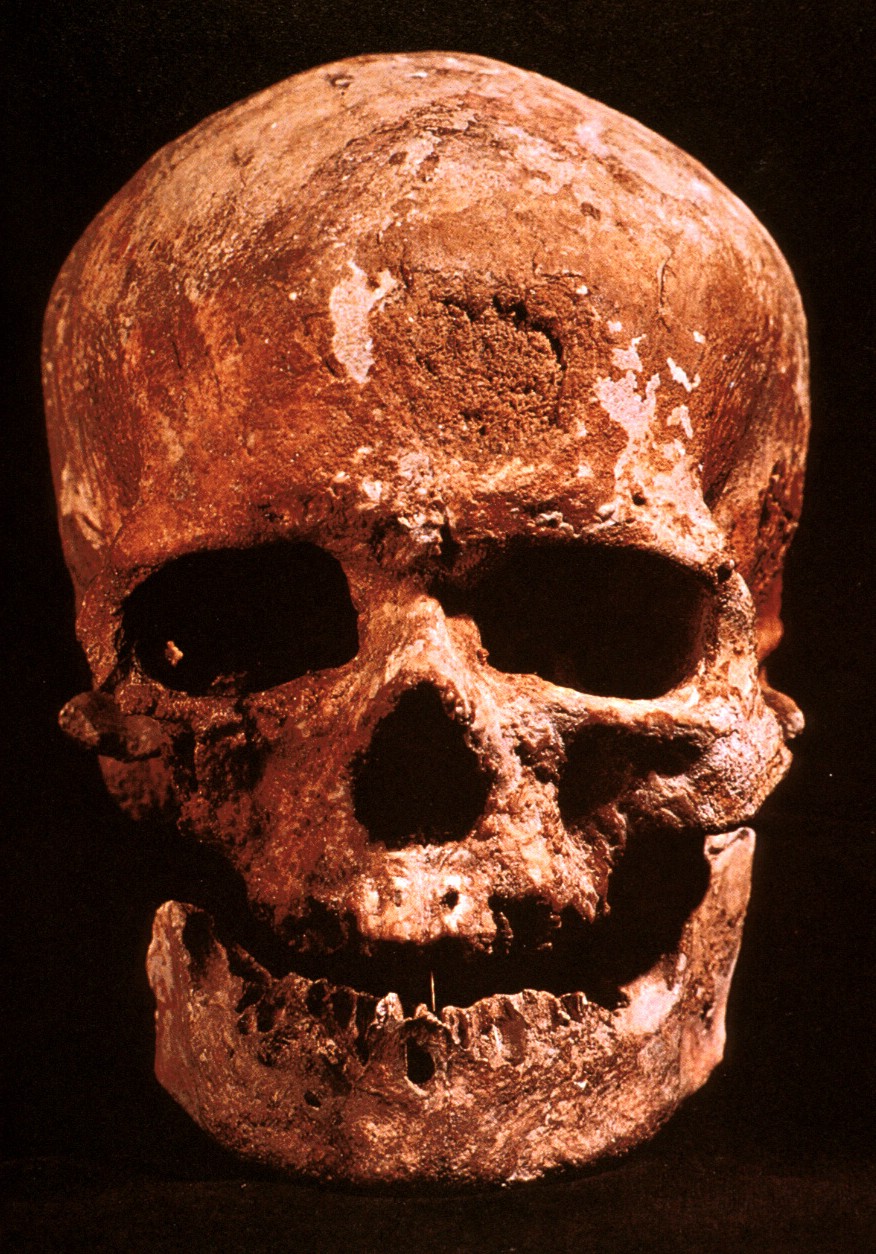
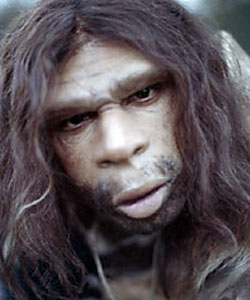
Today’s issue of Science announces the startling news that Neanderthals and Homo sapiens once interbred. The theological implications are enormous. I used to tell my students that the earliest evidence of religion falls not only among the artifacts of the Cro-Magnon branch of the hominid tree, but also among the remains of Neanderthals. If they had religion, and if they weren’t “human,” what happened to their souls when they died? I received a lot of puzzled looks from seminarians and more than one or two angry stares. The Bible, after all, claims that each was made according to its own kind. Seems like Adam and Eve might have been sleeping around with the non-Eden set. Looks like we’re in for another theological conundrum!

Neanderthals and Homo sapiens diverged once the human lineage left Africa, but once they met in a smoky Paleolithic bar, well, nature took over once again. And if these two hominid species interbred, who is to say what went on back in the days of Lucy? What happened in prehistory stays in prehistory, religions must needs proclaim. If we are honest with the evidence, our bonobo cousins share ancestors so do they share souls?

Some of the present human race, according to the DNA evidence, is walking around with Neanderthal blood, while others are not. I suppose gene sequencing might reveal which camp you are in. Will there be a Church of the Neanderthals? And will non-Neanderthals be allowed to share communion? And were the founders of the world’s great religions all Cro-Magnon or not? If they were of a slightly differences species, can I still join? Theologians, it is time to grab your pencils!

Maybe your dad, but not mine!


Ape Versus Primate


I have just finished reading one of the most important books I’ve found in quite some time: Frans de Waal’s Our Inner Ape. My attention was first drawn to the author when Rutgers University sponsored a talk he gave in the fall that I was unfortunately unable to attend. Simultaneously I saw his book footnoted in a text I was reading and decided to follow up on it. In addition to containing fascinating, documented anecdotes concerning ape behavior (he tells of a bonobo that attempted to help an injured bird fly!) de Waal holds a mirror up to the great apes and sees humanity reflected back. His discussion of the origins of morality makes far more sense to me than any theory I’ve seen a professional ethicist concoct. Our sense of empathy, de Waal notes with considerable evidence, derives from our common ancestor with the apes.

After discussing the understudied trait of kindness in the apes, de Waal writes: “With morality firmly rooted in sentiment it’s easy to agree with Darwin and Westermarck on its evolution and to disagree with those who think culture and religion contain the answer. Modern religions are only a few thousand years old. It’s hard to imagine that human psychology was radically different before religions arose. It’s not that religion and culture don’t have a role to play, but the building blocks of morality clearly predate humanity. We recognize them in our primate relatives, with empathy being most conspicuous in the bonobo and reciprocity in the chimpanzee. Moral rules tell us when and how to apply these tendencies, but the tendencies themselves have been in the works since time immemorial” (225).

These might just be platitudes if ample evidence did not demonstrate their veracity. Apes plan ahead, recognize fairness, and can even see issues from the point of view of others (something Gorgias Press might benefit from learning). They are clearly inheritors of the moral sense that evolution has crafted among all cooperative animals over the eons. Religions like to lay claim to the origins of morality: we behave this way because our god told us to. In a sense that may be true, but only if the “god” is nature itself and the instruction it gives is the way for a species to thrive. Caring for one another, all religions aside, is the formula that evolution presents as the most successful choice of natural selection.


Naughty Religion is Bad Science

In the continual struggle of Fundamentalist Christianity against the rest of the world, new Creationist grounds have been made in Connecticut. Connecticut is not exactly the first state to spring to mind when it comes to extremist conservative religion, but Fundamentalism knows no bounds. Perhaps the largest disappointment, from the point of view of a student of religion who knows the Fundamentalists a little too well, is that otherwise intelligent people simply accept what their clergy tell them. Having been a seminary student and professor, however, I know the kinds of training clergy receive and if the whole wide world knew things would be different.

Clergy of all stripes of all denominations of all religions are just as human as the rest of us. They do not have special physiognomic features in their brains or hearts or cellular structures that allow them to receive private messages from God/the gods. Many are trained in special schools where people like myself teach them, often against the blustering of their clergy supporters back home, what we factually know about the Bible and other aspects of religion. Many successfully block out what they are forced to hear and emerge just as ossified, if not more so, as when they entered. In other words, their “education” has been an exercise in learning to ignore the truth. They are then made into clergy who continue the deception. Even worse are the clergy who receive no training at all, frequently fresh from an overly-heavy-dinner-induced religious experience, who claim that the biological responses to overtaxed gastric juices is some message from beyond.

The average citizen naively accepts the religious credentials of their clergy, supposing that this “holy” person has had some special word from on high. That word is often factually wrong, especially concerning evolution and the origins of life, but it is accepted as gospel truth and disseminated among unsuspecting children. Religion is a matter of belief, not of fact. As America lags farther and farther behind even developing nations in science education, Fundamentalist clergy give a self-satisfied smile. They have become the gods of a nation that was once able to land some of its citizens on the silvery moon in that great literal dome that surrounds our flat earth.


Religion Embraces Science

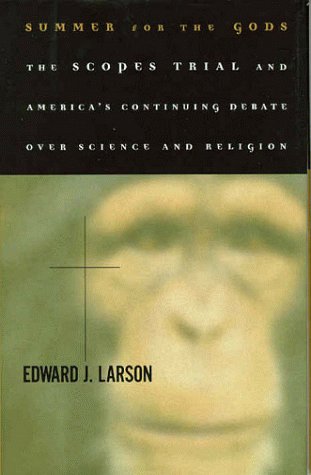
My colleague and one-time dean, Michael Zimmerman of Butler University, has brought his Clergy Letter Project to the Huffington Post. Well, he has written an online piece for the Huffington Post entitled “Redefining the Creation/Evolution Controversy.” His article is clear and to-the-point: the Creation/Evolution debate is not about religion versus science. That has been shown repeatedly for those who care to examine the history of this controversy. Evolution barely caused a ripple among clergy when it was first becoming popular among scientists. Ministers assumed it was just one of God’s mysteries and went about their clerical duties. The issue became a public relations boondoggle with the Scopes Trial of 1925. One of the best books written on that subject is Edward Larson’s Pulitzer Prize-winning Summer for the Gods.

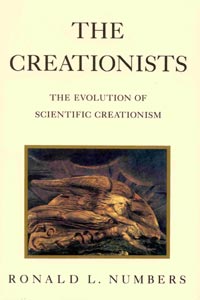
As I have stated in my podcast on this issue, Creationism is a splinter movement within Evangelical Christianity. Over the years it has drawn in members of a wide variety of Christian groups, including Roman Catholics and mainstream Protestant denominations. It has publicized its concerns so well that many people assume that this is the “Christian” viewpoint and that all other views are, by definition, non-Christian. This is the perspective that has driven a wedge between religion and science, creating a false front that has led to many confrontations between Evangelicals and scientists. My favorite history of the Creationist movement is Ronald Numbers’ The Creationists.

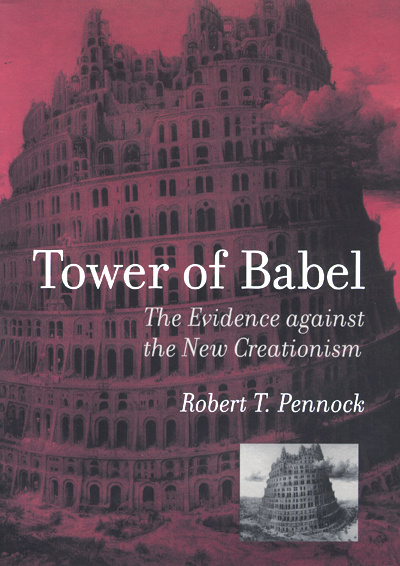
The true motivation of the movement is, without doubt, political. While many sophisticated people scoff at the apparently simplistic machinations of the Creationist movement, what they do not realize is that it is a highly organized and politically savvy alliance of special-interest groups. Robert Pennock’s Tower of Babel was an academic exposé of the inner workings of the Creationist movement. It is perhaps the most important book written on the subject. Published by an academic press, however, it has not found the wide public readership it deserves.

Do yourself a favor: read Dr. Zimmerman’s post. I believe he has framed the dilemma in the correct way: the struggle is one within a specific religion, Christianity, not one between religion and science. The more the public knows about this issue the better off we all will be in the long run.