Dinosaurs, Old and New

T._rex_old_posture

Tyrannosaurus rex, aside from being a photogenic movie star, was one of the top predators of its day. Ironically, in the Jurassic Park original trilogy (which would have been, more appropriately Triassic Park) tyrannosaurus rex becomes the ultimate protagonist, while unfeelingly killing to meet its own instincts. Since saying “tyrannosaurus rex” wears you out, we’ve become accustomed to calling the great carnivore t-rex. Everyone knows t-rex when they see it. Its a sign of danger, aggression, and unthinking acquisition. In one of nature’s great ironies, however, t-rex had tiny arms, nearly vestigial. What it wanted it had to get with its mouth. To live like that you have to grow pretty big, so big that nobody else can really challenge you. Punching is out of the question.

I’m often struck as how appropriate dinosaur evolution is to the human situation. Dinos (because “dinosaurs” is also too long) grew to be the top life-forms of their day. (We like to think of being the top. The perspective from down here in mammal land, in those days, was pretty different.) If you’re big enough, who’s going to stop you from taking what you want? Endless rows of teeth and a constant hunger can do wonders for evolutionary development. But then, extinction. Recent analyses have shown that it wasn’t as simple as an asteroid strike. It seems that many features of nature conspired against the dinosaurs, including the tyrant lizard king. T-rex had evolved into the monster featured in many pre-teen nightmares, only to be replaced by birds and mammals. Maybe it grew too big to be supported by the planet that allowed it to crawl out of the slime eons before.

In a recent photo of a Trump rally, one of the signs of a supporter had flopped over leaving just the word “rump” visible. I had to ponder this. T-rump. “Dinosaur” is a word used today to mean something that has outlived its time. Ideas, as well as such practices as, say, claiming that one race is superior to others, have rightfully gone extinct. There are those who say that t-rex was less a fierce carnivore than a scavenger. A vulture rather than an eagle. They claim that such a large snout and such small arms better suit one who picks at that which is already dead instead of working hard to bring down the more challenging beasts, often with horns. I’ve always thought dinosaurs were very appropriate metaphors for the human situation. Even Jurassic Park was superseded by Jurassic World, after all.


The Philosophical Neanderthal

HumansExtinctExtinction. It’s a depression concept, but one that nevertheless constitutes a reality in evolution’s world. When applied to members of our own species we term it genocide and declare it an evil. Our perspective—not to dispute the value judgment—is hopelessly foreshortened. Our brains have evolved to promote individual survival, not to see the longue durée. How often do we worry about the extinction of Homo erectus? Or the australopithecines? Without them we wouldn’t be here, and yet, they’re gone. The case of the Neanderthals is perhaps closer to home. We now know that Homo sapiens overlapped with Neanderthals. Some of the questions raised by Neanderthal extinction are given serious consideration by Clive Finlayson in his study, The Humans Who Went Extinct: Why Neanderthals Died out and We Survived. To get a sense of how this works out, and how it applies with our current contribution to global warming, we must be prepared to view the extreme longue durée. Duration beyond comprehension.

One thing that becomes clear from the very beginning here is that climate has driven evolution perhaps more than we often think. Species, which tend not to live through the relatively long reach of climate change timescales, adapt to the circumstances of their environment. They either do, or they go extinct. Climate, however, is a balancing act teetering toward equilibrium. Hot and cold, evening each other out. Over an even longer duration, our sun will run out of metaphorical steam and things will get quite a bit chillier out there. For the meantime, however, shifts between ice ages and periods of warming will continue to seesaw across time and our race, among many, will need to adjust to survive. Perhaps acknowledging our own role in the current global warming might be a way to start. Our species tends to be short-sighted.

There is an irony here. History and prehistory have shown that, as Finlayson points out, that those best equipped to survive radical changes are the poor. Extinctions—some of them quite dramatic—have occurred before. They will surely come again. When times get tough, it seems, the comfortable get going. Going extinct, that is. Those who climb the corporate ladder the highest have the longest distance to fall when things go bad. The poor, who have to struggle every day to survive, are the ones who know how to get along in circumstances that turn sour. I have called this an irony for what might seem obvious reasons. There is another as well; here we have science pointing again in the direction of the Bible. There it was noted long ago that the meek would inherit the earth. And that’s a bit, it seems, that should be taken literally.


Fossilized Views

Not all Fundamentalists are the same. I grew up believing the Bible was literally true, but in my family we recognized that fossils indicated the earth was older than just a few thousand years. Keep in mind that I never tested this with any preachers—we didn’t need to. We knew that evolution was wrong, but that didn’t mean there had never been dinosaurs. Kids are as sure of dinosaurs as they are of angels. Besides, we lived beside a tributary to the Allegheny River that was rich in fossils. We’d spend summer days wading in the water looking for rocks with impressions of various bivalve shells in them. They weren’t hard to find. And being collectors of just about anything inexpensive (or free, as in the case of fossils) we brought them home. We really didn’t see any great disconnect between the black book on the table and the rocks in our hands. There was room for both.

It must’ve been a slow news day at Huffington Post recently when a story titled “This Guy Is Pretty Sure He Found Fossils From Noah’s Flood” ran. The guy in question is from Texas, and, finding fossils probably not unlike those we used to, supposed that they were laid down during Noah’s flood. This was an idea that I only encountered after I’d left home. We couldn’t afford many books when I was growing up, but we did have conventional dinosaur material. Nothing strange enough to suggest that the flood created all the landforms and fossils on the planet. That would’ve sounded just a bit strange. Today, however, it is common to suppose all Fundamentalists are naive and enemies of science. Not all are. Some, I hope, are like I was, trying to find a way to fit their faith into a world that science has come to help define a bit more clearly. Positions have, however, polarized a bit since my tender years. We now fight over things we used to wonder about.

IMG_2734

The fossils I found as a kid found their way back into nature before I grew up. If I ever have the time when visiting home these days, I still try to get an hour or two to spend down by the river to look for the rocks that filled me with such awe as a child. That was a world where belief was fairly easy. I loved science. I loved my religion. I loved the fossils that told me the story was a complicated one. Only I wouldn’t have believed that decades later I’d still be trying to suggest to others that the world is big enough for both facts and faith. I haven’t been a Fundamentalist for decades, and given a few million years, who knows how even the nature of the debate might evolve.


Apes’ Asherah?

As a part of my class on Ancient Near Eastern Religions, since we were dealing with the earliest textually recorded religions, I explored origins. Specifically, the origins of religion. For years I told my students that biologists had observed behavior among chimpanzees that was proto-religious. Imagine my delight in seeing an article on New Scientist headlined “What do chimp ‘temples’ tell us about the evolution of religion?” The article, by Rowan Hooper, describes chimpanzees banging rocks before a “sacred tree” and storing the rocks in the tree in a ritualized fashion. That’s a long way from Episcopalians putting on their Sunday finery, but it is a fascinating piece of a larger puzzle. As the article points out, other symbolic action among chimps has been observed—some of it the basis for what I discussed with my students. The impulse to acknowledge the power of the Other runs deeply within animals, particularly mammals and birds.

This may seem an odd thing to suggest. We do know, however, that among the earliest attested behavior or Homo sapiens, along with hunting and seeking shelter, is religious behavior. It is part of who we are. Primatologists, such as Frans de Waal, have noted that the great apes engage in altruistic behavior. It is only when they become billionaires, apparently, that the urge dies. Again, other mammal species and some birds also show altruistic behavior. We are part of the natural world. Our religion, rather than being a collective insanity, is part of a continuity with that natural world. It is much a part of who we are as is seeking food or putting on clothing.

DSCN6152

The more rakish side of my imagination goes to the fact that this article begins with a sacred tree. Tree worship is part of early religions. Some scholars suggest it is part of Asherah’s cult in the ancient world. (I discussed this in technical terms in an article some years back; take a look at my Academia page if you can’t sleep without reading it.) Goddess or not, trees are essential for our survival—call them a godsend. Would it not make sense for religion to include reverence for trees? It seems that some great apes, at least, agree. Are these primates religious? We can’t say. One thing, however, is certain. Our fellow animals show more moderation in their use of the environment than our species does, and that in itself is both logical and religious.


Long Live Life

Horseshoe CrabsShortsighted and arrogant. No, I’m not describing Richard Fortey’s Horseshoe Crabs and Velvet Worms, but rather the collective human race. I love people—I really do. Collectively, however, we sometimes act in the most inexplicable ways. This thought came to me repeatedly while reading Fortey’s book. The subtitle might explain the subject a bit fuller: The Story of the Animals and Plants That Time Has Left Behind. Fortey is a paleontologist who tells the stories, almost biographies, of various creatures that have survived eons with little change. He is quick to point out that all creatures evolve, but in the case of some, evolution has been minimal. Animals, such as his titular examples, and many others (cyanobacteria, tuataras, and, of course, coelacanths, just as a sampling) can sometimes be so well adapted to their environments that they change very little over time. In this book Fortey travels to see the living examples of those creatures he’s studied in fossils, and tells the story of an amazing continuity in a world of constant change.

Some of the species, particularly the plants and microscopic organisms, I’d never heard of before. I also have to admit to being surprised at how many very old life forms still exist. And admittedly, this is only a snippet of a much larger cloth. Throughout, I was pleased to see, Fortey mentions various religions—themselves often throwbacks—but not disparagingly (except the creationists). Noting that some creatures have a Buddhist-like calm, or that the Bible occasionally provides the phrase a naturalist writer seeks, here is an irenic meeting of science and religion that is so much needed. So why did I say “shortsighted and arrogant” at the start of this post?

One of the more disturbing truths revealed, and not just about charismatic megafauna, is that people have often hunted animals to extinction. Fortey suggests it has always been so. Large animals (megafauna) are easy targets and we have repeatedly hunted (and continue to hunt) them to extinction. We destroy habitats and thereby drive species extinct that we haven’t even yet discovered. What could be more arrogant of a single species? Looking back over 4 billion years of evolution should give us some perspective. We’re relative newcomers on this planet, and it isn’t ours to do with as we please. Fortey is gentle, but he does remind us that some of the creatures in this book will likely, no matter how great the catastrophe, long outlive us on the planet. Ours is a brief day in the sun. Shouldn’t we care for our planet rather than pillage it for our own gain? Ask the horseshoe crab. When we understand its language we might be able to begin to call ourselves wise.


Monstrous Intentions

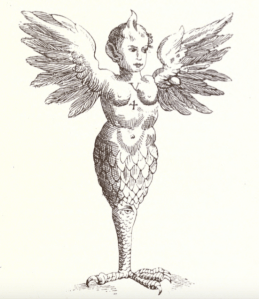
Atlas Obscura is one of those websites where you could spend all day and feel like you’ve just traveled the world. Featuring less know locations, and strange spots that you might like to visit, sometimes it also has stories about monsters. Well, at least one story about monsters. A friend of mine recently shared Cara Giaimo’s story about thirteen lesser-known monsters from history. While none of these are likely to keep you up at night, they do demonstrate the endless imagination people devote to the unknown. Monsters, like religion, defy easy categorization. Is something that’s “too big” or “too small” for its type a monster? Is it a monster if it is a mix of things that don’t normally come together? Or is it merely a matter of baleful intention? What doth a monster make?

Taking a page (almost literally) from John Ashton’s Curious Creatures in Zoology, the Atlas Obscura page runs down some monsters once believed to have existed. Some of them, despite our flattened world seen only through the eyes of rationality, were actually reported to have existed. The “monster” of Ravenna, for example, was apparently a sad case of a medieval/early modern birth defect that, in the popular imagination took on monstrosity. We now know that birth defects may contain throwbacks to earlier stages of evolution, or that genetic coding may contain mutations. None of this suggests any evil intention on the part of anybody. Accidents of nature may be the saddest kind of monster of all.

Screen Shot 2016-01-27 at 5.42.32 AM

A surprising number of the monsters from Ashton’s sampler here are mixes between human and animal. Indeed, that mix is still a potent force, theologically. One of the loudest voices speaking out against evolution is the one that says people are “not animals.” Having grown up with that belief, it took a couple years of college to convince me that we fit into the greater biological scheme of things. We fear that which resembles us, but is not quite us. Perhaps part of the mystique is that we haven’t quite yet learned to be humane to one another. Being a monster may just have more to do with what one does with prejudices than it does with physical features of their bodies.


Nothing But the Truth

Blurbs are the way of the future. It is so much easier to read something brief than to have to wade through an entire article. Is that the way the future’s going? I read the blurbs for Christian Century’s round-up page when it lands on my desk at work, and I find plenty of interesting things there. For example, a recent issue suggested that truth may be getting harder to find. It began: “George Johnson [New York Times was the source] says modern culture is reaching the point at which there are no longer any incontrovertible truths, just competing ideologies and narratives.” It goes on to describe how issues like creationism are less concerned with “truth” than with fitting the world into their view. Likewise, those who object to putting telescopes on Mauna Kea see science as cultural hegemony. In a post-modern world there is no objective truth. Even as a college student I remember learning that if I found the Truth, with a capital T, there was no way to know it was actually the truth. “All truth is God’s true” some professors used to say tritely.

That doesn’t stop those of us who’ve been motivated our entire lives by the search for the truth. But how will we know when we get there? I first learned about post-modernism in my teaching days. Some of its ideas are perfectly logical: we can’t completely share an author’s meaning; words have no meanings, only usages; when we read we bring our own meaning to the text; an author’s intention is not definitive for what a text means. These ideas are deeply disturbing when we look at them closely. Then I began to read that scientists recognize that our brains did not evolve to discern the truth. Our brains evolved to survive, and even a dim approximation of the truth will help us get to reproductive age. In fact, dim approximations of the truth might explain much of our dating behavior. So, we’re led to conclude, there’s no Truth after all. Just “competing ideologies and narratives.”

DSCN2025

I studied a fair amount of philosophy in my time, and I do believe in Truth. That’s not the same as saying I’ve found it, since no one can honestly make that claim. All that we can admit is that we believe we’ve found it. Those who object to evolution say they know the Truth and it is special creation. All the evidence points against it, but all the evidence doesn’t fit the worldview. We lose something that can’t be replaced when we jettison the truth. As soon as I learned about existentialism I realized that it had long been my philosophy—making our own meaning in a world where certainty is unknown. Even those who claim that science will give us the answers have to admit that if faced with ultimate Truth we might not like what we find. We can only believe that it will be good. And hope that we are right.


Shooting Stars

One of the professions I used to consider as a child, before I had any real concept of the way the world works, was a scientist. I wasn’t sure what scientists did, beyond a broad idea of learning about the world though close observation. I was too young to see that it would likely conflict with the Fundamentalism in which I was being raised, and I suspect the same is true of many who become scientists and never stop to question the religion in which they were reared. Although religion, as a profession, won out in my case, I was, I recognize now, motivated by a deep and undying desire to know the truth. I still am, although you couldn’t tell that from my career path. In fact, rationally, it is the most important thing to me. What is truth?

Science has become extremely complex. The average citizen can’t afford the kinds of equipment needed to unravel the fabric of reality. A cyclotron wouldn’t fit in my backyard, and, besides, I rent. When I sat outside this morning looking for the Perseid meteor shower, I didn’t see a thing due to the ambient light. Even looking through a telescope, I know I don’t have the calculus to explain the things I see. Given all this, the average person requires a scientist to explain. But scientists are only human. We know that we haven’t evolved to discover the truth. Evolution favors survival, not philosophy. We also know that we don’t perceive everything. Some animals have senses that we humans lack. Still, we suppose through our use of our five—obviously the best—we can come up with an explanation of everything. The truth will be ours! Or will it? Even thinkers of such stature as Richard Dawkins and Stephen Hawking make mistakes. They’re only human. When we idolize them, we make them gods.

Back in seminary I learned about the three-legged stool. The basis of authority, in the church, rests on three legs (four if you were Methodist): Scripture, Reason, and Tradition. Methodists added Experience. There were checks and balances here. Well, Scripture seems to have fallen out of the running with the Enlightenment, and nones don’t much value Tradition. Experience is subjective, so we’re left with Reason alone. And yet, reason leads to paradoxes such as if the universe is infinite, how can it be expanding? In classical theological terms: can God make a rock so heavy he can’t lift it? Add to that the fact that some neuroscientists are now suggesting that emotion may be the seat of thinking rather than reason and you might begin to wish you had some tradition to guide you. In my experience, I’ve seen, I suppose, my fair share of shooting stars. I sat outside in the predawn hours this morning and saw nothing. Perhaps I should have had a three-legged stool upon which to sit.

Photo credit: Nerijp, Wikimedia Commons

Photo credit: Nerijp, Wikimedia Commons


Human Race

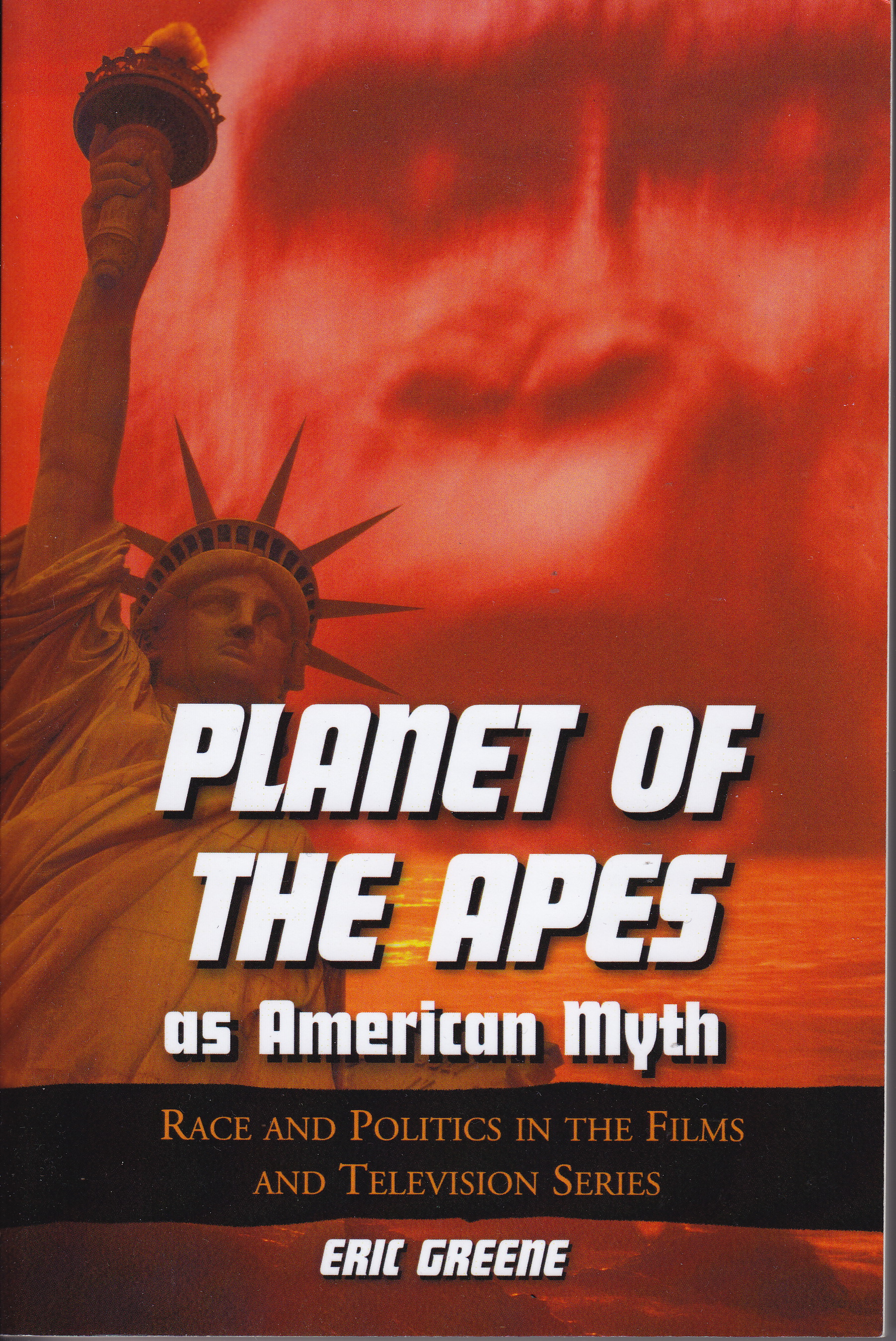
PlanetOfTheApesMythFor reasons no one fully understands, Planet of the Apes touched a deep level of responsiveness in American society. I have to admit to having fallen behind a bit; I need to see Dawn of the Planet of the Apes to be back up to speed, but nevertheless, I remember the television releases and airings of the originals, and even have gone through the entire series in the form of home theater offerings. One Saturday long ago on a visit home, I sat through a marathon of the entire five-movies sequence all in a day. It should be no surprise, then, that as soon as I saw Eric Greene’s Planet of the Apes as American Myth it went on my reading list. Race and Politics in the Films and Television Series, the subtitle read. I admit that I grew up in a conservative, but sheltered environment. Having friends who were African-American, although, admittedly, they were a small fraction of the demographic in my small town, I never realized that there was a problem. Not until I took history and social science classes in school. You have to learn things such as racial distrust.

Struck by Planet of the Apes when I first saw it, I had no idea that it was a racial tale. It makes sense now, in the light of Greene’s analysis. To a child fearing evolution as much as Hell itself, the movie was a kind of forbidden fruit, and by making it science fiction, there was no reason to suppose there was a message here. It was a powerful kind of captivity. I have watched the movie, and current adaptations, many times over. Greene does an excellent job of demonstrating that the movies came at a time of great racial distress. Civil rights, the Vietnam War, the fear of the Communist—xenophobia was perhaps at an all-time high when the apes invaded our planet. As the series goes on, the identifications become clearer and clearer.

But more than that, Greene pointed out some very obvious—in retrospect—religious symbolism in the movies. Some of it was so intentional that it was written into the script. Among the scenes from the life of Jesus, the movies borrow most heavily from Exodus. Moses figures abound. Even Charlton Heston, in his role as Taylor, was following up on the Ten Commandments. Holy families and sacrificial victims mark just about every stage of this dystopia, a world where trust is always far from any relationship with someone physically different. It’s about time that I watched Dawn of the Planet of the Apes. And after that, I need to go back to the beginning, and watch them all with renewed eyes. In the light of current events, also with the hope of a more just future.


Life as we Know it

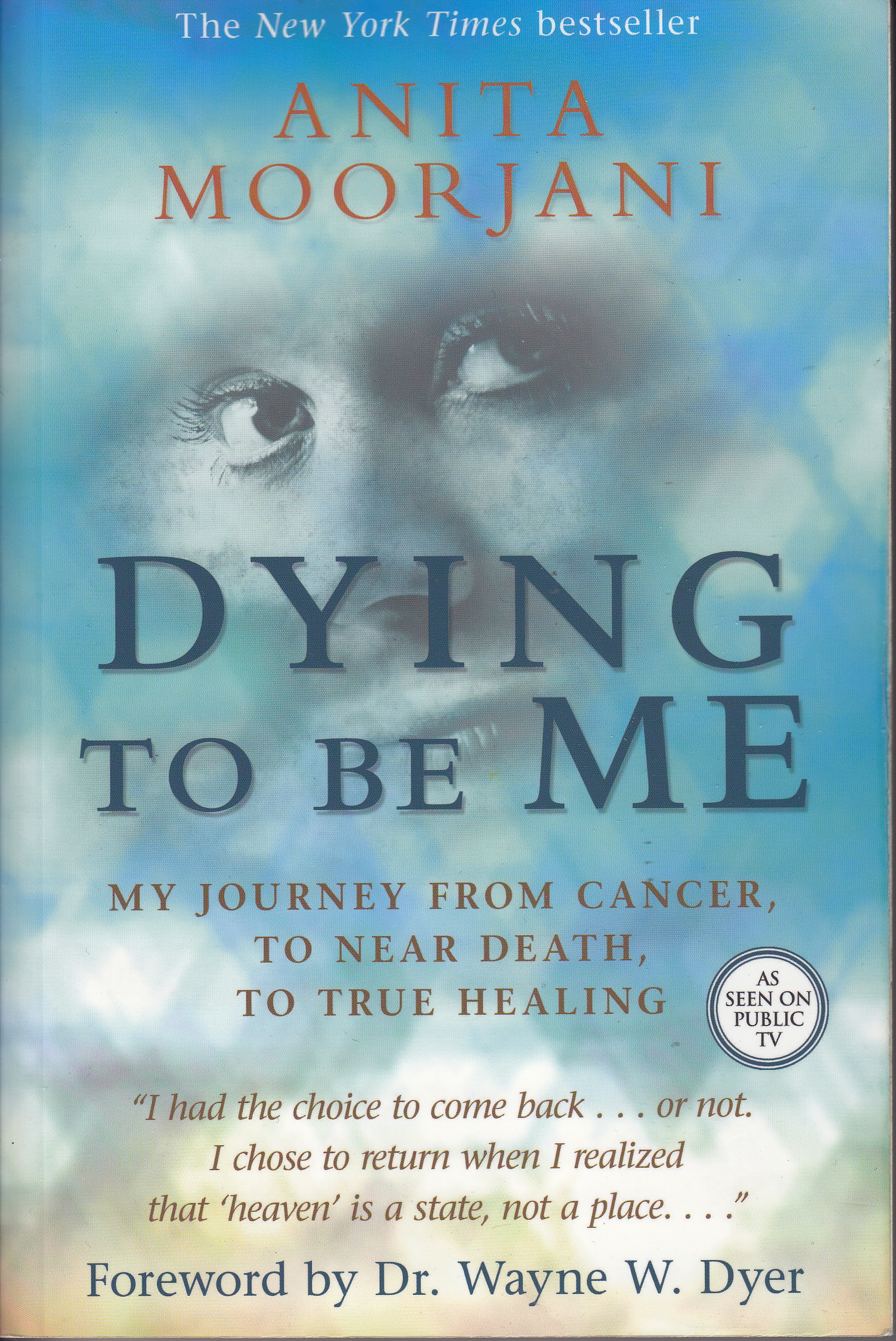
Dying2BMeA friend asked me for a book. Since my life has mostly been about books, I’m generally happy to supply what I can. This friend is a cancer survivor and wanted to read Anita Moorjani’s Dying To Be Me. The last time I saw this friend, she handed me the book, saying she didn’t care for it. Although the author tells of her dramatic Near Death Experience, and is very optimistic about all that we can improve by loving ourselves and others, she isn’t a Christian. Raised as an Indian living in Hong Kong and sometimes attending a Catholic school, Moorjani is conversant with several religions but doesn’t favor one above the others. Her experience of being in a coma with very advanced cancer and having a prognosis of days, at most, to live, yet coming out of the coma and being completely healed of disease within weeks could be overlooked on the basis of a belief system. I decided to read her account myself.

Ironically, Moorjani directly describes why she can’t accept any single religion in her book. Her reason is because religions tend to block being open to possibilities that fall outside of doctrine. Her Near Death Experience, described in great detail, doesn’t fit any particular religion very well, including her native Hinduism. It led her to believe in a kind of universalism with everyone ending up realizing their own divinity and loving all others unconditionally. Even though many of her interpretations of her experience are a bit too New Agey for me, I have a deep appreciation for her advocacy of trying to understand others and loving everyone. I saw nothing incompatible with Christianity there. Or any other ethical religion.

Religion can divide as much as, if not more than, plain common sense. Those who think deeply about it realize that religion should make life better for all. That seems to be its evolutionary purpose, apart from personal survival. Of course, some religions also reject evolution as well. When missionaries reached far shores and found good people living ethical lives, they feared for their souls, thinking only one religion could fit all. Many of us are heirs of such missionaries, being taught from our youngest days that living in fear and self-abasement is the loving, Christian way. It may be that a Hindu who learned to trust herself by nearly crossing the brink of death has something to teach the missionaries as well. If only they could listen.


Scientific Belief

AtlanticThe human brain is a marvelous thing. Neuroscientists find all kinds of surprises as they probe the gray matter in our heads. One of those findings is that we don’t always believe what we say we do. Some time ago I read Matthew Hutson’s Seven Laws of Magical Thinking. Scientists didn’t like the book too much since it caught them with their empirical pants down. Really, there’s no shame in that. We are at the mercy of our own minds. In this month’s Atlantic magazine, Hutson has a brief piece entitled “The Science of Superstition.” In the space of just over two columns he runs down the evidence that even those who claim materialism is the answer to all life’s mysteries, even those scientists can’t escape superstition. Friday the thirteenth, a couple of weeks back, I walked under a ladder on my way to work. What happened? I had to go to work. Is that bad luck? I suspect it’s a matter of opinion. I’m the first to admit, however, that I did have fleeting reservations.

Study after study, as cited by Hutson, shows that physiological measures indicate anxiety when those who don’t believe in God say bad things about him/her. We all attribute cause to natural events, even those steeped in the hard sciences. Thinking about death reveals subconscious beliefs about God. It’s the way we’re hardwired. Hutson himself, if I recall correctly, doesn’t really attribute much credence to the supernatural. This is all a matter of what our material brains believe. Interestingly, we are evolved to be open to religious ideas. Many choose to believe, despite our brains, that we are evolutionarily deceived. Screwed by natural selection, as it were.

Far more interesting, in my deluded opinion, is that we don’t really choose what to believe. At least not at first blush. Our brains tell us to believe in the invisible causation that just doesn’t fit in a material world. To get beyond that takes some effort. It does give one pause, however, to consider that blind evolution has puckishly kept all this in the mix. Does evolution have a sense of humor? Perhaps we are all taking all of this far too seriously. Or maybe, just maybe, our brains are smarter than we think.


Seeing I

One of my few Twitter followers (stawiggins) suggested that I watch Dr. Ken Hayworth on YouTube. Specifically, Part 3: If we can build a brain, what is the future of I?, hosted by Galactic Public Archives. It is well worth 9 minutes of your time. Trying to figure out consciousness has been a major preoccupation of mine for some years. I don’t have the tools of neuroscience, but I do have over half a century of coming to know this “I” that constantly seems to wake up in this same body and experience all its woes and occasional joys. Hayworth suggests that the self is a model projected by our brains to help us make decisions and to plan for the future. In a fascinating thought experiment, he notes that if a duplicate self were made, we (or I) should not object to being executed since there is an exact copy now. Hayworth notes, however, that any individual will object because we are “designed” to think this way about ourselves. Designed, I wonder, by whom? I suspect Hayworth means evolution designed us that way, but evolution is non-teleological, and, I suspect, not really reificatory. Evolution is merely a process.

Perhaps the horns here are only those of a semantic dilemma, but I feel not. Hayworth goes on to discuss how instinct works to continue this illusion of self. I’ve never found instinct a very believable concept. We use it when we want to deny consciousness to animals and very young children. Since they can’t have a concept of “I” they have to have “instinct” to preserve themselves. Logically, to me, this seems to be fudging. What is instinct? Is it really any different than admitting at some micro-level, animals have consciousness? To me it seems that consciousness is one of those “turtles all the way down” kinds of propositions. To be alive is to be conscious at some level. Be careful how far down you dig here.

DSCN2021

Hayworth then goes on to what sounds like an almost biblical conclusion. Ethics insists that humans are part of a whole. (A very diseased whole, as the imbalance in society forces us to conclude, but a whole nevertheless.) To kill one is to violate the consciousness of the whole. This concept seems sound, and I would suggest that it might benefit from expansion. Why stop at the human level? We are animals. Animals are conscious. Here we are back at the turtles again. Perhaps we have expended too much energy trying to parse self from soul from mind from consciousness. Perhaps we are all part of a large collective consciousness. If so, we got some very sick units near the top. Any organic being that insists only one percent needs to be kept in perpetual plutocratic indigence while billions of others wonder how long they will survive at this payscale in this economy, or, more realistically, act as slaves to that one percent, is a sick beast indeed. If consciousness is collective, we could all use a massive shrink.


Angels We Have Seen on High

Humans have always ascribed significance to what they see in the sky. Evolution, I suspect, has a great deal to do with it, but so does religion. As I suggest in Weathering the Psalms, the sky is the barometer where we seek the temperament of the divine. The weather is an indication of what God might be feeling, in the pious mind. Of course, as a child I used to lay back and look at the clouds to see what messages I might find there. Pareidolia makes the process good fun, and lots of random “noise” can be interpreted as “signal.” It’s all done in a light spirit. Still, if the internet is to be believed, many people take images in the clouds much more seriously. Apropos of the holiday season, a story in The Telegraph tells of a woman from Lincolnshire who, on her way to a Christmas gathering, saw an angel in the clouds. Or more properly, an angel of clouds. Being the anniversary of her father’s death, she saw this as a sign from above that left her in tears. Others would call it matrixing.

The photo the woman’s daughter took as they were driving is impressive (click the link above to take a look; I’ll wait). I understand how it could be interpreted as an angel. Or even a bird. The feathering on the left wing, along with the wing structure itself, is stunning. And of course, given the time of year, angels are much on the minds of many. What would any manger scene be without them? Although pareidolia is not a religious phenomenon by nature, it nevertheless is frequently interpreted that way. We certainly don’t take much personal comfort in a mechanistic universe. When a loved one is gone, we would rather consider the more human (and perhaps supernatural) aspects.

430px-Bernhard_Plockhorst_-_Schutzengel

Interpretation of information is a constant activity of sentient beings. We don’t want to miss anything that will be of survival value. In the case of the angel in the clouds, the survival is beyond that of every day. We are constantly reminded that death is the final word, and yet we can’t quite bring ourselves to believe it. Whether it is shepherds on a Palestinian hill in the first century or a woman motoring along A17, the sight of an angel is something that stops the viewer and inspires an openness that we otherwise have been taught to deny. It may be that all she saw was a pattern of water vapor in a December sky. But even water vapor can mean much more than two hydrogen atoms binding to one of oxygen. It can be part of the breath of life itself.


Exobiology

Are we alone in the universe? The answer is every day growing more and more certain that we are not. Humanity may experience shortages of many things, however, pride is not among them. For millennia we’ve been convinced of our own superiority and, of late, we’ve become convinced that we must be as good as it gets. We’ve mastered logic and our material world. We’ve sent probes to land on Venus and Mars, and flying by just about every other planetary body close enough to reach. We sure are smart. So it stands to reason that we are the brightest beings in a universe that we tell ourselves is infinite. A recent article on Exobiology that my wife pointed out to me on The Conversation, traces the history of the idea of life outside the earth. Not surprisingly, the idea has its origins in religious thought.

Giordano Bruno was an early modern Dominican who was burned at the stake for his heresies. Like his near contemporary Galileo, he was fascinated by the sky and postulated that the world up there could be full of life. A church increasingly under pressure from the pesky Protestant movement had no time for flights of fancy among the faithful. No, religion at the time wanted its feet planted on solid ground. The only life up there was angels and God. Still, the idea had been broached. Since the world’s major religions have been geocentric, as a rule, they’ve had a bit of difficulty adjusting to the idea of the other other. God as other is one thing, other creatures as other is quite another. How do earth-bound religions account for the possibility of life in space? This is not merely academic fancy at play. We will almost certainly discover life elsewhere—whether it comes to us (or already may have), or we go to it (which might take a little longer), we will discover that a universe that is infinite has infinite possibilities. Will religion keep us grounded?

596px-Apollo_11_bootprint

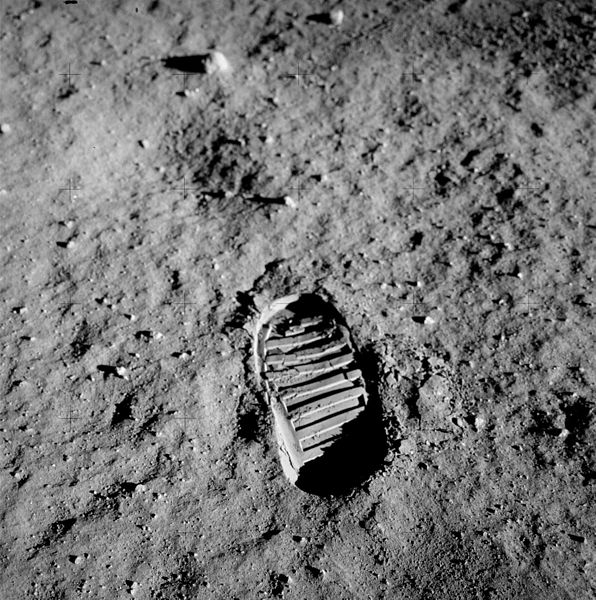
Ironically, one of the areas where science and religion have broadly agreed is in the superiority of humankind. Both remain staunchly geocentric. Religions and tend to say we’re sinful, but other than that, pretty much the best the earth has to offer. Although biologists say evolution is non-teleological, they still have a hard time imagining something more advanced than us. We are pretty self-absorbed. Meanwhile, we are discovering water is likely not unique to earth. Rocky planets seem to be the rule rather than the exception. And there are billions and billions of stars in our own galaxy alone, among billions of others. What are the chances we’re alone? Virtually none. Here is one place that both religion and science might learn a lesson based on early spiritual teachings. In the face of the unknown, humility is the most logical response. I’m impressed in how far we’ve come in the last several millennia of civilization. I think, however, that we’d better be prepared to meet exobiology with a realization that Genesis 1 was only the beginning.


Darwin Down the Road

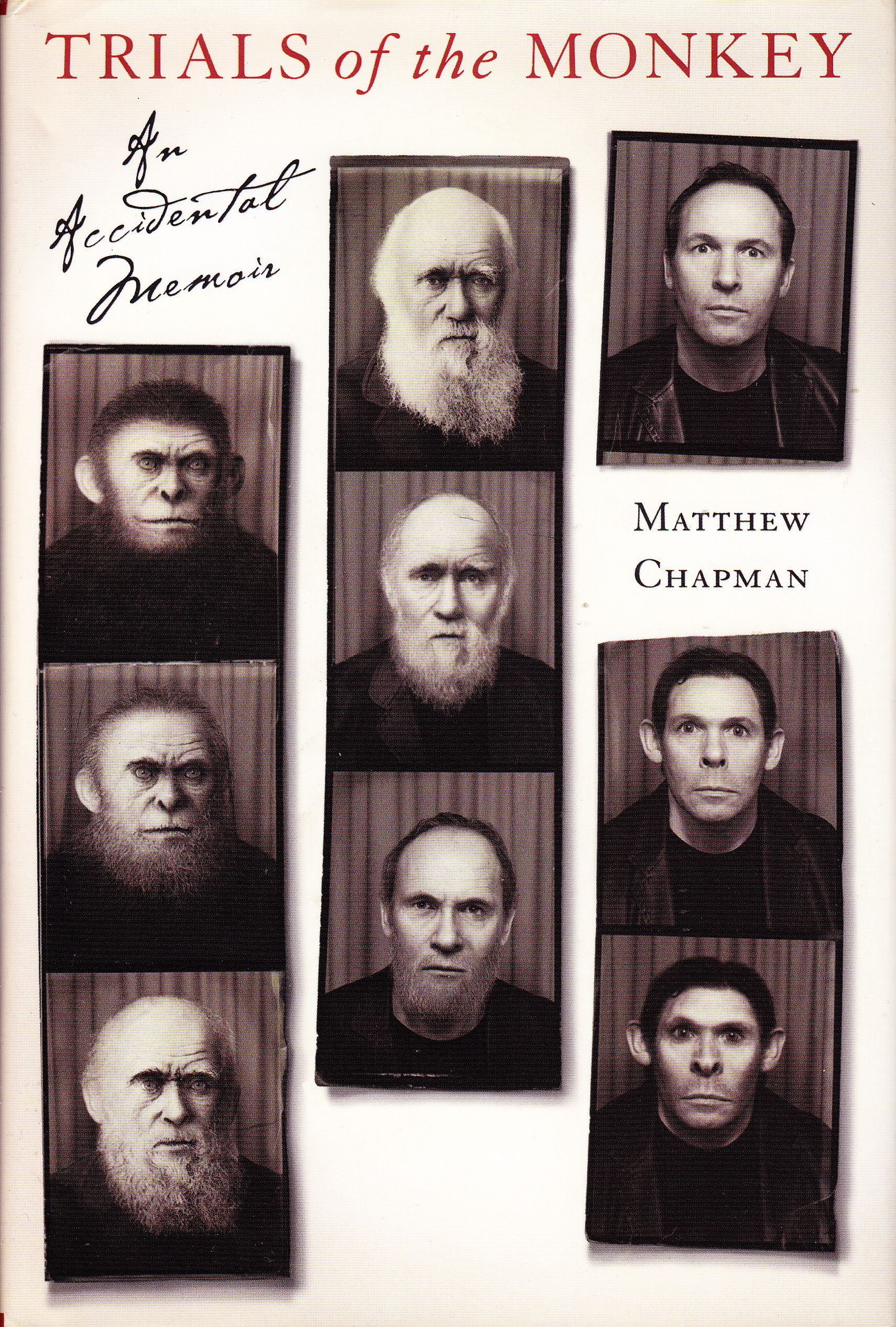
Chapman TrialsThe accidents of birth are the stuff of evolution. When I first heard of Matthew Chapman, direct descendent of Charles Darwin, over a decade ago, I was determined to read his book (then new). Like the accidents of birth, the finding of books at used bookstores is also a kind of evolution, so I picked up Trials of the Monkey: An Accidental Memoir recently and finally read it. Mission accomplished. It had been long enough that I couldn’t recall what the reviews said that made me so eager to read it—I had been developing a course on science and religion at Nashotah House and had been reading about evolution—but I’m glad I got around to it. The book was neither what Chapman nor I had expected. Maybe I’d better explain.

The year 2000, apart from its millennial aspirations, was also the 75th anniversary of the Scopes Monkey Trial. Chapman, a screenwriter from England, decided to go to Dayton, Tennessee to report on the reenactment of the Scopes Trial that was caused, accidentally, by his great-great-grandfather. With acerbic and self-deprecating wit, he narrates how he missed the performance by arriving for the wrong weekend and yet how he’d already begun the book based on it. Instead of reviewing the reenactment, he wove his own life story into those of the people he met on his two trips to Dayton, and left us with an engrossing memoir. Most Europeans, we know, consider American reaction against evolution with some puzzlement. As an Englishman, Chapman shares that curiosity and also, he admits, kind of wanted to make fun of southerners. His encounters, however, forced him to realize just how human all people are.

There’s a healthy dose of exposure to some of the weird ideas of fundamentalism here, but Chapman pulls no punches. The people he met treated him kindly. Some fundamentalists were even likable, even though they could not agree on much. At turns very funny and very sad, this autobiography represents, in its own way, the tensions of any life. The sensual confessions would have made famously squeamish Darwin blush, no doubt, but demonstrate to the reader that a man who can make a lot of money writing movie scripts can be very human as well. And so can the religious. The denizens of Dayton didn’t convince Chapman that their exclusive faith was true. They did, however, open him to the realization that such faith is not as simple as it may seem. A fortnight may have passed since the millennium, but creationism has continued to gain ground. Until more people take Chapman’s cue and actually try to understand those who believe, the trial of the century will continue to go on and on, ever evolving.