Commandments by Committee

Something about the holiday season seems to bring out atheistic activism, or at least media interest in atheism. Now that we’re safely in 2015, I suspect things will quiet down a bit until the next major religious holiday comes along. Ironically, since I was a child I’ve heard about how secular Christmas, in particular, has become. Reactions to this have led to “Christmas wars” that give the lie to sleeping in heavenly peace. In any case, back in December CNN ran a story on the atheist ten commandments. This was just before the holidays, but just after the release of Exodus: Gods and Kings, so it was a story sure to capture human interest. The atheist commandments were chosen by a committee, and, of course, have no binding value. Many of them are more precepts than commandments since, it seems, you need a deity to command all of humanity. Nevertheless, the number 7 commandment has a very biblical sound: “Treat others as you would want them to treat you, and can reasonably expect them to want to be treated.”

More interesting than the list, in my way of thinking, is the form of delivery. The ten commandment format is an obviously religious one. Atheists have long tried to make the case that non-belief is not the same as immorality, and there can be little doubt that this is correct. One need not believe in order to be a good person. Yet, the force of the symbolic ten commandments comes from a divine mandate. Committees, as efficient as they may be, don’t have the same kind of authority. You can hear it now—“Why should I listen to you? Who are you to tell me what to do?” With God there is always the threat of eternal damnation or the sending of plagues. Commandments by committee appeal to reason.

The ten commandments—here I mean the traditional ones—haven’t fared especially well among the faithful. Survey after survey shows many people don’t know all ten well enough to cite them. Some, such as the one against coveting, are hard to demonstrate or prove one way or the other. Honoring parents, in some extreme cases, seems sinful in itself. What doesn’t count as a graven image? So my question is, who has the authority in a post-Christian world to give commandments? The religious certainly won’t take advice from atheists, and religious leaders disagree among themselves about what the deity demands. No committee, it seems, can capture the true essence of divine demands. Perhaps it is a matter of boiling the ten down to one (similar to number 7 cited above) and getting our leaders to truly believe this before imposing it on all.

480px-Rembrandt_-_Moses_with_the_Ten_Commandments_-_Google_Art_Project


Not Your Grandma’s Moses

Exodus Gods and Kings

Exodus: Gods and Kings is, in many ways, a startling movie. It didn’t leave me with a strong impression of profundity, but it did make me a bit reflective. The media hype about God as an eleven-year-old boy proved to be merely hype. In fact, the boy deity was one of the most intriguing characters in the film. The role was played respectfully, and God, like a good Englishman, favored his tea. There was nothing comedic about it, however. More troubling was the agnostic Moses, à la Clash of the Titans with its unbelieving Perseus. Moses, even after meeting God, comes across as having little interior life. He hides in a cave and builds an army of terrorists making him seem like Moses bin Laden. He conceals himself while innocent Hebrews are hanged for his crimes (and did they even hang people in ancient Egypt?). When a great storm brews over Memphis, however, it is with a sense of wonder that we ponder at an eleven-year-old doing all this.

The movie plays lightly with the scholarly “explanations” that used to be doled out in seminaries about how one plague led to another. In fact, the character called “the Expert” in the credits is shown lecturing the Pharaoh on the causation scheme of clay churning up in the Nile turning it red, and killing the fish which in turn drove the frogs from the toxic water, but when they died flies came along and the flies spread disease. Then the Expert is hanged. Not so subtle a warning to biblical scholars. In fact, there seems to be a science behind much of the movie that makes miracles less acts of God than acts of nature. Even the drying of the Red Sea is understated. Its return is reminiscent of the Christmas Tsunami of 2004. God is sometimes not there when you’d expect a deity to care.

On the matter of caring, for an age of nones who have concerns for equality, the film was thin on women’s roles, making even the Bible appear to foreground them more. Sigourney Weaver—great in any context—seems only to be there to wish Moses dead. Even Miriam is given scant lines in the movie and no role in the Exodus itself. In Prince of Egypt she at least led her famous song. Zipporah is lovely but shows no sign of being as handy with a flint knife as Exodus makes her out to be. A woman of action. Miriam’s quick thinking saved the infant Moses. Overall, however, the Bible is a guy’s book, and Exodus is a guy’s flick. Opening with the battle of Qadesh on the Orontes is a way to draw men to a Bible movie. Lots of slashing, gashing, and charging horses. And the splendor of Egypt, filmed in Spain and the Canary Islands. Some miracles, it seems, are even impossible for CGI.


Behind the Exodus

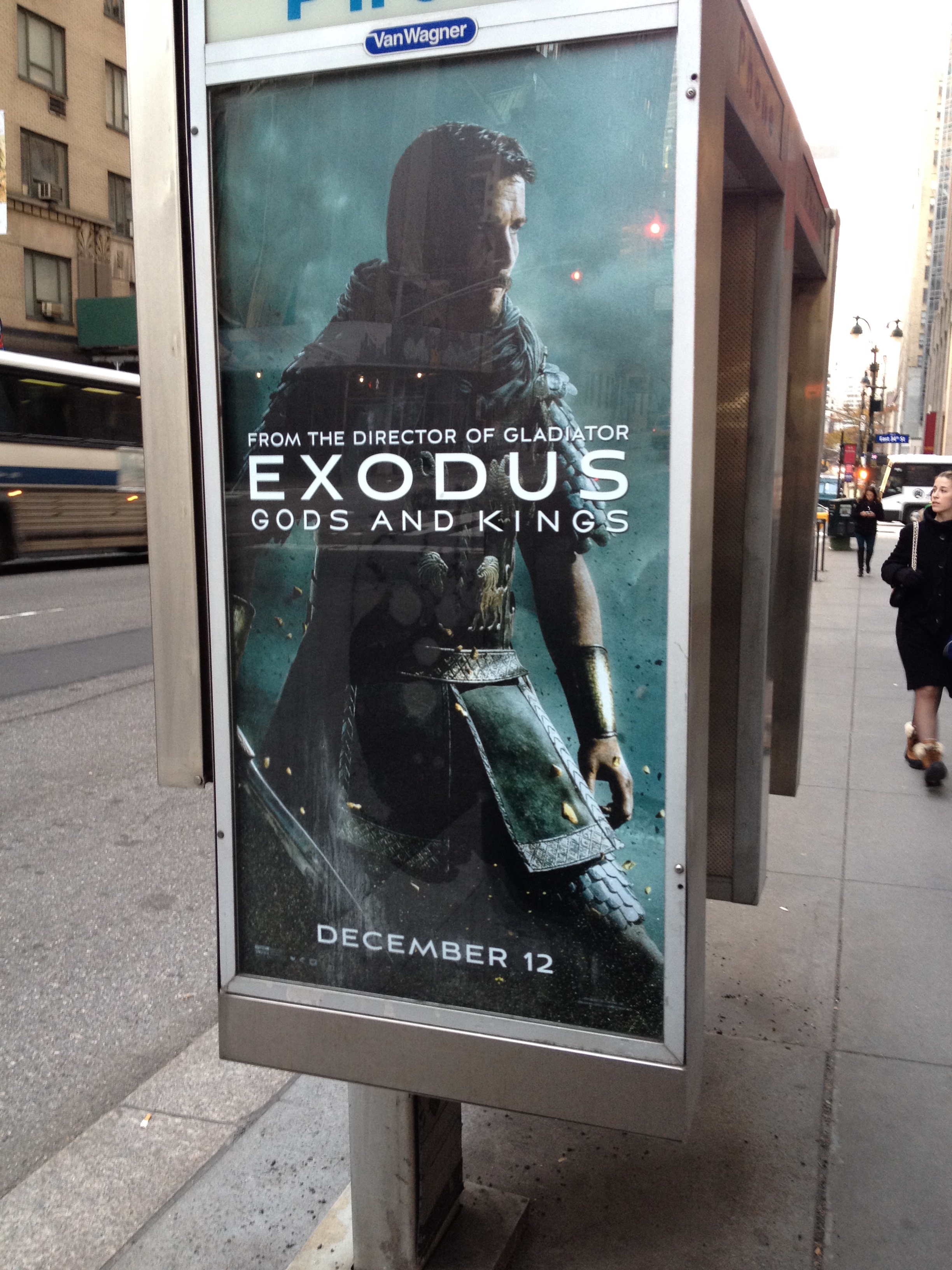
Over this past week two of my friends/colleagues were quoted in major media outlets about Exodus: Gods and Kings. Being merely a blogger with nearly two decades of teaching Hebrew Bible means, naturally, that I have nothing valuable to say. Nevertheless, I would meekly venture to make my own observations and cast them out there into the world-wide web and see what happens. I haven’t seen the movie since it only opens tomorrow. I already know it is only loosely based on the Bible. Still, I wonder at the talking heads who constantly declare the Bible to be irrelevant to a throughly modern world. Okay, so I realize that this is about money, but Manhattan is often seen to be one of the more sophisticated cultural landmarks in the country. This summer I couldn’t walk more than a book or two without being inundated with Noah posters. Now I am finding the same with Exodus paraphernalia. If we try to put the Bible away, it seems, it will come to find us.

IMG_1843

The Bible, relevant or not, is full of great baseline stories. Even in a secular society we can see the appeal of Noah and his menagerie to young children who are so fascinated with animals. We decorate youngsters’ sleepwear and toys with elephants and lions and giraffes (interestingly not mentioning that these are primarily African animals) aboard an ark with an unfailingly cheerful Noah. Now we have another classic—the great liberation story (also set in Africa) of a people held in bondage being released by divine command. We are a post-Christian society, according to the pundits, so who this divine one is remains an open question. The idea that one people is kept oppressed by another people, however, is presented as unequivocally wrong. Moses rides out on a horse, weapons in hand. Are we not focusing on the larger point yet?

IMG_1848

This latest love affair with the Bible as a source of great cinematography will not last forever. It will surely ebb away until only a few old blog posts might remain to remind us there was a time when Holy Writ inspired screen writers and directors. Nevertheless, the Bible bides its time. Back in the days when I used to teach Hebrew Bible Hollywood didn’t do too much to help out. Students had to slog through pages of picture-less Bibles to get the gist of the what God had in mind. The results may not be the same from those comfy seats in movie theaters, but a future generation will come to see Charlton Heston as a white man who loved guns being overcome by a newer generation of producers and directors who know there is a larger story here. Of course, I’m only a blogger with no credentials. Still I know what I see on the streets of the city.


Get Out of Town

If the Bible were to be written today, it would be more graphic. Those who’ve read it know that it is a graphic book already, but with no literal illustrations. Somewhat surprisingly for a post-Christian society where the Bible generally gets bad press, this year has seen the release of at least two major movies based, loosely, on scripture. Noah came with a flood of hype this summer, and even then we were told to keep an eye out for a movie on the exodus later in the year. The New York Times heralds the imminent arrival of Exodus: Gods and Kings with a movie preview. Like Noah the new movie will take liberties with the biblical accounts of the exodus. (The Bible itself is not consistent on the story in any case. The “Song of the Sea” in Exodus 15 differs considerably from the prior prose account.) Ridley Scott, who gave us Alien, has cast the iconic Batman, Christian Bale, as Moses. When I first read about this during the summer, I wondered how Bale would take the meek role of the humblest man on earth. With considerable chutzpah seems to be the answer.

The review by Michael Cieply and Brooks Barnes, however, make the most not of Moses but of his mentor, Yahweh. Using an eleven-year old, Isaac Andrews, as the deity, the movie “preserves the awful severity of the Old Testament God.” In this it touches on one of the sore-spots among biblical scholars and theologians both—the characterization of a bifurcated deity. God in the New Testament is frequently said to be loving and kind (except for the iron-clad rule that makes him (as he is male) sacrifice his own child), while the deity of the Hebrew Bible is said to be angry, mean, and vindictive. Others say he’s simply just just. We like to see a divinity who is swayed by mercy and is deeply aware of the human condition. The Bible presents, it seems, a conflicted God who is sometimes just as confused as we are.

800px-Lamentations_over_the_Death_of_the_First-Born_of_Egypt_by_Charles_Sprague_Pearce

Casting a deity who is forever young, however, may be a stroke of genius. In the Bible, in as far as there is a coherent storyline, God does seem to evolve. Sure, there are those who claim God always remains the same, but any deity whose first recorded words to Adam and Eve, after laying down the rules, take the form of an interrogative certainly must be able to learn and grow. Of course, it is very much like a human to suppose that the world could not have existed before we got here to see it. We who are so fascinated by the idea that the world could have carried on without us for the generations before we were born. What was God doing in those eons, besides playing with dinosaurs, like a child? I don’t suppose Exodus will delve into those questions, busy as it will be with battle scenes and other adult situations. At least if it’s true to the Bible, which, despite popular opinion is so graphic that would have a hard time retaining an R rating, if taken literally.