Six Red Flags

Answers in Genesis’ biblical theme park with its life-sized ark was back in the news yesterday. Journalists just seem to be fascinated that people really do believe in their religious convictions. Having grown up in a religious family, I understand where they’re coming from. The version of the Bible they offer to the public, however, is much too tame. I spent the day dreaming about a literalist Bible theme park that would put Evangelical Christianity back on the map. I’m thinking it should be in Rick Perry’s Texas and we could call it the Literalist Six Red Flags.

The first attraction would be the Garden of Eden—sans clothes. If we’re going for the full Bible experience we should go all the way. The full Methuselah. For those who are worried that this might lead to morality concerns, I would assure them that experience belies that. From the few nude beaches I’ve stumbled upon—who would’ve thought there’d be one in New Jersey? New Jersey!—it is my guess that this might be the most effective way to scare kids into religion. Why pass up an evangelical opportunity like that?

Station number two would be the Egyptian Late-Term Abortion Clinic. By this I mean Exodus chapter 1, with a nice tie-in to Leviticus 20 and Psalm 137. The pro-lifers could leave a little green but very self-righteous after seeing what the Bible prescribes for uppity children.

Our third flag could be the battle of Jericho. Especially interesting for the kids would be the visit of Joshua’s spies to the prostitute who betrayed her city. Children could blow on ram’s horns, carry a plastic ark with authentic death-rays emanating from it, and shout while the Styrofoam walls come tumbling down. If they wanted to be really literal, however, they’d have to explain that archaeology demonstrates that Jericho had been abandoned for a century before Joshua showed up, but who wants to dampen all that youthful, Christian bloodlust?

Flag four could be the story of Samson. After leaving his first wife to visit a prostitute, kids could watch in fascination as Samson heaves the city gates of Gaza from their place, showing that the Lord approves. Since he’s a muscleman who likes to have affairs, maybe we could check to see if Arnold Schwarzenegger is too busy to take on the role of God’s version of Hercules. I’m sure that Delilahs would not be too difficult to recruit. Perhaps this could be an audience participation event.

Attraction five has to be the Story of David. This would be a good opportunity for parents distraught after the previous stations to take out some aggression with the sling. I’m sure my friend Deane could come up with some giants for them to practice on. Otherwise, maybe something could be worked out with the NBA. After killing a few giants, the station could lead to the palace roof with a view to Bathsheba’s bathroom. Since David didn’t want to send her to the clinic (see station number two), he decided to have her husband killed instead. Maybe we could have a side exhibit: Uriah’s Last Ice Cream Stand. (He was only a Hittite, after all.)

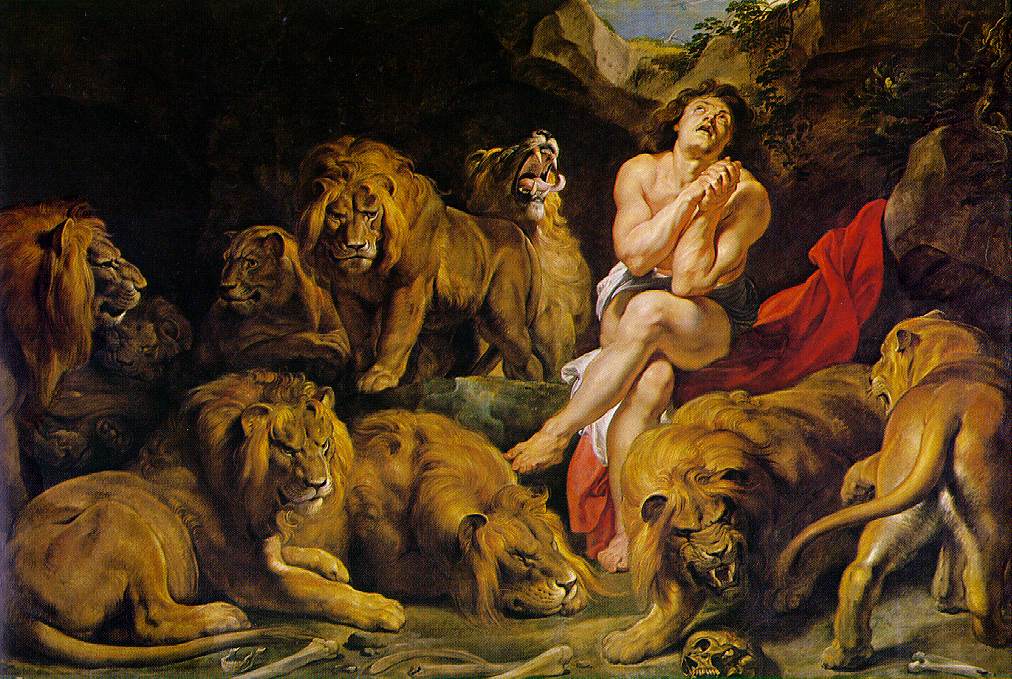
Our sixth red flag would be the Lion’s Den. Here we could offer Tea Partiers and NeoCons the opportunity to prove their faith by spending a night in a den of hungry lions. They like to claim loudly that their faith is being castigated, just like Daniel’s was—here would be the opportunity to prove it! Somehow I believe that the lion’s den would remain empty and crickets could be heard chirping throughout our Literalist Six Red Flags even before it opened its festively decorated gates.
"Oh please let Rick Perry be nominated!"



Agenda in Pink

One advantage of the technological revolution is that it is a lot easier to look things up in the Bible now. As a biblical scholar who cut his teeth the hard way by reading and rereading Holy Writ until great swaths were committed to memory, now I find it much easier to visit BibleGateway.com rather than haul out the old print concordance and crack my knuckles before straining a muscle to lift the thing. The other day while looking up a passage for class on BibleGateway, I saw an advertisement that made me cringe. Zondervan, owned by Rupert Murdoch’s News Corporation, is now offering a “Precious Princess Bible.” I did a literalist double-take at the banner. My imagination began to spin: does this edition offer all the misogynistic passages in pink letters? Should not the owner of all FOX News do all that is possible to keep women in their place?

Even a short list will serve to make the point:
Exodus 21.7: And if a man sell his daughter to be a maidservant, she shall not go out as the menservants do.
Leviticus 27.3-4: And thy estimation shall be of the male from twenty years old even unto sixty years old, even thy estimation shall be fifty shekels of silver, after the shekel of the sanctuary. And if it be a female, then thy estimation shall be thirty shekels.
1 Corinthians 11.3: But I would have you know, that the head of every man is Christ; and the head of the woman is the man; and the head of Christ is God.
1 Corinthians 14.35: And if they will learn any thing, let them ask their husbands at home: for it is a shame for women to speak in the church.
1 Timothy 2.12-13: But I suffer not a woman to teach, nor to usurp authority over the man, but to be in silence. For Adam was first formed, then Eve.

The Bible is hardly a tome to affirm the “precious princess” concept that many modern parents believe they are fortunate enough to claim. No matter how much we candy-coat it, this is salvation with a double standard. One of the truly remarkable aspects of Christianity is the number of women who adhere to it despite the secondary status the foundation document lends to them. Despite a few harsh words, Jesus is depicted as treating women well. But the Bible tantalizingly refuses to tip even his hand in favor of feminism. The Bible is a man’s world. I am personally awaiting the He-Man Combat edition. It would fit many parts of the Scriptures remarkably well.


The Very Blustery Day

What is it with car service and religion? After a long drive to and from Montclair yesterday to teach my mythology classes, I realized the poor car was due for an oil change. I try to be religious about auto service since the gods of mechanics seem to have bypassed me when handing out their gifts. I am pretty good at taking things apart, but when it comes to reconstructing them, well, they seem to work in new and interesting ways when I’m done. I don’t trust too much auto repair to myself. At the same time, Jiffy Lube is not my favorite hangout. I always take a book along, but the waiting area always has a television going and stale coffee perking, and other people chatting. It is sometimes hard to concentrate. A Friday afternoon seemed like a good time to go since weekend warriors would not be spending their first free hours at the Lube.

I had a choice of seats. I sat behind a Plexiglass divider from the television, figuring it might muffle the sound a bit, and began trying to focus on my work. The TV was on ABC, an early news show was running. I hadn’t been reading ten minutes when I heard the Bible mentioned on the news. I scrunched forward to peer around the windshield wipers suspended from the rack on the other side of the Plexiglass. An official looking authority named Carl Druze of the National Center for Atmospheric Research was explaining to an unseen journalist how he’d discovered the miracle of the Exodus! The government scientist explained, with a fancy graphic illustration, how if the wind blew all night the Red Sea would part into a marshy bit of mostly dry land for up to four hours, giving the Israelites an opportunity to walk right out of Egypt. The woman tending the register was so curious about my bent-over posture that she came around to see what the story was about. When she saw, she gave me a doubtful smile. The story concluded by mentioning that Carl Druze is a devout Christian, but that had nothing to do with his research.

Scientists have long tried to explain mythological episodes. Over the years I have read many implausible conjectures of “perfect storm” conditions that could lead to a dried sea bed, a series of horrific plagues, a world-wide flood, or even the earth itself holding still on its axis for 24 hours. While clever, these scientific fictions miss the point. The Bible is presenting miracles as unaccountable acts of God. No formulas or figures can explain them. I was bemused since four hours would hardly be time enough for the (at least) three million Israelites cited by Exodus to have made it across marshy swampland with their considerable material goods. The fact remains that no archaeological evidence for the exodus exists, claims of chariot-wheel shaped coral in the Red Sea notwithstanding. If the Bible had been intending to be literal here, it would have been the end of Egypt since the army was completely wiped out. And this was on the eve of the invasion of the Sea Peoples. There is a reason I let automotive experts work on my car. It is always interesting when scientists tinker with the Bible, but I’m glad that such tinkering doesn’t involve a half-ton of metal that is capable of racing down the highway at speeds the fleeing Israelites would have been overjoyed to have achieved on the road out of Egypt.

Dive low, sweet chariot


Bigger than Manhattan

Walking inside with the newspaper this morning, I would have wagered that the word “biblical” would appear on the front page. This would have been a fairly safe bet since the headline of the New Jersey Star-Ledger reads, “Fire, Flood and Now a Massive Iceberg.” The reference is to the Petermann Glacier iceberg from Greenland that will likely threaten human maritime activities in the North Atlantic for some years to come. The massive iceberg, “four Manhattans” in size, is expected to drift down along the Canadian coast, causing potential problems for off-shore oil wells and shipping traffic. Sounds like a job for James Cameron, or maybe Kevin Costner.

The biblical connection comes in paragraph three: “It’s been a summer of near biblical climatic havoc across the planet, with wildfires, heat and smog in Russia and killer floods in Asia.” The more I ponder this curious superlative for disaster (i.e., “biblical”), the odder it grows. The Bible is really home to few epic disasters, most of them centered in the flood, the exodus and wilderness wanderings. Those who favor an apocalypse might throw Revelation in for good measure, but overall the Bible deals mostly with everyday occurrences that seldom find reflections in the media. To convey the idea of grand disaster, however, the Bible remains unrivaled.

While the Petermann ice island may not be the end of life as we know it, it is an appropriate symbol of our times. Our planet is warming; no one denies that. It is through human irresponsibility, it is true, but like all truths, this is controversial. The Bible, that great bastion of western morality, is frequently used to bolster positions that claim God gave the earth to humanity to do with as we please. It might serve the captains of greed and industry well to realize that the world given to Adam and Eve was flat, with a see-through dome overhead, and it was the only habitable space in a very limited universe.


Reaping the Exodus

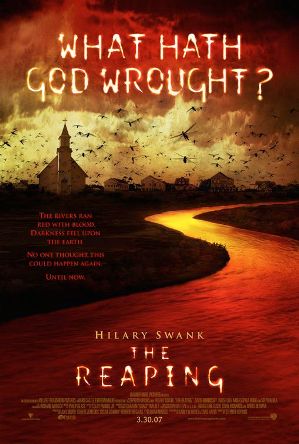
Strange coincidences transpire. In 2007, just after the professor in my discipline at Rutgers University retired, I showed up in the Religion Department seeking adjunct work. With the vicissitudes of “full-time” employment, at times my part-time stint at Rutgers is all I have. While covering the book of Exodus my first year there, students began asking me what I thought of The Reaping. I hadn’t seen the movie, which had been released on Good Friday of that year, but I promised my charges that I would. Still on my Hollyptic kick, I decided to rewatch it last night. The script was handled much better than that of Lost Souls, although the movie as a whole lacks credibility. It is, however, an example of how the Bible mystique continues to pulse through Hollywood’s veins.

The concept of bringing the plagues against Egypt into the bayou was a fresh one, but the satanic cult aspect has been overdone. A strong female lead in the role of a disenchanted former clergy-woman was a nice touch, and although the premise of her back-story was contrived, it was also decidedly eerie. The element of the movie that students wanted professional comment upon, however, was Katherine’s scientific assessment of the plagues of Egypt. This idea has a comparatively long history. Since critical biblical scholarship began, naturalistic suggestions for the non-historical plagues have been offered. Strangely, these offerings are intended to buttress an historical event that the theories themselves undermine. There is no archaeological or historical evidence for the exodus. Why then, are scientific explanations of the plagues necessary?

The story of the exodus is liberating; slaves liberated by a loving God forms a back-story that most oppressed people want to be true. The sad fact is that religion is more often used to repress than to liberate. Somewhere along the trajectory of human social evolution, religion became a key element in the control of the masses. This becomes clear from the merest glimpse at religion as it existed in ancient Egypt itself, or any of the other cultures contributing to Israel’s religious tradition. The Reaping, like so many films that springboard from the Bible, offers a conflicted worldview where nobody really knows who is in charge of the universe. In that aspect, it mirrors human religious experience.


Heavenly Visitors

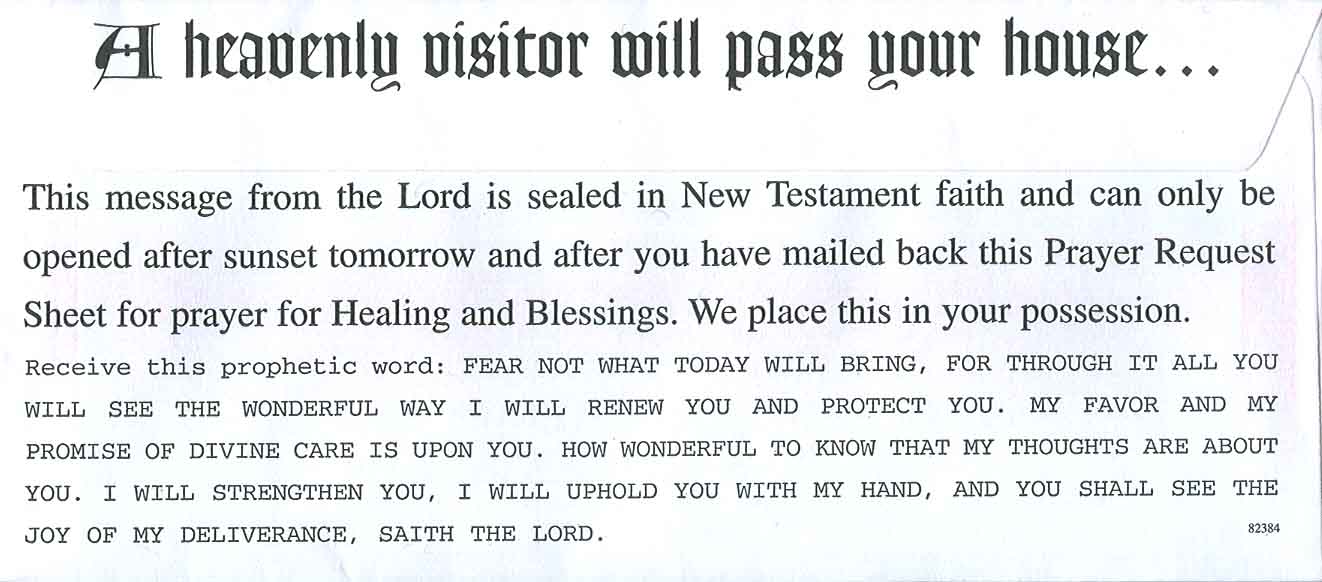
With Passover hard upon us, I was a little disturbed to receive a letter on Friday that read, “A heavenly visitor will pass your house…” Having been raised on the sturdy fare of Exodus, I knew that heavenly visitors more often take the form of marauding angels than of jocular Santa Clauses. It seemed an ominous warning. Of course, it came from the Saint Matthew’s Churches that sent me such good wishes of divine promises of prosperity some months back, so I had to assume it was a purely coincidental biblical reference. The folks at Saint Matthew’s Churches are, after all, Bible believers.

Perhaps because of that fateful letter, I dreamed, in good Genesis style, a dream two nights ago. I dreamed that I found a dollar coin on the ground at a family outing. A few feet away lay another. And another. Wherever we went in that Morpheus-bewitched town there were silver dollars unclaimed on the ground. My trousers were being dragged down with the weight of the lucre in my pockets. I couldn’t believe my good fortune! Then I awoke, still employed only part-time, still worrying every minute about whether we can meet all the bills. Perhaps the dream was a message? Should the Saint Matthew’s’ folks be right, prosperity was headed my way. Saturday’s powerball jackpot was in the double-digit millions. I very rarely play the lottery, but since state education in New Jersey needs all the help it can get, I offered up a dollar to see if Saint Matthew’s’ prosperity was at hand.

No. Not even one number came close. Perhaps there is a secret clause in the prosperity gospel contract. Perhaps those who prosper must hold certain conservative views on social issues. The views, say, my mother holds. Yet she lives in a trailer on a severely circumscribed income. That doesn’t seem to be it either. Last night I awaited another dream. Instead, the next-door neighbors were holding a loud party until 3 a.m. Perhaps celebrating Palm Sunday? Or perhaps that was the heavenly visitor passing over for Passover a couple of days early? Either way, I didn’t sleep well last night knowing that something was just outside my window.


Bible Lite

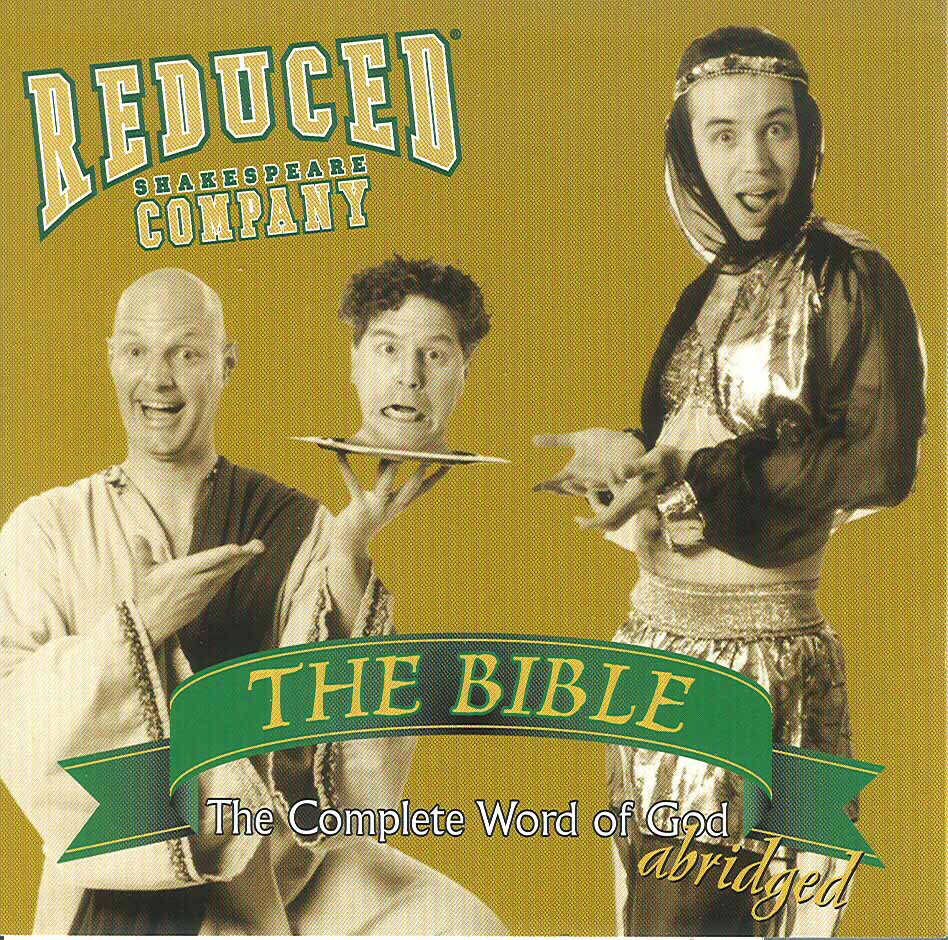
Over the holiday weekend I listened to an amusing recording my wife gave me as a holiday gift. A comedy troupe known as the Reduced Shakespeare Company produced a recording of their sketches entitled The Bible: The Complete Word of God, abridged. As might be expected from a comedic treatment of sacred writ, there were a few moments that were calculated to make those who take their religion very seriously tremble a bit, but overall the recording was quite funny. While listening to it, however, I became aware of just how much time the Company was spending on Genesis.

Not a sophisticated, exegetical approach to the Bible, a comedy album is not the place to assess the status of serious biblical study. Nevertheless, a deep truth emerges from this lighthearted treatment of the Bible — people today tend to focus too much on the beginning. Every semester I ask my students, “What is Genesis about?” and inevitably the answers begin with, “the creation of the world.” Genesis is not about the creation of the world, despite its unfortunate title. Genesis provides two of the many biblical creation accounts, but its primary purpose is to introduce the Israelites and the special relationship Yahweh has with them. Nearly four-fifths of Genesis deals with Abraham and the next two generations of proto-Israelites. Once Exodus is reached, we are fully within the realm of Israel’s story.

This misunderstanding of how to read the Bible has led to countless uninformed attempts to make the Bible into a narrative of the science of cosmology. Nobody was present for the creation of the cosmos, and the point of Genesis is not to state what actually happened. In borrowing mythic themes from Mesopotamia and Egypt, at the very least, the biblical writers start their account of Israel’s origins with a “a long ago in a land far away”-style introduction. Modern-day readers are trained to latch onto first sentences for vital clues as to what happens further along in the story. The Bible was never intended to be read this way. When we mix ancient ideas of setting the scene with modern attempts to understand our world, it might be better to listen to the Reduced Shakespeare Company than to pundits who claim that earth’s light was created before the sun.

In the beginning was a laugh