
One of history’s great ironies is that, despite being visually oriented creatures, we often do not know what famous people looked like. The further back in time we go the more difficult the reconstruction is. Ancient people practiced portraiture, although their efforts may have been hampered by stylistic conventions. Egyptian artwork is recognizable at a glance, and Mesopotamian art, with its weightier, angst-laden form is easily distinguished. Their stylized images generally do not allow for direct correlations to Renaissance portraits. When searching for specific individuals, even famous ones, however, the likeness may be completely absent.
Among the most notorious (from a biblical viewpoint) ancient emperors was Nebuchadrezzar. Demonized for his role in the destruction of the sacred temple in Jerusalem, Nebuchadrezzar becomes the hypostasis of Antiochus IV Epiphanes in Daniel and even worse in Christian apocalypticism. For all that, Nebuchadrezzar seems to have been a jolly good fellow. An able emperor, he was noted for his building an empire and the loveliest gardens in Iraq. Yet no images of him survive. They may be out there, buried, waiting to be found, but we do not know what this emperor looked like.
A recent web search nevertheless turned up the clearly Greek version of that famous, if forgotten, face on an onyx cameo. It even appears on Wikipedia’s page for Nebuchadnezzar II as an actual image of the man, the legend; this despite the fact that William Hayes Ward, in the American Journal of Archaeology in 1887, explained how the cameo was an early forgery. Originally an “eye of Nabu,” the proto-cameo was the eye of a statue, the pupil of which was carved by a reconstructionist Greek artisan into what he supposed Nebuchadrezzar looked like – a Greek warrior – centuries after the fact.
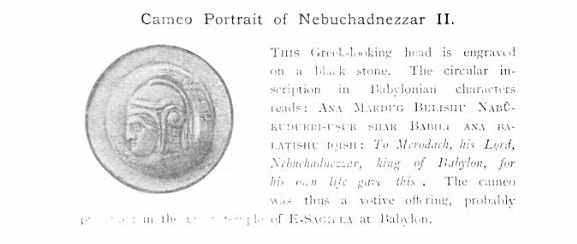
From Ball's Light from the East
This might be a simple historical curiosity were it not for the fact that evangelical websites and wikis are quick to claim that this clean-shaven, Olympian-profiled vision of masculinity is an actual image of Nebuchadnezzar. Why? He occurs in the Bible and therefore must be “proved” to have been historical. Not only for the real Chaldean Empire, but also for the fictional one concocted by Daniel. Seeing is believing. While history did not see fit to leave a lasting image of Nebuchadrezzar, evangelical websites will use the tried and true god-of-the-gaps methodology to show us what he actually looked like (not).
 Steve A. Wiggins