Social Media and Persia

A story appeared on the BBC recently about “sin free Facebook.” The website, which started in Brazil, is based on the idea that users don’t like having swear words and violence among their friends. According to the story some 600 words are banned from use, making me think that I’m seriously behind the times. With an “amen” button and a keyword of “bless” Facegloria has been growing dramatically. Some 100,000 friends are now on board. Of course, the concept of friends in a religious conceptual context goes back to the Quakers, but they tended not to use computers, if I remember my history correctly. The odd thing, to me, is that on social media you get to select your friends already. If you don’t like what they post, why are you friends?

Sin is going through a resurgence of academic interest these days. One of the features that emerges from all this exploration is that sin is not as clearly defined as we might think it is. Wrong and right. White and black. Things in their proper order. In the biblical world the word “sin” seemed to mean missing what you’d aimed at. From there it grew to cover all kinds of infractions. Today most people think of sin in sexual terms—those things you aren’t allowed to do. Ironically we call other things phrases like “hate crimes” rather than “hate sins.” And crime is supposed to make it worse, since sin is often not illegal. Or if it is illegal, it’s not often brought to the law.
800px-Forbidden_fruit

I have a Facebook account, but I have to confess to not looking at it much. My days are busy and although the marketing departments of publishers use Facebook, those of us with editorial roles are seldom encouraged to spend time on it when we could be doing something more valuable. I arrive home so late I don’t even check my email before bed. I guess I haven’t had the time to notice the sin on Facebook. Yes, a few of my friends use what Spock might term “colorful metaphors,” but I seldom feel the need for confession after reading a post or two. My friends, like me, are fallible and many of them are in less-than-ideal circumstances. I really don’t think social media with further restraints would help the situation. Of course, I could use an “amen” button on this blog, I suppose. I think I’d rather have it read “verily,” though.


Skynet

DSCN5012

Of cultural innovations, none rivals the internet. Engulfing the world in its wide web, the constant availability of signal has changed everything. In the past five years, civilization has become something that it was not. Take today’s northeast blizzard, for example. Apocalyptic meteorologists (are there any other kind?) are sincerely telling the camera that nothing like this has been seen in recorded history. Meanwhile, my wife’s company sends a Honeywell alert to our phone saying the offices will likely be closed, and please make arrangements to work from home. The snow day is dead. One of the simple joys of life, that delightful naughtiness of playing hooky, is now extinct. Work knows where you are at all times. You are being watched. Sound paranoid? I have known people who had firsthand knowledge of employers following them on Facebook to make sure they didn’t say anything that might make the company look bad. The world is not the same one into which I was born.

Screen Shot 2015-01-26 at 7.55.18 AM

I happened upon a web page the other day advertising for an Advanced Assistant Professor in Digital Shakespeare Studies. A poem by any other name we would tweet. So we have become part of this collective mind known as www dot. The internet is aware that it is still snowing, but only in an academic sense, since it’s not going anywhere. The internet has never had a three-and-a-half hour commute home because of an accident on a single highway in New Jersey. Oh, and don’t forget to check your work email when you get home. We may have sometime more for you to do once you’ve clocked out. Maybe I should see what my social network is up to.

Screen Shot 2015-01-25 at 7.20.01 AM

LinkedIn, Facebook, Twitter, Google +—they all suggest people that I might know. Someone I might rate, or like. The internet, after all, knows which of its myriad sites I’ve viewed, whom I’ve emailed, and what I’ve purchased. The ads from those companies show up on every website I visit from now on, world without end. ThinkGeek emails me every day. My new best friend. Google + is the more intellectual Facebook, I’m told. Whenever I log on, it tells me with whom I might want to connect. Just now Newt Gingrich showed up in my list. Should I add him to my circles? Or should I just venture out into this blizzard and hope I make it to New York City alive? To me, it seems, the odds are equally good in either case.


Small Town Heroes

When World War Three starts I hope someone will let me know. You see, I barely have time to satisfy the needs of employers and tax collectors to get everything done in a day, let alone read newspapers. Or Facebook. I check my page, very briefly, twice a day and get on with the business that I’m assigned in life. But yesterday I had a notice from a high school friend that one of my teachers had died. Since I don’t name people I know here without their permission, suffice it to say I took a current events course with this teacher in either my junior or senior year. Then, as now, I didn’t read newspapers. Given the small town rags available in rustic regions, there was often not much mentioned beyond deer season and local tragedy anyway. Originally enrolled in the regular curriculum, several friends told me, “You’ve got to take Current Events! The teacher is great!” Those who’ve influenced my life for the good were great teachers, and despite my reservations, I took the class. When it came time to sign up for projects, I was a bit flummoxed. What did I know of current events?

Our teacher kindly allowed me to offer evolution as a topic. It was occasionally in the news then. Six of us decided to debate the issue, three for, three against. My religion having held me in a headlock, I was the lead debater against evolution. The day for the debate came and we ran over the bell. Our teacher, with his usual calm wisdom, suggested we continue the next day. And the next. Three days of sometimes acrimonious debate and it looked, from my point of view, as if creationism had demolished evolution. How terribly naive I was. Ironically, I had just posted a piece on evolution yesterday when I saw the notice about my teacher’s demise. The position in my post was a sharp 180 from high school. It was a tribute to the love of education.

Source: Wellcome Images, Wikimedia Commons

Source: Wellcome Images, Wikimedia Commons

I was an outsider in high school. I literally lived outside of town and after school activities were not really feasible. We were poor and couldn’t afford extra-curriculars anyway. I wore a large cross on my chest and although I was shy, I felt that it said all I had to say. My teachers, to their eternal credit, let me explore. In college I learned about Fundamentalism. I had never heard the term although I grew up in it. Gently my teachers nudged me to think more deeply about things. Through three degrees delving more profoundly into the origins of religion, as well as humankind, I came to see the errors of my ways. Had I been forced in high school I would’ve fought back. Instead, a persistent, patient wisdom guided many of my teachers. I don’t know how they recognized that I might be worth salvaging, but they apparently did. They let me speak, they let me trip. Just as I was about to fall they caught me. And I hope, in my own small way, to repay this favor in kind.


Unspoken Reality

In that impressive cultural marvel known as Facebook, a few gems amid the overburden occasionally appear. The post of a friend brought to my awareness a site known as everyday feminism, where, last year a post about religious privilege appeared. The brief piece entitled “30+ Examples of Christian Privilege” highlights one of the persistently overlooked aspects of religious liberty. No matter how much the founders of the United States valued freedom of religion, the colonials were, at least on the part of the non-slave side of the equation, Christians. Whether Jamestown, Plymouth Rock, or Guanahani, those Europeans who first set foot ashore did so under the banner of one variety of Christianity or another. (Such a case might be made for Vineland as well.) Religious liberty meant fleeing the oppressive practice of state religion—always Christianity—that kept shifting according to the whims of frequently unstable monarchs. For all its wide variety, Christianity is cut from a bolt of the same cloth. At least in the lining.

The Christian Privilege cited on everyday feminism is the most insipid kind brushed with the widest strokes. Still, it does reveal just how thoroughly Christian even the secular can be. Christianity, as I often told my students, pervades our culture. We live it, breathe it, ingest it. Often subconsciously. America was and wasn’t founded as a Christian nation. Intentionally, according to the wishes of the founders, no. Unintentionally, according to the dictates of privileged classes, yes. The problem here is not Christianity—it is privilege. Depending on whence you read the words of Jesus, his message seems to have been one of a general equality, or at least fairness. Those same words, however, can be distorted to support the monolith of the privileges granted those who follow the “one true faith.” The privilege to own slaves, for example. Or to oppress others born into less fortunate circumstances.

Ironically, among academics, I’m told, there is a push to hire those who are authentically unprivileged. Although I must, by my accidental Caucasianness, maleness, and inherited Christianity, be classified as privileged oppressor, I did grow up in economic privation. So much so that my wife feared to take our infant daughter to the unsafe house in which I was reared (which was, fortunately, condemned and demolished before that became an issue). It still shows in my natural, placating obsequiousness to supervisors and bosses—I was raised knowing my place. Yes, sir. As a first generation college student, I still find myself confused by why I was rejected by a higher education into which I poured all my youthful energy. Yes, in such circumstances, it is difficult at times to see the privileges. They are there, however, as anyone willing to walk across town with their eyes open may see.

IMG_0714


Heaven Forbid

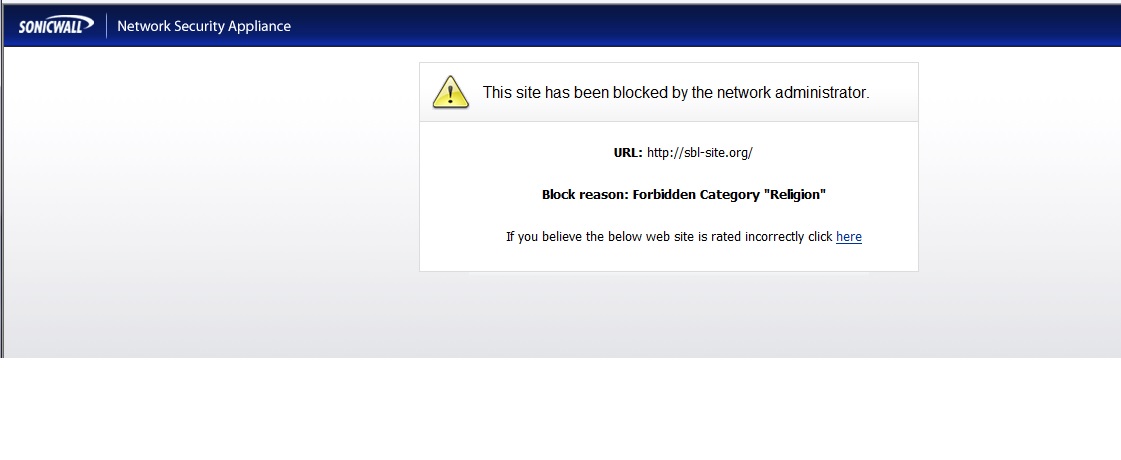
Cars can be a nuisance—they consume resources, pollute the environment, and have a habit of being very expensive to repair. We’ve been pretty good about taking our car in for its regularly scheduled Toyota check-up. Since the garage is several miles away and my wife and I both work, it is often a matter of the one who can most easily work from home the day of the car doctor appointment taking it in. Our Toyota dealer has in-store wifi for those who can’t live without the internet. For some of us, work is almost exclusively internet. So it was that I drew the short straw and dutifully drove out to the dealership. I was pleased that my VPN connected so easily; this was going to be a snap. I was working happily away when I had to find somebody on a university website. I googled the name and clicked. I received a forbidden website message (copied below) explaining tersely: “Block reason: Forbidden Category ‘Religion’.” I tried again on the Society of Biblical Literature website—same message.

ForbiddenReligion copy

Now I can understand workplaces blocking pornography sites, and even Facebook (I found the latter to be blocked at Toyota some time ago, but I’ve never tried the former), but religion? I am a religion editor. How am I to work when I can’t access websites that contain the word “religion”? The more I pondered this—I could still check my email, and do VPN-type work with files from the office—the more it bothered me. On the television in the background inane daytime talkshow hosts were interviewing someone who’d written a book about God. How many more businesses out there are biased against internet religion? That means my blog is blacklisted along with the scantily clad and overly chatty. I fully support the disestablishment clause, but I also subscribe to the freedom of religion. Smirks aside, there is a serious undertone to all of this.

I have no desire to be proselytized at work. I also agree that it is the right of others to expect the same. Sometimes, however, a little religion might help work go down like a poppinian spoonful of sugar. One time when I worked for Ritz Camera in Brookline, Massachusetts (I seem to have a knack for working for businesses that are on the way out), I had a tough day. Some of our customers could be quite abrasive, and since the customer is always right, we had to take personal insults with a smile. One lunch-hour I told my manager that I needed to recoup my moxy (I didn’t use those words). I ducked out the door and stomped to the first church I could find and asked if I could just sit in the pew for a few minutes. The church secretary, a complete stranger to me, said “of course.” Ten minutes later I returned to work collected and able to face more unreasonable customers for the rest of the afternoon. Maybe it wasn’t religion, maybe it was only the calm of sitting in what some believed to be a sacred space, but my capitalist company got better performance out of me that day because of it. Ironically, at Toyota, my religion editing is cast in with the tax collectors and prostitutes. Only the tax collectors, I’m pretty certain, are always permitted to work.


OMG, MOMA!

New York City can wear you out, spiritually. I suppose that’s why so many people go there, to face the challenge. Thanks to Target, Friday evenings the Museum of Modern Art gives out free tickets for its world-class collection. We knew that Vincent van Gogh’s The Starry Night was there, and had planned on seeing it sometime. Well, Friday of spring break offered an opportunity, so last night, with several hundred, maybe a few thousand, others, we made our way to MOMA. We arrived around 5 p.m. and found the line literally around the block. It wasn’t as cold as it had been, so we braved the hour to wait our turn. Yes, it was worth it. As my wife noted, it was very good to see so many people wanting to see art. Manhattan offers many, many other diversions for a Friday night, but hundreds opted for art. I had long anticipated this. Since my school days I’d seen replications of many of the paintings in the museum, and it was inspiring to be packed in so close with so many people wanting to be close to art. Hoping, somehow, to commune with the emotion in us all seeking such profound expression.

IMG_0602

It was a little difficult to commune, however, with so many other religious seekers. This is a religious experience, to touch the soul of another. Standing inches away from The Starry Night, I could almost feel the desperate, longing hands of van Gogh stroking out a manic sky, surreal and ethereal. I could almost hear the echo of his spirit. Were it not for the many crowding next to the painting to be photographed with it. Fellow spiritual seekers, I hope. Van Gogh was a troubled soul, as we all know. How many artists take their own lives after reaching out to touch what so few of us even dare. A sadness so profound as he climbed down that mountain. The starry night is the photograph of a suffering soul.

IMG_0614

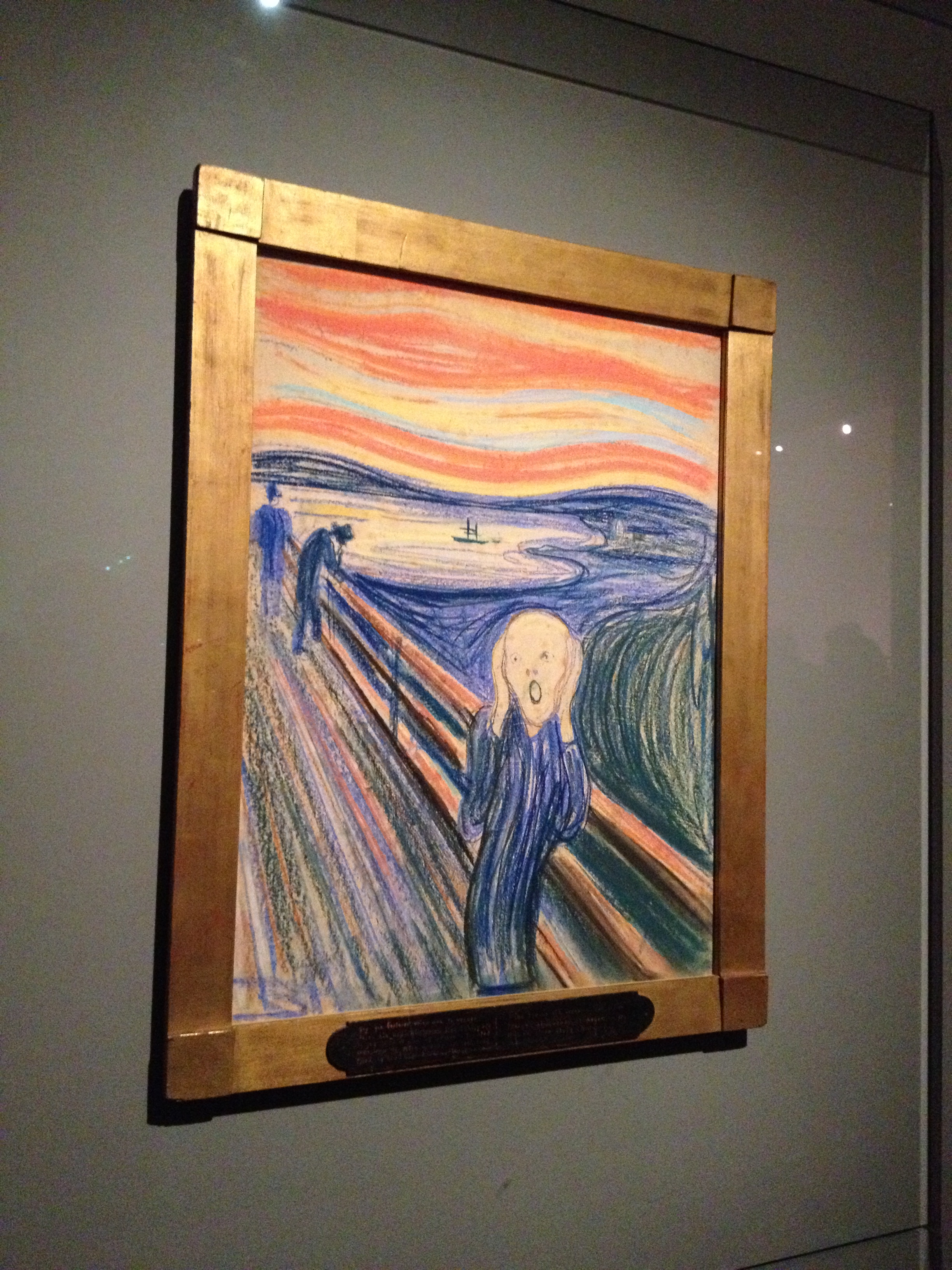
Then there was Edvard Munch’s classic, The Scream. On a limited engagement at MOMA, facing, just across the hall, van Gogh’s Starry Night. Was there ever such depth of soul in such close proximity? It was there that I began to question the faith that I had hoped impelled the countless masses yearning to observe free. MOMA allows photographs, and cameras, cell phones, and iPads were ubiquitous. To reach The Scream was to endure a crunch of strangers’ bodies pressing you forward, cell phones held aloft, illicit flashes popping, worried looking docents. I was anticipating another spiritual moment when I heard a woman say that she had to get close for a picture. “This is going to be my status!” she cried. So this is modern spiritually, the life splayed on Facebook, bragging about bagging Munch. Yes, Edvard, I am screaming too.

IMG_0610


Accidental Abortion

There comes a time in life when you realize that if a small town you know makes it into the news headlines, it is likely tragic. So it was when I read this morning that a man in Mercer, Pennsylvania—just a few miles from where I grew up—shot and killed his 7 year-old son, by accident. I grew up in a part of the country that has a love affair with guns. This may have been understandable in the days when a stroll to the outhouse could mean chancing a bear or cougar encounter, but these days bear sightings are rare and cougars, well, almost unheard of. The man was trying to trade in a couple of guns at Twig’s Reloading Den. Climbing back into his truck, the handgun discharged, killing his son. This is very tragic, yet the officer making a statement said something chilling. The man thought the gun was unloaded but, “This happens all too often where people think the gun was empty.” All too often. All too often.

I grew up in western Pennsylvania, and if Facebook is anything to go by, it has become consistently more Evangelical since I left. And that is saying something. In my younger days I wore a large cross around my neck and took my fair share of ribbing for being religious. Now I see those with whom I attended school posting on all manner of conservative causes, including the contradictory anti-abortion and loosening of gun control. This is not a phenomenon restricted to western Pennsylvania. At Nashotah House it was alive and well. Several students kept guns in their dorms, protested against the violence done to the unborn, yet called killing heretics “retroactive abortion.” It was their smiles when they said such things that frightened me. Wait until they grow up to kill them.

Like any insecure person I sometimes think a gun for protection might be good. I especially think this when I’m in the grizzly bear habitat of the Pacific Northwest, miles from civilization. I picture myself shooting into the air with a rifle that out-Thors thunder itself, a mighty man. Yet the only time I actually saw a grizzly bear I immediately jumped out of the car to snap a picture or two. I dream of going back to the days before guns were invented, but this evil genie has been let out of the bottle. There’s no getting it back in. Are we vulnerable without guns to “protect” us? Yes. But my reading of the Bible my Evangelical friends so often cite insists that turning the other cheek is the way to show that you believe it. A seven-year-old is dead not far from my hometown. His father was trying to sell guns at a store that doesn’t even buy guns. The boy died in the gun store, and yet my fellow Americans feel safer knowing they’re armed. I hope your hometown stays out of the news.

Feel safer?

Feel safer?


Lessons from Sandy

While many are still without power and school is cancelled for an unprecedented sixth day in a row, the eastern Mid-Atlantic states are still recovering from Hurricane Sandy. As I noted in my first post-storm blog post, one of the largest disorientations I experienced was being cut off from the internet. An article in Friday’s New Jersey Star-Ledger gives a name to this phenomenon: “nomophobia,” the fear of being left without access to an internet-connected device (specifically a mobile device, but in a pinch even a desktop will do). An article by Allan Hoffman suggests that two-thirds of the population suffers from nomophobia and that there are actual treatment programs available. A decade ago no such phobia existed and some of us were only just beginning to hear about the World Wide Web. This is a fear born of our own engineering—the virtual world of our making has come to haunt us.

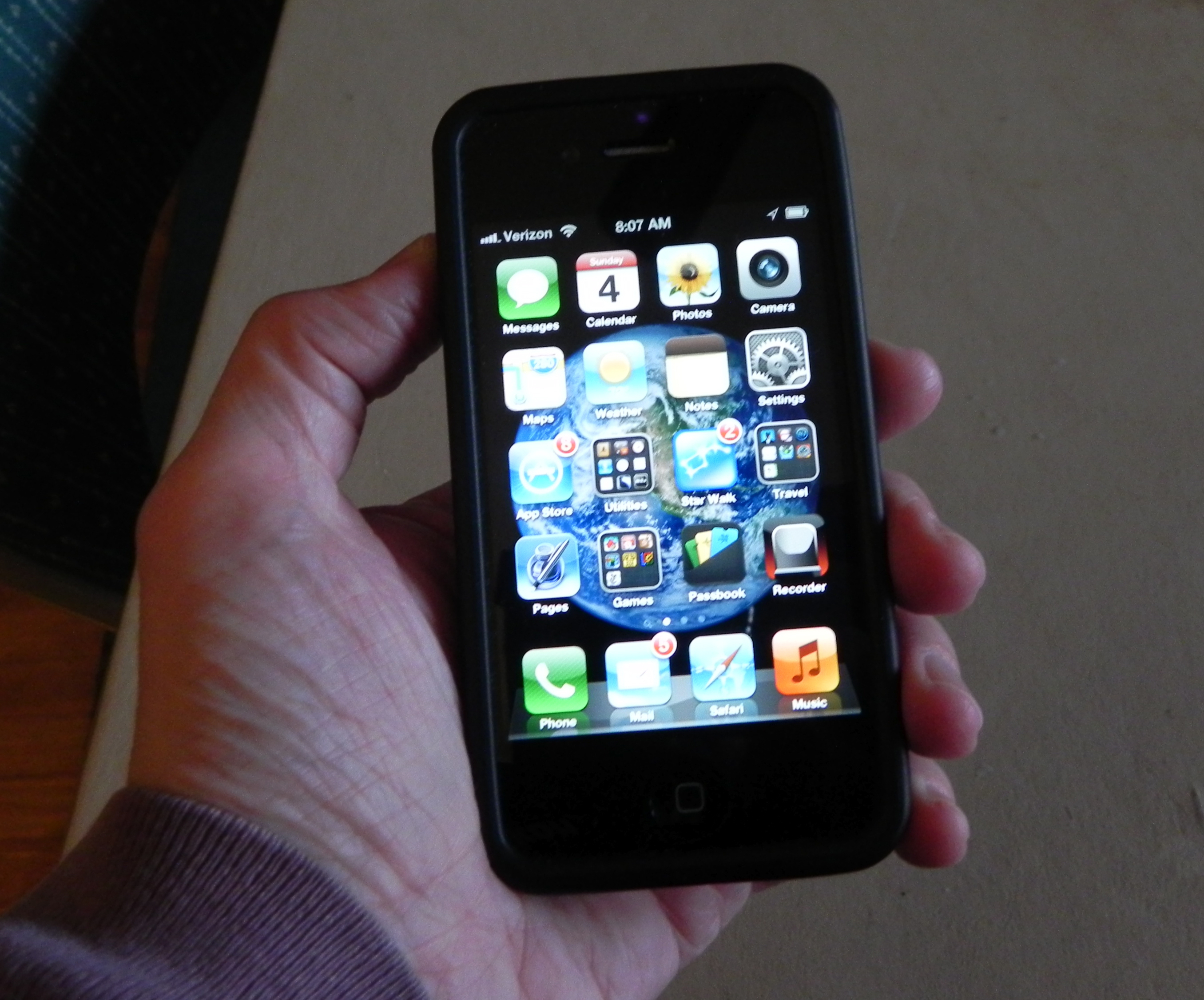
No doubt life is somewhat easier with the internet. One word will suffice to illustrate it: phonebook. When is the last time I looked something up in a phonebook? While pulling open a drawer beneath the accumulated phonebooks on the phone stand, I noticed how thick with dust they were. Even the cordless phone with its answering machine appeared just a little bit medieval to my cyber eyes. If this is evolution, we may be in trouble. Technology was envisioned as the liberator from labor, but we’ve clearly become its slaves. Don’t worry about the food spoiling in the refrigerator, get me back onto Facebook—now! My smartphone has a flashlight, several email apps, and can soothe me with its music. It is my rod and staff.

On a short drive to run an errand this weekend, I went by one of the few stores with power in the area. Their electronic marquee read “cell phones charged here.” The greatest service that could be offered to a cold, hungry population living in the dark.

One of the hallmarks said to have ended the Dark Ages was the printing press. Literature, on paper, could now be spread (mostly in the form of the Bible) from person to person until all of Europe would have access to sacred knowledge. That knowledge (and a great deal of nonsense) is now worshipfully cupped in the palm of my hand. As Hoffman notes, even the librarians were telling patrons not where to find books, but where to locate outlets. Robots fight our wars remotely, and wireless networks link us in a web far more valuable than that of the silk moth. And we have realized that even the creator of an entire universe can be held in a child’s hand.

In the valley of the shadow of death, I will fear


Facebook Apocalypse

Facebook can be a fickle friend. Oh yes, there are rules that we know everyone doesn’t quite obey. You are not allowed to falsify evidence about yourself on the great FB, although characters like Jesus have their own pages. The Chronicle of Higher Education this week followed the efforts of a University of Nevada at Reno librarian who tried to use Facebook for educational purposes. Donnelyn Curtis had set up Facebook accounts for two students early in the twentieth century to give current students an idea of how times had changed. The pages were summarily removed by Facebook staff, leading to the unfortunate second deaths of Joe McDonald and Leola Lewis. Second deaths always get me thinking about the book of Revelation. After all, we are now into the fatal year of 2012.

My Mayan Calendar

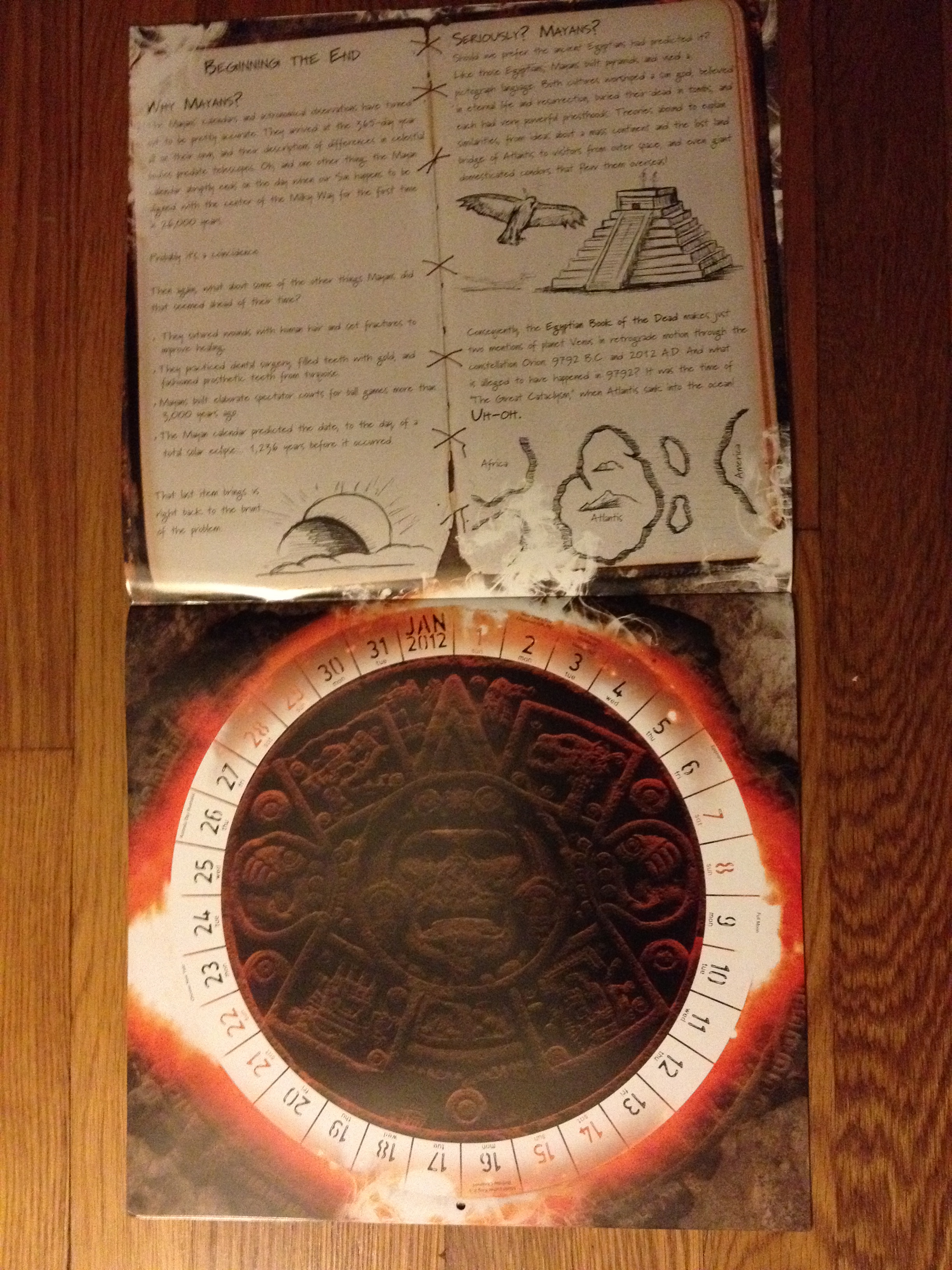
Few events elicit religious fervor like the end of the world. In the most highly touted end-of-the-world scenario since 2000, 2012 has emerged as the great contender for wrapping up the show we call life on earth. When I spotted a calendar to prepare the user for the end of the world, well, how could I resist? Each month on this terminal calendar features facts pointing to the culmination of this strange experiment that evolution hath wrought. If we can’t pull off a good, old-fashioned Evangelical rapture (sorry Rev. Camping), maybe the Maya can get the job done. They certainly managed to pull off an impressive vanishing act a few centuries back. Or did they? Despite the overrunning of enthusiastically avaricious Christian invaders, the Maya accommodated themselves to less-than-ideal circumstances and survived. They are still among us. Their culture, however, didn’t fare so well at the hand of the church. Nobody’s asking them about any of this.

Apocalyses occur all the time. When religions meet, one inevitably tries to vanquish the other. No one walks out of that arena without a limp. And the winners look over their shoulders for ever after. To prepare for this apocalypse, the January on my new calendar narrates how the Mayans and Egyptians shared some cultural secrets—such as how to build pyramids. How did they know about one another? My calendar says they could have walked across Atlantis, or they might have been carried by giant, domesticated condors. Either alternative seems as likely as the other. Either alternative seems about as likely as the world ending this year. But then again, already in 2012 a couple of promising young people have already been kicked off of Facebook for being dead. I think I feel the apocalypse beginning already.


Job Well Done

By now the world is well aware that Steve Jobs has died. As an avowed Mac user, an encomium for a man I never knew seems somehow appropriate. In a world where most religious leaders are known for their lack of vision and staunch conservatism (“Where there is no vision, the people parish,” to paraphrase Proverbs 29), Steve Jobs gained high priest status among technocrats for making the computer accessible. Even if you are reading this with a PC—thank your lucky Mac-OS-emulating Windows that you didn’t have to begin with a god-forsaken C-prompt—Jobs’ impact is part of your daily life. Although Mac has always been second fiddle in the computer market, Apple has always taken the lead in the gear: your iPods, iPhones, iPads, perhaps even the letter ”i” itself. We have entered the world of the Matrix, so much so that earlier this year it was reported that Apple fans experience a high like a religious encounter when they behold Apple’s mighty hand.

Nevertheless, a deep uneasiness overtakes me when I consider how helpless I am without my electronic accoutrements. When my laptop crashed last month, I was completely disoriented for about a week. I didn’t know what the weather was supposed to be like, who had tried to email me, and just how few people had decided to read this blog. I had become immaculated, and I was embarrassed. I miss the days of wandering carefree through the forest, concerned only about bears, cougars, and getting lost. Not having to wonder if there is an email I had left unanswered or if some new gadget had been invented, or if I had forgotten the birthday of someone I barely know on Facebook. No, electronic reality has supplanted actual reality. On the bus I’m nearly the only one who passes 90 minutes with a book. The glow of LCD screens peer like huge eyes in the pre-dawn of a New Jersey highway.

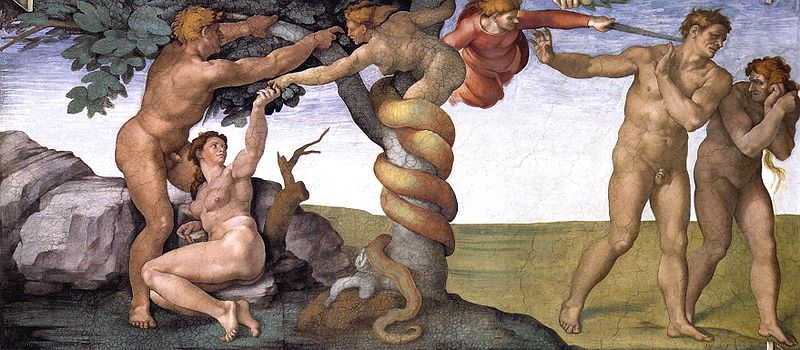
If it hadn’t been for Apple, I would not have joined the computer race at all. Back in college, several of my friends and I vowed we would not give in to the computer craze. I made it through my Master’s degree using an honest-to-God typewriter with ribbons, white-out and retypes. Today I can’t image how I ever survived all that. My wife first encouraged me to use a computer. She took me to the computer lab at the University of Michigan one Saturday and sat me in front of an Apple. “See, it’s easy,” she said. She was my Eve, offering me the bite of an Apple I’d never be able to put down.

We dream of building legacies, something to show that we’ve passed through this weary wilderness. Steve Jobs did not live to be an old man, but he has left a legacy. This blog, and countless others like it, would be inconceivable, were it not for his genius.

The apple tree keeps giving.


Lead Us Not

The media love the story of the fallen. Sometimes even those in religious institutions secretly delight in seeing the foibles of their infallible leaders. Part of the problem is that many clergy (but by no means all) place themselves on a moral precipice impossible to reach by mere mortal standards. So the Associated Press carries the story of a Neptune, New Jersey pastor who’s taking a sabbatical. What makes this leave noteworthy is that Pastor Miller railed against his flock using Facebook, arguing that it leads to adultery. So far, so good. This is standard pastor-babble. The problem is a decade ago the good reverend was involved in a ménage à trois, thereby predating even Facebook and still finding access to adultery. The response of Living Word Christian Fellowship Church: take some time off.

The real problem, the Republican symbol in the room, is that human nature likes to place the blame elsewhere. “The Devil made me do it,” was the 1970’s version (thanks, Flip!). Many religions, uncomfortable with the implications of humanity’s evolution, have devised means of shifting the blame. Augustine gave us “original sin,” suggesting that the true blame went back to our first biblical ancestors and forever made sex dirty. Somebody else must take the fall, as the Neptune preacher has discovered. The words of another famous New Jerseyan capture the sense exactly: “Now he walks these empty rooms looking for something to blame, if you inherit the sins you inherit the flames. Adam raised a Cain.”

Coming to grips with being human may be the greatest challenge bestowed by consciousness. There are primate survival strategies inherent in shifting the blame. Where evolution is disallowed, supernatural agency – even Facebook – is placed in the dock. Facebook may encourage the wasting of time on trite sentiments endlessly repeated across this universe we call the Internet, but it can hardly be blamed for adultery. For that, the beast is within. And those who place themselves on pedestals have a great distance to fall.

Lead us not into Facebook...


The Good (Face)Book

One of the funnier books I’ve enjoyed has been Sarah Schmelling’s Ophelia Joined the Group Maidens Who Don’t Float: Classic Lit Signs on to Facebook. Its unwieldy title as well as the temporary nature of the subject ensure that this book isn’t destined to be a literary classic, but it is a nuanced and subtle treatment of the Facebook phenomenon. (My daughter found it on the bargain table at Borders, and it cost us less than two dollars.) Schmelling presents the Facebook pages of famous, departed authors, often with hilarious results. For some time I regarded YouTube, Twitter, and Facebook as passing fads, but now I’m beginning to wonder if we’ve become so connected that shutting down the networks would be tantamount to pulling the plug on the respirator. We live to be connected. Humans are social animals, and yet many of us find ourselves isolated and alienated, living apart from family and those who were significant to us in times past. It’s the Internet to the rescue.

My wife pointed out an article on CNN entitled “The theology of Facebook, an online ‘altar’” by Omar L. Gallaga. Gallaga explores the concept that Facebook is now being taken as a spiritual venue by many. Quotes from the Bible or self-righteous, self-congratulatory religious sentiments are very commonly posted. So much so, Gallaga suggests, that some clergy worry about their jobs. Facebook has developed its own “spirituality” quite apart from anything its creator may have imagined. Facebook is evolving. I joined Facebook last year, but I limit my involvement to mostly watching others. Rather like I did as a kid on the school playground.

Is there balm in Gilead? In rereading Brave New World I am reminded of the insidious nature of soma, the feel-good drug. I’ve been to churches like that. Like Bernard Marx I left feeling empty. In Facebook-world it feels the same to me. We are communal creatures by evolution, but we want to talk about our troubles more than we want to listen. We are seeking that mythical, homeopathic cure to the ills our society creates: lack of prosperity (except for the Prosperity Gospel crowd, of course), joblessness, despair. Misery loves company and Facebook loves company. It is like the confessional without the absolution. Gallaga may be right; maybe Facebook has become a religious institution for some. If Facebook had come along a little earlier there would be no lost years of Jesus for us to ponder. We would know through his posts and tweets, exactly what it was like to be the son of God.


True Colors

Over the past year several colleagues have urged me to join Facebook. To put this in context, I am one of those dinosaurs who made it through a Master’s program without having touched a computer – all theses and term papers were typed on a typewriter. It was only with the sheer volume of written material for my doctorate that I finally gave in to the technological revolution. Since then I’ve been sucked further and further into it, always a little bit reluctantly. When I read I like to have a book or magazine or newspaper in hand. When I communicate, I prefer a conversation to an electronic chat. Well, there are advantages to the technological world, but Facebook seemed a little too much. Caving to pressure, however, I eventually gave in and became a Facebooker.

One of the things I’ve learned from the daily updates of people – many of whom I’ve not seen since high school – is just how religiously conservative many of my friends are. I get daily, sometimes hourly, news updates about what the Lord is doing. He’s a pretty busy guy. Sometimes these friends look at my blog and wonder what has happened to me. When they ask, I have to wonder how deeply down the rabbit hole do they really want to go. I’ve been a professional religionist for nearly 20 years now – unfortunately several of those years have not included regular employment, but the work it took to get here can’t be undone – and prior to that I spent nearly 10 years in school studying religion. Anyone who makes it through an advanced degree in this field and comes out with the same viewpoint as when they entered it has had their mind firmly closed all along.

Religion is a phenomenon that can be studied, just like pottery or fashion history. Once a genuinely open mind is brought to it, perspectives begin to shift. Some of my friends who are less gracious about this respond by quoting the Bible at me, as if I’ve somehow learned how to forget the Bible while earning a Ph.D. in it. What they don’t realize is that if you want to learn about your religiousness in any serious way, there will be several Rubicons to cross and some pithy snippet from Paul is not going to change that. I don’t use Facebook to announce my religious thoughts to the diverse body of “friends” on my account. I use this blog for that. Those who are truly curious about religion might learn something from someone who’s been in the biz for nearly three decades. Others are content to announce to the world what the Lord is doing through Facebook.


Jesus Friends Me

From Jesus' Facebook profile


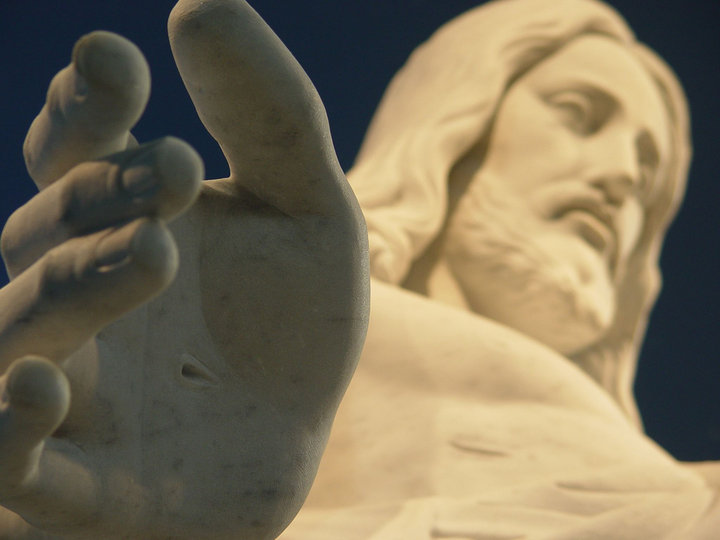
Jesus has a Facebook page. Given the circumstances it is highly doubtful that he set it up without some help from his friends. I went to the page to check out his friend list, but apparently he’s not accepting invites. Over 125,000 like the page, however. I wondered if it might be a stunt, since when I found Facebook they insisted that you could only sign up with your real name. While there is no doubt that this is a stunt, it turns out that it is considered an evangelistic tool wielded by a John 3:16er. On his info page, Jesus writes, “Please invite your friends to ‘Like’ (love) Jesus Christ,” an upgraded “honk if you love Jesus” if ever I read one. If you read the comments on his wall, it is clear that some people believe Jesus himself really reads his own page. It doesn’t mention the car accident.

A Rutgers student once told me about the “six clicks of separation” phenomenon on Wikipedia. Apparently, no matter how obscure a page you’re on, just six link clicks can get you to the page on Jesus. Don’t get me wrong: with his impact and importance Jesus certainly should have a Wikipedia article. There can be little doubt that anyone else can claim his level of influence in both the Dark Ages and Twentieth Century America, now creeping into the Twenty-First. The sad part is, those who constantly link to Jesus have latched onto a chimera grafted together from disparate sources. And they are his followers on Facebook.

I wonder who has the audacity to speak (type) for Jesus. Who is it that believes they have the deep insight into who Jesus was – deep enough to speak for him? WWJT? Technology speeds along and fans of Jesus fear he may be left behind. By making your Facebook admiration for Jesus public, I suppose, a kind of “witnessing” is going on. It would seem to me that a better way to show support for Jesus would be to care for others, the poor, the disadvantaged, the lonely. Feed the hungry, provide healthcare to the sick, offer justice to those who have been treated unfairly. If a friend invitation came from this faux Jesus, who would be inclined to accept it?