I recently came across a website with academic papers available on it. Although the internet has yet to achieve its promise as a locus of solid academic material, such sites are becoming more common. I’ve been uploading my own papers onto Academia.edu since they seem to be old enough not to impact anyone’s sales aspirations. In any case, this particular website I found noted that a paper had been updated at such-and-such a time, and that anyone who had downloaded the previous version should delete it and use the new one instead. This is a dilemma. I know of publishers who make corrections without issuing new editions. When I buy a book, what it actually says will depend on the printing rather than on the edition. I wonder if such retractions are really fair. How does one know when she’s reading something outdated?
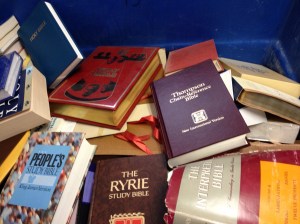
Picture this: a young kid, perhaps an unknowing fundamentalist, reading his Bible. Then he gets a newer copy of the same translation. But soon he notices that there are differences. Although the example may sound overly Talmudic, it is factual. Bibles, being printed in large quantities, are especially susceptible to error. When did the printed word become something that’s negotiable? I’ve been pondering clay tablets and their apparent immutability. Contrary to popular belief, most clay tablets weren’t fired—it was a lot of effort for something that had limited value. Some tablets show signs of erasure or additional words being added. In the case of clay, this is often very clear. Besides, the readers were few and specialists. They knew what they had. But for a modern person staking the salvation of her soul on a document, is it not problematic to change a jot or tittle (of which not the least shall pass away)? Has technology made us immune to fixed texts?
Back to the website I found. What if I downloaded the faulty paper and wrote my own paper based on it? How would I know to go back and check to see if a new version had been uploaded? Am I to spend all my time revisiting web pages to see what has changed? Knowledge itself seems now to have become whimsical. What is true depends on the date and time you accessed it. Perhaps I’m just a dreamer, but there was a time, it seems to me, before post-modernism, when you might purchase a book and be fairly certain of what you had. Errata sheets (or the more fancy addenda et corrigenda) didn’t intrude into the typeset page. You could still read correctly, assured that someone had spotted and acknowledged the mistake. We have, I fear, outlived the need for sic. And it is only a small step from siclessness to truth that changes second by second. Is this the siclessness unto death?
Empire State
Hegemony is a funny word. In studies of antiquity it is commonly found since it denotes the “Leadership or dominance, especially by one country or social group over others,” according to the Oxford English Dictionary. Today it has a vaguely imperialist taint, although it doesn’t necessarily require that one nation actually pillage another’s wealth or resources. The idea that people are, and should be, free is pretty much assumed in developed nations. Or so at least our rhetoric dictates. The word hegemony came to mind, however, as I saw an interview with a corporate leader. He was discussing how his company had budgeted for technology development on an increasing scale, to catch up with current developments, and then leveled the tech expenses off after that so that the business could move into its prime objectives. The reality was vastly different, however. Each year’s budget saw increasing technology costs and it shows no signs of slowing down. Every industry, it seems, will have to keep devoting larger and larger shares of its budget to technology. Hegemony.
It’s not that any one company is solely responsible for our obeisance to technology, so this hegemony has no head. It is the idea of progress gone wild. Last year as I set out for the American Academy of Religion and Society of Biblical Literature annual meeting, a notice popped up on my laptop that a software upgrade was available. Since I file that I required was no longer accessible unless I updated, I clicked through all the agreements and provisos that I can’t understand and began the upgrade. Download and installation time measured in hours rather than minutes and I soon had to interrupt the process to get to the conference. This had consequences that nearly led me to becoming utterly lost in a part of Baltimore I’d been warned to avoid. The gods of technology demand their due. Now, less than a year later, I can’t access certain files unless I upgrade again.
Don’t get me wrong—I’m not a complete Luddite. I enjoy the instant gratification of finding information in seconds through a web search, but I’m not always sure that I can believe what I read. Technology means photos can be manipulated, sounds can be fabricated, facts can be created, all with no basis in reality. I used to have students ask me if such-and-such a fact they’d read online was true. Facts, it appears, are now negotiable. Nobody’s really in charge, it seems. Instead we are lead by the vague idea of progress, a new god with technology as its prophet. Even now I know people who think they never use computers but they drive without realizing their car is full of them, and turn on the television not realizing that the tech is no longer chip-free. Meanwhile those in the technology industry seem to have plenty of extra cash around, while those of us in the humanities ponder whether the ancient hegemonies have really changed at all. Let me look that up on the internet, once this upgrade is through.