Heal and Farewell

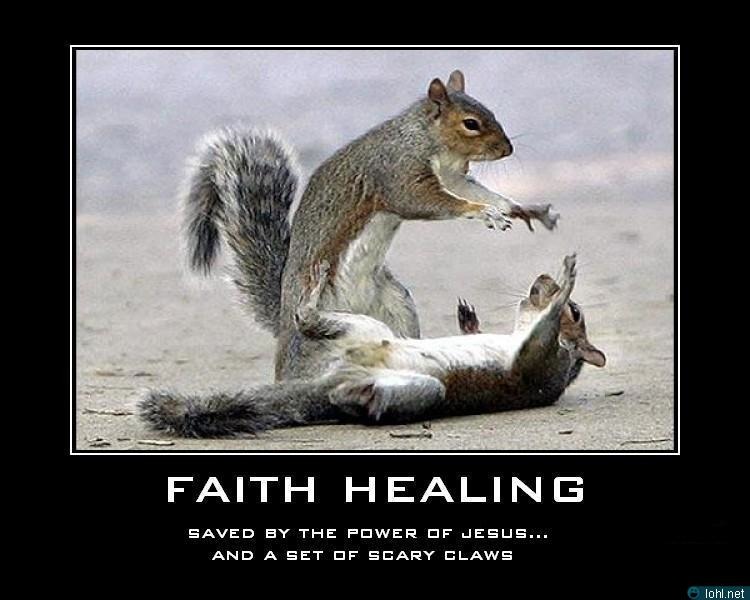
What could Aimee Semple McPherson have in common with the devious Russian monk Rasputin? Apart from being contemporaries for a couple decades, they were both faith healers. Well documented cases exist for both of them, and the medical profession has started to come around to the idea that belief can, and does, heal. The stories of Sister Aimee’s healings, witnessed by thousands, make me fear being thought gullible just for bringing it up. That doesn’t mean it didn’t happen. Cases exist even today where healing inexplicably takes place before scientific eyes. Often it occurs in response to religious stimulus. We may have proof that it happens, but we tend not to believe. This is a curious state of affairs. We trust in reason to the point that it may prevent us from being healed by faith.
Some object, of course, to the theological element. It’s pretty tricky to believe God has healed you if you don’t believe in God. The thing about faith healing, though, is that it seems to work no matter the religion of the person healed. This, it would seem, suggests we should be applying our rational minds to understanding belief. Instead we use it to find new ways to make money or to build smarter weapons to kill one another more efficiently. The more we come to understand the physical world around us, the less we know. As our research institutions take on the shape of the businesses that increasingly fund them, interest in this phenomenon shrinks. Medicine, in all its forms, is big money. Living in central New Jersey you can’t help but notice the palatial campuses of the pharmaceutical companies, nor ignore the mansions on the hill they have built. If only we could believe.

Faith healing was this aspect of her ministry that propelled Sister Aimee to fame. She constantly underplayed it, not wanting to be considered a healer of bodies so much as a healer of souls. Rasputin, of course, had political motives. Both lived—not so long ago—when faith was taken very seriously. Judging from the posturing around the least religious president in decades, whatever faith is left has been sorely effaced. Maybe it’s our minds that have the capacity to heal, but even that well seems to have been drained with the leaky bucket of rhetoric. History can teach us so much, if we’re willing to invest in it. How does faith healing work? I have no idea. Nor, it seems, does anybody else. So it will remain until it becomes commodified.

Seeing Things

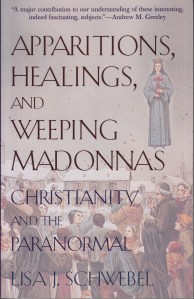
SchwebelWe have to learn to see the world. Traditionally religion and science both had roles to play, but as science grew better at explaining physical causes, many consigned religion to mere superstition. In such a paradigmatic world, Lisa J. Schwebel’s Apparitions, Healings, and Weeping Madonnas is something of an anomaly. Schwebel begins by noting that the Catholic Church has long accepted the reality of psi. As the branch of Christianity with the strongest commitment to furthering science, this itself might seem unusual. We are taught to see the world in a binary way: either this or that, not both. Books such as this challenge that convention, asking us to look at a world that doesn’t always conform to expectations. Parapsychology has made inroads from superstition to science because of testable hypotheses and statistically significant results. What it might mean is up for grabs.

Some claim that Catholicism is credulous. Actually, as Schwebel adequately demonstrates, criteria for declaring even spectacular events as miracles are amazingly high. Merely paranormal events seem common in comparison. In many ways, this is a disorienting book: the supernatural is assumed to exist, but miracles are treated as less common than the everyday supernatural. Those of us raised in a rationalist scholarly world might find the acceptance of that which we’ve learned is impossible just a bit unexpected. No doubt, visions of Mary are reported. Crowds often visit trees or highway underpasses where pareidolia impresses an image on the faithful. Schwebel, however, is discussing visions of another sort, and finds that they may involve the power of suggestion rather than the miraculous.

Faith healing, on the other hand, is something for which empirical evidence exists. Doctors still disagree about whether prayer speeds healing, but there have been many instances of unexpected healings that have occurred, apparently in relation to a person noted for bringing wellness about. Causality, of course, can’t be proven, but many people find themselves believing in a spiritual world after such an encounter. Perhaps that is what is so intriguing about books like this; they make readers uncomfortable in a world that is purely material. Finding a credentialed author who actually believes and has evidence to back her up is a rarity. Challenging conventions is part of the territory in most religions. Schwebel is simply straightforward about it.


Med Ed

I’m not really the one who should be on oxygen in this situation. It was a routine, scheduled oral surgery for a impacted wisdom tooth. Not mine, but my wife’s. I sat in the recovery room and they wheeled her in on oxygen. When the doctor stopped in to check on her, he looked at me and said, “My God, get that man on oxygen! He’s going to pass out!” So they took the gas from my wife and laid me down instead. My wife had the magnanimity to think it was cute, but I felt embarrassed nevertheless. I couldn’t go into medicine even if I wanted to. I haven’t the stomach for it. So as I write this in the Urgent Care unit, I’m a bit light-headed. We came in for treatment of a snow-shoveling-related injury for my wife, and my mirror neurons are firing overtime. I hear them call a code red, and I think I hear the helicopter coming down and I think I might pass out. I can’t stand the pain-filled groans coming from the next room.

Compassion is one of the most overlooked of human virtues. I haven’t taken a sick day since 1987, but I’ve had companies tell me I hadn’t earned any yet. You have to earn the right to be sick. Even when I threw up on public transit two weeks ago, in one of the most embarrassing moments of half a century, I still got up at 3:30 the next morning to climb aboard again. So I’m sitting here, feeling ill, although I’m fine, and thinking about how people naturally feel for others. Only practiced cynicism can erode that. Or maybe I’m just a wimp.

It is no coincidence that most religions feature healers or healing as one of their central tenets. Life involves suffering, anticipated or not. There is something more than the physical going on here. Pain is the enemy, and I’m the one who’s well. There may be atheists in foxholes and even in hospitals, but they must be aware that the chemicals chasing one another around the neurons upstairs believe something else. Religion is a coping mechanism, perhaps something even more. So the winter takes its toll, and the snow claims another victim. All those instruments on the wall are beginning to creep me out. My mirror neurons suggest that if only those made of ice could melt with a little compassion, this world would be a more humane place. And when you get a moment, could I get a little oxygen over here?

Scare-Yous


Jesus, My Foot

A story going around the internet features pictures of Paula Osuna’s bruised second toe. According to the YouTube story, Osuna fell down the stairs then had her boyfriend rub some sacred dirt from the shrine of El Santuario de Chimayó in New Mexico over the injury. As part of the healing process, an icon of Jesus appeared on her injured toe. Now, New Mexico has a reputation for hiding some potent sites of paranormal import (at least 51 of them), but I had never heard of Chimayó before. It is apparently one of the most visited shrines in the country. Like Holy Hill, a local shrine I used to visit once in a while back in Wisconsin, the site itself is supposed to lead to healing. Healing sites sometimes hold their own irony.

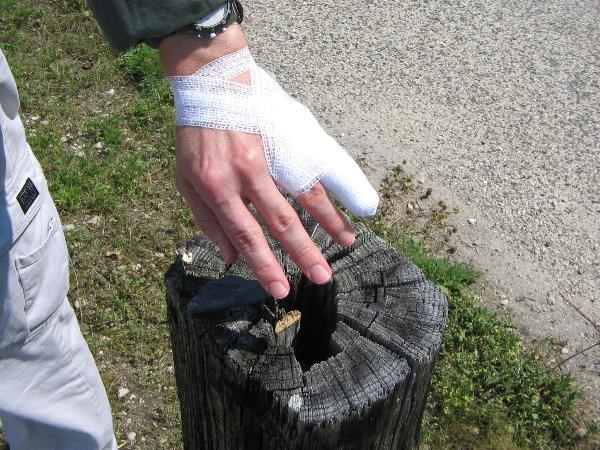
When we lived in Wisconsin, my family used to be avid geocachers. We still go out once in a while to find the little boxes hidden in the woods, but in Wisconsin there were plenty of day trips to be had with minimal traffic (unlike our current setting). One day we drove to Holy Hill National Shrine of Mary, Help of Christians, a discalced Carmelite community built atop a glacial moraine that gives spectacular views of the southeastern corner of the state. Inside there were many abandoned crutches, as I knew from previous visits, but this time we were present to find a small ammo box filled with trinkets, hidden in the wooded grounds. As our GPS narrowed us in on the coordinates, I made the typical error of watching my device rather than my feet. I slipped on a pile of rocks and my left hand slid onto a broken beer bottle, slicing open my little finger. Fortunately our geocaching bag held a small first aid kit, but no amount of gauze and holding my hand over my head could stop the bleeding. After we’d logged our find, we drove to a local emergency room where I received about ten stitches. Although the injury took place on the grounds of a healing shrine, no Jesus appeared on my shredded pinkie. Nor did miraculous healing come because of the location.

DoYouSeeWhatISee

Pareidolia is a most fascinating evolutionary development. One of the first things imprinted on a newborn person is the image of a human face. In remarkably short time the infant can register the intent of various expressions on a human face and will soon learn to mirror them. That desire to find a friendly face never leaves us. We see faces everywhere. There are entire websites dedicated to pareidolia. We like to think there is a watchful parent ensuring that we won’t stumble and fall. Life, however, is full of accidents and injuries. Some of them are even the results of visiting healing shrines. Belief is what makes the difference. Ironically, even when Osuna’s bruise lost the shape of Jesus, she still believed in the healing power of the dirt. Her story has been covered on television and is easily found on the web. It is a fame born of faith. Miracles are always there for the taking.


Playing Doctor

Science, religion, humanity. People are a conundrum. Medical professionals have the unenviable task of sorting out what is wrong with this jumble of organic biological systems and also attempting to address the uniquely human aspect of their subjects. As far as life forms go, although we may not be on top of the evolutionary ladder, we are suitably, impressively complex. We haven’t yet sorted out how mental states figure into physical processes: a number of cases of “faith healing” seem to have been verified, but the mechanism remains unknown. Praying has been demonstrated to improve some physical conditions with the believer saying God is doing the work and the skeptic suggesting it is the healing aspect of our own minds. How do you treat a creature that may not even agree with you on the ground-rules?

A story in yesterday’s New Jersey Star-Ledger revealed that New Jersey hospitals are experimenting with human subjects. The subjects, however, are doctors, not patients. In an effort to bring science and the humanities together, several hospitals are sponsoring reading groups for doctors. Like a garden-variety Oprah reading club, the physicians read a novel and discuss the human elements with each other. The theory is that it may help them understand the softer side of the science – how to touch the human reality of a field of study that has become very scientific. Specialists in the sciences and humanities have grown apart.

The humanities have long been assigned to the “less necessary” side of both university programs and the job market. Ironically, among those who are most famous in our pragmatic, make-a-buck world are musicians, actors, film-makers, best-selling novelists – in short, masters of one of the humanities. A darker side exists here as well; even celebrated humanities specialists can turn on one another. Contradictions and conflicts are part of human nature. Religion, one of the humanities, is a stellar example of the heights and depths of human behavior. As physicians attempt to discover what really makes us tick, reading novels is a good place to start. Attending religious services may be a bit more chancy, but like any human endeavor, one might get lucky and make a truly groundbreaking discovery. Did Rasputin write any novels?

Playing doctor, once upon a time.


Faith Stealing

The sad story of the Schaible family of Philadelphia has reached a compromise that demonstrates just how awkwardly religion and politics sit together. Believers in faith healing, the Schaibles watched their two-year old son die for lack of medical attention. No limits exist on what people are capable of believing. Belief is at the root of most religions, so any nation that advocates freedom of religion has to open itself to the bizarre and wonderful possibilities that follow. Belief can’t be legislated. Too many revolutions throughout the world have amply demonstrated that. If a religion decides that the use of turn-signals is sinful (apparently a popular doctrinal stance here in New Jersey), it may bring conflicts with civil authorities and other citizens. When a religion declares professional medical treatment to be wrong, it is simply exercising its right to believe. When civil laws declare that parents must watch over the physical welfare of their children, clashes with such faith systems are inevitable. Believe what you will, physical death will not be cheated.

The shift of religion from praxis to belief gave believers a shove down a very slippery slope. Ancient religions tended to be matters of practice: gods demand sacrifice, so we grudgingly give them that. In actual fact, sacrifices supported the temple staff, often an arm of the government. It was, although probably not disingenuous, taxation in disguise. To be the member of a community, you have to pay the price. The system started to break down when religious individuals began to internalize this external structure. Instead of just offering the sacrifice, you have to do it with the right intentions. Those intentions evolve into beliefs. And beliefs are the ultimate free agents.

When a society defines religion as a belief system to which you may (or may not) subscribe, then myriad religious concepts emerge. Offering religious institutions tax-exempt status only encourages such behavior. If you tax them, on the other hand, the wealthier religions will have more political influence. No matter what pious lips may say, money will always trump pure belief. Meanwhile very real human suffering takes place, hostage to belief systems made up by somebody else. Religion has given us many lofty ideals; maybe one of those ideals is that we should limit its own infinite power.

Borrowed from some place on the Internet


Faith Healing

Having dissociative reading habits sometimes leads to fortuitous coincidences. My interests have always been widely dispersed, and although I have a few perennial favorites that I keep coming back around to, reading about new interests predominates. One of my favorite reading topics is science. Apart from the requisite intro courses in college, I have unfortunately had little formal training in the sciences, so I read extensively in the field. A number of my recent reading projects, books on widely divergent areas of science, have coincidentally mentioned faith healing. Being books written by scientists, there is little by way of physical explanation except that people who believe they are improving generally do. The mechanism remains undiscovered, but the phenomenon is well documented.

Faith healing has long lain among the taboo subjects of snake handling and snake oil hawkers. Those who approach the phenomenon from a religious angle claim that it is no less than divine power that causes a person to heal. Physicians and scientists who rely on empirical evidence, however, declare that a physical cause must exist, albeit a yet undiscovered one. With no way to test results, the objective approach simply must accept that it happens, we know not why.

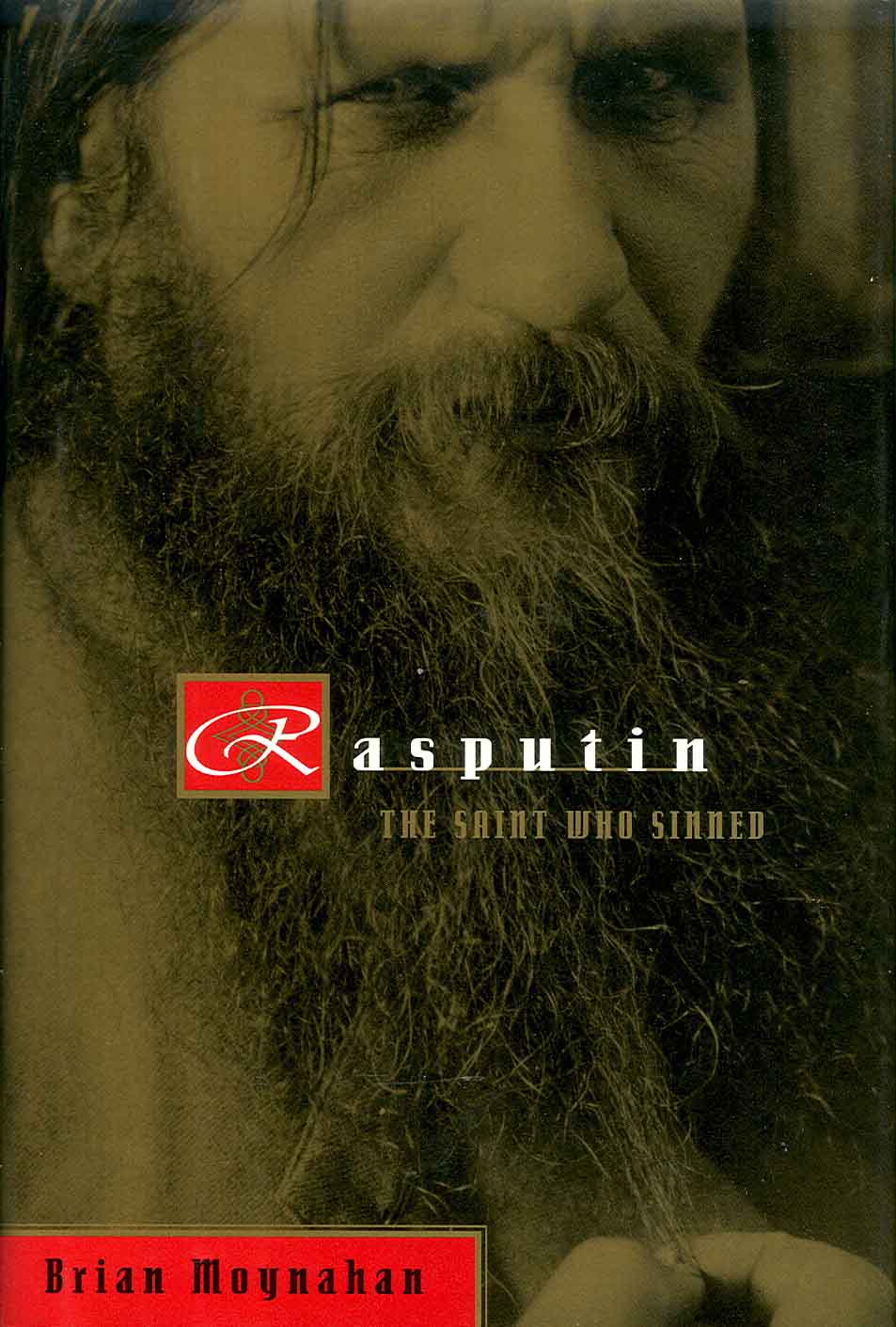
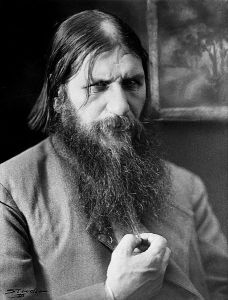
A number of years ago I read a book about Rasputin (Rasputin: The Saint Who Sinned by Brian Moynahan). At the time I was teaching at Nashotah House, a monastery-like seminary heavily influenced by Orthodox pretensions. “Rasputin” was a common slur on campus, particularly for a slovenly prelate-in-training. I had no idea who Rasputin was until I read this book. Apart from the distinctly creepy vibes his photographs give off, there are many documented cases of Rasputin’s ability as a faith healer. Few today would consider the “mad monk” as any kind of saint, but he apparently had a salubrious effect on those who believed in his power. This would shift the cause from supernatural to the suspect, unwashed hands of a notorious sinner.

Who wouldn’t want the ability to heal and make the world a place with a little less suffering? While faith healing has become a kind of holy grail for scientists, there are some not-so-holy religious folk who’ve unlocked a door that many never even suspected was there in the first place.