Problematizing Noah

As I continue to Tweet the Bible, I’ve been working through the story of Noah. Considering the number of children’s items imprinted with the friendly, smiling Noah and Mrs., and the cute, predatory animals they’re taking aboard their private yacht, the utter belligerence of the story is frequently lost. There is one seriously peeved God behind this. “And it repented the Lord that he had made man on the earth, and it grieved him at his heart,” Genesis 6.6 states. And it only gets worse from there: “I will destroy man whom I have created from the face of the earth… for it repenteth me that I have made them.” Indeed, the wrath of God is emphasized more than the wickedness of the humans that have spawned it. No matter what is done, it seems, God will still be in a rage.

The truly striking aspect of this account comes, however, when Noah is instructed on whom to save. “Thou shalt come into the ark, thou, and thy sons, and thy wife,” verse 18 dictates. Men first. Now, we cannot judge a product of the past against standards of the present day, but it is quite clear why many women find the biblical text less-than-friendly. Even the animals are explicitly paired from the start do not receive the radical disjointing that the women receive from the men. If the purpose is to procure a new generation, arguably pregnant women could have done that with the men treading water above the remains of Eden. If survival is the point of the story, as the saying goes, ladies first.

The flood story is a complex account of a deity with anger management issues and a preference for the company of men. Although theologians may say with a wink that God has no gender, clearly the Bible begs to differ.

Humans and animals alike are victims of the divine wrath, and even though humanity survives the flood can the relationship with deity ever be the same again? How do humans face a creator turned destroyer, knowing that they will never really please him again? The weight of such divine displeasure is surely greater than all that water pressing our ancient cousins into fossils on the primeval sea bed. I think back to all the children’s toys with the happy little animals and a smiling Noah and I know they resemble the biblical version only in the most fleeting of fashions. Yet the myth lives on.

What shape is your ark?


No God for Women

A friend recently asked me to write a post on the feminine image of God. Specifically, she noted that images of God tend to be overwhelmingly male, even today. Having written a book on the goddess Asherah, and being very interested in gender equality issues, I was intrigued by this request. Growing up male it seems natural in our culture to find representations of God as a man. It stands to reason that in a culture more open to feminine experience we should find female images of God. They are, however, still lacking. This combination of improbable facts kick-started some ideas about both religion and culture. To begin at the beginning, although the Bible makes passing references to God as either non-gendered or even female in rare places, clearly the predominant metaphor is masculine. The third-person masculine singular pronoun (i.e., “he”) is almost always used for God, beginning in Genesis 1 and running straight through. The Judeo-Christiani-Muslim deity is decidedly male in his demeanor. All three religions developed in circumstances of male social dominance.

Enter the 60’s (1960’s, that is. C.E.). Women were able to begin expressing their needs without the whole weight of a social McCarthyism bringing down the girth of the government upon them. Instead of finding feminine traits to the god of the Bible, interest in goddess worship revived. Now, serious scholars disagree on just how much a role the goddess played in the development of monotheistic religions. The end result, no matter how you parse it, is pretty masculine. Therefore some women found the goddess to be more conducive to fulfilling their needs. Problem is, there never was, historically, a goddess monotheism. There were always goddesses, plural. Without the unifying force of a single, female deity societies just never fully coalesced around a single, strong image of feminine deity. Some have tried to put Asherah in that role, but she was defined by her husband El and shared the stage with Anat, Shapshu, Ashtart, and a host of other potent females. In a world of two basic genders, monotheism favored the male.

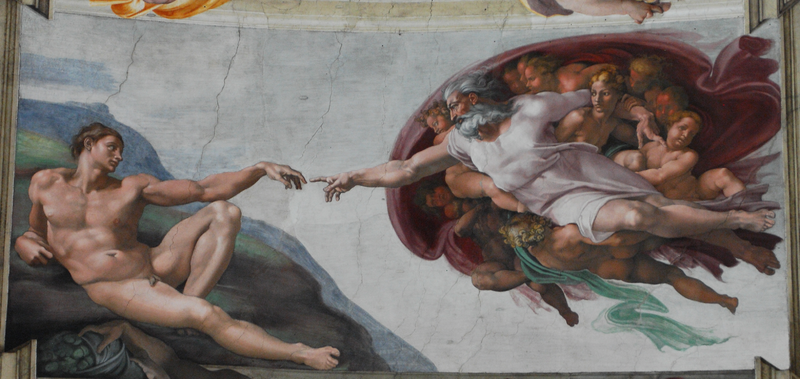
Are there female images of god? Undoubtedly there are. There will be a great deal of difficulty finding them because Christianity very quickly invented the idea of heresy (something Judaism fortunately lacked). This assured that the “orthodox” voice would always be the loudest in the shouting match that we call religion. This situation has had two millennia to ferment and brew. Theologians (mostly male) early on stated that God really has no gender. After all, a male god does imply a lady somewhere in the wings—otherwise human maleness is really superfluous, theologically speaking. Rather than embrace castration, let’s just keep god male, the thinking seems to go. Religions are conservative by nature. They may breed radical free thinkers, but natural selection comes to their rescue by reinforcing the bearded, chastely clothed, divine father. Until society is ready to embrace true equality, however, religion will continue to privilege the big man upstairs.

Monotheism’s bete noir?


Stormy Weather

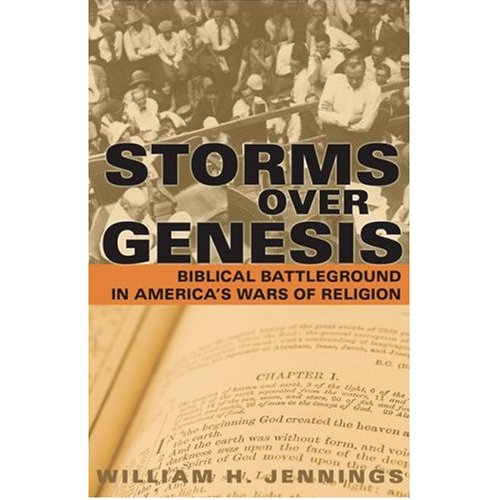
The privileging of one literature over others is problematic. Of course, the entire industry of biblical studies is built around such preferential treatment. And so is a large share of Christianity. I’ve just finished reading William H. Jennings’ Storms over Genesis: Biblical Battleground in America’s Wars of Religion. For someone who has taught Genesis before there wasn’t too much new material in here, but it strikes me as a very good primer for those who wonder about why the issues of gender inequality, global warming, and evolution remain firmly entrenched in evangelical minds, and therefore, our society. Just the first three chapters of Genesis, as Jennings points out, have led to the much of the irrational, at times inane, arguments that just won’t go away. Tea Party kinds of issues.

At the base of it all is the concept that Genesis somehow represents the way the world is supposed to be (rather than the way it actually is). As if seconding my choice of bus reading, The Economist recently published an article on Glen Rose, Texas. I’ve known about Glen Rose since I was a child. There, in a bizarre twist on the Flintstones, locals claim human and dinosaur footprints intermingle in a nearby creek bed. As the article points out, some locals see this as evidence of young earth creationism—seems Fred and Wilma missed the ark along with Dino. For decades paleontologists have tried to explain that the “human” tracks are actually dinosaur tracks as well. Given their size and stride, if they were human Adam must’ve been a giant. Despite the science, the myth persists. Even the article in The Economist doesn’t give the scientific answer.

It would be difficult to find a book more influential than Genesis. It would also be difficult to find one that is less scientific. Anyone who has studied ancient societies knows that they delighted in telling outlandish stories to explain the origin of the world. After all, there were no eyewitnesses. No channel 11 helicopters hovering overhead to bring you the story live. It all comes from mistaking a good story for a good book. In an era when evidence of evolution literally abounds, we still have nearly half the population of this technological nation trying to make room for the Valley of the Gwangi. Jennings may not hold the answers to all the problems Genesis raises, but if people would read Storms over Genesis, we might be able to afford a little more energy to solving global warming rather than running from dinosaurs in Texas.


Lost Purpose

In a move that demonstrates its love of Inquisitions, the U. S. Conference of Catholic Bishops is officially investigating the Girl Scouts. Seemingly forgetful of the fact that a bunch of unmarried men with a record of protecting pedophiles is not above scrutiny itself, the Catholic Church now seems to think it has the right to police other organizations. The concern these men show for what goes on in other people’s underwear is beyond perverse—WWJD indeed? Both my daughter and my wife are Girl Scouts, and so I know it is not a perfect organization. I also know that it lives up to its goal of offering girls the chance to gain self-confidence and become empowered women. Women who are not trodden under the heavy feet of doctrine are tied to stakes and burnt, in good old-fashioned Christian charity. And why the fuss among our Roman companions? They’re afraid because of demonstrably false allegations that Girl Scouts “associates with” organizations to which the church also objects.

I was a Boy Scout for a few years. Already in those days jokes of homosexual leaders—and a few actual cases—were de rigueur. Where was the Catholic Church? Yet this year alone they have made strident moves against their own nuns and now, again, against the Girl Scouts. Where two or three women are gathered together, the Catholic bishops will begin to pick up stones. Better not read what Jesus is scribbling in the dirt. Some of my readers have problems with my biblical interpretation. I will now ask if anyone can produce a biblical prooftext for the church’s mandate to oversee the organizational structure of secular, non-profit, non-religious associations. What does the Bible say about that? Clearly what the Bible does allow sexually favors men. Where your testosterone lies, there will be your heart also.

All of this belies a lost of purpose for the church. Like the empire whose epithet it shares, the Roman Catholic Church is perceiving paranoid threats from every quarter. The purpose of Christianity, at least according to a guy called Jesus, was to help the poor and underprivileged and to love all people. Even those who crucify you. Now the message the headlines declare is that any organization offering women sexual autonomy will be investigated by the bishops. It matters not whether any allegations have a basis in fact. Christianity’s purpose? To assert male authority. To prevent any organization of women from achieving confidence or equality. To subjugate an entire half of the human race to the will of a single man. Does that sound like the true purpose of religion to you?


Paradise by Half

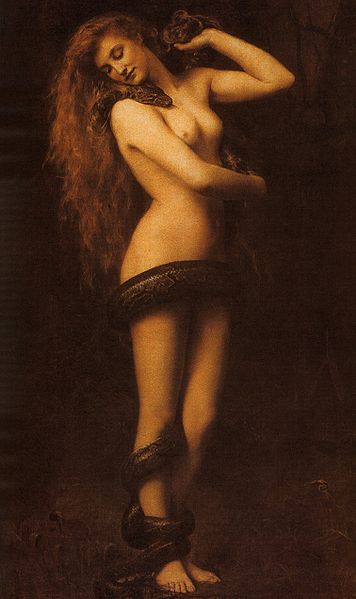
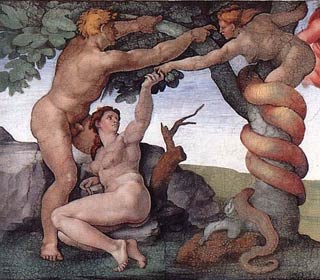
Some times the Bible is best taken in small doses. I’m no technical guru, but I do know that Twitter doesn’t always display the Bible bits I type in daily. Perhaps in some far distant future civilization that has learned how to recover “data” from fried pieces of digital storage devices, the Bible will be woefully incomplete. Maybe not woefully, depending on whose point of view sees it. Reading over passages worn smooth by timeless repetition, it is sometimes difficult to notice the harsh undertones. My twittering is up to Genesis 3 now, the infamous Garden of Eden episode. Over the last few days I’ve tweeted, “And the Lord God called unto Adam and said unto him, Where art thou? And he said, I heard thy voice in the garden, and I was afraid, because I was naked; and I hid myself. And he said, Who told thee that thou wast naked? Hast thou eaten of the tree, whereof I commanded thee that thou shouldest not eat? And the man said, The woman whom thou gavest to be with me, she gave me of the tree, and I did eat. And the Lord God said unto the woman, What is this that thou hast done?”

The weary “blame it on the woman” trope aside, several things stand out. God seems to be interested only in Adam. Perhaps the divine Dad wants to take his boy aside for a man-to-man chat, but it seems more likely in the context that Eve is simply irrelevant. Even Adam’s response is completely void of Eve, “I heard,” “I was afraid,” “I hid.” For a man about to shove the blame off onto his significant other (sorry, Tea Partiers, nowhere does Genesis say Adam and Eve were ever married), he is strangely circumspect about his recondite female. Even God sounds surprised, “Who told thee that thou wast naked?” Hmmm, who else is there in the Garden? Adam suddenly abandons the first person singular and begins his response with, “The woman whom thou gavest…” Blame anyone but Adam. The tragic disappearance of Eve until blame is to be attributed should warn us that the remainder of the Bible will not be a happy book.

The first chapters of Genesis have a lot of uncovering going on. God, like a detective in a CSI drama, tries to uncover the mystery of the naked man. When man is found naked he blames the woman, not even bothering with her name. Much is revealed here. Coming as it does as the first biblical story of human interaction, this tale sets the stage for all subsequent developments. From this point onward, with rare exceptions, the story will be a male narrative. Women will be assigned to, literally, support roles. Is it any wonder that women gather to protest against women’s rights, when under the thumb of such teaching? I suggest that what is required is even more uncovering. If we examine the bare facts of the Bible, we might be able finally to get to the root of this problem. That root lies deep in the literal interpretation of mythology.

Who's missing?


Attack of the 50-Foot Women

A society will be remembered by its lowest common denominator. At the mention of the Roman Empire many people immediately think of the decadence of that once mighty power in decline. Rome ruled the world at one time—or so it seemed—but Nero had his fiddle and Caligula favored his horse Incitatus as a senator (today we’re more accustomed to seeing asses in government than horses). The madness of Napoleon. The insanity of Hitler. Mighty powers crumbling under their own weight. Walking through Times Square is an education. Recently a fifty-foot woman appeared, looming over the heads of commuters, tourists, and the homeless. Unlike the classic 1958 sci-fi flick, this woman is apparently happy, smiling broadly, and nearly naked. She is an advertisement for Sports Illustrated’s soft porn swimsuit edition. Stories above us all, she pulls back her hair and, if she weren’t a fantasy, I’m sure she’d be chilly dressed like that in a New York winter.

We’re talking lowest common denominator here. As I man I can’t help but to understand the appeal. Advertisers know it too. At the corner of 42nd and 7th, there is another fifty-foot woman, apparently nude, sitting in an office chair for Go Daddy with a QR card across her torso offering to those who would scan her, “See More Now!” It is difficult to be judgmental when advertisers are using basic psychology to sell their products, and studies have shown that men are very easily aroused by visual images—our juvenile imaginations never do grow up. But women this large? In 1958 Nancy Fowler Archer was salaciously considered a monster, but the producers knew teenage boys would watch in fascination. Such simple creatures.

There is a disturbing subtext here. Men are weaker than they pretend to be, but that doesn’t bother me much. Vulnerability is where humanity is most authentic. The problem with the fifty-foot women in Times Square is the message to American society that women are a commodity. They, like everything else in Times Square, can be purchased and owned. They exist solely for the pleasure of men. I am not a prude, but I do believe that such blatant shows of the female body for sale bear as a subtext “mene mene tekel upharsin.” A society that cheapens its women in such a forum is creating the standards by which a hopefully more advanced future will remember it. Standing beneath the open thighs of the fifty-foot woman on my way to work, I am profoundly sad. This is Rush Limbaugh’s American Dream writ large.


Genesis Too

My Twitter Bible verse yesterday landed on a passage that has been routinely ignored by the church in favor of a different mythic construct in Genesis 2. Assuming the Bible to have been written by a human-like god, the natural expectation is that the manuscript would have been checked for inconsistencies before being sent to the publishers. Any close reading of the Bible, however, reveals a number of contradictions that have crept into holy writ through what seems to be poor editing. The verse to which I’m referring is Genesis 1.27, “So God created man in his own image, in the image of God created he him; male and female created he them.” Readers and commentators have endlessly remarked upon the tripartite structure equating deity-male-female in this passage. This single verse, however, is soon forgot once the need to harmonize with Genesis 2 sets in. There man is given utter primacy and woman comes almost as an afterthought, even after the animals. That is the version fundamentalists consider inspired.

Readings of scripture are done only with the pre-decided outlook of the believer. We do this all the time, unconsciously, when we read. We approach texts with expectations, outlooks, and assumptions firmly in place. When dissonant notes sound, we try to harmonize. We’ve got a whole chapter stating that man was god’s first thought, and woman only comes later. We have only a single verse stating their equality. Before Paul and company distorted the story of Eden into a “fall” narrative—note the words “fall” and “sin” occur nowhere in the account of Eve and Adam—some ancient readers toyed with the idea that maybe the first human was actually intersexed (or hermaphroditic) and the word translated “rib” meant “side.” Genesis 2, in this reading, understood women and men to be equal and of the same creative moment of God.

Some in the early church, however, valued doctrine over equality. Afraid that heterodox teaching might win out—we know there were many early Christianities, not a uniform body only latterly split apart—what came to be orthodoxy rallied around Paul and his fallen humanity with man first and woman second. And thus it has stayed in the sand castles of power for two millennia. Setting aside the unreliable narrator, our present sensibilities for reading are generally to take the first information as correct and later changes to be embellishments. In the case of Genesis, this tendency is overlooked. Too many men have too much invested in male priority to suggest that the Bible actually says what it does. Such is the problem with sacred texts—they are far too serious to be read for its plain sense, which is, after all, its common sense.

We're all in this together


Seedless

“And Onan knew that the seed should not be his; and it came to pass, when he went in unto his brother’s wife, that he spilled it on the ground, lest that he should give seed to his brother” (Genesis 38.9). During the conference last week the Routledge booth stood across from that of an evangelical publisher. One of the realities of conference life from the point-of-view of an exhibitor is over-exposure to what is fresh, clever, or cute upon first blush. Harper One’s continuous loop video, however, demonstrated that N. T. Wright, Desmond Tutu, and Bart Ehrman can sound repetitive, and even Colbert loses his punch when you hear the jokes for the twelfth time. The evangelical publisher across the way, however, had a large cartoon drawing that mapped out the believer’s life, book-by-book through the Bible. As probably anticipated, I can’t get that silly cartoon out of my head. After four days of exposure, I finally succumbed to asking for a flier. It was the usual evangelical fare, and the warning against adultery on back used the traditional term “seed” for “semen.” I found myself pondering the implications.

Since the King James Version shares the pre-scientific worldview of the ancients, the term “seed” has been preserved in the literalist mind. Even Alice Cooper uses it in his lyrics (his father was, after all, a preacher). Well, since the Bible is Holy Writ, it seems that semen has been transubstantiated into seed. The seed, as biologists tell us, contains all the genetic material to grow a new plant. Just add water, warmth, and a little light. Presto! Life sprouts. Since evangelicals tend to be fluent in biblicalese, even today men—the default, fully equipped model of humanity—come complete with abundant seeds. Agway should be so lucky. It feels, however, as if half of the equation is missing. If the Bible-writers had raised chickens, perhaps men would be full of eggs.

Thinking life cannot exist without metaphors. Metaphors are very dangerous in the hands of religion where they get taken literally. Too easily imagery slips into facticity. The male seed demonstrates a diabolical gospel truth: men alone provide the next generation. Women, as usual, are largely superfluous. The biblical male dominates the biblical female. The man owns the wife and must be enticed to share his precious seed. If conception fails, it is inevitably her fault. The metaphor has become a thumb-sized rod. Let us speak plainly here. The Bible has betrayed womankind. Judas Immaculate. In ancient times this was accepted fact. The microscope and biology should have buried this seedy metaphor centuries ago. But once again, the unthinking promulgation of a biblical trope survives at the expense of women. I have no seeds. No man since Adam has.

An obscene photograph?


Brain Death

The computer revolution has spoiled some of the wonder associated with old films that had been formerly staged with cheap props and poorly written dialogue. (Well, computer literacy has not always improved the dialogue, in all fairness.) Nowhere is this more apparent in the science-fiction/horror genre where CGI has made the impossible pedestrian. There’s little we’re not capable of believing. Back in the fifties and early sixties when even color film often went over budget, some real groaners emerged. Over the weekend I watched one of the movies at the front of the class for poorly executed. The Brain that Wouldn’t Die, however, is experiencing something of a renaissance with a stage musical coming out next month in New York based on this campy classic. Most horror movies don’t really scare me much, probably due to overexposure. The Brain that Wouldn’t Die, however, creeped me out in an unexpected way. Daring toward exploitation status (the movie was shot in 1959 but not released for three years), the “protagonist” is Dr. Bill Cortner who specializes in transplants. When his girlfriend Jan is decapitated in an automobile accident, Cortner keeps her head alive while seeking a body onto which to transplant it. Ogling over girls in a strip club, or even stalking them from his car while they’re walking down the street, the doctor imagines what features he’d like grafted onto his girlfriend’s still living head.

Campy to a nearly fatal degree, the film is nevertheless disturbing on many levels simultaneously. Although I was born the year the film was released, I was raised to consider both genders as equal. The unadulterated sexism of a man grocery shopping for the body he wants stuck onto his girlfriend’s head was so repellant that I reached for the remote more than once. A bit of overwritten dialogue, however, stayed my hand. Kurt, the obligatorily deformed lab assistant, while arguing with Cortner declares that the human soul is part in the head, yet partially in the heart. By placing a head on another body, the soul is fractured. Now here was a piece of theological finesse unexpected in such a poverty of prose. The question of the location of the soul has long troubled theologians, an inquiry complicated by the growth of biological science. Heart transplants are common today, but the resulting people are in no way monstrous. The amorphous soul, theologians aver, is non-material yet resides within a specific biological entity. Some have even suggested that you can capture its departure by weighing a dying body at the moment of death. Others suggest no soul exists—it is a mere projection of consciousness. Cortner, however, once his eyes have opened the possibilities, can’t look back.

Our social consciousness has grown considerably since the late 1950s. Politicians and Tea Partiers who hold that era up as a paradigm of sanity do so at the price of half the human race. On the outside with the oiled hair, polished shoes, spotless automobiles, society seemed clean cut and orderly. Women, however, were relegated to inferior roles while men made the rules. Life was less complicated then. We knew who was in charge. Or did we? As a species that has evolved via sexual reproduction, it has taken us surprisingly long to realize that both genders are essential to humanity. We still tolerate gender disparity in pay scales, often shored up with the tired excuse that pregnancy and childbirth disrupt “productivity” and therefore female efforts are worth less than male—never changing due to biology. Such trumped-up excuses ring as hollow as a head without a body. Many Neo-Cons will even use the Bible to support it. John Q. Public (always male, please note), they insist, yearns for the “good old days.” The days they desire, however, were days of cheap horror and unrealistic dialogue. If they can watch The Brain that Wouldn’t Die without flinching, our future is bleak indeed.


Girl Meets God…

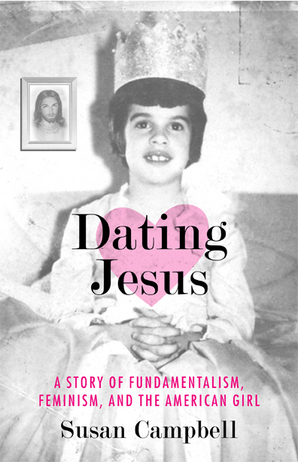
Once in a very great while I find a book that I simply can’t put down. It is a rare windfall when that book feels like it was written especially for me. I was instantly engrossed in Sarah Sentilles’ Breaking Up With God. Like Susan Campbell’s Dating Jesus, this book reinforced the fact that women experience a side of God’s character generally closed to men—the idea that God might be a lover. In our distorted, still patriarchal culture we have yet to grow beyond the idea that God is male. This simple, persistent teaching ensures that a gender-divide will always remain in effect when it comes to monotheistic religions. What truly spoke to me from Sentilles’ book, however, was not the theology, but the heart. Although the gender view from which I approach concepts of divinity must necessarily be different, here I found someone with a journey in many ways similar to mine. The honesty with which the author lays open her experience is beautiful and terrifying.

One of the recurring questions on this blog is whence the concept of God arose. Anthropologists, psychologists, and theologians come up with varying answers but the fact is the real impact is felt in very human minds. We have, perhaps unwittingly, devised a punishing image of the creator of the universe. A God who causes, allows, or at least condones arbitrary human suffering. A God who permits atrocities daily to be committed in his name (for this is a masculine god). A God who has left a burning ruin in his wake. Those of us who’ve attended seminary, as Sentilles makes vividly clear, are taught perceptions of the divine that can never be translated into the pulpit. Those of us who go on to graduate school are permitted a rare glimpse behind the veil to see something that it frightens us to contemplate, let alone write or speak about. It is a burden best worn like a hairshirt—beneath other clothes so that people don’t know it’s there. Many of us are then cast into the career outer darkness with nothing but our highly educated, disturbing thoughts for comfort.

Sarah Sentilles has given the world a gift with her revealing, sensible, and very human story. Having grown up with the image of God as a father, it was a shock when a seminary professor once revealed to me that God could never really fill that role. Nor, he added, could the church. While it cannot be the same as breaking up with God, the realization that what you were taught as a child was merely a metaphor forces a grand reevaluation of perceptions. My professor was, of course, correct. Carrying around a faulty image of God will lead only to intractable complications further down the road. Although Sentilles started down the path some years later than I did, it seems we have wound up in the same neighborhood. Her book deserves to be read widely, thought over carefully, and pondered for a time. We need to consider: what hath man wrought?


Zounds

Back in my first exposure to state university life in Wisconsin, I frequently received eager guidance from students on religion in the media. After having taught in a seminary where interest in the world beyond ecclesiastical walls was rare, this exposure to wider interpretation was welcome. One of the movies suggested to me by helpful undergraduates was the then fairly contemporary Stigmata. My interest in horror films was burgeoning again after my nightmarish experience at Nashotah House, so I watched the movie with renewed appreciation for the abuses presented on the part of the established church. I rewatched Stigmata this past weekend and a number of features stood out as apposite for this blog.

As always in movies, liberties are taken with reality. Stigmata presents the Gospel of Thomas as a serious threat to Catholicism. Of course, even the Gospel of Judas made a public splash back in my Oshkosh days, but the great Titanic of the church remained steadily afloat. The contents of the Bible are secure and non-negotiable for the vast majority of Christianity. There is no more room within its black leather binding for further revelations. The movie also presents a woman – an atheist, no less – as being the vehicle for a truth she can’t understand. In the masculine citadel of the Catholic Church she must be silenced, in an overly dramatic way, of course. The message seems to be that religion is unwilling to learn from secular women, even if they bear the truth.

The critics were not kind to the movie, but I found it a strangely religious film. The premise behind it advocates the reality of Christianity, only the Jesus of history is occluded behind a great mask of human tradition. Enamored of power, the church decides what will be revealed to the masses since control is more important than truth. A woman cannot correct the false belief of men, since a masculine god has given manly instructions to a male institution. Underneath it all, however, is a virgin Mary weeping real human blood as half of humanity is simply disregarded by the half that retains its abusive strength. Perhaps the commentary was a little too close to home, even for the (mostly male) critics.


Condom Not?

Newspapers and the Internet have been abuzz with Pope Benedict XVI’s leaked proclamation that condoms may be useful for male prostitutes in preventing the spread of AIDS. Many are astonished, and not a few heads have been scratched at the declaration from the stalwart bastion of “sex is only for procreation” Christianity. The announcement, while humanitarian, is deeply troubling. From ancient times it was recognized that human sexual behavior had more than procreational importance. The matter has been investigated by psychologists since the nineteenth century and the same conclusion was drawn: people engage in sexual practices for a variety of reasons. Meanwhile, the church has been holding out with a Hebrew Bible viewpoint enhanced by the personal outlook of Paul.

In the ancient world, the microscopic world of reproduction was unknown. What was actually happening in conception was misunderstood. Judeo-Christian sexual mores were based on faulty information, from a biological point of view. In such a view, the all-potent male gamete (inappropriately called “seed,” as if a womb were just a place for pre-formed humans to grow) was capable of producing life on its own. Reading a handful of Greek myths will demonstrate this principle nicely (since the Bible has a more demure and blushing way of discussing the idea). The concomitant concept that seed should not be wasted led to the faulty idea that, in the unforgettable words of Monty Python, “every sperm is sacred.” That mental construct has been used by the church to make women subservient to their biology in a way that never applied to males. The Pope’s declaration underscores this double standard.

If male prostitutes may use condoms with the church’s blessing to prevent the spread of AIDS, the only motivation left for heterosexual birth control is female control. The “lost cause” of male reproductive potential in male prostitutes does not apply in heterosexual unions? God holds married couples to a different standard than male prostitutes – why? Is the sperm in these two cases unequal? The Pope is undoubtedly on the right track by endorsing the use of condoms, but the church still has a profound distance to go before it can look women in the eye and say, “we believe you are truly equal with men.” Oh yes, and not blink while saying it.

Remember, these guys lost to the Greeks...


Jesus at the Prom

This week I read Susan Campbell’s Dating Jesus: A Story of Fundamentalism, Feminism, and the American Girl. Parts of her autobiographical narrative seemed so familiar that it was almost like we could have been siblings. Other parts demonstrated just how widely a religious upbringing in America may vary. Fundamentalism is a powerful force, and one that often feels impossible to outgrow. The added dimension of a constant, insistent criticism of gender made Campbell’s account truly wrenching at times. Having been raised in a similar environment, I had been taught that ministry is a male prerogative, an activity women were separated from just as surely as begetting babies. Having been raised mainly by my mother, however, I was more sympathetic to a woman’s plight than most of the outspoken advocates for male privilege. Campbell’s story hit close to home.

One of the most tenacious aspects of Fundamentalism is the brain patterning it impresses on young minds. Who doesn’t know that baby birds impress parenthood on the first creature they see after hatching? Young children, trusting well-meaning parents, are impressed with a religious branding iron before they can sort things out for themselves. We make our children in our own image. Few ever undertake the intense reflection later in life to challenge these impressions. Like Campbell, I attended seminary because I was curious. Many of my classmates had no questions in their heads – they knew already that they were to be ministers. Seminary was a hoop to be leapt through rather than a rung to be climbed for a different perspective. And their children will be taught their perspective. Denominations will continue to increase in numbers as acorns roll not far from the tree, but just far enough.

Campbell’s memoir is a gentle indictment of the male establishment. What once began as a biological division of labor has been given a religious imperative; male dominance is ordained by God, and women have no option but to comply. Even as the divine gets pushed into an unlit corner of everyday life, the deity may always be drawn back out for a session of gender oppression before being tucked safely away again. In these days of advanced technology and wide perspectives, women are still held down as some kind of inferior sub-species by men who believe that they are the default version of the image of God. It is time to be honest and admit that the only reason women are kept from the male preserve in any field is because of a jealous green-eyed god called privilege.


Mother’s Day and Earthquakes

It is Earth Day, a holiday that all the world should join hands to celebrate since it is secular and concerns all people. Except the religious. Theologies are inured to common celebration; any admission that others might be right is a chink in the implacable armor of conviction. So it was not such a great surprise when an Iranian cleric this week blamed Iran’s earthquakes on women. Fuming like Eyjafjallajokull, the imam cited immodesty on the part of women as leading men to temptation and the very earth whose day we celebrate shakes in rage. Why it is that the burden to prevent sexual temptation should fall on women alone is unfathomable. If men have such trouble controlling their urges perhaps they ought to explore real estate on Mars, although it is doubtful they would be happy there.

The earth, our common home, was conceived to be female by many ancient societies. The Greeks of the Classical era called her Gaia and gave her the honor of being the earliest deity to emerge from Chaos. In the Bible, desexed and depersonalized, the earth was constructed on the first three days before any living inhabitants cluttered its pristine surface. With the drive of Christian conviction that this unruly mother should be subdued under human dominion the industrial revolution began a process of disrobing and dismembering Gaia, an impersonal “it” to be exploited. The Bible could be cited as demanding such action; we were commanded to take control. And our religions provided the ethics to underscore our mandate.

If not for the second great awakening in the 1960s, Earth Day would never have found its fundamental expression. We would continue subduing and dominating, as per Genesis 1, until the great white man above would be forced to send his son on a great white horse to end it all. But the earth is our mother. The missing woman from the all-too masculine Trinity. Instead of blaming her daughters for the unstoppable lusts of her sons, and instead of repeatedly defiling her to keep up with the Republicans, we should take a moment today to honor her. She is the only such mother we have.

Son, behold thy mother.


Anat, Kali and the Violent Femmes

“Women and men,” runs the chorus of the They Might Be Giants song of that same title, “… everywhere they go love will grow.” Women and men. Thus it has always been. The Sumerians seem to have speculated, on a broken tablet concerning the creation of humanity, that some six varieties of gender had been ordained by the gods. This story reminds me of just how dicey gender definition can be. Despite the howls of protestation from man + woman = marriage crowd, the concept of gender is actually complex and diverse. The lowly slime mold of the genus Physarum has a combination of multiple sex-controling genes mixed with several different types of sex-cells, leading to a bewildering 500 different sexes. You’ve got to wonder what the Physarum bar-scene is like! So the whole women and men combination seems a little tame by comparison.

The ancients did, however, toy with standard gender role concepts. The Ugaritic goddess Anat, sometimes described as a “tomboy,” was perceived as a literal femme fatale, joining her in the company of Ishtar and Kali as warrior women-goddesses. She was a proto-Amazon (before they laid aside their male-bashing and set up a very lucrative web-site). Anat wears the severed heads and hands of slain warriors and stomps in blood-puddles, laughing all the while. Where did the ancients derive such violent feminine images as Anat and Kali? Some sociologists suggest that these myths were intended to solidify gender roles, although they seem to confuse the violent male with the shy and retiring female stereotypes. Perhaps the Ugaritians and other ancient folk knew deep down that gender is only a vague attempt to classify something that is really far more complex than it seems. Just when gender is nailed down you find yourself in a bloody mess as Anat swats at you again and again.

Anat ready to smite Egyptians who just don't understand the Violent Femmes

Anat ready to smite Egyptians who just don\’t understand the Violent Femmes

Nashotah is not far from Milwaukee where the folk-punk, genre-defining band the Violent Femmes started out. In college many of my overtly Christian radical friends told tales of how the Violent Femmes were a closet Christian rock group, based on some of the religious themes in Gordon Gano’s lyrics. When I listen to their CDs, however, I hear the same old angst that has plagued humankind for ages — what does a guy have to do to impress a girl (the same question may be reversed, turned upside-down, or dis-and-re-articulated, depending on whether you are female, male, or slime mold). At Ugarit they would have understood the Violent Femmes — listen to “to the kill” and tell me it’s not so! I would suggest that Gordon and the guys aren’t as much closet Christians as closet Ugaritians, struggling with the Anats and other violent femmes of their world and trying to make sense of it all.