Small Things Grow

I’ve always been fascinated with origins.  I guess I’m a kid who never grew up.  Now that I’ve turned my attention to movies, I sometimes wonder about the origin of the story.  For example, The Little Shop of Horrors.  I first saw the musical movie version of 1986.  It was cute, and employed horror themes like the Rocky Horror Picture Show from the previous decade.  Then, when Roger Corman died, I read that he’d filmed the story back in 1960.  Curiosity compelled me to watch the original.  Like its remakes, it’s comedy horror, or horror comedy.  But beyond that it’s a literal farce.  Roger Corman was a showman, and that means he tried different things to entertain.  One of them was Little Shop.  The idea of the plot you probably know, but I couldn’t remember the ending as I sat down to view it.  After all, it’s not meant to be taken seriously.
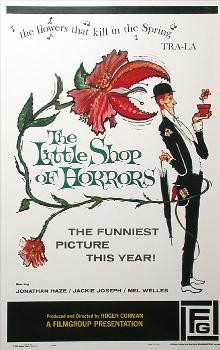
I have to say that the music makes it better in the remake.  The endless malapropisms and burlesque humor are funny, but really in the original they are presented as low comedy.  The Jewish humor led me to fear that it might be anti-semitic, although not intended that way.  I empathize with Corman.  It took him nine months to find a company to release the film.  Ironically, it attained cult status after being double-billed as the B movie with Black Sunday, which was a quite serious attempt at horror.  Camp has a way of living on in cult status.  Of course, the early bit part for Jack Nicholson didn’t hurt.  It isn’t bad for a bad movie.

The idea of people-eating plants is a reasonable approach for a horror story.  (I’ve used it myself.)  Plants move very slowly, however, which is one reason that the idea’s hard to accept.  Even The Land Unknown had used the idea three years earlier.  But the seed was planted.  The idea of the film lead to an Off-Broadway show, which led to the more famous movie.  Then it reopened off-Broadway and a reboot was planned (but currently seems to be on ice).  Not bad for a movie based on a desire to reuse a set that was scheduled to be torn down, and then shot in two days.  Classic Corman.  The result was a bad film that is still fun to watch all these years later.  I did miss the musical numbers, however.  When you plant seeds, you never know what might grow.

Carnival Days

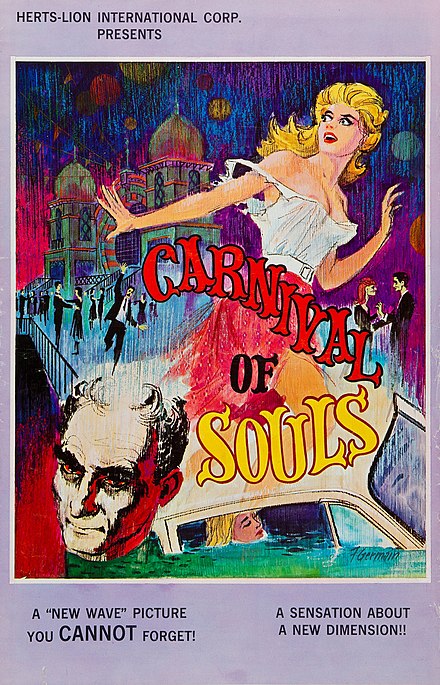
Carnival of Souls has been receiving renewed attention of late, so I decided to watch it again to see if I’d missed something the first time.  Indeed, I had. Carnival of Souls is one of those low-budget movies that was really never considered worth much until reevaluation started to take place several years after it was released (1962).  As a snapshot of an era, it offers a view of how horror and religion interact.  The story, in case you’re unfamiliar, follows Mary Henry, a young woman who’s a professional organist.  Even here a few things stand out.  She went to college, she relies on no man to support her.  And she views church work, as an organist, to be “just a job.”  This is pretty incredible on its own, but I’m getting ahead of myself.  Her car is nudged off a narrow bridge by a couple of guys out hot-rodding.

From the beginning the viewer is clued in that she drowned, although this isn’t made explicit until the end.  She makes her way to Salt Lake City where she’s been offered a job as an organist in an Episcopal church.  She “sees dead people” and becomes fascinated by an abandoned carnival on the shore of the Great Salt Lake.  The priest at first notes that she plays music to elevate the soul.  Later, however, after the dead man she keeps seeing unnerves her, she plays eerie music on the church organ (during practice) and the priest realizes that she’s not a believer.  He fires her on the spot.  Apart from getting the ethos of the Episcopal Church about right, this in itself is interesting.  The playing of creepy music is enough to lead to the loss of a church job.

John, the guy who won’t stop trying to score with her, wonders at one point if viewing church work as “just a job” doesn’t give her nightmares.  These attitudes, from only about six decades ago, seem terribly remote by today’s standards.  Many clergy have doubts about their faith.  Many don’t really believe what their church actually proclaims.  The movie shows a society that has an almost magical view of the church.  You can probably even take the “almost” out of that last sentence.  While the Bible’s not mentioned or quoted, the idea of a lost soul finding no home in the church is a telling bit of commentary.  Intentional or not.  Carnival of Souls will never be my favorite horror movie, but it has pre-echoes of Night of the Living Dead and a sincerity that invites consideration.  I can see why it’s gained renewed interest.


A Kind of Shine

Sometimes you just can’t not comment.  A few weeks after Donald Sutherland—known by some of us for his horror roles—passed away, Shelley Duvall has died.  It feels like the passing of an era for horror fans.  I never saw Sutherland in MASH, although I’m sure he made a good Hawkeye.  I did see him in Don’t Look Now, however, and An American Haunting.  Shelley Duvall grasped her claim to fame in The Shining, of course.  I can remember the apprehension that gripped me, after years of everyone telling me how scary it was, when I first saw it.  The Shining has its detractors, of course, but it remains one of my favorites.  That’s in no small measure due to Duvall’s portrayal of Wendy.

Duvall did other things, of course.  Since I tend to fixate on the things I like, I never followed her further career, but I did see her now and again.  She was in Tim Burton’s Frankenweenie.  For those looking forward to The Myth of Sleepy Hollow (I know I am), she’ll appear as the creator of Tall Tales & Legends.  She also created Nightmare Classics, which I have to admit to never having seen.  Although she was involved in other genres, she seemed to have a real interest in horror.  She retired from acting early in the millennium, but came out for one final film, last year.  It was the horror movie The Forest Hills.  Horror gets its hooks into you, I know.  But it keeps coming back to The Shining.  

In part it’s the claustrophobia of three people, only three, in an isolated hotel.  Of course it’s haunted as well, but the isolation premise alone is frightening.  Especially when one of the three (or maybe two) is becoming unhinged.  We live in an era of remakes and it’s possible someone will be foolhardy enough to try to remake Kubrick’s classic.  Even if it were a more faithful adaptation (Stephen King’s book is scary in its own right) it’s difficult to imagine that it could be better.  Part of it probably has to do with how Kubrick’s treatment of Duvall pushed her to the edge.  Fame has its cost.  And I suppose (since I wouldn’t know) that fame in a horror role comes with its own burdens.  Duvall went on to create things of her own.  More’s the pity that they’re not easily found either for streaming or on disc.  And things seem just a little bit quieter now, don’t they?


Hungry for Choice

I was recently asked to speak to a senior seminar about Holy Horror (many thanks for the invite!).  One of the questions asked was how/why I chose the movies I did.  The same question applies to Nightmares with the Bible.  The thing is, my avocation is an expensive one, particularly on an editor’s salary.  The number of horror movies is vast and our time on this planet is limited, so one thing any researcher has to do is draw limits.  Otherwise you get a never-ending project (some dissertations go that way).  I had figured, for both books, that I’d seen enough movies to make the point I was trying to make.  Neither book was intended to be “the last word,” or comprehensive, but were attempts to open the conversation.  Since none of my books have earned back nearly what resources I’ve put into them, a line has to be drawn.  Movies are expensive when they get to the bottom of the “outgoes” column.

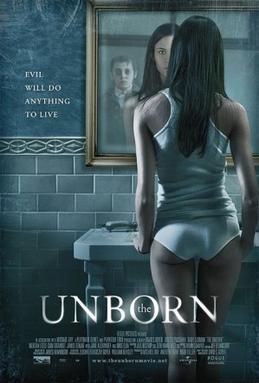
All of this is to explain why I didn’t include The Unborn in either book.  (It fits into both.)  I was aware of the movie, but I had to decide what I could afford in order to get the books written.  I confess that I wish I’d watched this one sooner.  (Remember, it’s a conversation!)   This movie has so much in it that I may break my self-imposed rule of no double-dipping for blog topics.  Or perhaps I’ll pitch something to Horror Homeroom.  The Unborn is about a dybbuk.  Like The Possession, it features a Jewish exorcism.  Like An American Haunting, a holy book is destroyed.  (The credits include a statement that no actual Torahs were harmed in the making of the film.) Interestingly, the exorcism is a joint effort between a rabbi and an Episcopal priest.  Held in an asylum.  It’s also a story about twins.

The skinny: college-aged Casey is being pursued by a three-generation dybbuk.  Her mother, who died by suicide in an asylum, had been adopted.  Casey is unaware that she was a twin, her brother having died in utero.  She discovers her birth grandmother, a Holocaust survivor, who clues her in to why all the strange things are happening to her.  Her own twin brother was possessed by a dybbuk at Auschwitz.  It is now after Casey, having caused her mother’s suicide.  The plot is pretty sprawling, and the exorcism scene over-the-top, but I’m only scratching the surface here.  There’s so much to unpack that I wish I had a bigger movie-and-book budget.  But then we all have our demons with which to struggle.


Monster of Aging

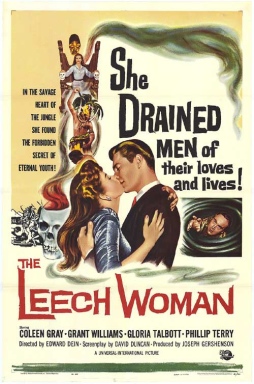
Movies with no likable characters, or none with any redeeming personality traits, are difficult to remain awake through.  At least on sleepy weekend afternoons.  The Leech Woman is one such movie.  It was difficult to get past the premise that an aging woman is cause for alarm among the overly entitled male characters.  Dr. Paul Talbot is disgusted by his older wife until he finds credible evidence of a concoction that will cause a person to grow young again.  Wanting her to be his experiment, he takes her to Africa where he witnesses the rejuvenating formula in person.  It requires, however, a murder to be effective.  For her victim, June chooses her husband.  The effects, however, are only temporary so June will need to keep on killing to remain young.  Each time the formula wears off she’s prematurely aged.

When she’s young again, the men around her feel it is their right to claim her, which, in a sense, provides her with a ready pool of victims.  On the other hand, it reflects attitudes beginning to die out as the sixties began.  Many of these movies from the fifties throw in a woman to provide little more than love interest.  Sometimes these women have a profession—reporter is one that shows up occasionally, or perhaps in a military role or as nurse—but mostly they are there to find a husband and become, ideally, a housewife.  Many unrealistic men today still think that should be the case, but few jobs earn enough for the possibility of being a one-income family.  Besides, did anyone ever think to ask the women what they wanted?

Aging isn’t the easiest thing to do.  This movie plays up the stereotype that men become “distinguished” with age while women don’t.  Such unreflective outlooks on aging completely overlook things like aching backs and forgetting things that are typical for just about anyone who makes it past a certain landmark.  In fact, aging is something we all face in common, and our attitudes toward it can make all the difference.  Fortunately since this movie came out, we’ve had many role models showing us that women do retain their worth and dignity as they age, even as men do.  We are an aging population.  One benefit, hopefully, to the passing years is the accumulation of wisdom.  And that applies, no matter gender or sex.  We reach a certain age and we look back and wish we’d known then what we know now.  That takes place with generations, too.  That way we can say Leech Woman is a period piece, but that still doesn’t make it a good horror movie.


Under Bite

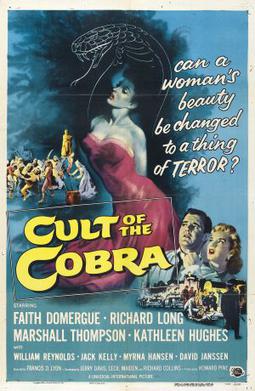
Religion and horror have long been bedfellows.  And quite companionable ones at that.  I’ve written a longer piece that I’ve not yet managed to wedge into a book about how the earliest Universal monster movies all involve religion in some way.  Maybe some day it will come out into the light.  In the meantime, I submit, for your consideration, The Cult of the Cobra.  This 1955 horror film was one of a series of movies about shapeshifting.  We’ve recently seen The Leopard Man on this blog, and before that Cat PeopleCult of the Cobra, set in amorphous “Asia” to start, involves the invented religion of the Lamians.  A group of US Airmen pay a Lamian to watch a woman transform into a cobra in an “Asian” ritual.  They’re revealed by trying to take a photograph—they’d been warned that if they were discovered the cobra would hunt them down and kill them.

Convinced this is all superstition, despite one of them dying the next night from a cobra bite, they return to New York City and civilian life.  The cobra woman follows them to carry out her mission.  She’s killed, however, before getting the last two.  What’s so interesting here is the discussion of belief that takes place throughout the movie.  Americans can’t believe in some “cult”—it’s clear from the start that anything not western is cult—but none of them show any inclination to church, or crosses, or even references to God or the Bible.  The only religion shown is that of the Lamians.  The cobra woman falls in love with one of the Airmen and tries to explain that she’s coming to doubt something she’s believed all her life.  She’s caught between religious duty and the experience of falling in love.

The movie failed to impress critics and was largely dismissed as a knock-off of Cat People.  There’s too quick a judgment here, however.  One of Universal’s earlier monsters had encountered a non-western religion but became much more famous for it.  The Mummy was based on “ancient Egyptian” religion.  Indeed, the whole story is premised on it.  The Cult of the Cobra, however, engages with the religion.  As jingoistic as it is, it nevertheless tries to represent “the cult” as a religion taken seriously by an exotic group of believers.  “Lamians” seems to have been borrowed from Greek mythology, however, where lamia were demon-like devourers of children.  I write about them in Nightmares with the Bible.  This isn’t a great movie by any stretch, but it shouldn’t be dismissed either.  It’s an important piece of the puzzle of how religion and horror interact in film.


Camp Tingler

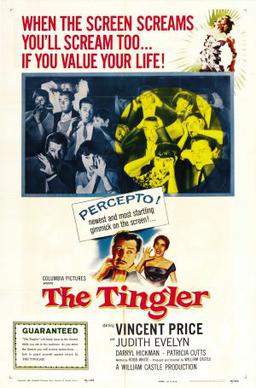
I don’t remember in which magazine where I saw the still, but I was immediately intrigued.  I didn’t know the movie it was from and in the days before the internet, when you live in a small town, avenues for finding the answer were few.  I just knew it was a photo of a woman in a bathrobe next to a bathtub filled with some opaque fluid (presumably blood), from which a hand was reaching out to her.  Or at her.  I don’t even recall when or how I learned that the scene was from the gimmick-driven William Castle film, The Tingler.  I’d heard of the movie before, but I hadn’t connected the scene with it.  No matter how you slice it, the story of the movie makes no sense.  That doesn’t stop it from being fun.  I’ve seen it before but had to refresh my memory.

I hadn’t recalled, for example, that Dr. Chapin (Vincent Price) uses LSD to try to get scared.  While the dialogue isn’t great, there are many observations on fear and how adults outgrow it.  Chapin wants to find the physical root of fear and drops some acid (apparently the first cinematic depiction of LSD use) to enhance the experience.  Although it’s crucial to the plot, I also didn’t remember that Martha Higgins can’t hear or speak.  Interestingly, she co-owns a silent movie theater and she’s a silent character in a sound movie.  She’s also the only character involved in the two color shots in a black-and-white film.  She remains in grayscale herself in these scenes.  In other words, there is some sophistication here.  And of course, Vincent Price was always classy.

Camp is an aesthetic that I appreciate but, like a tone-deaf person, don’t always recognize.  The Tingler has become a camp classic.  Many people know that Castle had vibrators installed in select theater seats so that some audience members would “tingle” at appropriate places.  This was the “Percepto” advertised with the movie.  Having himself introduce the film as too terrifying—echoing back to Frankenstein in 1931—Castle guaranteed the movie wouldn’t be taken seriously.  There’s nothing scary about this horror film.  Speaking for myself, I spent too much time trying to figure out what happened to poor Mrs. Higgins—yes, her husband’s trying to scare her to death but then she has hallucinations as if Dr. Chapin gave her the LSD instead of taking it himself.  It doesn’t make sense, but it’s fun.  I guess that’s the definition of camp.


Campus Monster

Universal was the studio that gave America its monsters.  Well, it wasn’t Universal alone, but the initial—almost canonical—line-up of monsters were Universal productions.  As horror grew to be more influenced by science-fiction in the 1950s, Universal kept at the monster-themed movies, cranking out many that I missed and on which I’ve been trying to catch up.  Monster on the Campus is interesting in a number of ways.  Directed by Jack Arnold, of Gilligan’s Island fame (or future fame, since this movie was earlier), it’s a story built around evolution.  Pipe-smoking professor Donald Blake has a coelacanth delivered to his lab.  Unbeknownst to him, the prehistoric fish had been irradiated with gamma rays to preserve it—as well as being shipped on ice.  The dead fish is about to create problems.

A dog laps up some of the blood (it started to thaw) and becomes a vicious evolutionary throwback.  Then Professor Blake cuts himself on a fish tooth and sticks his hand in the contaminated water.  He becomes a murderous caveman, but the effect is only temporary.  A dragonfly eating the fish transforms into a prehistoric insect that the professor kills, but its blood drips, unnoticed, into his pipe.  He changes and murders again.  Finally it dawn upon him that he was responsible for the murders.  In a remote cabin he sets up cameras and injects himself with the radioactive coelacanth plasma and ends up killing a park ranger.  Finally, he injects himself so that following police officers will shoot him to death.  Rather a bleak story.

The film has been read as social commentary since its “rediscovery,” but what caught my attention was the easy acceptance of evolution.  This was the late fifties and the creationist backlash was still pretty strong at the time.  If evolution didn’t occur, the professor (and dog and dragonfly) couldn’t have become their atavistic selves, giving the movie its plot.  The classic Universal monster of the decade was the Gill Man—aka Creature of the Black Lagoon—also an atavistic throwback to an earlier time, but also a divergent branch of evolution.  Creature was also directed by Jack Arnold, but four years earlier.  It began with a quote from Genesis 1, bringing creation and evolution together.  The title Monster on the Campus offers many possibilities for co-ed mayhem, but instead opts for a scientist who gets caught up in the tangle of evolution.  The movie was near the end of Universal’s monster run, but in the sixties horror would change forever.  This was a little fun before things got serious—horror school was about to start.


Horror History

Trying to make sense of life has perhaps been my only real vocation.  As I continue to work on horror-themed books, reasonable people ask why I keep doing this.  It’s a question I ask myself.  The other day, while working on one of these projects, I had a realization.  The narrative I’d been playing in my head is that I grew up watching monster movies and then, apart from a few slip-ups, fell off the wagon again after my career malfunction.  That’s largely true but I suddenly remembered that seminary was actually another period of my life when I watched a lot of horror.  Regular readers know that I’m intrigued by the connection between religion and horror, but I’d forgotten how early this started with me.

A friend, nameless here, was a fellow seminarian and a total cinephile.  He and I would watch movies together quite a lot.  As I was recollecting which ones, it suddenly struck me that many of them were horror films.  And it wasn’t just this unnamed friend.  Another anonymous comrade frequently talked me into theatrical horror.  He’d go with his girlfriend (something I lacked at the time) but he liked to chat about the movies with me and often invited me along.  So it was that I was watching horror into the mid-to-late eighties.  I stopped, pretty much cold turkey, when I married.  It seemed that the therapy horror was offering was no longer needed.  Life settled into a happy, if weird existence stretching several years into Nashotah House.  This was the locus of said malfunction.

Losing my only full-time teaching post led directly to watching horror again.  My wife had to take a job out of state.  We crammed ourselves into an apartment after having a four-bedroom house.  Jobs were not coming my way, no matter how low I aimed.  Horror was cheap therapy.  What’s more, it’s remained a hobby ever since.  (Read into that what you will.)  People who know me personally (but who don’t frequent this blog) are often surprised to learn that I watch horror.  I don’t act like someone who does.  At least according to this usual, prejudiced image of the horror fan.  What’s more, the friends who share this fascination are nice people.  I was recently asked to speak about Holy Horror to a senior seminar at Transylvania University (it’s in Kentucky).  The students all seemed to be upstanding, bright young people.  They, however, like horror.  I don’t know their stories, but I’m guessing that they’re probably quite interesting.  They’re just beginning to try to make sense of life.


Leopard Spots

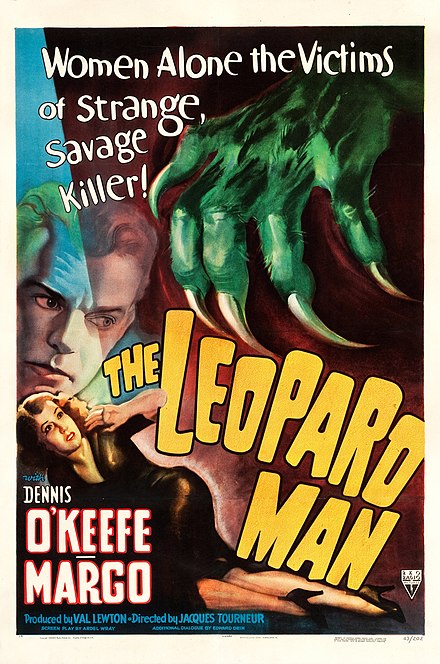
There’s always a dilemma involved.  Rent or buy?  Libraries face this when deciding on a subscription or perpetual access deal—is this something you’ll need for a long time?  More than once?  So also with movies.  Do you rent, watch, and forget or buy, supposing you’ll need to go back?  This plays out in my head when there’s a movie I want to see in these days of streaming.  The Leopard Man wasn’t a big hit when it came out in 1943.  There wasn’t really much of a taste for horror during the Second World War anyway.  In retrospect, however, it’s one of those films that has appreciated with age.  Apart from its effective use of the Lewton bus, the movie was well written.  It retains ambiguity and suspense throughout.  And if there is a leopard man who shapeshifts, we never see him doing it.  Spoilers follow!

Following on from his better known Cat People the previous year, Jacques Tourneur kept with the large cat theme in this film.  A publicist who (apparently) has no scruples, encourages his client/girlfriend to upstage a fellow performer by taking a leopard into her act.  The stunt backfires, however, when the frightened cat escapes.  Then mauled women are found and a hunt is on for the leopard.  If you’re adept at this kind of set-up you’ll figure out who the killer is—it’s not the leopard, except in the first case.  It’s implied that, rather like Cat People, the religion of the ancients, as Dr. Galbraith points out, might have some effect on modern people.  His dispassionate remarks about serial killers provides a clue, however, to who’s really behind it.

Religion runs like a thread throughout the movie.  The processions intended to alleviate the guilt for the treatment of the Indians, the ancient religion of those who made the museum pieces, and the Catholicism of the locals all play a part in this.  The question of whether Galbraith really becomes a leopard or not remains unanswered, but I sense it’s strongly implied that he does.  He had no intention of murdering the young woman in the cemetery and certainly had no time to premeditate the carrying of leopard hairs and claws to cover his tracks.  This is a man of science caught up in the spell of a forgotten religion.  Or so it seems to me.  In any case, it’s time to dust off this old gem and bring it back to the light.  It’s probably worth buying just to see it again.


The Movie Maker

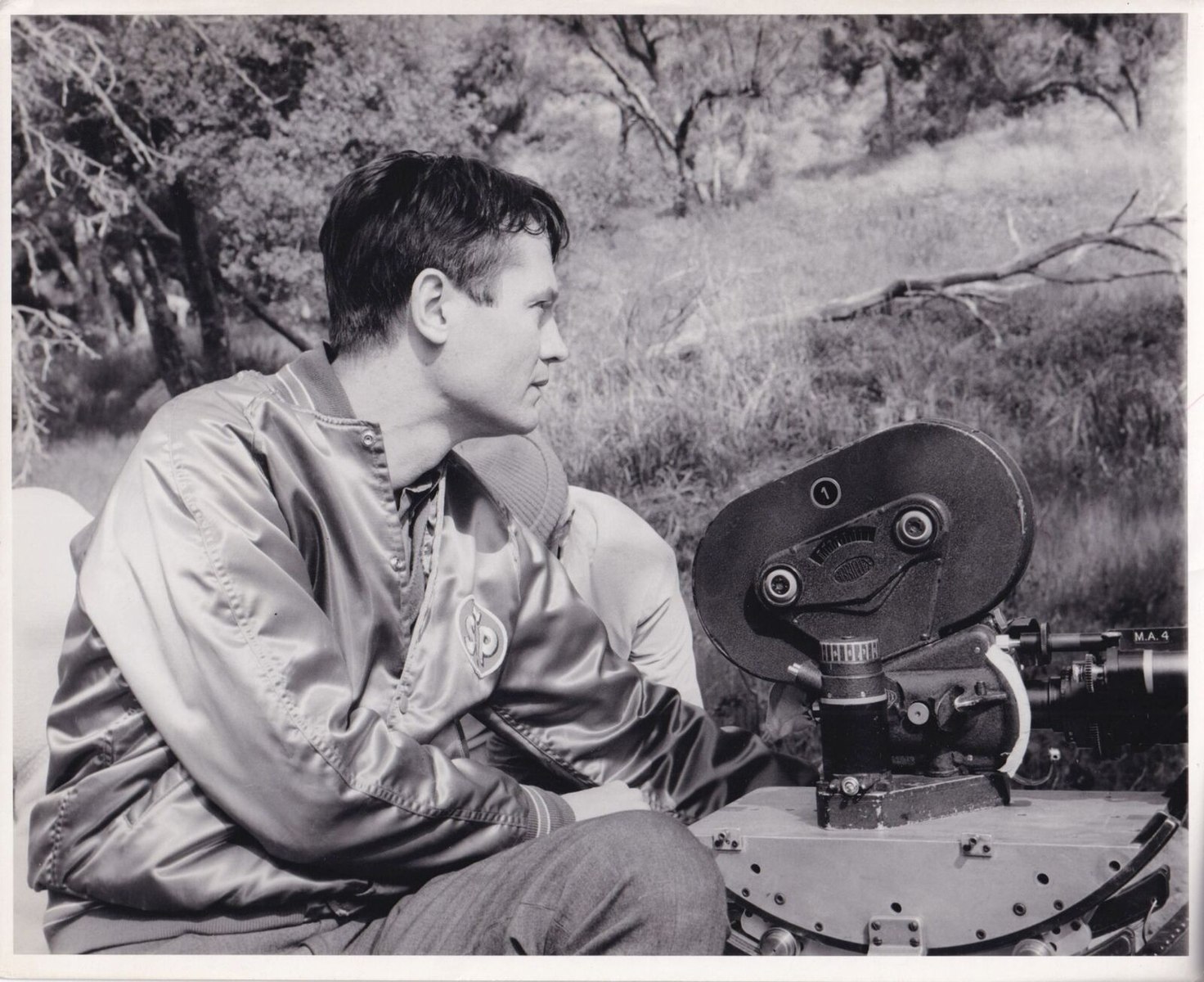
Roger Corman has died.  So passes an era.  I’ve always had an appreciation for the speculative films of the fifties and sixties.  Many of these involved low budgets and content intended to shock.  Or at least excite youngsters.  And Roger Corman was a huge name among directors, producers, and promoters of such schlock.  He entered the realm of horror in 1955 with Day the World Ended.   Attack of the Crab Monsters a couple years later put the focus firmly on monsters.  Producing and directing three or more movies a year, he built a reputation for being cheap and quick, but that didn’t prevent him from creating some good movies.  A film’s producer is the one responsible for overseeing the production.  Often they come up with the ideas of what to film.

Roger Corman, publicity still; public domain via Wikimedia Commons

As the sixties were dawning, Corman produced several films “based on” work by Edgar Allan Poe.  I remember seeing some as a young person and wondering what they had to do with the Poe I’d been reading.  Still, he managed to grace cinema with House of Usher and The Masque of the Red Death.  These are good films, despite limitations.  At the same time, Corman was still producing creature features as well, wracking up an impressive list of nearly 400 produced films.  As an established player in cinema he also took on the role of distributor from time to time.  When The Wicker Man was being ignored in Britain, Corman undertook the role of US distributor, likely saving the movie from total obscurity.

Circling back to Day the World Ended, we’ve become accustomed to believe that some kind of divine or human ending is in the offing.  These ideas get embellished over time, as I suggested in my new piece on Horror Homeroom.  Corman knew that this putative end would get the attention, whether or not there was any truth to it.  Perhaps that was the genius of his work—he knew how to attract attention.  And he wasn’t afraid to do so.  The business of cinema is one of attracting viewers.  Telling stories we want to hear.  We remember reading Poe, and even if the movies differ from the stories he penned, they are nevertheless reminders, reminiscent of what we’ve read.  If there are monsters they are somehow perhaps even more effective for not really being believable.  In short, Corman was a showman.  He made a living doing what he loved.  And he influenced many lives along the way.


Influential Horror

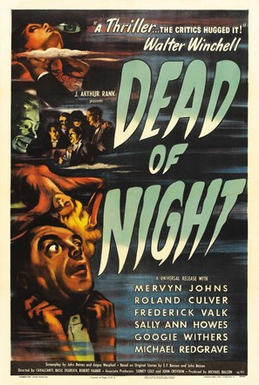
Media has a tremendous effect on society.  We all know that, and every four years elections prove it time and again.  Like an infinite loop or Mobius strip.  The Brits knew this well.  During the Second World War (which we seem eager to repeat), it was against the law to produce horror films in the UK.  Such things can demoralize, don’t you know, old chap?  The first British film to claim horror’s reopening was Dead of Night, released in 1945.  Germany had surrendered in May and Dead of Night, like a breath being held, was released in September.  Although hardly scary by today’s standards, it was an enormously influential film.  It’s an anthology with a framing story that ties all the pieces together.

Walter Craig is an architect called to visit a farmhouse that requires renovation.  Upon arriving, although he’s never been before, all the people at the house are familiar to him from a recurring nightmare he has and vaguely remembers.  He feels that something bad will happen since his dream seems to be a premonition.  Meanwhile, each of the guests tell their own uncanny stories.  Since this is horror, we know that the nightmare will exact its due.  Craig ends up murdering one of the guests before waking in bed.  It was his nightmare.  He receives a call to come to a farmhouse that requires renovation.  When he arrives it reminds him that the nightmare is about to play out in real life.

The movie influenced many others.  The most famous segment—a ventriloquist that goes mad when his dummy takes over—was fuel for many haunted doll stories.  One of the tales was based on a real-life murder than had taken place in Britain in 1860.  As I learned from Wikipedia, however, the most stunning effect the movie had was on cosmology.  You may remember from science class that a debate about the origin of the universe was fought between two models: the Big Bang theory and the Steady State theory.  What they don’t teach in science class is that Fred Hoyle developed the Steady State theory based on this movie of the recurring loop of a nightmare that the dreamer is helpless to escape.  I’ve been saying for years that horror is due a lot more respect than it’s given.  These movies, as an integral part of the media, do have a very real effect on the world around them.  Dead of Night is a good example of that.  And it’s still a bloody good film, after all these years.


Facing Fear

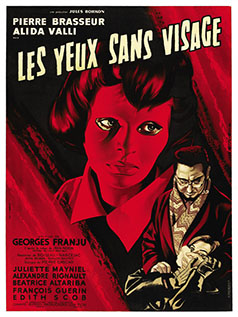
The relationship between fathers and daughters is intangibly profound.  (I can’t speak for fathers and sons, from either side of the equation.)  That was the angle that Georges Franju took when approaching Eyes Without a Face.  I have to confess that I knew the basic idea behind this movie and it took years to build up the courage to watch it.  I’m squeamish, and the fear that the film might show too much was a very real fear.  After you watch a movie, it can’t be unseen.  Still, it is a classic of the horror genre (although that is disputed) and it gets referenced all the time.  In case you haven’t heard about it, a plastic surgeon is attempting to graft a new face onto his daughter after she’s mutilated in an automobile accident.  Things, as you might guess, don’t go as planned.

Critics didn’t care for the movie when it was first released, but, as we’ve seen from time to time, re-evaluation changes things.  It is now considered good enough to be part of the Criterion Collection and ratings on the usual websites are quite favorable.  It’s often cited for its poetic treatment of the subject, and the response of Christiane, the daughter, seems to bear that out as she moves from complicit in her father’s crimes to sympathetic to his victims.  Indeed, the surgeon himself is conflicted, but that father-daughter relationship is something he can’t ignore.  He seems compelled to help her at any cost—it’s the price of parenting, I suppose.  It’s not for the weak.  But we’re in movie-land, aren’t we?

Christiane is sympathetic to the animals her father uses for his experiments.  When she frees them, after releasing the last intended victim, she’s depicted St. Francis-like, with the doves.  Knowing her own suffering, she can’t bear to impose it on another.  Our bodies are how we present ourselves to the world.  We rely on faces to tell us much of what we need to know, even without words passing between us.  Interestingly, even when wearing her mask, Christiane’s eyes tell the viewer much of what she’s experiencing internally.  Poetic, as the critics say.  If there’s a monster here, however, he’s driven out of love in the context of an imperfect world.  Eyes Without a Face works as a horror film and the reported fainting that took place among viewers early on demonstrate that we tend to feel for others, just as Christiane comes to.  And the father?  Well, that’s the unanswered question.  He’s a victim in his own way.


Wolfing Hour

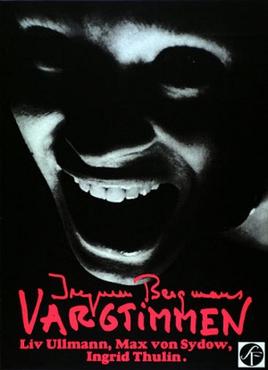
It’s not that I didn’t grow up watching horror; it’s that I didn’t grow up watching horror in theaters.  I’m sure Mom wouldn’t have had it, and besides, we could only afford movies spread apart by wide intervals.  You’d think that now I’m an earning adult (or so I’m told) that I’d have more control but watching is a kind of addiction and money’s still not abundant.  Every once in a while, however, I’ll splurge and pay for a film.  Mostly when they’re not available via any streaming service.  Like many Christians who’ve never read the whole Bible, I know the canon only piecemeal.  So I came to watch Hour of the Wolf, the Ingmar Bergman classic.  Now (at least then) streaming nowhere.  Intellectuals have always flocked to Bergman films since they’re full of symbols and not easy to understand.  (If you want to “get” Robert Eggers, though, you’ve got to do your homework.)

Hour of the Wolf is generally considered psychological horror.  It’s black and white—how scary can it be?  Pretty, depending.  The story of an artist’s wife (Alma) who lives with him in a small shack on an island in Sweden, it’s a tale of unraveling.  Nightmares become difficult to distinguish from waking realities.  The wife reads the artist’s diary, foreshadowing Wendy in The Shining, to discover that he seems to be going insane.  The island’s not abandoned, as they thought.  Soon Alma begins seeing other people too.  And attending their awkward dinner parties.  They speak freely of her husband’s previous affair.  There also seems to be an instance of a real person on the island that the artist keeps secret.

If this doesn’t give you enough to piece it together, well, it’s a Bergman film.  In college we watched The Seventh Seal.  And at least part of Wild Strawberries.  But in 1968 I wasn’t an intellectual and we were poor.  If I’d even heard of Ingmar Bergman it was via reference in some TV sitcom.   I knew to expect strangeness.  These days the box elder bugs are mostly gone from the house.  The weirdness started when, having never seen the film before, I began to pour a glass of water at the very second the artist picks up and begins to pour a glass of wine.  Strange coincidence, I thought.  Several minutes later I saw something edging around my glasses.  A box elder bug crawled right over my right glasses lens.  Like a scene in a Bergman movie.  I knew I’d have to ponder this for some time.


Wondering Wailing

You have to wonder, it seems to me, if the western, imperialistic gaze sometimes overcompensates for its past sins.  We remain reluctant to say we don’t understand something and sometimes even declare such things superior to what we produce.  That was the feeling that came over me upon reading about The Wailing.  Don’t get me wrong—I like K-horror well enough, but I’m not sure that I would say, with some critics, that it leaves American horror in the dust.  It’s good, yes, and it’s very long (two-and-a-half hours seems too long for a horror film).  The story doesn’t answer all the questions it raises and I was looking for some kind of religious message.  That’s why I watched it in the first place.  

What’s it about?  That’s hard to say.  The best that I can do is it’s about the doomed family of a Korean police officer in a small village.  As others have pointed out, this movie has ghosts, demons, zombies, exorcisms, and other horror standards.  There’s a considerable amount of Christian versus shamanism interplay.  And it seems okay, when someone else is doing it, to suggest a foreigner is the Devil.  None of this is intended to take away from the fact that the movie is effective.  I particularly found the shamanistic exorcism scene fascinating.  The thing is, you never really learn if the self-admitted Devil at the end is working with the shaman or not.  Or if the third potential villain, a woman named “No Name,” is in on it with them.  Or maybe I’m looking at this from the wrong angle.  Maybe the policeman’s family is simply doomed.  Nothing they can do changes that.

The movie suggests that such things are like fishing.  You can’t be certain who’s going to take the bait.  According to those who know, apparently a deleted scene at the end helps to clarify this a bit.  There is a lot of talk about belief, and a Christian clergyman confronting the Devil.  For me, however, I need to be able to follow a story well enough to figure out whether I’m misinterpreting or not.  The problem with a movie this long is finding the time to go back and rewatch it.  It opens with a quote from the Bible and it uses biblical tropes, such as the cock crowing three times, to make some strong points.  In fact, the opening quote from Luke 24.37-39 implies that the ghost may be God.  One thing is certain, I’ll be mulling over The Wailing for some time.  And maybe someday I’ll start to understand.  In the meanwhile, I’ll still watch and appreciate American horror, inferior though it may be.