October Early

Still feeling that August is the new October, although that particular day happened to reach over ninety degrees, I watched Halloween.  Not the John Carpenter original; I’ve seen that one a few times before.  No, I watched the 2018 version only to learn it’s a retcon.  If you’re like me you’ll wonder what a retcon is.  It’s a portmanteau of “retroactive continuity.”  That’s where a sequel goes back and makes adjustments, or simply ignores, story elements from the original to take the story forward.  I haven’t followed the Halloween franchise.  There are too many movies I want to see that are original, with fresh ideas, to be spending my time trying to find my way through an emerging mythology of a serial killer.  Michael Myers, as horror fans know, inexplicably killed his sister as a child.  As an adult he terrorized Haddonfield, Illinois  one Halloween and Laurie Strode was the final girl.
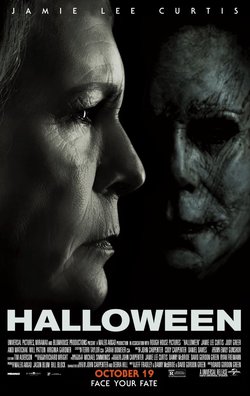
What drew me to this sequel was that Jamie Lee Curtis was back as Strode, all grown up.  Michael predictably escapes again and goes for an even higher body count in Haddonfield.  Laurie, meanwhile, has gone NRA and booby-trapped her entire house in anticipation of this day.  You can see the draw, I hope.  You kind of want to see how this ends.  The original had Michael’s apparently dead body disappear at the end.  In the retcon he was arrested after that and re-institutionalized.  The thing is, you can never really kill a monster.  Original scenes and scenarios are revisited, and those familiar with the Carpenter story are rewarded by situations that subvert expectations.  Where is he hiding this time?  You always watch the credits roll wondering how “the authorities” don’t realize that a guy shot, stabbed, and incinerated and keeps coming back might be something other than human to be put in an asylum.

I should know better than to watch these kinds of movies when I’m home alone, but I don’t.  So it’s a good thing that I try to piece all these things together.  We have three strong women—three generations of final girls here, and the obligatory basis for a sequel.  (At least two, in fact, bringing the franchise up to thirteen movies.)  Laurie’s granddaughter is among the virginal, non-drinking final-girl prototypes.  Her less Puritan friends are killed off, although her worthless boyfriend survives the night.  You’ve got to love the endless self-references of such situations.  That’s why we keep on coming back.  We’ve seen it before but we still want more.  Even if it’s only August.

Having X

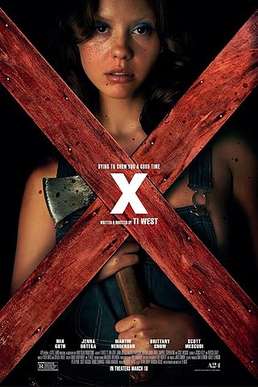
The final girl is such a classic horror trope that even horror novels can be titled after it.  You know the drill—teens hanging out, doing things that teens do, end up being killed off one-by-one by a monster or a disturbed person(s).  The one to survive is the virginal girl who doesn’t drink, use drugs, or whatever.  As a long-term horror watcher, I think the trope has been exaggerated, but it does occur enough times that there was clearly something to be noticed.  Enter X.  Released earlier this year, a slasher that rather obviously juxtaposes religion and horror, X features a “final girl” who is anything but virginal and sober.  The religion aspect is blatant from the beginning when the opening sequence involves a televangelist preaching to a viewership of the dead.

The title derives from the premise (which is a throw-back to the classic slasher era) that a would-be independent movie producer wants to shoot a pornographic movie.  Since this is strictly low-budget, he contacts an elderly gentleman on a remote Texas ranch who has a guest house.  With his one male and two female stars, a cameraman/director, and an assistant he drives to the isolated location.  They are all divided into couples, with each of the women having sex with the male star.  What makes this creepy from the beginning is that the old man, and his elderly wife, create a sinister presence.  She sneaks up on the young people, watching them through the window.  She misses her younger days when she was young and attractive.  As night falls the young people are killed off by the older couple one at a time.  What’s more, they’ve done this before.

X is a reflection on aging.  More than that, it’s a reflection on how religion leads to horror.  To say precisely how would involve giving away a spoiler, so I’ll leave the reader to watch the film to find out.  Suffice it to say, the televangelist is preaching about how sex leads to evil and the older couple kills because they’ve been listening to him preach.  X is not for the faint of heart.  I generally don’t like jump-startles and there were a couple of those that caught me off-guard.  (I try to anticipate them when watching slashers, or any horror, for that matter.)  But what of the final girl?  There is one, but it’s one who flies in the face of horror convention, if there is such a thing.  


Engendering Fear

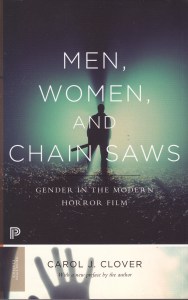
menwomenchainsawWe live in fear. At this point in history, it seems, with good reason. Horror films, apart from being considered low art, teach us to deal with some of these fears. I hadn’t been reading about the genre for very long before I began to notice the repeated references to Men, Women, and Chainsaws: Gender in the Modern Horror Film. This is Carol J. Clover’s seminal study of gender theory and horror. Probably best known for first identifying the trope of “the final girl,” Clover gives much more than that to the conscientious reader. Her chapter on possession movies is among the most insightful that I’ve read. And yes, she does make a very good case for the final girl.

Using theories of gender, she explores why both boys and girls (the former numerically more obvious) flock to such disturbing movies. Although she suggests masochism has something to do with it, is isn’t simply that boys enjoy seeing girls suffer. Quite the opposite. Boys often see themselves in the place of female victims. As with most things associated with gender, it’s far more complicated than it seems. In that sense, this is a book for our time. We live in what George Banks calls “the age of men,” and while Mary Poppins can hardly be called horror, the underlying narrative bears some warning tones. Men, left to their own devices, will seize what power they can grasp. We’ve spent the last five decades teaching men that this is no longer appropriate, only to have that message wiped away with the final trump. Horror can be remarkably pro-feminine. Business, as we’ve seen over and over, is less so.

Not having ever formally studied gender theory, some of the intricacies of Clover’s argumentation were no doubt lost on me. I was, however, able to gather a remarkable amount of appreciation for the subtexts in many of the movies I’ve watched. Gender, you see, touches everything we do. It behooves us to be aware that careless, or thoughtless support of misogyny does not lead to the results that many men suppose. Some horror movies are truly difficult to watch. Not all conform to the standard expectations. What Clover has shown, however, is that often the women are able to draw from a depth of strength to which the male characters lack access. They don’t do so willingly. In fact, they are often reluctant. When the horror is at its end, however, the final girl emerges triumphant.