
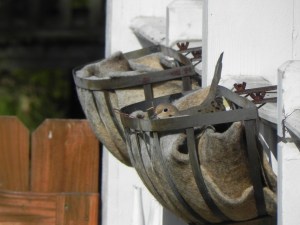
A loud flapping of wings. I looked out my window in time to see a mourning dove land on the roof opposite with audible bump. The poor thing sat there, looking stunned. Then another flapping of wings. Another dove flew over the gutter onto the higher roof. It was then that it dawned on me that these two were being pushed out of the nest. I’ll admit that I doubted the wisdom of a dove building a nest in the neighbor’s gutters, especially when the tropical storm dumped several inches of rain on us last week. Sometimes animals know what they’re doing, however, and even after the storm I could see the mother dove winking at me, her head just above the level of her aluminum-sided home.
The stunned youngster sat there for quite some time. As soon as Mom was gone, the one that had flapped above climbed back into nest. Was I watching a parable unfold? Mom flew back when chick number two decided to flap down and join its sibling. Throughout the morning I watched as the mother returned, landed in sight of her offspring, then showed them how to get down to the ground. Ensuring they were watching, she waddled to the edge, dropped, and spread her wings. She did this several times as the young birds kept carefully away from the edge. Mom, it seemed to me, was growing impatient. She’d occasionally fly back to peck them, but the siblings simply wouldn’t take the leap. She started coming back to feed them instead. I wondered how she managed with two beaks jammed into her own at the same time.
I kept an eye on the drama the entire day. By the time I turned in for the night, the two youngsters were bedded down next to each other on the roof. Their mother had landed, cooed insistently to them, but they dutifully ignored her, afraid of falling. We look at birds and think they’re built to fly. It’s one of their greatest assets. It is the kind of gift, however, that requires overcoming obstacles. Just because you can fly doesn’t mean that you’re not afraid to fall. There’s learning involved. Such episodes of animal intelligence always inspire me. We could learn so much if only we would take the time to see how birds learn to fly. The transition from coddled nesting to the freedom of the skies is not easy, and being built to fly still requires overcoming a very natural fear.
 Steve A. Wiggins