All the Tea

I’ve been reading a lot about China lately.  Political scientists have been interested in its economic growth for some time and it has rivaled the GDP of the United States in such a way that it’s an open question as to which is the larger.  With so many things to keep track of in daily life, I’m loathe to add poli sci to the list, but I’ve always found history fascinating.  China has long been the target of Christian missionaries.  Finding a culture that had developed quite differently, in some sense socially distant, they were anxious to make them in their own image.  China had its own religious heritage of folk traditions, Confucian beliefs, and Taoism (as well as Buddhism and Islam), and Christianity’s claim of being the only true religion caused considerable social turmoil.  One such event was the Taiping Rebellion in the nineteenth century.
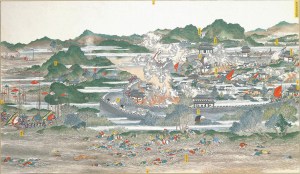
Image credit: Wu Youru, via Wikimedia Commons

A complaint of evangelical pastors, even in the United States, after Billy Graham had come through town was that local people, all riled up on revivalism, had unrealistic expectations for what their local churches could do.  Viewing this from a different angle, the issue was that one outlook on Scripture could lead to consequences that others didn’t understand.  The same thing applies to Taiping.  Hong Xiuquan, the leader of the Taiping Rebellion, had read his Bible (the activity encouraged by missionaries) and became convinced he was the brother of Jesus Christ.  He set about trying to establish what is called the Heavenly Kingdom.  This clashed with the government of China during the Qing Dynasty.  Eventually foreign powers even got involved.  The end result was between ten and thirty million deaths.  That’s right, ten to thirty million.

Religious ideas are powerful.  This is one reason that repressive governments often try to outlaw religions.  Other governments (including some not too far from here) use religions for political ends.  True believers are great followers.  I first learned about the Taiping Rebellion only relatively recently.  I’ve been reading snippets about China for several years now.  Its economic power may well be greater than that of the country in which I grew up.  Perspectives are shifting.  Vast numbers of people die because of religious conflicts.  If you’re one of them the real tragedy is that, in Stalinistic terms, you become simply a statistic.  There’s a reason authoritarian governments try to keep the opium from the hands of the people.  I’m no political scientist, but history reveals much about religion and its discontents.


Dying for Religion

devotedtodeathReligions never lose their ability to surprise. This entire concept of belief is one with which I am intimately familiar but about which I’m completely puzzled. If we’re honest, we don’t know from whence belief comes or why it is so effective in keeping people balanced. (There are fanatics for rationalism just as surely as there are for religious faith.) When I saw R. Andrew Chestnut’s Devoted to Death: Santa Muerte, The Skeleton Saint, I figured it would be a good read for October, when Halloween comes so readily to mind. Although I’ve studied religions all my life, I’d never heard of Santa Muerte, “Saint Death.” Probably this is because, as a representative of folk religion, Santa Muerte is not an “official” religious figure. Folk religions are what the faithful actually believe, rather than what the religious officials declare that they will believe. Many a deluded bishop would learn to his chagrin, if he deigned to speak with mere laity, that his platitudes count only in the high court of theological heaven. Saint Death is more like the experience of the rest of us.

Chestnut, a scholar of Mexican religions, discovered Santa Meurte while living in Houston. His book is a narrative introduction to the background and history of the religion, its beliefs and practices, and a consideration of what the skeleton saint offers so many Latinos. Although the news in the northern reaches of America often does not bear it, Santa Meurte has regularly made the headlines in southern climes. As a symbol of death, and therefore potential protection from death, Santa Meurte has gained notoriety by her worship being taken up by drug runners and convicts. Mexico’s regrettably long struggle with poverty and sometimes corrupt governments has led to a society in which death is very familiar. As Chestnut demonstrates, Santa Meurte likely has her roots in the Grim Reaperess of plague-ridden medieval Spain, and she has been a somewhat hidden figure in Mexican Catholicism for at least a century or two. Her first public exposure came in 2001, and since then her association with the criminal element has been repeatedly highlighted in the media.

Santa Meurte, however, is a source of consolation for those who have little in life to anticipate but death. Often, in societies driven by the acquisition of wealth, plutocrats forget that justice comes in the guise of the Reaper. To the believer, Santa Meurte is not evil. She is a natural offshoot of the Catholic veneration of saints in a culture where human aspiration is quickly and unfeelingly snuffed out. Those in positions of power claim the Santa is Satan, but they may be looking in the wrong place for evil. Pointing to the Gospel statements that death will be overcome, they overlook the passages that insist on giving away all that you have will make you ready for the kingdom of heaven. Death, even if trumped at the final trump, will greet us all by and by. Santa Meurte is a very practical saint. Chestnut’s book is a good choice to read when the chilly wind shakes the trees for their particular October rattle of dry, lifeless leaves.