
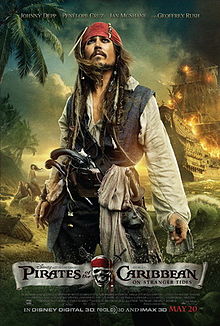
 Last summer I was invited to address a church in Princeton about Christian themes in the movies. Back in my seminary days I often presented biblical material at adult forums, but my interest in religious themes in movies has grown over the years. I don’t claim to be an expert, but I have watched secular movies with an eye toward religiosity since I was in high school. The day of the presentation followed a recent viewing of Pirates of the Caribbean: On Stranger Tides. Although I’ve posted on it before, that particular movie is among the most heavily freighted with Christian themes of any I’ve seen. Now that I’ve had a chance to watch it again on the small screen without the distractions of getting home through traffic afterward, I would redouble my assertions. The very premise of the movie—the hope for eternal life—is a decidedly Christian refrain and the pirates, who wear their sins on their sleeves, are eager to attain it. The missionary, mentioned in my previous post on the film, serves as a kind of foil for that theme, insisting that all souls can be redeemed. Except, he decides, Blackbeard’s.
The reason that Blackbeard falls out of the missionary’s personal book of life is his mistreatment of a mermaid. Now the swarming, man-eating mermaids are among the most memorable images from the story. One has to be captured to unlock the magic of the Fountain of Youth, and the victim happens to be the missionary’s mermaid. In a Florence Nightingale moment, the two different species fall in love—celibate preacher and heathen, mythological creature. An odd couple indeed. Carried in a glass coffin filled with water, the mermaid also needs air to survive and the heartless pirates don’t really much care. To save the little mermaid from asphyxiation, Philip shoves his Bible into the gap he breeched between coffin and lid, saving the fishwife’s life. Talk about conversion!
When the glass coffin breaks, spilling all the water, the mermaid is reborn as a human. Echoes of Splash come to mind here, as well as Disney’s earlier effort, The Little Mermaid. The transformation in this case, seems spiritual as well as physical. Syrena, whose very name invokes the classical sirens, is the one who delivers the magical chalices (communion, anyone?) to Jack Sparrow to save the life of Angelica, or, more likely, to bring Blackbeard to an end. Our busy mermaid, now transformed again to her fishly form, saves the injured missionary by converting him to her way of life under the waves. There are shades of Lovecraft here as well as a reversal of Ariel’s fate in Little Mermaid. Although critics were harsh on this movie where a comic character now takes on a serious role, I still find it compelling. Nearly all the main characters undergo transformations as the story unfolds and whether heathenish or not, almost everyone ends up a better Christian of one sort or another.

 Steve A. Wiggins