Shifting Gears

The question’s very basic: do you pay with cash, or by watching commercials.  When it’s the same three commercials the whole way through—for products you’d never buy—just paying the cash may seem the better option.  But it’s too late for that.  It’s the Graveyard Shift.  There’s no doubt  that Stephen King is responsible for the ideas for more horror movies than probably any other single individual.  I’d read his story, “Graveyard Shift,” many years ago.  I was warned, though, that this was one of the least favorite of his adaptations, and that’s a pretty low bar.  Still, it was just a matter of sitting through the same commercials over and over.  And one of them was more entertaining than the movie.  Of course, I don’t really watch for entertainment.  This is a learning opportunity.
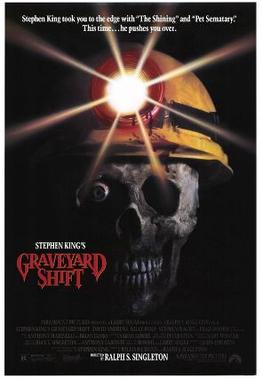
Let’s start with the basics: You need at least one sympathetic character.  Okay, you kinda like Jane, because she shows basic humanitarian traits.  And Carmichael.  Then you want a plot that makes some sense—what is Warwick’s motivation?  The writing is particularly bad.  If there’d been a bit more intentional camp, this might’ve made a reasonable horror comedy.  I mean, you’ve already got the empty aluminum cans being fired by slingshot.  As it is, it’s played straight with an evil foreman, rats everywhere, and a giant bat in the basement.  By the end you’re kind of rooting for the bat.  And whose idea was it to use voiceovers of the sub-par dialogue over the closing credits?  Is this so bad that it’s good?  I’m having trouble deciding.

Although set around the fourth of July I wouldn’t call this holiday horror.  Nevertheless, there are some moments of religious imagery that pop out.  The graveyard sinking in the river has a listing statue of Jesus near the start of the film.  And the exterminator—the only real camp in the flick—narrates how in Vietnam they pinned victims down, like Jesus, to feed them to the rats.  The final couple of minutes—well earned, I assure you—have Hall fighting the wicked foreman with the jawbone of an animal (one has to assume an ass), inexplicably among human bones (some still in their coffins).  And his slingshot ultimately killing the giant (bat).  The references are to Samson and David, respectively.  Perhaps this movie’s an indictment of capitalism, since the basement cleanup is on Independence Day.  Or maybe it’s just tired horror tropes on a break.  (Having one of the characters reading Ben in the diner was a nice touch.)  It may become a holiday tradition after all.

Storming Fourth

Our founders picked a day of uncertain weather to declare independence.  One gets the sense that people were more stoic about the weather in those days.  Of course, we’ve increased global warming and made things more extreme.  Nevertheless, I can remember very few fourths of July when the possibility of storms was zero.  The weather around here has been odd this year with a suddenly hot June, with a dry spell that killed quite a few plants, followed by a cool start to July and some very intense storms.  And now, on the fourth, the possibility of rain in the forecast.  The grass hadn’t been growing in the dry spell, but I’m hoping the rain will hold off today long enough for me to get that job done.  In fact, on this secular holiday I’d been hoping to get quite a few outdoors chores checked off the list.

When I was younger and fireworks were the main draw to the day, I noticed that just about every year rain fell, or threatened to, on July fourth.  I’m sure it’s not that way everywhere, but here in Pennsylvania, where the declaration was signed, it’s a reality of life.  Of course, the modern Independence Day celebrations evolved over time to include the cookout and fireworks—outdoor activities both.  For me, apart from the outdoor chores on a day off work, a movie seems like an indoor celebratory alternative.  Perhaps Return of the Living Dead, set on the fourth.  Or I Know What You Did Last Summer.  Or Graveyard Shift.  Maybe something else.

Watching the political theater unfold—and my, what a dramatic election year it’s been—perhaps a comedy horror is just about right for today.  This is going to take some thought.  Something to occupy my mind while doing those outdoor chores.  Of course, I’ve got a book to get submitted as well.  If the weeds can hold off for another day or two—is it wise to paint the porch when rain’s in the forecast?—maybe I can finish up Sleepy Hollow.  It’s a good American ghost story.  That might be appropriate as well.  You see, holidays are so rare that too many things crowd in on them.  They’re breaks from the constant earning of more money, which is the American way.  Of course, our founders were largely restless gentry.  For me a day off work is always a busy day.  Especially when the rains have returned and the grass has grown.  It must be the fourth of July.


Hoppy Fourth

Today is the one of the relatively rare summer holidays.  Modern industrialized nations tend to take a more relaxed view toward summers without having to give out too many prescribed company holidays.  This seems to follow on from school schedules because the kids are out in summer and adults need some flexibility when work demands collide with family needs.  The internet has made work-life balance a little tricker to achieve since work is always just a click away.  Some more generous employers gave yesterday as part of an extended four-day weekend, which is rejuvenating in a way that’s easily forgotten until you start to feel it.  The sense of obligation takes a couple of days to wind down, and then on Monday you realize “I’ve still got another day off!”  It’s a sublime feeling.  Why not watch holiday horror on it?

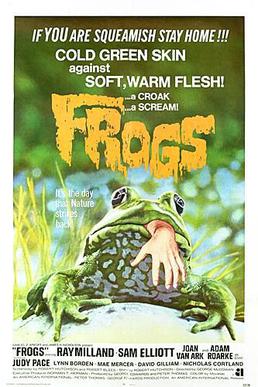
The Wicker Man is a holiday horror movie.  One of my arguments in the book is that holiday horror has to derive its energy from the holiday, and not just be set on it.  For example, I Know What You Did Last Summer and Return of the Living Dead are both set on or near Independence Day but the movies don’t really draw their horror from the holiday itself.  It falls into the same category.  Frogs?  Well, maybe.  Perhaps holiday horror, it’s definitely in bad movie territory.  A rich southern family is dominated by a Trump-like grandfather who controls the money and measures everyone by loyalty to him personally.  On his birthday, the fourth of July, nature revolts and his adult children and grandchildren (apart from one granddaughter), are killed by animals in this eco-revenge groaner.  But is it holiday horror?

One scene may suggest that perhaps it fits the category, but the real significance of that day is that grandpa won’t let it be celebrated any way other than by his prescribed plan.  Even as the estate is overrun by frogs (mostly), snakes, lizards, alligators,  tarantulas, and even some birds (thank you, Mr. Hitchcock), he insists that everyone do what they always do on the fourth of July/his birthday.  The only scene that suggests holiday horror is where the eponymous frogs hop onto a cake decorated like an American flag.  I normally like nature-revenge films, and this one starts out well but quickly goes downhill.  The environmental message is there, but underplayed.  There are some firecrackers and a number of dead rich folks, but otherwise the film seems to have no message at all.  It’s a bad movie.  Holiday horror?  Not really.  Something to watch for a day off work?  Definitely.


Independence Day Wishing

It’s Independence Day and what we most need independence from is our own government.  History is full of ironies.  Federal holidays falling on a Saturday, for instance.  In any case, here we are on the Fourth of July and still stuck under a repressive government that a small portion of people like.  Republican groups supporting Biden are starting to arise, but we can only dream on Independence Day.  Many of us would like to be independent of the coronavirus, and not a few people are acting like we are.  Cases are spiking, so the rest of us are staying indoors.  Fireworks are okay, but I have trouble staying awake until dark these days and more often than not they just keep me awake as I’m starting to doze.

Maybe for Independence Day I’ll take leave of reality.  Maybe I’ll imagine a government that isn’t so utterly corrupt that some people might have some faith in it.  Maybe I’ll dream that black lives matter and that our leaders would believe it.  Maybe I’ll think what it would have been like if caring officials addressed the Covid-19 crisis directly instead of brushing it off, so that like all well-run nations cases would be going down here instead of back up.  There’s so many possibilities and the one thing they all have in common is that they point to independence from the Trump Administration, if that’s what it can be called.  Maybe it’s time to light a sparkler of hope.

Independence Day can be a day of looking forward instead of looking back.  If we can look ahead we might see a country where anyone will be allowed to exist and not be condemned by “Christianity.”  We can come to see that privileging any one “class” or “race” or “sexual orientation” is a form of bigotry from which we can and should be independent.  We can try to think what it must be like to experience life from somebody else’s skin.  We can try to understand instead of standing ready to condemn that which is “different.”  Fact is, everyone is different from everyone else, it’s only a matter of degree.  And difference can unite rather than divide.  The whole idea behind uniting different states was that those who were different could support one another and figure out how to make room for everyone to fit.  It won’t be easy to do, but we might use today to envision a country where we can work together, and figure out that leaders who bring people together are the only hope we have for the future.


Freedom’s Price Tag

Independence Day makes me feel conflicted.  Jingoism seems to be an international problem, and although patriotism is deemed next to saintliness, I have my doubts.  No nation is perfect *gasp!* and we would all do well to learn from others.  America is a nation in love with money and that affair has serious consequences.  One is our medical care system.  We’re one of the very few (if not only) “advanced” nations without universal medical coverage.  In fact, people routinely suffer because they lack insurance or their coverage doesn’t provide for what their physicians think is best.  This came home to me while staying with a family member who was hospitalized recently.  On the television the GOP was sponsoring ads against universal health care.  The irony was thick enough to be sickening.

Highly touted as the most affluent nation in the world, we refuse to take care of our own.  How am I supposed to get into the mood for Independence Day?  In Britain (as in most other places) they have universal health care.  I lived there for three years and knew that I could get treatment without emptying out the bank.  Here, in my native country, we have less care.  Someone might make a few dollars less, and that, we’re told, is unacceptable.  Anyone who’s experienced the illness of a family member knows the old one-two.  The treatment itself and the bills that come after.  Lately I’ve just been throwing up my hands and opening up my wallet.  It’s Independence Day.

Not that I’d expected much to change, but my first inkling of being a writer was winning a state-wide essay contest right here in Pennsylvania.  I wrote an essay on “Americanism” back in 1980.  It noted the false sense of righteousness that accompanied the notion.  I was an evangelical Christian then, but that didn’t mean I wasn’t cynical.  In my small town I’d seen John Cougar Mellencamp-level suffering.  I saw unemployment, drug use, and desperation.  I saw politicians saying everything was great and would be even better if we had more guns.  I saw trickle-down economics stemmed at the source.  I knew we were being lied to.  I did hope that things would get better, but now with the GOP fully behind 45 the true ugliness of jingoism has become clear.  It’s Independence Day and I feel sick.  I look across the ocean and see the nation from which we declared said independence suffering from a similar backlash.  But at least they can afford to go to the doctor.


Only Takes a Spark

Fireworks have been the main event for Independence Day celebrations ever since I was a child. The fourth of July is a day for playing with fire. As a child I remember spending the meager allowance I had on sparklers and snakes. I haven’t seen one of those ash snakes for decades now, but the impression they made remains strong. A plug of some kind of carbonish material—you’d light the top with a match and it would flame and hiss and start to grow into a long, twisting exoskeleton of ash. They left a blackened circle on the sidewalk, and when they were cool enough you could try to lift the fragile snake in your hand, but it almost always broke apart before blowing away in the breeze. We also wasted our money on smoke bombs with their multi-colored smoke, but we never had actual firecrackers. Given the trouble we could make with an ordinary roll of caps, that was probably a wise decision on our mother’s part. All of this, however, was just a prelude to the fireworks.

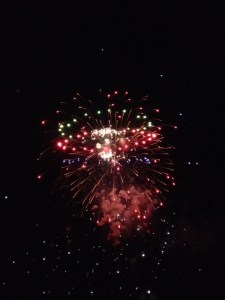
As I sat under a cloudy sky last night wondering why every July fourth seems to rain, it occurred to me that fireworks are a violent form of celebration. Indeed, they are designed to imitate the sounds of battle—before the nuclear age—and we all know the thrill of when the loud, bright burst of pure light sends a shock wave through you. It is like a canon rocking your soul. Like many stirring experiences, fireworks had religious overtones from the beginning. Invented in China, fireworks were used for religious festivals. They were believed to be effective at driving away evil spirits and bring good fortune. Pyrotechnics, however, clearly have military applications as well. It is this strange nexus between religion and violence that makes, I suspect, fireworks displays so compelling.

IMG_2287

The local display here in Somerset County, New Jersey, was impressive for a region without large cities. I couldn’t help pondering the strange aesthetics of contained violence as the colorful explosions took place over my head. Illusions, I know. We always talk afterward about whether some of them are meant to represent anything. Did you see a smiley face, the United States, or even New Jersey? It depends on your angle of view. Is this a religious display or a celebration of violence? Looking around at the amazing diversity of peoples gathered here in this park with me, I feel strangely satisfied. I hear languages I don’t understand, and see people from all over the world here for a good show. Although thousands of us try to get to our cars at the same time, spirits are positive, for the most part, and all go home in a celebratory mood. Maybe the ancient Chinese were right and these pyrotechnics do drive away evil spirits after all.