Going Below

Indiana Jones in National Treasure, in found-footage horror format.  That’s the feel of As Above, So Below.  Only Jones is a woman.  There’s plenty of religious imagery in this movie, but the story’s not that great.  One of the reasons is that it’s too difficult to swallow, although it does score serious points on the claustrophobia scale.  At the beginning I wondered if I was going to make it through since Dr. Dr. Scarlett Marlowe’s cell phone is constantly moving as she continues her father’s search for the philosopher’s stone.  Surviving the situation in Iran, the remainder of the film takes place in Paris, especially the catacombs.  My level of impressedness went up when I learned that the movie really was shot in the catacombs.  Unfortunately it didn’t really help the story.
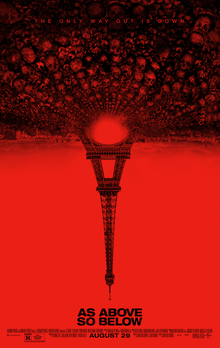
Alchemy, as part of esoterica, is purposefully difficult to understand.  Marlowe is continuing her dead father’s search for the philosopher’s stone that can change things into gold.  Her friend George (who repairs the clockwork for the bells at Notre Dame) is forced into the catacombs with her and her cameraman Benji.  They’re led by three Parisian cataphiles and some shots look like they were lifted directly from Indiana Jones and the Last Crusade, including the use of her father’s notebook.  Instead, the group enters the gates of Hell.  There are lots of scary things down there, many of them unexplained.  Some reflection reveals that they are all having to confront their pasts—or at least some of them are.  One of the cataphiles is killed before we learn her secrets.  And one of the survivors has no real backstory.  Six go in and three come out.

The movie plays with some interesting ideas, but it’s hard to swallow that an actual bona fide archaeologist would go on an illegal treasure hunt.  And that she knows of a secret chamber in the catacombs that has remained undetected by specialists.  I began scratching my head.  And when the group (or some of them, anyway) begin finding artifacts from their personal pasts in the catacombs, credibility is strained even further.  The idea that it’s important to come to terms with your past is a good one.  But once the young people begin dying and the rest have to keep going deeper and deeper to get out, the illusion is broken by Marlowe just dashing back to get a different stone to save George.  If it were just a matter of popping back, wouldn’t they have tried that earlier?  There are some Bible quotes, making this a candidate for the also unlikely Holy Sequel.

Contrariwise

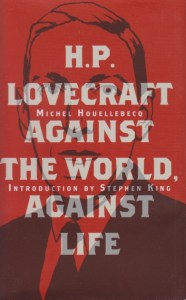
When you set out to research a topic, reading is the first step.  These days you can’t possibly keep up with everything that’s written—particularly on the internet with its endless iterations and reiterations, and incipient plagiarism.  Even books often come at you in great numbers, from angles you don’t expect.  Apart from holidays, daily life doesn’t give much time for reading.  So how does one get a handle on H. P. Lovecraft?  I’d been aware of Michel Houellebecq’s essay, H. P. Lovecraft Against the World, Against Life for some time, but as always, finding time is the trick.  This short book, however, is profoundly insightful.  Not a biography and not literary criticism, it is more an appreciation of a misanthrope.  One of the things that Houellebecq makes clear is that Lovecraft was a man out of his time.

Continuing the tradition of French writers appreciating the more macabre of American writers (Poe was celebrated more in France than his native country), Houellebecq pays tribute, but doesn’t fawn over, Lovecraft.  In this series of brief essays he manages to highlight much that might remain hidden to those who know H. P. from either only his writing or from the somewhat small circle of experts on him.  Sometimes it helps to break away from the experts to get a fresh view.  I’ve read quite a lot of Lovecraft’s fiction, and when you do this you tend to think you know the author.  You may or you may not.  To know is to delve.  And delve Houellebecq does.  

Serious reflection is too often considered a luxury.  With the exception of a few privileged occupations, think of what would happen at work if you took to reflecting while on the clock.  Those who dole out the lucre prefer to see signs of busyness—fingers clacking keyboards and numbers being lined up, preferably in the black.  Time thinking, so capitalist thought goes, is time wasted.  If you can sell enough copies of your book to afford a little time off for reflection you can make connections, I presume.  You can see things that those who are too busy cannot.  There are many astute observations in this slim volume.  While not making excuses for Lovecraft’s faults, Houellebecq doesn’t attempt to correct him either.  That’s difficult to do with a person, if the author is correct, who hated life itself.  Books like this also demonstrate that a huge word count isn’t necessary for erudition.  And it is still possible to learn, even with limited time.


Huge or Not?

The word “refugee,” I recently learned, was originally coined to refer to the Huguenots. As the Reformation began to take hold in Europe, although mostly associated with Germany and Switzerland, many French believers left Catholicism and became known as Huguenots. Early modernity was a time when religious persecution was rather openly practiced (as it still is in parts of the world) and many Huguenots were forced out of their homeland where Catholicism was the state religion. The word used to describe these unfortunates was “refugee.” For whatever reason, the plight of the Huguenots has never really captured the public imagination the way that many groups of displaced individuals has. We seldom hear of Huguenots any more, but generic refugees are daily in our news.

800px-Print_entitled_Horribles_cruautes_des_Huguenot_en_France_16th_century

While it is hardly a mark of pride or accomplishment to have Christians persecuting Christians as the origin of the term “refugee,” the fact that refugees are becoming more common rather than less so should be worrying. Borders, all of which are artificial, no matter how high we build our walls, lead to closed opportunities. Every once in a while, I ponder the phenomenon that none of us has any control over where we’re born. We might be fortunate enough to find ourselves in an affluent democracy (so I’m told) or equally beyond our control in a repressive totalitarian military state. The ability to see things from another’s point of view is essential to the concept of the refugee. Can we imagine what it is like to be persecuted for religious belief? For being born female in a chauvinistic society? For being poor when money seems to be everywhere for those who know how to extort it? Have we no sympathy for those who find themselves conceived under trying circumstances? If it were me, I’m sure I would think differently about it.

Historically, and by the numbers, the Catholic Church has been by far the most successful form of Christianity that the world has known. Claims to the title of “Christianity” are hotly contested, but the continuity, in some form or other, has hung together for a couple of millennia. In times past, those who differed, such as the Puritans in England and Huguenots in France, were encouraged to leave. The world was plenty big enough. Were the borders of today erected in early modernity, the plight of the Huguenots, like that of many untolerated religious groups, might have been far more dramatic. Largely assimilated today, the Huguenots are not much on most people’s minds and yet refugees still regularly approach the borders beyond which a more humane life awaits. Religious persecution gave the world the word; could its opposite provide the solution?