Final Thoughts

You feel kind of special running stop signs and red lights.  I’ve never driven in a funeral cortege before but this one is somehow taking place on an obligingly rainy October afternoon.  Although I was in that kind of emotional shock that you feel at the death of a close family member (it isn’t my first), I couldn’t help but consider all those behind the scenes who work in the death industry.  From the mortician at the Gardinier-Warren Funeral Home—where my grandmother’s funeral was also held—to the undertaker getting soaked in the chilly rain, everyone was friendly and kind.  I also reflected that watching horror movies is homework in a world where death is inevitable.  As a child I already knew about death, and although I’m not afraid to die, I’m not eager to have that particular experience just yet.

Horror movies are all about learning to cope.  Not so different from the book of Job, they’re reflections on why “the good life” doesn’t continue as it sometimes does for various stretches of a human life.  And as we age, death more and more naturally comes to mind.  I’ve written before about the therapeutic aspect of my odd avocation.  One of the realities of growing up religious is that my mother—may she rest in peace—taught me early on that this would be my bodily fate.  I found it disturbing seeing my grandmother in her casket.  I remember distinctly Mom telling me, “this is just her shell,” that her soul had moved on.  That didn’t prevent nightmares of that shell rising and walking again.  Is it any wonder I grew up watching horror films?

Reflecting afterwards with my brothers on our physical ailments—we aren’t young any more—my thoughts wandered back from time to time to horror movies that had made this just a little easier for me.  Life is full of opportunities to do our homework.  As I grew up reading the Bible and watching horror, I didn’t think of it as studying, but it was.  Many kids with whom I went to high school have died over the years.  I tend to look at the alumni magazine necrologies even as medical science improves our chances of surviving some of nature’s more dreaded diseases.  Life comes with no guarantees and horror films reinforce that it’s not a bad idea to think of some of these things ahead of time.  Afterwards, at one of my mother’s favorite local overlooks, I reflected on how I have a lot yet to process.  Homework never ends.


Hotelling

Perhaps I’m just sleep-deprived, but staying in a hotel is a collective experience.  It’s a place where communal consciousness should run high.  You’re stacked (in many cases) on top of and/or beside strangers.  And strangers have different habits.  Back in my hometown of Franklin for my mother’s funeral, there aren’t many options for accommodation.  Her last years in this region were spent in the small “suburb” of Oil City called Seneca.  An ambitious Holiday Inn Express visionary put a not-exactly-cheap establishment in this economically depressed area.  It’s generally a pretty comfortable place to stay.  I am, however, an early riser.  (I know this can’t be easy on my family since I go to bed early and that means televisions have to be kept low after 8 p.m. I’m part of the problem.)  As I say, it’s a collective experience.  I’m constitutionally incapable of sleeping in, so late nights lead to sleep-deprived days.

Around 1:30 new upstairs neighbors checked in.  Walker, Texas stranger types.  Heavy-footed with a penchant for running.  Their arrival awoke me at a dangerous hour since any time after midnight my body says, “You’ve had a few hours’ sleep, and dawn’s not that far off.”  As I groggily tried to remember relaxation techniques, my mind kept getting sucked back to our New Jersey apartment.  We rented the first floor of a house and one set of upstairs neighbors had a son who would run back and forth the length of the apartment, shaking all the light fixtures, knocking down plaster, and breaking concentration.  And sleep.  One particularly memorable work night, said urchin was leaping off a bed and running at about the same time as our late visitor last night.  The husband had a police record but we had to call the landlord for an intervention (I had to get up at 3:00 to be ready for my early bus).

When staying in a hotel, we’re living a model of life in community.  I think of this as a parable.  Societies thrive only when everyone considers the effects of their actions on others.  Arriving at a hotel after a long drive, kids are full of energy (I was, believe it or not, once one myself).  Still, if children aren’t taught that strangers are sleeping below, as adults will they ever internalize the message?  Or maybe it’s simply the trauma of those disturbed and frustrating years of constantly pounding feet above my head that have come back to me at an inopportune 2 a.m.  I have a funeral later today, but perhaps I’m just sleep deprived.

Who might be staying upstairs?

Preacher’s Best Friend

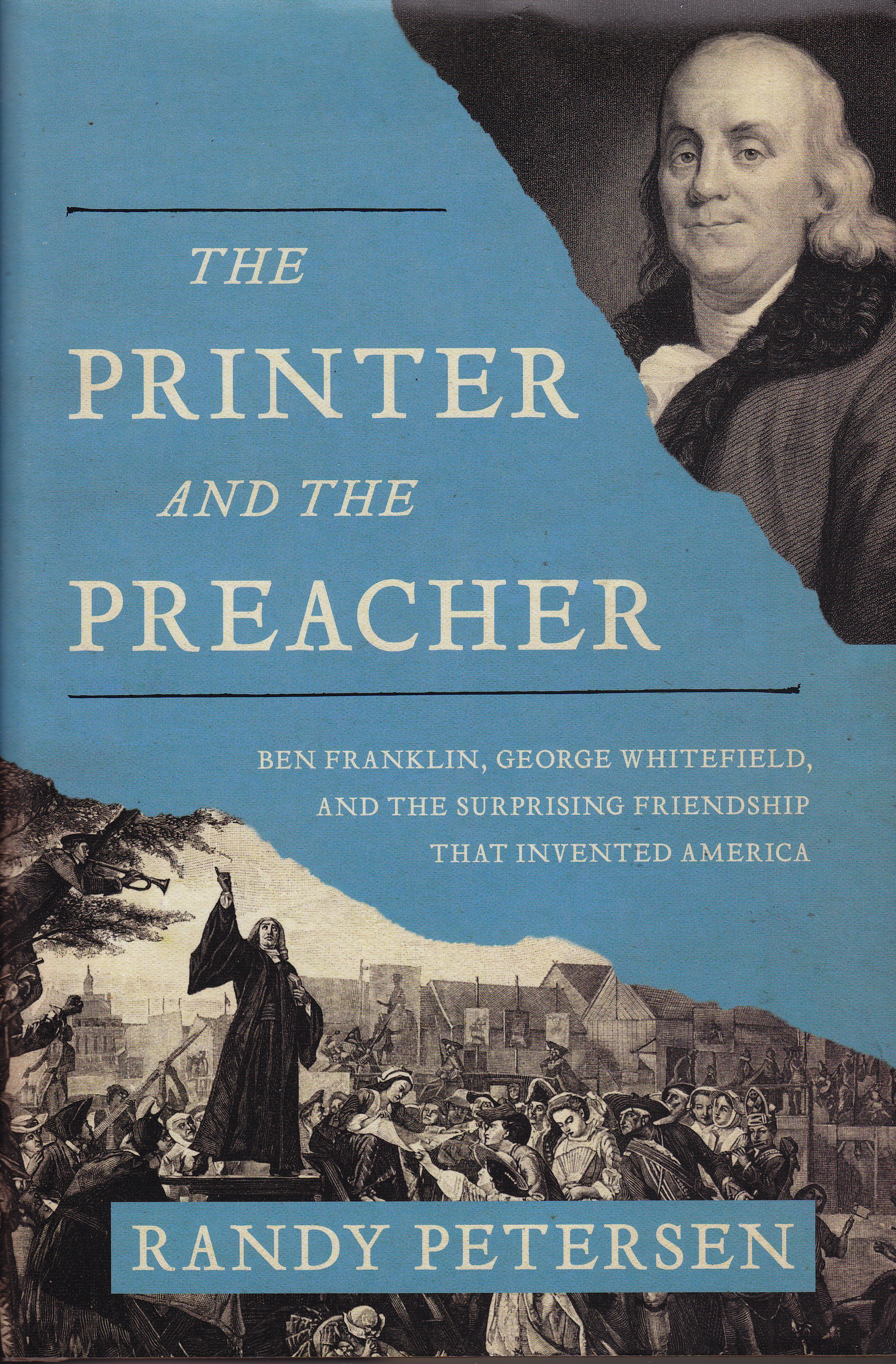
PreacherPrinterPerhaps it’s because I was born in Franklin, Pennsylvania, or perhaps it’s because everything I’ve ever read about him suggests he was delightfully unorthodox, but whatever the reason, Benjamin Franklin has always held my admiration.  Probably we all like to hear echoes of ourselves in the great.  It is difficult to believe that during his early rise to fame, Franklin was eclipsed by an unlikely superstar who was, of all things, an evangelist.  George Whitefield, an early English Methodist, wowed the colonies with his born again message, perhaps being responsible for its appeal even today.  Randy Petersen’s The Printer and the Preacher explores the unlikely friendship that sprang up between Franklin and the younger Whitefield.  While cataloguing early founders’ religious lives is always problematic, Franklin was a self-described Deist, and certainly not an Evangelical.  Whitefield was very into the personal relationship with Jesus idea that Franklin found, at best, simplistic.

Petersen’s book is a kind of wishful history.  He wants to see Franklin and Whitefield together, often suggesting that they might have met here or there, or that they might have discussed this or that.  The fact is, we have little to go on beyond the reality that the two knew and respected one another.  Whitefield stayed in Franklin’s house in Philadelphia.  Franklin printed and sold Whitefield’s best-seller sermons.  Certainly there was a good business opportunity here.  Even today the evangelical Bible market is a strong one.  Savvy businessmen and women know that a good living may be had from the Good Book.  You can’t read a book like The Printer and the Preacher without thinking that Whitefield and Franklin were a kind of odd couple.  Franklin is remembered as a man of wit and science.  Whitefield is barely remembered at all.  One of the first preachers to hire a publicity manager, Whitefield was the Joel Osteen of his day, raking in the accolades for being emotional in front of salt-of-the-earth colonials.  His oratory skills were legendary.  Even though he is honored as one of the founders of the University of Pennsylvania, he was no scholar and has largely been relegated to an historical footnote.

Petersen’s book is a quick read.  His writing is winsome in an evangelical way.  He assumes the truth, or so it appears, of the evangelical position.  Nevertheless, there is material to stop and ponder here.  Many of the questions can never be answered: why, particularly, did Franklin and Whitefield hit it off, for example.  On a more approachable level is the why of Whitefield’s faded flower verses Franklin’s perennial bloom.  The message of Whitefield simply doesn’t stand up to the experience of history.  Human beings—many of them born again—experience constant turmoil in their lives.  Franklin, on the other hand, was the consumate pragmatist.  His aphorisms are regularly mistaken for verses of the Bible.  Although others would have gotten there, we largely have him to thank for our harnessing of electricity, and even the birth of a new nation.  Whitefield’s spiritual descendants now rally to prevent stem cell research and the teaching of evolution.  Franklin’s children, illegitimate or not, reap the benefits of the lightning rod.


Maine Event

We have no control over where we’re born. Place, however, has a sacred significance. Many people have a sense of where they belong. Life may be a prolonged journey, like that of a salmon, to find one’s way there. While in seminary, one of my professors had the class introduce itself by name and town of birth. This was in Boston, at a school with a highly eclectic student body. I was born in the small town of Franklin, Pennsylvania. Other than having been the setting for an X-Files episode may years later (not filmed there, of course), it was not the kind of place anyone was likely to have heard of. In a class of maybe 50, imagine my surprise when an older gentleman announced he was born in Franklin, Pennsylvania. We was not of my generation, but it turns out, we had origins in common. As the introduction passed further forward, someone about ten years my senior announced, with a glance at the first student, that he was from Franklin as well. By the time it reached me, this seemed more of a synchronicity than a mere coincidence. We were all entering Juniors (the starting year of seminary), all born in the same hospital, and none of us had known the others existed prior to that day.

I was in Boston, however, because of a deep-down conviction that I belonged in New England. More specifically, Maine. After having grown up for about a decade in Franklin, we moved to Rouseville, Pennsylvania when my mother remarried. Apart from the industrial, drug-intensive culture, there was a haunting sense that this was not where I belonged. I began to read voraciously. My literary adventures found my spiritual home: Maine. Vividly I could imagine its rocky coasts and large stretches of northern woodland. I had never been to Maine—had never even seen the ocean at that point—but I knew, without a doubt, that Maine was my spiritual home. While a student in Boston I made several trips to Maine, each one convincing me more that I shouldn’t be leaving when Sunday afternoon rolled around. I should be staying here.

Life has, however, kept me from my beloved Maine. Academic jobs, mythical beasts that they are, are location-specific. You have to follow the jobs (I almost wrote herd there, but there’s nothing close to a herd of such employment). The population of Maine doesn’t support the number of schools that places like Massachusetts, New York, and Pennsylvania do. Even all of these were closed to me. Maine never abandoned my dreams. I moved to Wisconsin, following a job that abandoned me. I moved to New Jersey to take another, which also abandoned me. One of the motifs to which I constantly return is the sacredness of place. A sense that a person belongs somewhere. Out in the ocean, many salmon are captured before they make it to the stream of their birth. I wonder what their thoughts might be as they lie gasping for breath, knowing deep in their piscine souls, that this is not where they were meant to be.

Maine


Without a Hitch

I’m not really afraid of dying. All those years of being taught that “to die is to gain” have obviously done their work. At the same time, it is a poignant exercise to read the posthumous memoirs of a dying man. I remember my first funeral. Although I don’t recall the name of the poor, deceased honoree, I still see the reactions of the living vividly. I was under ten at the time, and the funeral home in Franklin, Pennsylvania was in a very somber mood. The man, who had been a friend of the family, “was not a Christian.” Having been buffed and rubbed in the Fundamentalist tub from my earliest days, I didn’t realize that what was meant was actually that he hadn’t been an active member of our particular church. Nevertheless, as a child, you get deeply impressed with these kinds of things. “I’ll never go to the funeral of a non-Christian again,” I remember my mother telling a friend. “The minister couldn’t find anything comforting to say.” While funerals are sad occasions by definition, this one left a crater that is still fresh over forty years later.

MortalityChristopher Hitchens is someone I found through his book God is Not Great. I don’t have time to read magazines, and I hadn’t read any of his previous works, but he raised some extremely valid points in this diatribe. My wife recently bought me his final oeuvre, Mortality. I felt as if I were back in that funeral home. It is not that I still hold to the odd belief system of Fundamentalism—of this my regular readers will have no doubt—but it is the forlorn feeling of reading the words of someone dying who hopes for nothing. Yes, it may be Stoic, and even noble. Certainly it seems far more worthy than visions of living in opulence with lots of available virgins with whom to toy while angels strum their harps overhead, but the certitude that one’s final days will be nothing but prolonged suffering—ouch! Maybe there isn’t a heaven, and if there’s a hell there’s something morally wrong with the universe, but doesn’t some residue of a human life remain? Even if it’s just the memories, the marks that we’ve made on others’ minds, don’t we somehow survive? Dying without hope nevertheless feels like milling about in that doleful crowd of specific Christians years ago.

Hitchens does offer a chapter in his final words devoted to those Christians who responded to his cancer with an unholy Schadenfreude, trying to torture the thoughts of a dying man with the promise of an eternal hell after experiencing a temporary hell of cancer treatments. This chapter made me sick. Anyone who so completely misses the message of compassion that suffuses the Gospels can hardly claim the designation Christian, I would insist. No one, no matter what their eternal plans, has the right to try to fracture anyone’s tenuous tranquility to make their own crown shine a little brighter. Such weekend warriors likely imagine that they are defending their fragile God, but in reality they are demonstrating that some of the criticisms of Hitchens were very well placed to begin with. No religion will live up to its full potential until it succeeds in the most basic practice of all—treating all people with respect and dignity. Until then, death has the final word.


A Sense of Place

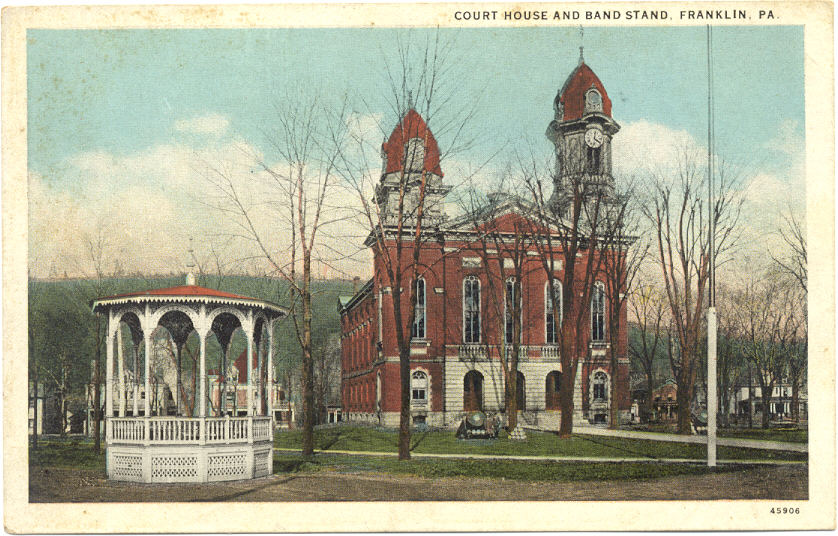
Franklin, Pennsylvania. The place I was born seems to participate in what is sometimes labeled “sacred geography.” No one really knows why people imbue certain places with a sense of particular significance, but we all do. Whether it is world-famous tourist sites or our humble hometowns, there are places for us that possess an emotional resonance that other places lack. By the time I was an adult I was eager to get away from my hometown, to stretch myself and see if there was more to this world than these ancient green hills were willing to disclose. But still I return. When something brings my town into prominence, it somehow still impacts me. In the second season of the X-Files Mulder and Scully came to Franklin. Of course, the episode was not filmed here, just set here. But that was enough. My small hometown had been validated. It is part of my personal sacred geography.

I recently learned about WestPA Magazine. While it still has a way to go before becoming mainstream, it needles into that sense of belonging that refuses to let me go. Reading about the grandeur that once settled over this town feels like reading my own biography at times. Last night, for example, I learned that one of the first steps of female equality—a small step, but we all must begin to walk somewhere—took place here. One of the inheritors of the oil wealth that originally put this region on the map was Charles Joseph Sibley Miller. He hosted two presidents on his yacht, partnered with John Astor and William Vanderbilt on a business venture, and had his car personally delivered by Louis Cheverolet. Although largely overlooked by history, Miller purchased a hot air balloon in which he took his wife, Mary Prentice Miller, for a ride, making her the first known woman aeronaut in history. One small lift for a woman, one giant lift for womankind.

There seems to be no scientific basis for sacred geography. It is simply something that we sense. I left my home region, the birthplace of the oil industry, a site of some importance in the Revolutionary War, to pursue a more tenuous, if abstract career track. And still I come back and find myself amazed. I suspect our sense of sacred geography evolved along with our penchant for territorialism, our desire for private property, and our need to find sanctuary of some kind. I can stake no claims for the accomplishments of those who settled this region, but for me it will always be a touch-point for sacred geography. When I make my occasional returns, it feels as though I might still belong.