In the Details

To a certain mindset, nothing conveys a threat quite like Satanism. Many parts of the world witnessed this dynamic during the “Satanic scare” of the 1990’s. In reality, however, most groups identifying as Satanism do not believe in a Devil and, often enough, don’t engage in worship. These groups are a reaction against aggressive Fundamentalism. For example, a Washington Post article timed as parents (at least) are thinking of back-to-school worries, announces “An After School Satan Club could be coming to your kid’s elementary school.” News headlines are intended to make you want to read a piece, and this one worked in my case. It turns out that the Satanic Temple, the group behind this current initiative, is one of those rationalist groups that doesn’t believe in the Dark Lord. They object, however, to schools allowing Good News Clubs to meet after school hours and want to make a point by offering alternative programing. Devil-themed, but not Devil-believing.

It’s difficult to imagine this kind of situation developing in many world cultures. It raises some very basic dilemmas where two conflicting freedoms co-exist: freedom of speech and freedom of religion. Most people would agree, upon reflection, that public schools should not be used for religious instruction. After school programs, in the minds of kids, still take place “at school” and are not easily separated from regular instruction. (Just ask an undergraduate what an adjunct instructor is and you’ll see that they pay little attention to administrative issues like that.) Fundamentalist groups, such as Good News Clubs, use freedom of speech as their wedge to offer after school programs. It’s not “school,” and it’s after hours. Don’t we allow freedom of speech, and isn’t there space available? Good News Clubs are, of course, evangelistic engines. The Satanic Temple makes the claim that if one religious group can meet after school, so can another.
Neither academics nor society have a good understanding of literalist beliefs. Those of us who once believed—sincerely believed—Fundamentalist teachings are a resource academia has chosen to ignore. Higher education is still an “old boys network” where jobs are offered on the basis of who you know and not on the basis of the knowledge they might offer to students. This, I suppose, is yet another clash taking place. Fundamentalism may seem laughable from the outside, but from the inside the untenable beliefs are taken with deadly seriousness. After school programs are an expression of a very deep-rooted fear that such religions promote. Satanist groups will get headlines by taking them on, but they will continue the conflict rather than offering dialogue to try to understand. They’re only doing what higher education teaches them to do—support those you like instead of trying to move knowledge ahead. Perhaps that’s the real work of the Devil after all.

The Survey Said…

Survey

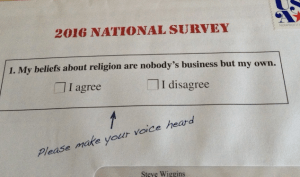
There may come a time, perhaps “when the trumpet of the Lord shall sound,” that junk mail will be no more, a mere historical curiosity. For now, in these days of declining postage prices, we’ll continue to put up with it. I suspect much of it targets my generation and those older—people who are modest about the time they spend on the internet, and who long to look out the windows when they’re at work. (The non-virtual windows, I mean.) Although I lament the waste of paper, and the cost to our literal dendritic friends, sometimes free amusement comes in my mailbox along with the occasional profundity. I received a survey the other day that had decorative check-boxes on the envelope for agreeing or disagreeing. “My beliefs about religion are nobody’s business but my own” the question read. My knee-jerk reaction, itself a religious term, was to think “Of course! Nobody can tell me what to believe.” An occupational hazard of being a religionist, however, is that the ready application of exegesis always stands to hand.

Are my religious beliefs nobody’s business? I suspect since the sender was looking for money that some manner of business was indeed involved, but beyond that are my beliefs nobody’s concern? Freedom of religion allows us to believe what we will, and since beliefs are very, very difficult to change, this is a central tenet of any form of democracy. You can’t have a free people without letting them believe what they can’t help but think to be true. It may, however, sometimes be somebody else’s business what I believe. If my religion is dangerous—and what religion isn’t, to some degree?—don’t hoi polloi have a right to know? Ah, but then aren’t we in danger of registering, profiling the believer? This is a violation of rights as well.

My pen hovers uncertainly over the paper. My views are something that I keep to myself. Few people know what I actually believe. On the other hand, day after day I post thoughts that in some way can be tied to religion. Is this a trick question? A junk mail survey shouldn’t be so hard. When did studying before checking the mailbox become a requirement? In my teaching days I had students who claimed they had a right to know what I believed. I had a right to keep my views private. Who’s right? Whose right indeed? Belief doesn’t come easy. It’s not as cheap as the media makes it out to be. Unless, of course, it arrives unbidden among the junk mail that makes up so much of our lives. And even then it might be something to take seriously, at least for a little while.


Religion Undisclosed

I’m getting to be a pat-down connoisseur. In Raleigh-Durham it was a more intimate affair with Mr. TSA—I don’t even have his name or number—narrating the intimate details. “I will move my hands up your thigh until I encounter ‘resistance,’” he said. At Newark the pat-down was quicker, more business-like, almost as if Mr. TSA were embarrassed. In Raleigh-Durham, nobody batted a lash when I said full-body scanners were against my religion. At Newark, they laughed. The gate attendants began asking me what my religion is. Private. My religion is as private as my “resistance.” And I was being ridiculed for it. This is the Patriot Act vision of America. Regular readers of this blog know that I have never revealed my religious convictions. They are a very private matter with me, and I had supposed that I’d been born in a nation where that was respected. Instead, I am laughed at.

We extend religious liberty to those who wish to handle rattlesnakes. To men who wear black dresses and have an historic penchant for young boys. To people who believe the world was created in six days. To people who believe golden tablets only seen by one man through rose-colored glasses are the basis for sacred scriptures. To the traveler who believes in the integrity of the human body and cannot divorce it from the respect and dignity of human modesty, this does not apply. Religions arm military forces. Religions rape women. Religions murder children as well as adults. Who’s laughing at them?

I wonder if I might have a legal case here. When has the free practice of my religion—which decrees that full-body scanners are immoral—been opened to public scorn? And don’t tell me it’s the price of security. I walked through “security” with my eyes open; first class passengers do not get scanned like hoi polloi. It’s not a matter of security—it’s about control and money. When will the people take back control of their own country from officials inebriated with power? I feel no safer with a stranger’s latex-gloved hand on my resistance. I feel no safer when people who couldn’t cut college get jobs in the US government and look at their fellow citizens naked. You’ll blank out my face? That makes it even worse. If someone’s going to violate my dignity I want him to look me in the eye and realize that it’s a human being he’s humiliating, not just a hunk of meat. Or in the language of the TSA, mere resistance.

First, show me yours


Reverend Sanders?

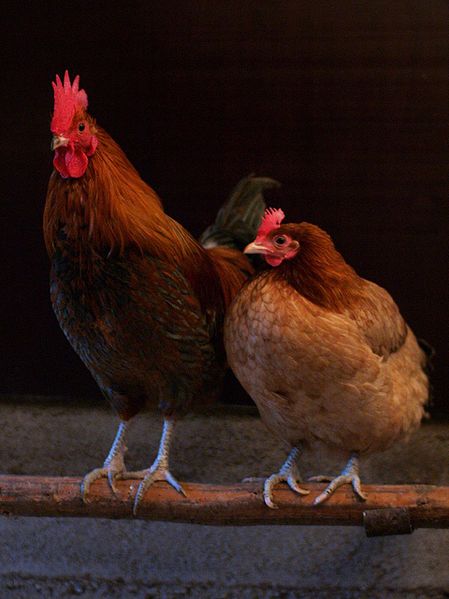
According to the Associated Press yesterday, Yenitza Colichon was sentenced to 18 months’ probation for child neglect and cruelty. The charges stemmed from a 2007 religious ceremony in which her seven-year-old daughter was made to watch a chicken sacrifice in New Jersey, and the girl was fed the animal’s heart. The practice is part of the Palo Mayombe religion of central Africa. This whole incident highlights the vital question of when religion crosses the line into child neglect. Many of us bear scars—some psychological, some physical—from our religious upbringings. It has been concluded by psychologists that children do not possess the level of abstraction necessary to deal with religious concepts until they are about the age of twelve. Parents, often fearful of eternal consequences should their children depart the one, true faith (whatever that is), begin religious instruction early, often passing their children off to others who are in no real sense an expert in the religion itself.

The United States embraces, on paper, the concept of freedom of religion. Rightly, it seems, the strong arm of the state will step in when a child is endangered or neglected. The unanswered question is at what point does this neglect or endangerment occur? Authorities turn a blind eye if the faith is time-honored, and, especially, if it is of European/American extraction. Typically of the monotheistic variety. What is standard practice for other religions, as this case demonstrates, may be called into question. Sacrifice is also at the heart of the Judeo-Christian tradition. Sublimated into different forms for both political and theological reasons, those of us in that tradition have abstracted sacrifice to bloodless words on a page. When we see red, child neglect and cruelty are cited.

Religions frequently make extreme claims over the lives of their adherents. Most religions relax such claims for children, but others continue ancient practice that is tacitly condoned. Sometimes those permissible rites cause real physical pain and scars. If under the hand of a moyel, okay; if scarification in African tradition, not okay. Religions denigrating personal achievements of the young, setting them onto a path of failure, okay; religions ritually killing animals, as even the Bible demands, not okay. Without making any judgment on specific religious outlooks, the reality of lingering effects remains. Are the terrors of Christian nightmares inspired by tales of Hell any less cruel than watching a domesticated animal die? Is eating a chicken heart any less unusual that fish on Fridays? Is being unfamiliar with a religion grounds for dismissing its authenticity or claim for equality? Some of us find animal sacrifice distasteful, but if we proclaim a tidy sacrifice each Sunday, and share it with our children, that particular rite/right is protected by law.

What would (wiki-commons) chickens do?


Shopping for Truth

Friends often tell me that I should start a new religion. After all, modern day religious practice is generally a matter of “shopping around” until you find a brand you like. Lifetimes go into shaping religious sensibilities and outlooks, and when we see something we like, we choose that as our spiritual refuge. I was reminded of this once again by a story in Friday’s New Jersey Star-Ledger about a girl who’s been suspended from school for following her religion. Her North Carolina school has a dress code forbidding certain body piercings, but the girl belongs to the Church of Body Modification. The girl’s mother makes a valid point (in the words of the Associated Press article by Tom Breen): “school officials are setting themselves up as judges of what constitutes a ‘real’ religion.”

Religion may be defined in many different ways. Today many people consider religion a belief system that requires a strong faith commitment; belief is primary in such a definition. On the other hand, today’s world still includes many people who are born into a religion that is essentially a system of rituals or practices rather than a belief structure. It could be argued that such people do their rituals and practices precisely because they believe them, but often belief is not even discussed. It is simply a matter of who they are.

If religion entails solely a belief system, then any number of philosophies and outlooks might be defined as religious. Governments would need to be liberal with their tax-exempt status coupon books, since should I declare that my predilection for things Ugaritic to be a religion, who could reasonably protest? With a couple of like-minded adherents, we would have created a new religion (or a very old religion, depending on how you look at it).

Religious freedom defines the United States. For all its faults and foibles, this nation has allowed freedom of conscience to be the yardstick by which we are measured. If the girl’s religion insists on a nose-ring, who is local government to dispute this? If we could learn to define what a religion is, perhaps we would be much further along the path of ensuring true religious liberty.

Finding true religion in the shopping mall of life