Just As I Was

It was kind of a game. A game to teach us about important people, living or dead. The fact that we were playing it in high school history class, taught by one of my favorite teachers, made it even better. Everyone wrote a name on an index card—a person in the news or somebody from American history in the past. A student sat facing the class while the teacher selected a card and held it over the student’s head, so we could all read who it was, all except the chosen one. Then s/he would ask questions to guess whose name was written. I remember very well when the teacher picked up my card and read it. He said “that’s really a good choice!” The name led to a bit of joshing. “Is he alive or dead?” the student asked. “How can you tell?” joked our teacher. It was the one name the selected student couldn’t pin down, no matter how many questions she asked.

It’s fair to say that Billy Graham had a profound influence in my life. As a curious—and very frightened—child, whenever his crusades were on television I would watch, transfixed. I responded to his altar calls at home. Multiple times. My emotions were overwrought and I’d awake the next day feeling redeemed, for a while. I had no real mentors in my Fundamentalism. Ministers preached, but they didn’t explain things. Not to children (what was Sunday School for, after all?). All I knew was that when the rhetoric reached Hell, and the possibility I would die that very night, repentance seemed like the only logical option. The reality of the choice—a black and white one, no less—could not be denied. Either you were or you weren’t.
Source: Beinecke Rare Book & Manuscript Library, Yale University via Wikimedia Commons

As my point of view eventually shifted around to that of my high school teacher—I was in college at the time—I began to realize that Graham’s version of Christianity wasn’t as monolithic as it claimed to be. Once you experience other people’s experience of religion, if you’re willing to listen to them, it’s pretty hard to hold up the blackness and whiteness of any one perspective. Over the years Graham tainted his pristine image in my eyes by his political choices. His son now stands as one of Trump’s biggest supporters. Now that Billy Graham has gone to his reward, I do hope that the Almighty doesn’t hold his mistakes against him. He had no way of knowing that his sermons were terrorizing a little boy in western Pennsylvania into a career track that would never pan out. Largely because other followers of Graham’s so decided. It’s kind of like a game.


Christian Sister

Difficult to believe as it may be, some of the biggest superstars in America’s history have been clergy. The case has been firmly made that George Whitefield, the evangelist, was the first to hold “rock star” status in these United States. He drew stadium-sized crowds before there were stadiums and was, perhaps, the most famous man in the country. Fast forward a number of years and we find a name that may not ring so many bells today. Aimee Semple McPherson, however, was more famous than Hollywood actors and most political figures of her day. The founder of the Foursquare Gospel church was, in the roaring ‘20s, one of the most recognizable names in America. It may not count for much, but even in rural Pennsylvania we learned about her in American History class in high school four decades after her time.

I read quite a lot about American religion, and Aimee Semple McPherson frequently comes up. I knew little about her, however, until reading Daniel Mark Epstein’s Sister Aimee: The Life of Aimee Semple McPherson. While it has its faults as a biography, it does convey a fair image of who this fascinating woman was. An evangelist when few women preachers existed, she was creative, crowd pleasing, and remarkably broad-minded for a Fundamentalist. Her personal life was full of drama—three marriages and at least one kidnapping episode—wealth, and want. She trusted Jesus implicitly and often suffered alone in silence. Secretly she befriended Charlie Chaplin, a man drawn to her stage presence but not her religion. It’s difficult not to like this woman who insisted on doing things her own way, and who ended up alienating her family (apart from her son) by doing so.

There can be no doubt that Aimee Semple McPherson believed what she said she did. Although she didn’t approve of theater she brought theatrics into church via her famous “illustrated sermons.” She pioneered radio evangelism, which subsequently grew into a hackneyed soapbox for lesser thinkers. She was a faith healer, a world traveler, and a woman who genuinely cared for the poor. Epstein’s book tells the story with heart and a touch of hagiography, but it is an entryway into one of the lives that shaped Jazz Age America, even if it is now largely forgotten behind flappers and Fitzgerald. It’s hard to believe that some of the most famous people in American history were religious leaders of their time, especially when we see what’s on offer in that arena today.


Spiritual Education

The water was hot. Notoriously hot. Our Junior High School had been built in the days of the prison esthetic, with heavy, cinderblock walls painted in penitent colors. And the water was famously hot. One of our gym teachers, nameless here forevermore, challenged us to be men. It takes a kind of courage mostly illegal these days to lecture a room full of naked boys, but he once came in during mandatory shower time to tell us that anyone who could hold their hand under the hot tap for a full minute would get an A in gym. Since he was an ex-Marine nobody was foolish enough to take him up on this challenge. At least not in my class. It’s difficult to be courageous when you’re unclothed.

The incident I recall, however, occurred at the opposite end of the spectrum, in art class. You may remember those days when you wove reed baskets to take home to your mom. The thing about reeds is that they’re brittle unless soaked in hot water. That was the key to working with them. Make them supple with hot water and then when they dried, they’d be remarkably sturdy, if somewhat lopsided. We had been weaving reed baskets when someone, unbeknownst to the teacher, had filled the sink with water as hot as our old school could deliver. Thinking it funny, since even in those days educational budgets were under threat, somebody dropped one of the very limited number of heavy reed-cutters into the sink, now at the very bottom of a basin of very hot water. I was not the guilty party; I don’t know who was. The drain was plugged from the bottom. Very funny, no?

At the end of class. the teacher was not amused. “No one leaves this room until that cutter is out of the water,” she flatly said. The first bell rang. She stood in front of the door. We would be late for the next period. Perhaps it is the weakness of character my religion instilled in me, but I’ve always had a great fear of not doing what I was told. It lingers to this day, that Fundamental unworthiness. This body of mere flesh is weak and prone to sinfulness. The clock was ticking. Teacher wanted the guilty party to suffer the price of their prank. I pulled up my sleeve, plunged my hand into the scalding water, pulled out the reed-cutter, slapped it on the counter, and walked out the door. We were released to class and the searing pain didn’t last long physically, but spiritually it has never gone away.


Persecution Myth

The myth of persecution is a great cover. Christians, we are accustomed to think, are timid and loving individuals eager to turn the other cheek. In this sophisticated world of science and technology, they might appear a little naive, but they’re not really out to hurt anyone. Or at least some of them aren’t. I grew up among what would now be called Fundamentalists. Harsh to their own sins, they’d not imagine harming others. The story went that in the Roman Empire days it was open season on Christians and the oppressors liked nothing better than killing off a dozen before breakfast. That myth has largely been debunked by historians. Yes, there were some brief periods of intensive persecution, but for the most part the early Christians were left alone.

Many of the more zealous among the literalist sects today feel the loss of that mythology keenly. What can you do when you learn that your primitive ancestry wasn’t as heroic as you thought it was? For some, that myth must be kept alive today. When it is acknowledged that our world has become a smaller place because of technology, we get exposed to those who give the lie to our prejudices. Moral Muslims (despite the media portrayals), Hindus, Buddhists, and even secular humanists, abound. News, however, thrives on negativity. After all, it too is a capitalistic enterprise. We see the violence, the hatred, the bigotry. The myth lives on. Christian Dominionists have simply given up on the rest of the race. The Bible, after all, says few will be saved. And they have thrived for decades based on the simple fact that nobody takes them seriously.

I have seen the lack of compassion in evangelical eyes firsthand. A coldness that declares education to be evil since the only truth was revealed long ago in unchanging form. The word of God stands forever. It says so itself. And among the most despised of all human beings are those who study that word instead of “just reading” it. Those outside this camp know there is no such thing as “just reading.” They also know that we have no original biblical manuscripts at all and that translations are merely approximations. It’s difficult to build absolute laws on approximations. Among themselves these groups claim that legislation to treat others equally is a direct affront and insult to them. In fact, they claim they are persecuted because of the fair treatment of others. The thing about democracy is that any system can be gamed. Even Putin can be your friend, for this is the world of myth.


Overlooked Scripture

In this great Trump Tower of capitalism in which we all live, I often wonder about the overlooked Bible. Fundamentalist Trump supporters certainly know how to thump it, but do they know how to read it? This thought occurred to me as I was rereading the story of Ananias and Sapphira in Acts 5 recently. The narrative isn’t hidden or obscure. Here’s how it goes: the earliest Christians were communists. Literally. Peter himself was involved. After Jesus’ ascension, his followers pooled their resources and divided them up by how much each person needed. Ananias and Sapphira, a husband and wife duo, sold their property and presented the money to Peter and the collective. They held a little back, though, just in case. The result? Peter saw through the lie and they died instantly. The point was pretty clear—Christians don’t hold anything back for themselves. They live communally.

Obviously, this didn’t last very long. Let the one without a savings account cast the first stone. In fact, by half-way through Acts the holy experiment is already forgotten. Nevertheless, it was the ideal. Christians were people who took care of one another, especially the poor. By the time communist governments (which didn’t work because people are people) took hold, Christians were dead-set against them. Okay, well, they were godless—but the idea behind them was biblical. Today any form of socialism is soundly condemned by most evangelicals. Apparently they don’t read the book of Acts any more. There was no moment when this commune was castigated in Holy Writ. It simply vanishes without a whimper to be condemned as utterly evil in these latter days.

The wedding between capitalism and Christianity has proven an enduring one. Capitalism allows, indeed pretty much mandates, selfishness. It’s difficult to live in such a system and not feel entitled to more than you already have. Who ever says, “No thanks, I don’t need a raise. I have enough”? Those who attempt communal living are generally called “cults” and the suspicion is omnipresent that the leader isn’t holding (usually) himself to the same standards as the pedestrian members. The story in Acts 5, however, is even more extreme. After Ananias lies to Peter and dies on the spot, his wife Sapphira comes in just as those who buried her husband are returning. Peter baits her with a question about how much money they received for their property and when she concurs with her late husband, the undertakers have a second job for the day. This is a faith taken seriously. It was bound not to last.


Noah’s Parable

I write a lot about Noah. For those who didn’t know me before this blog, I was once invited to write a book on Noah for a series ironically published by Oxford University Press. I had been researching Noah for years, and I intended to write the book. Then, as the kids are saying these days, life happened. My interest in Noah has never waned, however. And part of the reason is that it is perhaps the most influential story in the entire Bible. I realize I’ll need to explain that, but stop and think about it—Evangelicals seldom talk about Jesus any more. Their concerns are with unborn babies, people making babies outside wedlock, and destroying our environment in the name of capitalism. It is the last of these that brings us back to Noah.

A friend recently sent me a story on Splinter by Brendan O’Connor titled “How Fossil Fuel Money Made Climate Change Denial the Word of God.” O’Connor is looking at the history of how a pro-environmentalism-inclined evangelical movement decided to shift its base to align with climate-change deniers. Behind the scenes are fundamentalist clergy. Oh, we like to laugh at them and their ways, but they are the power behind the throne and we should really not let them out of our sight. You see, as O’Connor points out, they believe that the God of Noah can protect the world from the worst that we can throw at it. It’s perfectly okay to try to destroy the planet because the magic man upstairs can fix everything right back up if he needs to before sending his son back to town on the final business meeting. Laugh if you will. These people are dead serious and many who hold power in Washington believe every lie they utter.

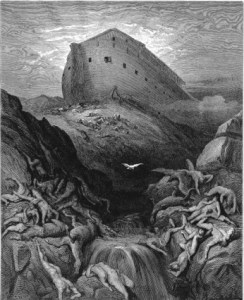
As a nation—perhaps as an entire western culture—we’ve laughed off religion. Secure that there’s no God up there to rain down, well, rain, we laugh and jeer at Noah. It’s a children’s story, after all, isn’t it? Okay, forget about the part where everyone in the entire world drowns, except eight people. And when he gets drunk and lays naked in his tent after it’s all over. Other than that, it’s a kid’s story, right? The story of the flood is one of the oldest myths in the world. It has been part of human story-telling for millennia. We now have very powerful people with smart phones in their pockets and access to vast hordes of money who believe it literally happened. And since God took care of his own once, he can do it again. The educated smirk. The smart start building arks.


Power in the Blood

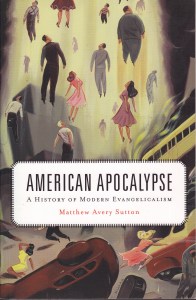
Converts, they say, are often the worst. It matters less what the conversion is to or from, since the zeal of the newly enlightened is impossible to match. The textbook example with religion, especially in America, is Evangelicalism. Those who’ve “found Jesus” are eager and too willing to tell others about it. You don’t often hear, however, of those who grew up Evangelical, but then had second thoughts. Often they disappear quietly. Evangelicalism is a potent force in American life. Intellectuals, embarrassed by it, tend to pretend it doesn’t exist. Or it’s on its way out. No need to approach, with nervous laughter, those who actually believe this stuff. Evangelicals, however, can get presidents elected and their zeal can take away any number of freedoms deemed “godless” by those who may have no more education than the local bartender. Matthew Avery Sutton’s American Apocalypse: A History of Modern Evangelicalism is masterful. Although not comprehensive (the movement is too large for that) this book does not shy from the unifying fact behind radical evangelicalism—the belief that the end is nigh.

Oh, I know. Those of us who are educated have no need to take such nonsense seriously, right? Sutton may change your mind on that. When you realize just how close to disaster after disaster this thinking has led (and continues to lead, under the current administration) us, you might want to take the Fundamentalists a bit more seriously. They constitute the largest religious bloc in the nation. One of the baffling things about them is their protean nature. What’s the difference between an Evangelical and a Fundamentalist? And what’s with the obvious differences between a Timothy LaHaye and a Billy Graham? And where do these people get all their money? (Fundamentalists have always been close to nearly endless, well, funding.) Republican presidents from far before Nixon realized that big business and conservative theology, although strange bedfellows, are remarkably compatible. (Each thinks the other side doesn’t realize it’s being used.)

American Apocalypse is an important book. Written before perhaps the strangest turn in US history last November, it might have helped to show that Trump was a serious threat from the beginning. If only the educated took it seriously. Evangelical antipathy to women’s rights, civil rights for minorities, and socialized medicine run very deep. It’s the Old Boys’ Club with a vengeance. Recent events have shown yet again how important it is to understand these ways of thinking. And those of us with insider knowledge have never been welcome in the academy. That’s okay, though. If I go back to my roots I’ll realize the world’s about to end any day now. Those who’re smart might think about taking equestrian training because I’m sure there will be white horses involved. If only I could get myself converted back.


Heresy Collection

Geology isn’t a great avocation for those of us with an unsettled existence. Having grown up with a fondness for fossils—maybe because they were so transgressive—my initial collection was tossed out because of a family move. Rocks are too heavy to take with you. I made the mistake of thinking, back in my Nashotah House days, that I was settled enough to let my rock-hounding sensibilities loose. Not that fossils were common, but Wisconsin has some great geological formations and I joined the Wisconsin Geological Society and even dragged my family along on some field trips. By the time Nashotah informed me my talents were no longer required, I’d amassed a few boxes that I was embarrassed to admit to the movers that, yes, contained rocks. New Jersey also has some great locations for rock-hounding, but my sense of being subjected to sudden, geologic career shifts has kept me from picking up nearly as many stones as I’d like to bring home.

The Museum of the Earth, here in Ithaca, is a dangerous place for someone like me to visit. I thought I had my fossil-collecting habit under control. The gorges in this region are famous for their fossils. Wandering through the museum, reflecting, as it does, the immense stretch of prehistoric time, it was obvious how arrogant humans are for assuming “control” of the planet. We’re so terribly late as to be classified as invaders on this planet. The world got by just fine billions of years without us. Perhaps that’s why I experienced transgressive fossils so captivating as a child. Ironically I found them in the creek bed right behind the Fundamentalist church we attended and where we were taught that evolution never occurred. I was fascinated by what I’d now call the juxtaposition of evidence and faith. We never questioned the reality of fossils. It was their interpretation that was the problem.

You can hold in your hand the most solid evidence that life evolved and call it heresy. Those delicate impressions of creatures dead for millions of years argue eloquently against Genesis and its mere 600 decades of world history. For me the fossils always won. On trips home from the seminary I would gather more fossils to add to the growing museum of time I’d been amassing in my basement. Then a Fundamentalist administration took the same approach as my exasperated mother trying to pack to move. Jettison the fossils. They’re heavy and they kind of make us uncomfortable anyway. Maybe the idea of too much time is something the biblically constrained simply can’t face. And when I see a fossil right there on the surface in one of Ithaca’s many gorges, perhaps I need to learn simply to let it lie.


Ellis Island

A few years back we made a trip to Ellis Island. This is a common field trip here in New Jersey, although none of my immediate family passed through this portal. The most recent immigrants in my own heritage seem to have arrived by the early 1800s. In any case, Ellis Island is an impressive location. Now a museum, you can wander through the rooms and get an idea of what newcomers faced after a long and trying ocean voyage. What struck me the most was that large numbers of people were turned away for mental problems. I suspect mental illness of one sort or another is unnervingly common among human beings, and our current frenetic pace of life probably only exacerbates the situation. Still, I wonder if we really have a clear grasp on what is “normal.”

As humans become more adept at understanding their own brains, a need for more precise definitions asserts itself. A friend recently sent me an article suggesting “Neurologists Have Identified Brain Lesions That Could Be Linked to Religious Fundamentalism” on Science Alert. The article my Mike McRae ultimately doesn’t suggest that brain damage is the answer to Fundamentalism, but the story reminded me of an unscientific observation by one of my seminary professors decades ago. Harrell Beck once said something along the lines of Fundamentalism isn’t a theological position, it’s a psychological problem. Indeed, those who fall into the literalist camp have a preternatural urge to see things in black and white. Rules that can’t be violated, even if it means your deity’s an angry old God. With literally Hell to pay if you’re wrong, the right course of action is strikingly clear. Only life’s seldom so simple.

We study our brains but we don’t have a baseline for normal. I can’t believe that waking before dawn to catch a bus to work a job that pays less than a successful high school degree in other states is a good bet by anybody’s standard measure of normalcy. Those who read probing biographies find that even our brightest and best have quirks they didn’t wear in public. Surely the physicians on Ellis Island had some guidelines in mind when they were turning away those who didn’t measure up to the standard of what an ideal American mentality should be. Although Ellis Island shut its doors over half a century ago, it’s clear that even if we kept some unstable candidates out, we’ve done a stellar job of growing our own. And that can be taken as truth by faith alone.


Trusting Truth

How do we know what’s true? For many the answer is what your experience reveals. If that experience involves being raised as a Bible-believer, that complicates things. A friend recently sent me a New York Times piece entitled “The Evangelical Roots of Our Post-Truth Society,” by Molly Worthen. For those of us raised in Fundamentalist conditions, this isn’t news. Then again, those raised Fundamentalist assume that everyone knows the truth but others have blatantly decided to reject it. It’s a strange idea, inerrancy. It’s clearly a form of idolatry and its roots can be traced if anyone wishes to take the time to do it. Inerrancy is the belief that the Bible is correct, tout court. It’s right about everything. If it contains one error, so the thinking goes, it topples like a house of cards. (Cards are sinful by the way, so get your hands off that deck!) If that’s your starting point, then the rest of the facts have to fall into place.

As much as I wish I could say that this simplistic outlook may be corrected by education, that’s not always the case. Many children of inerrantists are raised to question what they learn in school. Worse, many are home schooled so that they never have to be exposed to the sinful machinations of others until they try to enter the job market and are utterly perplexed by the fact that they don’t even speak a common language with the rest of society. Key code words don’t mean the same things outside that safe, withdrawn community where everyone knows the Bible and understands that to know it is to love it. Science doesn’t love the Bible, they’re taught. So science is wrong. It’s quite simple really. You already have all the information you need in one book. If science disagrees, then, well, you already have all the information you need.

There’s an internal logic to all of this, and dismissing the heartfelt beliefs of Fundamentalists only gets their backs up. It’s not about logic, but the emotion of belief. Some neuroscientists have been suggesting that we reason not only by logic but also with emotion. That complicates things, for sure, but it also explains a lot. For example, in a world where religion drives nearly all the major issues facing society, logic would dictate that universities would build up religion departments to try to understand this very real danger. Instead we find the exact opposite. Withdrawing into your own little world occurs on both ends of the spectrum. Dr. Worthen is to be applauded for bringing this out into the light. If society wants to benefit from this knowledge, it will need to stop and think about what it really means to be human. Fundamentalists, for all their foibles, illustrate that nicely.


The Scofield Connection

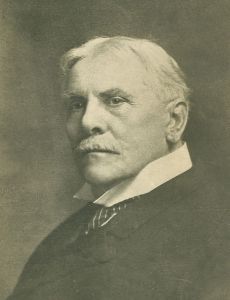
While reading about Cyrus Scofield recently—and that book has stayed on and played with my mind for some reason—I ran across the conferences that he held in preparing his famous reference Bible. Although he claimed the sobriquet “Doctor,” placing D.D. after his name, like many a self-puffer Scofield has no university that will support the claim. (It’s amazing how many high-level CEOs and “important” businessmen pad their résumés with false degrees. Even some government wannabes do it, and then they want to defund education after they get into office.) Perhaps because he had no seminary training, and likely didn’t even graduate from college, Scofield might’ve felt a sense of insecurity when it came to a very large book originally written in languages he couldn’t read. There’s a reason “King James Only” Christians exist. In any case, he set up meetings in a couple of conspicuous places to go over his work. One of those places was Grove City College.

Now, like many small, Christian colleges, Grove City isn’t widely known. Most of the student population—at least when I was there—was fairly local. Pennsylvania, Ohio, and New York, for the most part. Still on the (admittedly rare) occasion when someone asks me where I went for my undergraduate work, they generally haven’t heard of Grove City at all. Even though I spent four years of my life there, I had no idea about the Scofield connection until I read Joseph Canfield’s book. That’s because not all Fundamentalists grow up with Scofield. I’m sure I heard about the Scofield Reference Bible but I didn’t own one and I wondered what the big fuss was all about. After all, the annotations were the work of a man, and I was interested in the words of God. Far more popular was the revision of Scofield known as the Ryrie Study Bible, but I never read that either.

The end result is that many people think that Scofield’s words are “the Bible.” As I used to tell my students, binding pages together within a book makes a statement. If you’re saying “this is the word of God” and part of “this” is Scofield’s annotations, most people can’t distinguish between text and commentary. I eventually acquired a Scofield Bible, not for valid information, but simply for information. I was amazed at how poorly executed it was. Nevertheless, a true believer reading through the first chapters of 1 Chronicles is ready to accept even minimal narrative as divine. So it is that many Americans have come to believe in a Bible that’s not biblical. Religion is full of paradoxes and in this case I’d shared sleeping quarters with one in my more formative years although the connection was unknown at the time.


Mark of the Beast

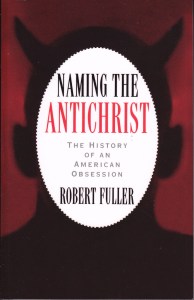
namingantichristI grew up believing in “the Antichrist.” As I came to realize that much of the New Testament pointed to contemporary problems (for them) with the Roman Empire and that what appeared to be predictions were actually safe ways to discuss forbidden topics, I began to worry less. It was about the past, not the future. Recent political events have ratcheted up my anxiety level again—maybe there is such an evil after all. Robert Fuller’s Naming the Antichrist: The History of an American Obsession is an important book in this regard. Although end-time worries have diminished among some now that we’re safely into a new millennium, for the true believer none of that matters. The Antichrist is a great motivator. I hadn’t realized until reading this book just how much of contemporary culture has grown from this fabricated fear.

Let’s get this straight from the beginning. In the Bible there is no figure known as “the Antichrist.” The generalized word antichrist is used only twice and in neither instance is the book in question Revelation. Early Christians speculated that the beast of Revelation might be “the Antichrist” but that identification wasn’t solidified until the beginnings of the Fundamentalist movement in the late 1800s. By the time Fundamentalism was a fully developed system, by about the 1920s, believing in the Antichrist and trying to identify him had become a cottage industry. I grew up in the shadow of Hal Lindsey and the pressing concern that “the Antichrist” was alive in the world today. Face it, The Omen loses something if he isn’t. This strange, non-biblical belief has come to define a large number of true believers.

Fuller’s book is important for the insight he brings into why some “Christians” are avowed enemies of peace, toleration, and the improvement of human conditions. Those who believe their tribe is the only correct one hold the double standard of ethical treatment of those inside and scorn and hatred of those without. This view believes that the world is to be condemned, natural resources used up, wars started, and civil rights suppressed, in the name of Christ. Perhaps you may begin to see why a chill ran down my spine as I was reading this book. We need to try to understand this perverted way of looking at the world in order to understand the forces that would rather see a dictatorial billionaire run the country than an eminently qualified woman. Reason’s got nothing to do with it. It’s all about conviction. Failure to understand that is perhaps the surest way to bring about the end of the world. We ignore religious thought to our own peril.


Behind Left Behind

Now that September’s here, we can begin thinking back over the summer, scratch our heads, and say “huh?” We’ve been so blinded by the Trump that we haven’t had time to reminisce over what’s been happening fundamentally. I mean among the Fundamentalists. This summer Timothy LaHaye went to his reward, followed this week by Phyllis Schlafly. I’m sure they’re basking in an all white, straight, and Protestant Heaven. For those of you unfamiliar with LaHaye’s name, you’ll know his fruits. The Left Behind series was his brainchild and many other aspects of this not-yet-raptured world spun from his squeaky-clean mind. He and Ms. Schlafly spent their lives telling others how to be good. I’m sure their only regret is that they won’t be here to be raptured away so they can see the look on the rest of our faces. No matter, they’ve gone to a better place.

Also this summer Lyle Jeffs, another sort of Fundamentalist, also disappeared. Under arrest for some suspected crime or other, Jeffs escaped from the FBI by worming out of an ankle monitor. His attorney, however, has suggested that Jeffs was raptured instead. Come to think of it, that could explain these other disappearances as well. It’s a regular Bermuda Triangle of Fundamentalists, it seems. The rapture is the ultimate excuse because the Almighty can trump any suit, any hand. Maybe they all just wanted to get off the earth before this fall’s elections. Fundamentalism, it seems, is missing from the political docket this year. Whereas since I’ve been able to vote candidates have been raising issues of concern to the more right-wing contingent, this year the fundies seem to have vanished. Maybe the rapture did occur after all.

teachings_of_jesus_39_of_40-_the_rapture-_one_at_the_mill-_jan_luyken_etching-_bowyer_bible

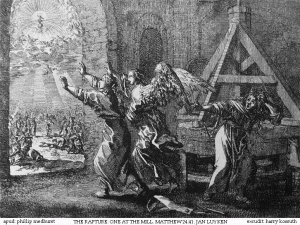
You see, I’ve read enough of the scenarios to know that those left behind are always confused. They don’t believe in a rapture and the missing people are only part of the problem. Things are going awry (again, look at the politics and differ!). What will life be like in this post-rapture world? How will we survive with our conscience gone? All things considered, it’s going pretty well. Missing the rapture was one of my greatest childhood fears. Like all good Fundamentalists I assumed I wouldn’t be deemed worthy of that first reaping. I’d be left to suffer through tribulation and, hopefully, beyond that salvation might lie. LaHaye and Schlafly got out before the action started. Lyle Jeffs, his lawyer suggests, did too. The FBI found olive oil all over the ankle tag and, perhaps, the signs of a struggle. I’ve watched enough movies to know that when someone is raptured, however, all their clothes are left behind. The only way mortals ever face the Almighty is naked as the day they were born again.


In the Details

To a certain mindset, nothing conveys a threat quite like Satanism. Many parts of the world witnessed this dynamic during the “Satanic scare” of the 1990’s. In reality, however, most groups identifying as Satanism do not believe in a Devil and, often enough, don’t engage in worship. These groups are a reaction against aggressive Fundamentalism. For example, a Washington Post article timed as parents (at least) are thinking of back-to-school worries, announces “An After School Satan Club could be coming to your kid’s elementary school.” News headlines are intended to make you want to read a piece, and this one worked in my case. It turns out that the Satanic Temple, the group behind this current initiative, is one of those rationalist groups that doesn’t believe in the Dark Lord. They object, however, to schools allowing Good News Clubs to meet after school hours and want to make a point by offering alternative programing. Devil-themed, but not Devil-believing.

It’s difficult to imagine this kind of situation developing in many world cultures. It raises some very basic dilemmas where two conflicting freedoms co-exist: freedom of speech and freedom of religion. Most people would agree, upon reflection, that public schools should not be used for religious instruction. After school programs, in the minds of kids, still take place “at school” and are not easily separated from regular instruction. (Just ask an undergraduate what an adjunct instructor is and you’ll see that they pay little attention to administrative issues like that.) Fundamentalist groups, such as Good News Clubs, use freedom of speech as their wedge to offer after school programs. It’s not “school,” and it’s after hours. Don’t we allow freedom of speech, and isn’t there space available? Good News Clubs are, of course, evangelistic engines. The Satanic Temple makes the claim that if one religious group can meet after school, so can another.

Neither academics nor society have a good understanding of literalist beliefs. Those of us who once believed—sincerely believed—Fundamentalist teachings are a resource academia has chosen to ignore. Higher education is still an “old boys network” where jobs are offered on the basis of who you know and not on the basis of the knowledge they might offer to students. This, I suppose, is yet another clash taking place. Fundamentalism may seem laughable from the outside, but from the inside the untenable beliefs are taken with deadly seriousness. After school programs are an expression of a very deep-rooted fear that such religions promote. Satanist groups will get headlines by taking them on, but they will continue the conflict rather than offering dialogue to try to understand. They’re only doing what higher education teaches them to do—support those you like instead of trying to move knowledge ahead. Perhaps that’s the real work of the Devil after all.


Camping Season

Summer is the time for camp. I’m not into extreme sports, like sleeping outdoors in the snow, so in my mind, summer is the time for camp. While in college I spent two summers as a counselor for the Western Pennsylvania United Methodist Conference camps: Wesley Woods, Camp Allegheny, and Jumonville. These were formative experiences for me since I’d never camped as a kid (beyond sleeping on the front porch and an ill-fated attempt at Boy Scout camp one winter), and certainly not in a Christian context. My wife recently sent me a story in The Guardian about Jesus Camp. The documentary is a decade old now, and people are wondering if the religious indoctrination of children is child abuse or what. As always in such situations I tell myself the real issue is that you can’t understand Fundamentalism unless you’ve believed it. Really believed it.

IMG_2856 copy

Some psychologists claim children can’t conceptualize God. Many adults can’t either, but for those who try, what they believe is true. The Fundamentalist parent doesn’t attempt to deceive his or her child. The thought of having your own children suffer eternally in Hell is a wrenching, and very real one. A convinced adult is morally, viscerally, and utterly compelled to teach her or his child the truth. Anything less would be monstrous, hideous, and inhumane. Critics from the outside say that such nonsense damages children psychologically. I have to admit that watching Jesus Camp made left me feeling enraged and, in some measure, victimized. The untold reality, however, is that apart from some cases of deep insincerity, most Fundamentalists truly believe what they teach their children. They’re not trying to abuse any more than a parent who teaches their progeny that the stove is hot. They want the best for their kids and life is full of uncomfortable truths.

Richard Dawkins, notably, has argued that teaching children religion is a form of child abuse. The fact is nobody knows the truth about religion. All we can do, scientists included, is believe. Believe for or against or somewhere in the middle. God, by definition, stands outside the reach of empirical evidence. Perhaps it’s just a trick of consciousness, but we have to leave the possibility open. We don’t even understand consciousness yet. Rare aberrations apart, people love and care for their children. They try to give them the best that they can, and that includes their religion or lack thereof. I saw some strange stuff at church camp. It wasn’t in any sense “Jesus Camp,” but it’s safe to say it changed my life. On the brink of fully legal adulthood I was coming to learn that certainty was impossible, and the only honest way to be in the world was to admit that we all, in some form, believe.