Not the Exorcist

It’s too bad The Pope’s Exorcist didn’t come out before Nightmares with the Bible.  In that book I tried to make the connection between demons and nightmares and in this movie Asmodeus, the “named demon” gives his name as “Nightmare.”  Released in April of this year, The Pope’s Exorcist received a considerable amount of fanfare.  Starring Russell Crowe as Fr. Gabriele Amorth (two of whose books I’ve posted on), the entirely fictionalized account ends up coming across as, I shudder to say it, rather silly.  Using just about every exorcism movie trope available, the film goes over the top and really doesn’t have much scare in it.  Let’s start from the beginning.  Fr. Amorth is in trouble at the Vatican but the Pope’s his personal friend, so no worries there.  Meanwhile an American woman has inherited a decrepit abbey in Castille, Spain.  Her late husband owned nothing else and she has to be there personally to oversee restoration, dragging her two kids with her.
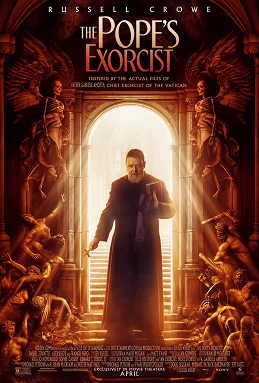
It turns out that this abbey contains evidence of a centuries’ old conspiracy during the Spanish Inquisition covered up by the Vatican.  It’s also the home of Asmodeus, king of Hell.  And one of 200 locations that fallen angels came to earth.  After the demon scorches a couple of restoration workers, the woman, Julia, is left in the spooky abbey alone with her kids.  They both end up possessed, but the boy, Henry, is the focus of the body horror.  Since Asmodeus has clearly seen The Exorcist, he says outright that he’s after Fr. Amorth, who is sent by the Pope himself to take care of this.  To save the boy Amorth has to be possessed in his stead (as in The Exorcist).  Together with a younger priest (really, is any of this sounding familiar?), the demon eventually has to capitulate.

Apart from not being “based on a true story,” the movie also takes seriously the fictionalization of characters.  “The Pope,” never named, in the 1980s was John Paul II.  He’s portrayed as bearded and in poor health.  Amorth (Crowe) is also bearded, although historically Amorth, like most Roman priests, was clean-shaven.  The “silliness” of the movie derives from not having researched Roman Catholicism thoroughly.  All of this makes me wonder if an exorcism movie can be made that surpasses The Exorcist.  Much has been written on that movie since William Friedkin recently died (and much was written on it before).  It’s difficult to put a finger on just what made that film so superior.  It doesn’t stop others from trying, of course.  And now there’s talk of a sequel for The Pope’s Exorcist.  The nightmares, it seems, never end.

What’s the Story?

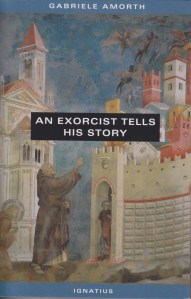
Belief is truly an amazing phenomenon. Even as we see it play out daily in the news, rational people ask themselves how people can accept something that all the evidence decries; just take a look at Fox news. In any case, those who study demons come up against the name of Fr. Gabriele Amorth with some frequency. Amorth was a true believer. Earlier this year I read one of his books and I wondered if he might reveal more in An Exorcist Tells His Story. Forgive me for being curious, but I really am interested in his story—how did this man become the passionate spokesperson for exorcism being reestablished in every Catholic diocese? What were the personal experiences that led him to this? Who was he?

Some people can’t write about themselves. Some, and I suspect clergy often fall into this trap, can’t write without the material becoming a sermon. This book is such an extended homily. Along the way Amorth does discuss a few cases of demonic possession and how it is to be confronted, but mostly he discusses the theology of his view of Catholicism and how that is essential to understanding demons. What is most odd about this is the inconsistency of a true believer in Catholicism admitting that Protestants too can drive out demons right after declaring the Roman Ritual is the only way for Catholics to do so. And only bishops, or those priests appointed by them, are permitted as exorcists. Is this a case of the enemy of my enemy is my friend? Protestants, according to the theology he espouses, shouldn’t be able to do this. If they can, why doesn’t it make him question his faith?

Known for his thousands of exorcisms, Amorth continues to have a healthy following. Anyone reading this book for a consistent outlook will be left wondering. How can Catholic exorcism work only if it follows the rules, and Protestant exorcism work when it is done by those who believe falsely? The same applies to his assertions that those who are possessed are not morally at fault, for it is the demon that makes them do evil things. At the same time those who lead “immoral” lives—according to Catholic standards—are more likely to become possessed. A few pages earlier we’d been told about saints who’d been possessed. I don’t mean to suggest anything about Amorth’s faith commitments—it’s celestially clear that he was a true believer. His commitment to help those who were possessed was legendary. Perhaps it’s just that demons are agents of chaos, and in such circumstances even theology can become a victim. I’m still wondering about his story, though.


Candles vs Demons

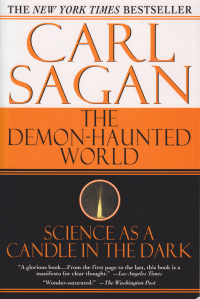
Among scientists who write Carl Sagan has always struck me as one of the more open minded. Dedicated to the scientific method, he nonetheless admits that there are some things scientists don’t know. The last time I was in Ithaca, therefore, I picked up a copy of his tour de force, The Demon-Haunted World: Science as a Candle in the Dark. I wasn’t really sure what to expect—I’ve been researching demons and I supposed they would be addressed in his book, since they feature in the title. Although that is indeed the case, the book is a collection of essays vindicating in various ways the practice and teaching of science. It is quite a scary book. It was also Sagan’s final book published in his lifetime.

Reading this just after Gabriele Amorth’s An Exorcist Explains Demons, noteworthy for its credulousness, The Demon-Haunted World was like whiplash into reality. Back into the realm of observable facts and testable hypotheses, it was indeed like a candle in the dark. Sagan admits that science can’t speak definitively on the supernatural—something that sets him apart from other science writers—but that doesn’t mean we shouldn’t apply scientific thinking anywhere it’s appropriate. And that includes the universe of politics. Published some two decades before the rise of Trump, the book is surprisingly prophetic when it points to the possibility of the rise of fascism in a nation that distrusts science. Indeed, the book shows Sagan clearly worried that an authoritarian, totalitarian government was on the rise. It’s almost preternatural in its accuracy.

The tome is large enough to dissuade a full summary within the word-limits I set for myself on these daily posts, but I can say that this book is necessary now more than ever. Sagan was a celebrity in his lifetime, a “rock star” scientist. Even so he worried about the deplorable state of science understanding among political leaders he met. For many years America has been mired in conservative causes that distrust science implicitly. Another strain that runs throughout this book is the need for education. Not only has America catered to anti-science groups, it has fallen behind much of the rest of the world in science education. Those who claim to make America great again can’t see that their very tactics have made our nation fall behind the rest of the world when it comes to education, across the board. Surely Sagan was right that a good grounding in scientific thinking is the equivalent of lighting a candle. As for the rest of the country it has been getting darker and darker, and our “leaders” have no idea even how to strike a match.