Weird Films

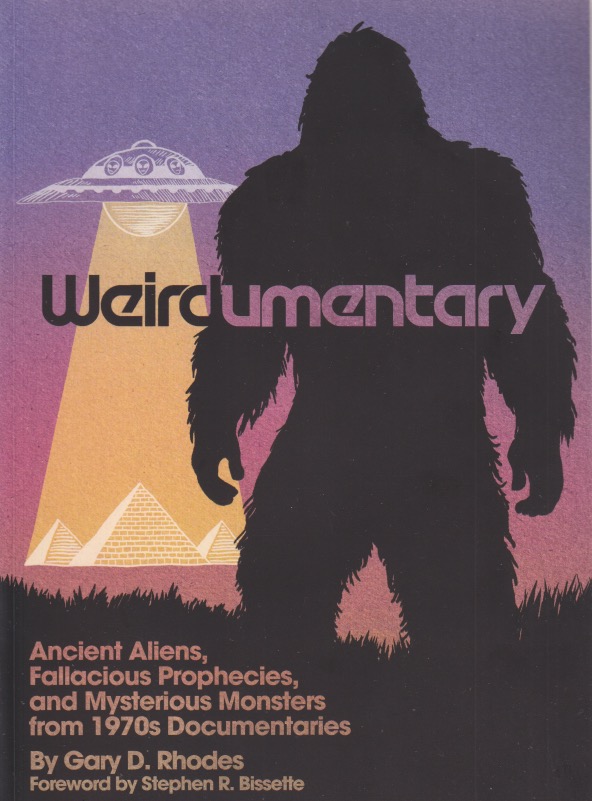
I’ve read Gary D. Rhodes before and found him informative and enjoyable.  Although I hope his recent offering Weirdumentary moves beyond its ideal readership, I suspect I’m among that class.  I was alive and somewhat aware of cinema during the period under discussion—the 1970s—and I even saw a few of these films in the theater, as well as watching some of the television offerings.  I think Rhodes is correct in pointing out that this genre was a product of its era.  And what a strange time the seventies were!  I grew up watching the series In Search of…, which is discussed at some length here.  But before I get more into it, I should explain that a “weirdumentary” is a pseudo-documentary that has characteristic features such as dramatic recreations, questionable authenticity of at least part of what it covers, and often a famous personality as a host.

The book is handsomely illustrated with pictures that will offer a nostalgic rerun of the seventies for some of us.  It divides the material into eight sections:  the proto-weird, ancient aliens, UFOs, the Bermuda Triangle, the paranormal, mysterious monsters, speculative histories, and prophecies.  The proto-weird are this kind of documentary from before 1970, and the rest of the categories sometimes bleed into one another.  Not to detract from this excellent book (it’s often quite witty), my mysterious mind thinks a straightforward chronological treatment might’ve worked better.  “Paranormal,” for example, could cover quite a few of these topics.  Still, the organization of a book can be a personal thing and this layout, with “prophecies” at the end, works well.  A number of speculative religious films make the list, including In Search of Noah’s Ark and Late Great Planet Earth, both of which made it to my small-town theater, and drew me in back in the day.

I also admit to having spent some of my summer earnings to see Mysterious Monsters.  And maybe Chariots of the Gods—although I can’t remember for sure.  I certainly read the book.  Rhodes begins by explaining how 2001: A Space Odyssey set up viewer expectations for such films as these.  I definitely saw that one when I was young.  So the ideal readership here would seem to be those born in the sixties who were old enough to see these movies (and television programs) when they were making their initial rounds in the next decade.  Kids suggestible enough to believe the pseudo-science of many of these offerings, who would grow up to look back on them nostalgically.  Written with a light touch, but true appreciation of the subject, this book was a great way to relive one of the strange segments of my early life. 


2020 in Books

As has become traditional on this blog, I like to revisit my reading for the year before the next one begins.  No matter what else goes wrong, we have books.  As I noted yesterday, I’ll be devising my own reading challenge for the coming year and if nothing else, it’ll be diverse.  For 2020, according to Goodreads, I finished 78 books.  Since I was in the final stages of getting Nightmares with the Bible to the publisher, several books early on were about demons, and many of them were quite good.  The nonfiction that really stick out in my mind, however, includes D. W. Pasulka’s American Cosmic, Richard King’s Ahab’s Rolling Sea, Gary D. Rhodes’ The Birth of the American Horror Film, Jeffrey J. Kripal’s Secret Body, Barbara Ehrenreich’s Living with a Wild God, and Ernestine Hayes’ The Tao of Raven.  If anything ties these books together it is likely their honesty when it comes to the spiritual quest.  It can legitimately take many directions.

Fiction has, at least for much of the year, been driven by a few factors: books I have on hand during a pandemic, The Modern Mrs. Darcy’s reading challenge, and books on my reading wishlist.  That list is constantly growing and the books that stand out particularly are again diverse.  Especially memorable were Ralph Ellison’s Invisible Man, Hank Green’s An Absolutely Remarkable Thing, Han Kang’s The Vegetarian, Scott Shibuya Brown’s The Traders, Andrew Michael Hurley’s The Loney, and Silvia Moreno-Garcia’s Mexican Gothic.  Apart from their diversity these books have little in common.  I suppose that’s a testament to the importance of reading widely.  On that list there are only two “white” men but a lot of great books.

Another couple of categories might apply: big books and short story collections.  Big books intimidate me, but I read five of over 500 pages: Ellison’s Invisible Man again, Herman Melville’s Moby-Dick, Mark Twain’s The Innocents Abroad, George Eliot’s Middlemarch (my longest book for the year), and Ann Radcliffe’s The Mysteries of Udolpho.  These books are all in the “classics” category, I see.  Short story collections are more edible, and I read nine of them, including four “by” Rod Serling.  The first was an edited collection of his works, and the other three were his own Twilight Zone adaptations.  I read a few plague books because of the pandemic, but they weren’t really among my favorites.  Perhaps they were a little too close to reality.  Nevertheless 2020 was a good year of reading, overall.  I’m looking ahead to what gems 2021 might hold.


The Birth of Horror

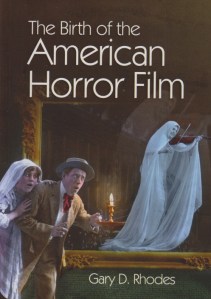
In both Holy Horror and Nightmares with the Bible I concern myself with horror films that have appeared since 1960.  I’m not enough of a cinema studies type to argue eloquently about the various stages of the horror genre on celluloid, but the many histories I’ve read settle on 1931, the year Universal’s Dracula and Frankenstein both appeared.  Dealing with more contemporary fare, I often use that as a mental benchmark.  Gary D. Rhodes has changed  that perspective, however.  The Birth of the American Horror Film is a somewhat sprawling treatment of a subject that’s more involved than I had supposed.  Early films didn’t suddenly appear, of course, and Rhodes spends some time surveying what came before the film that eventually produced what we recognize as cinema.  One of the things he notices is that which we call “horror” was pretty much there from the beginning.

Call it morbid curiosity.  While not everyone admits it, it is a pretty widespread human condition.  After surveying literature, theater, and visual culture, Rhodes moves on to consider many different genres of pre-1915 horror.  Some of them don’t strike every reader as horror today, but that’s a point I tried to make in Holy Horror.  The definition depends on the viewer.  Rhodes suggests throughout that American viewers tended to prefer non-supernatural horror.  While statistically this may be true, he devotes several chapters to genres that fall into the supernatural category.  These were, in the opinion of this reader, the best in the book.  One of the reasons is that horror and the supernatural naturally go together.  Many of us working in this field have noticed, some with embarrassment, that the two are closely related.

What might strike other readers as starkly as it did me, is just how terribly prevalent “horror” films were before there was a proper genre.  Rhodes makes the point that even if we like to think otherwise of ourselves, if there hadn’t been a substantial market for such movies they wouldn’t have thrived.  Some of them, like murder mysteries and other dramas, we might cast more as “thrillers” today.  I included a few of them in Holy Horror.  The real terror, however, often arises from subjects that were somewhat taboo in the late eighteenth and early nineteenth centuries.  Religion was handled with all seriousness.  I wonder if this might be one of the reasons that the supernatural didn’t appear, in the early days, as much as it would later.  This is one of those books that raises many questions such as this, and that makes me glad that the author is working on a sequel.