Portrait of an Artist as a Young Woman

The world is a topsy-turvy place. In times of turmoil people turn to the old, the familiar, the classic, for assurance of continuity and stability. Ah, those halcyon days! Perhaps the newspaper is not a place to seek solace, but as I was flipping through the Friday edition, usually a little lighter after the dread of another week, I noticed a story about Leonardo da Vinci (before the code made him famous).
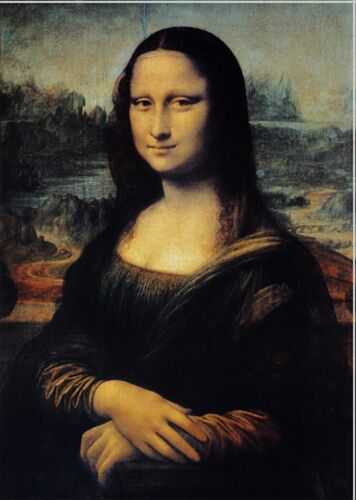
Self portrait or mirror?

For many centuries people have pondered the understated smile on the Mona Lisa’s placid yet knowing face. Recent forensic-type investigations are now strengthening the old suggestion that the Mona Lisa was actually a self-portrait of the artist as a woman. Some will, no doubt, find such news distressing – a masculine artist portraying himself as feminine? (Surely such a thing has never been done before!) Most concerned of all would be the Religious Right, a group that seeks a god excelling in sharp distinctions. Either male or female, no intersexuals need apply!

Over the past several months I have been reading Stephen Asma’s On Monsters, a book that can’t really be called “enjoyable,” although it has been eye-opening and informative. One of the recurrent themes throughout the book has been the fear of the liminal being conjoined with our growing understanding that sharp distinctions are rare. Ever since Freud it has been known (at least subconsciously) that people participate in aspects of both genders with social constructs determining which role is to be filled, feminine or masculine. Those who look honestly at the aggregate of the human race realize that we are all points on a continuum rather than simply members of one or the other gender. As Asma points out, however, we prefer distinctions.

In painting himself as a woman perhaps Leonardo once again proved himself ahead of his time. Perhaps the Mona Lisa is a mirror we should long gaze into before judging others on the basis of artificial distinctions.

Live and Let Love

The vote on homosexual marriage comes up in New Jersey today, and headlines are tense with anticipation. The New Jersey Star-Ledger’s assonant alliteration announces “Same-sex showdown” on page one. Protesters for and against are both shown in photo-ops as the sides line up for this epic battle of morality. Or is it?

“Same-sex” is a phrase I find offensive. One of the uncontested realities of life is that gender is much more complex than is usually supposed. Intersexual individuals (sometimes still called hermaphrodites) make up a larger part of the population than most citizens are consciously aware; studies suggest that in the United States the number may range from 50,000 to 5,000,000. Worldwide the number is likely higher. If the big guy in the sky wants to make gender straight and clear, we are receiving mixed messages.

If we are honest about this, we need to admit that what is on the docket is not morality but power. Apart from a few purists who have no choice on what to say in the matter, people are now widely aware that sex is not just for procreation. Studies of animal populations demonstrate this, and any number of people who use birth control, for whatever reason, also know it. Once sex is released from its procreation-only bounds, then where is the moral qualm within committed, loving relationships? The Bible says much, much more about adultery than it does about homosexuality (but don’t tell that to televangelists or Republican elected officials). Both are eligible for the death penalty.

One of the groups shown protesting in the paper is Torah Jews for Morality. They hold a sign reading, “Gay Union A Rebellion Against the Almighty.” One wonders what they are afraid of. The Torah is only binding on those who adhere to Judaism, no matter what Christian groups say. This is one point on which Paul and Jesus actually agree.

If we follow logic rather than emotion on this issue it is clear that all that is preserved by refusing marriage to homosexual couples is the privileged status of heterosexual couples, whether they engage in adultery or not. Society turns a blind eye to infidelity while going ballistic over committed homosexual union. So pick that gnat out of your teeth and get ready for swallowing a camel.


Anat, Kali and the Violent Femmes

“Women and men,” runs the chorus of the They Might Be Giants song of that same title, “… everywhere they go love will grow.” Women and men. Thus it has always been. The Sumerians seem to have speculated, on a broken tablet concerning the creation of humanity, that some six varieties of gender had been ordained by the gods. This story reminds me of just how dicey gender definition can be. Despite the howls of protestation from man + woman = marriage crowd, the concept of gender is actually complex and diverse. The lowly slime mold of the genus Physarum has a combination of multiple sex-controling genes mixed with several different types of sex-cells, leading to a bewildering 500 different sexes. You’ve got to wonder what the Physarum bar-scene is like! So the whole women and men combination seems a little tame by comparison.

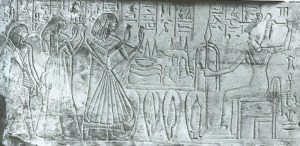
The ancients did, however, toy with standard gender role concepts. The Ugaritic goddess Anat, sometimes described as a “tomboy,” was perceived as a literal femme fatale, joining her in the company of Ishtar and Kali as warrior women-goddesses. She was a proto-Amazon (before they laid aside their male-bashing and set up a very lucrative web-site). Anat wears the severed heads and hands of slain warriors and stomps in blood-puddles, laughing all the while. Where did the ancients derive such violent feminine images as Anat and Kali? Some sociologists suggest that these myths were intended to solidify gender roles, although they seem to confuse the violent male with the shy and retiring female stereotypes. Perhaps the Ugaritians and other ancient folk knew deep down that gender is only a vague attempt to classify something that is really far more complex than it seems. Just when gender is nailed down you find yourself in a bloody mess as Anat swats at you again and again.

Anat ready to smite Egyptians who just don't understand the Violent Femmes

Anat ready to smite Egyptians who just don\’t understand the Violent Femmes

Nashotah is not far from Milwaukee where the folk-punk, genre-defining band the Violent Femmes started out. In college many of my overtly Christian radical friends told tales of how the Violent Femmes were a closet Christian rock group, based on some of the religious themes in Gordon Gano’s lyrics. When I listen to their CDs, however, I hear the same old angst that has plagued humankind for ages — what does a guy have to do to impress a girl (the same question may be reversed, turned upside-down, or dis-and-re-articulated, depending on whether you are female, male, or slime mold). At Ugarit they would have understood the Violent Femmes — listen to “to the kill” and tell me it’s not so! I would suggest that Gordon and the guys aren’t as much closet Christians as closet Ugaritians, struggling with the Anats and other violent femmes of their world and trying to make sense of it all.