
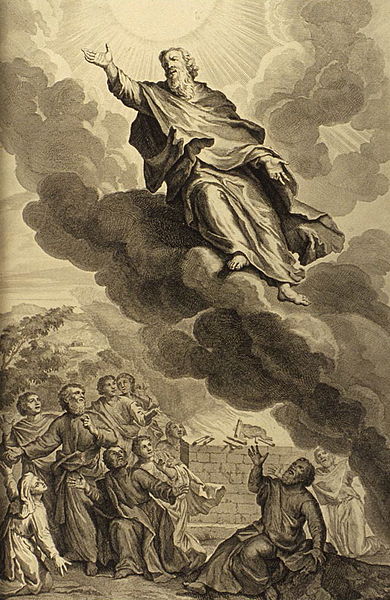
“And all the days of Enoch were three hundred sixty and five years: And Enoch walked with God: and he was not; for God took him.” These two verses from Genesis 5 convey just about all we know of Enoch. That, and he was the father of the oldest man ever, Methuselah. With this intriguing introduction, however, the religious mind insists on a backstory. Over the centuries of antiquity, books grew about this mysterious character as he became the prototype of the person who never died. The Bible doesn’t state that Enoch didn’t die. Nor does it state that he did. Plenty of wiggle room for the mythic imagination. In what appears to be an unrelated story, the Chronicle of Higher Education this past week reported on technology that builds on the strange but natural idea of phantom limbs.
When a person loses a limb, sometimes they report still feeling it. Their brains grew in a body that possessed the limb, and once it is gone the brain still has memory of it. The term used for this is a phantom limb. Knowing that mind does control matter to some extent, robotics experts have figured out ways to wire a robotic limb to the brain of a paralyzed person that responds to brain signals sent to the phantom limb. As much like science fiction as it sounds, this is already happening. The robotic limb responds just like a biological limb. This technology is just developing, of course, and is very expensive. It also implies that cyborgs, once the fodder of futuristic fiction, are becoming reality. Some theorists, such as Raymond Kurzweil, suggest that the brain itself can be converted to electronic signal and transferred into mechanical storage. Once that is achieved, we will have Enoch without any God to take him.
The world that we’ve been engineering bears a strange resemblance to the world of the Bible. For the people of ancient Israel death was the final word, and with rare exception (the only unquestioned case of the undying man was Elijah) people simply accepted the inevitable with no concept of an afterlife. Contact with the Zoroastrians convinced some Jews of the possibility of life beyond death and the quest for immortality was on. It has been a desideratum of human aspirations ever since. We invented machines to help us do what nature has not equipped us to attain. Finer and finer lines have been drawn between the biological and the mechanical. While it make look like immortality to some, to others it seems that we have been kidnapped—taken, if you will—by technology. What really happened to Enoch? The Bible doesn’t say, but it seems that we are getting very close to finding out on our own.

 Steve A. Wiggins