Making History

We should learn from our mistakes. This is something of which historians are keenly aware. James Grossman, executive director of the American Historical Association addresses the recent concerns raised on campuses throughout the world of removing monuments to historical founders who’ve fallen from grace. The dead white man has been out of favor for some decades now, but Grossman, as an academic, is keenly aware that we can’t take only the good from history. Who would ever read it if it was all sweetness and light? History is who we are, and there are unlit corners in every soul and although we prefer to think of ourselves as victims, we sometimes find ourselves asserting our will over that of others. It’s only human. The related question Grossman addresses is that of monuments. The winners of the moment, after all, incise the figures in stone and cast them in bronze.

IMG_0814

As an example, he notes, Stone Mountain in Georgia commemorates leaders of the Confederacy. Knowing that slavery is, was, and always has been wrong, casts a strong shadow of emotion over such monuments. The question is how to handle them ethically. I recently mentioned female figurines from ancient Israel in a post. Although they offend some, we know not to destroy them because they tell us something of how we became who we are. We have a moral obligation not to run from the darkness. We need to be willing to face who we really are.

History is interpretation. Everything that has ever happened is potentially a part of it. None of us has the scope, the breadth, the depth, to understand where any of this may be ultimately leading. We can only interpret. Religions, often positive, but also often negative, play an important part in that history. We can be assured they will continue to make history in the future. We have, as a society, decided religion isn’t worth our time to learn about. Our institutions of higher learning can less about history or religion than about business and economics. Ethics? Isn’t that somewhere in the philosophy department? You’re welcome to it, if you can find it. Meanwhile monuments are raised to trump the naysayers, and history becomes what we decide to make it.
Atlanta Bound

IMG_2600

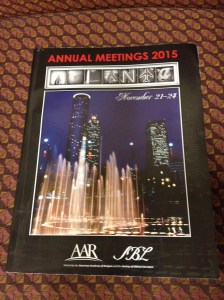
Every year as the latter half of November rolls around, the mind of religion scholars goes toward the American Academy of Religion and Society of Biblical Literature Annual Meeting. This morning I’m off to Atlanta to join a myriad of others who still think the academic study of religion is a good and noble thing. For those who read this blog regularly, it will be no surprise that I’m giving a paper this year. Honestly, I’m a little nervous. I haven’t delivered a paper in years—it is nearly impossible to do research when you are cut off from academic libraries and, more importantly, the time it takes to do the work. Having only weekends to pull ideas together is not conducive to pushing the frontiers of knowledge forward. Sleepy Hollow came to my rescue this time around. That, and reception history.

Reception history is the hermeneutic that looks at the Bible from the point of view of later interpreters. For the Hebrew Bible that reception might be that of the New Testament, or even later books within the Tanak itself. Of course, the Bible has been studied and interpreted for nearly two millennia now, and not all those reading the Good Book have official training. Increasingly, with religious extremists making headlines from decrying the color of Starbucks cups to an all-out attack on Paris, understanding the reception of religious texts is important. The Fox network hit Sleepy Hollow is an excellent example. The show begins with the Bible and although the end has yet to be determined, Scriptures have played a role throughout. And a viewership of pitiful biblical literacy drinks it all in. It is important to understand how the Bible has been, and is being, perceived.

It may be, over the next few days, that my posts will be disrupted from their usual schedule. It is always a little hard to predict how things might play out when you’re away from home. I’m not sure what wonders Atlanta might bring. My own book should be on display in the book stalls for the first, and likely only, time. I will be meeting with people from dawn to dusk, discussing their book ideas. And I will, of course, be listening. Listening for the gallop of horse hooves in the background. Yes, the meeting is always a stimulating event, and with apocalypses in the news, I think I have selected a very timely topic this year indeed. If the frogs croak my name, I will know it is only my imagination.


Science Friction

What hath CERN to do with Jerusalem? It might seem that the House Committee on Science, Space and Technology would be a reasonable place to look for members of Congress with a grip on science. But then, I often live in a fantasy world where things make sense. It is with some sadness, but no real surprise, that I read about the words of Georgia Representative Paul Broun, lambasting evolution and the Big Bang as theories from the Devil. Broun is a medical doctor who, under conviction of his Fundamentalist faith, has rejected the basic tenets of science. According to the Associated Press, he told a Baptist church congregation, “All that stuff I was taught about evolution and embryology and Big Bang theory, all that is lies straight from the pit of hell. And it’s lies to try to keep me and all the folks who are taught that from understanding that they need a savior.” Sounds like Satan had a very busy pre-history.

Anyone who knows me knows that I begrudge no one their personal religious beliefs. Someone who does not believe in embryology, however, might have selected a career more commensurate with his religion than medicine. Election year does tend to bring out the shock value statements in politicians. Having to convince their constituencies that they are just simple folk, they deny what their faith belies every time they accept an inoculation. If evolution is a lie, so is vaccination—something most medical doctors would have to have understood before facing medical school examinations. In the United States, however, such wrong belief is a generally apt qualifier for Congress. Especially among the Tea Party. Broun hails from the ironically named Athens, Georgia.

Over the weekend I watched the Star Trek (original series—please, I’m a connoisseur) episode, “The Mark of Gideon.” It is one of the episodes I don’t recall from childhood, but then, with Kirk and all that “mushy stuff” of being alone on the Enterprise with a woman, well, maybe it just didn’t stick when I was in my tender years. In any case, the symbolically named Gideonites have overpopulated their planet to the point of disaster by good clean living. They attempt to hijack themselves a disease “inadvertently” to reintroduce population control. Captain Kirk asks why they don’t use safe methods of birth control, even volunteering the Enterprise to be a kind of inner-galactic condom-dispenser. The Gideonites explain that they believe all life is sacred, and that preventing life is a great crime—regardless of the misery it causes. I had to smile to myself. Sounds like the people of Gideon may have had been lectured by a Georgia medical doctor who had gone off on a peculiar flight of fancy.


Deliverance from?

At times it seems strange that I missed so many formative movies when I was growing up, but then my wife pointed out that many of the films were released when we were minors. That, combined with the fact that most of them bore R ratings, acted as an effective deterrent at the time. So it was that we only saw Deliverance yesterday. References from friends, colleagues, and even The Simpsons made us feel like we’d missed a part of American culture that everyone else had seen. Of course we knew the basic story, but seeing it played out intact is a much more satisfying experience. Since I am scheduled to do a church talk on Christianity and the movies later this morning, I was interested in the way the church is portrayed in the movie.

After the three survivors make it back to civilization, the first building that meets them at the riverfront is a plain white “Church of Christ.” At the moment of their eponymous deliverance, the church is there. As Ed and Bobby are being driven to the hospital in a taxi, however, the church appears again. The valley is being flooded to bring hydroelectric power to Georgia, the reason the men set off to see the river in the first place. Since the town is shortly to be flooded, the church is being moved. The taxi driver tells the men, “We might have to wait a minute for the church to get out the way.” In the extras director John Boorman spoke about the highly symbolic nature of the film, including the way that the symbol of stability in the community, the religious establishment, could not hold its own ground.

I also sensed another element of irony here. The church had been, symbolically, in the way of the advancement of civilization. Paralleling this inhibition is the utter, and bewildering freedom from the law experienced by the men following the murder of the mountain man. The viewer is left to decide which is the worse fate. Now that I have seen the film, I think I can understand the depth of struggle it represents. As the continuing debate on the relative merits and demerits of religion in society rages on, there is always a very human aspect that stands beyond simple formulae. Perhaps we save religion in the hope that it will save us.