Odd Getaway

It’s small.  Almost cramped, you might say.  But then again, a Pennsylvania Railroad caboose wasn’t really designed to be a two-bedroom apartment with en suite bath.  Why the Gideon Bible was laid open to Ezra 2.62–4.19 I couldn’t fathom.  I suppose the story begins in Wisconsin, and ends up with me deep in Trump territory for an overnight getaway.  Let’s start at the Badger State.  I’ve always been a sucker for the unusual.  In that regard, I suppose getting a job at Nashotah House was inevitable.  When I spied Weird Wisconsin in Books & Company in Oconomowoc, it became an obvious birthday ask.  When we moved to New Jersey I learned that Weird NJ was a magazine as well as a book, and I bought, and read, every issue.  I also bought both volumes of the book and those of nearby New York and Pennsylvania.  It was in the latter that I first read about it.

The Red Caboose Motel began as a kind of a lark in the late sixties.  A Lancaster county man bought a bunch of cabooses at an auction and then had to figure out what to do with these tons of steel.  He settled on refurbishing them as individual hotel rooms.  I read about them in Weird Pennsylvania and hoped that someday I might stay in one.  My family, feeling restless after more than two years of pandemic isolation, wanted a short staycation.  Hotels involve corridors and breakfast rooms, often tiny, and too many Americans just won’t get vaccinated.  This seemed an ideal opportunity to spend a night in a discrete, self-contained caboose.  And, I admit, to tick something off my bucket list.
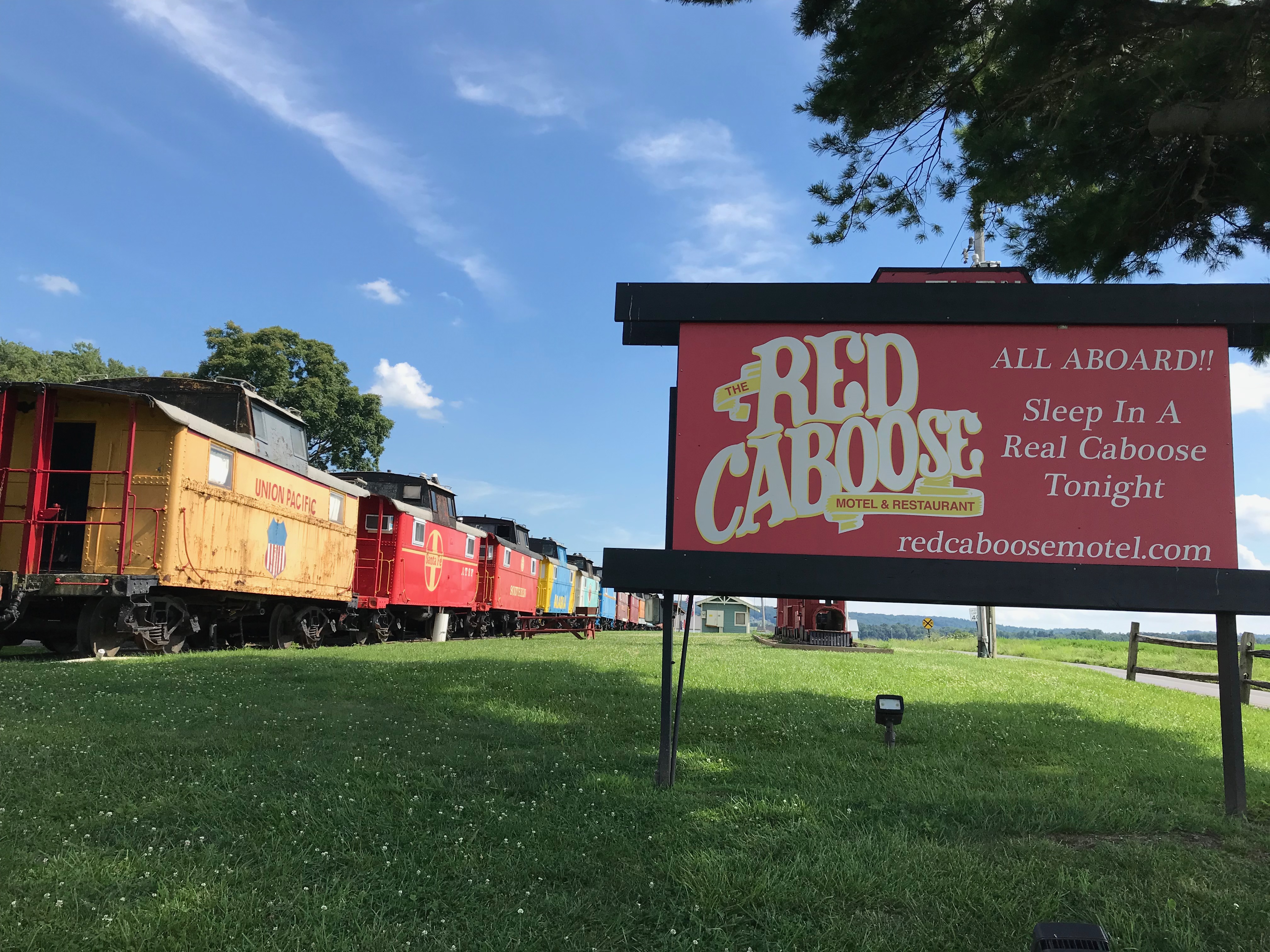
Driving behind Amish buggies to get there after a hot day on the streets of Lancaster—a surprisingly busy and loud city—the Red Caboose felt like a good getaway.  Given the number of cars parked outside cabooses, we weren’t the only ones with this idea.  Lancaster is more than just Witness territory.  Known for its boutique shops and pretzels, as well as its thriving Central Market, it’s a busy place in July.  Bumper stickers and loud, aggressively roaring pickup trucks indicate that outside the city the Trump myth reigns supreme.  In town we visited two independent bookstores, one of them quite large.  With at least seven to choose from, Lancaster feels like a readerly place.  Indeed, I could, had I the money and time, envision renting a caboose for a month or two to do nothing but write.  Why they wanted me to read about rebuilding the Jerusalem temple I just don’t know.  I’ll chalk it up to being weird in Pennsylvania.

For Sale for Free

It’s one of the signs of spring.  Although it may be more appropriate for winter when we’re holed up inside for much of the time, the library book sale often takes place when it’s a bit more conducive to being outdoors.  When we travel, which isn’t frequently these days, we often spontaneously stop into an advertised library book sale.  Most of the fare is fairly pedestrian, but sometimes you find something you simply didn’t expect.  On one such recent outing, that’s just exactly what happened.  Back when we lived in New Jersey the Friends of the Hunterdon County Library book sale was a much-anticipated event.  It remains, in my experience, one of the largest of such sales.  (Believe it or not, there are websites dedicated to pointing inveterate readers to book sales and that’s how I found this one.)  That’s not the surprising part, however.

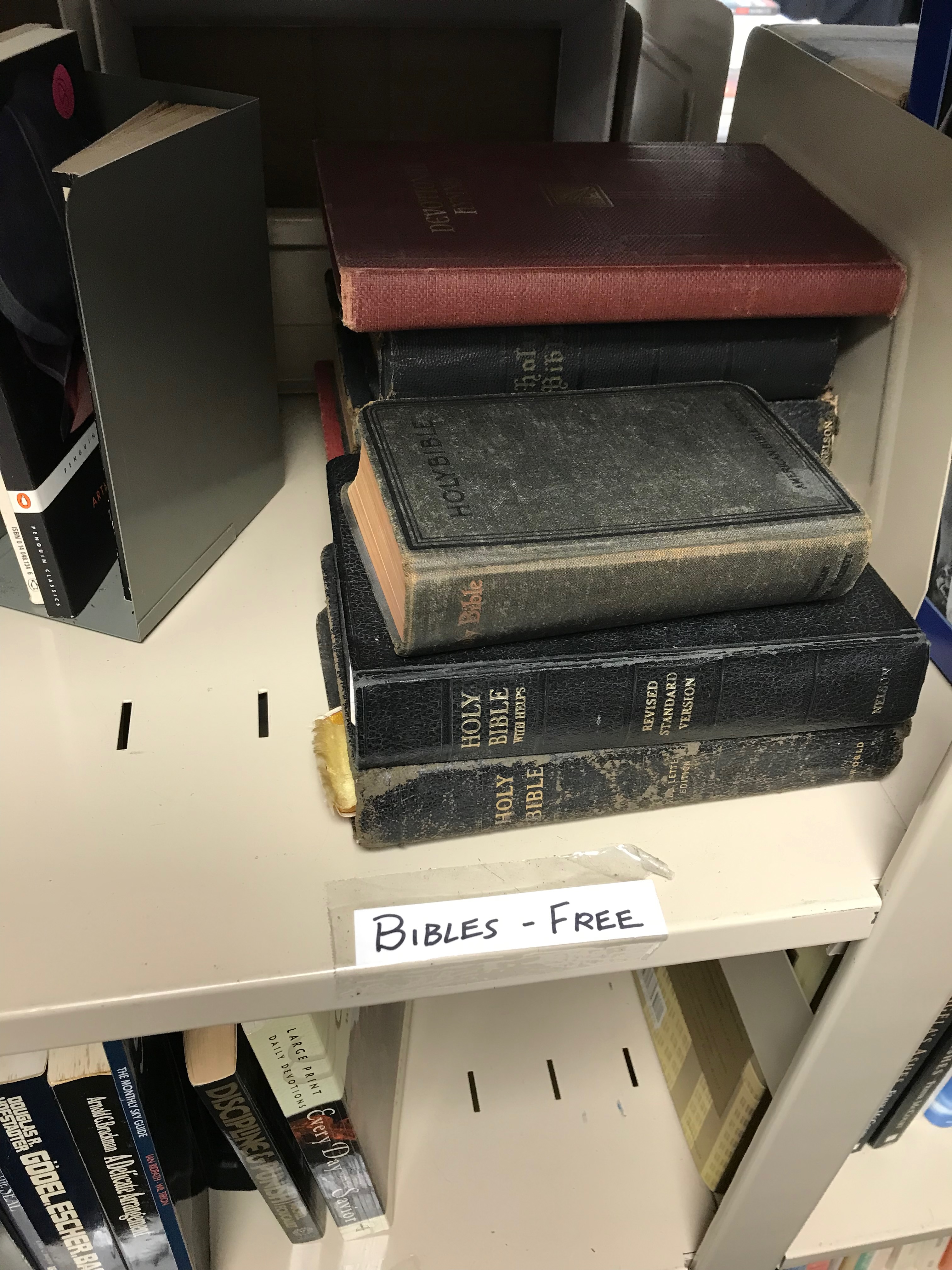
One year when I went, one of the library friends was working the pre-entry crowd, proclaiming some of the treasures inside.  One of them, he announced, was a Bible from the nineteenth century.  They were asking more than the usual one or two dollars for that one.  If I recall, it was $100.  No, I didn’t buy it.  I have dozens of Bibles right behind me at this moment and if I had a Franklin to spend I’d load up on books I don’t already own.  Many of the books mentioned on this blog came from just such sales as these.  That big Bible’s not the surprising thing either.  Here it is: on a recent library book sale day, I saw a shelf with Bibles.  They were free.  Library book sales are intended to raise money, but Bibles for free?  Unexpected, no?

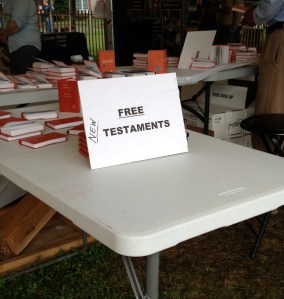
America is the land of free Bibles.  They are printed in vast quantities and sold cheaply, without a thought to what this says in a capitalist world.  Some Christian rock groups were famous for throwing free Bibles from the stage—you’ve got to think those in attendance already had one—and any county fair will usually have at least free New Testaments for the taking.  Ironically, most of those who distribute free Good Books are also the staunchest supporters of capitalism, one of the most exploitative economies ever invented.  Attending library book sales entails more than just finding books that you perhaps didn’t know about.  It’s more than being tempted by something for which you’d rather not pay full-price.  It is, perhaps surprisingly, a learning experience in and of itself.


Unlearning Prejudice

With the terrorist attacks in Belgium on our minds, people are asking once again, “What’s up with Fundamentalists?” My jeremiad that the only solution to religious violence is to study religion reaches few eyes, I realize, but the internet has the capability of spreading memes far and fast. It is merely the hope of a closet optimist. One thing that Fundamentalists believe—I know from personal experience—is that the stakes are based in eternity. In Christian fundamentalism, for example, Hell or Heaven will be forever and any parent would be depraved indeed not to teach their children this belief from their earliest days. That parent-child bond is strong to the point of being unbreakable. That’s why what children learn about religion tends to stay with them all of their life.

IMG_0922A story on the Freedom from Religion Foundation website describes how it is fighting the distribution of Gideon Bibles in public schools in Delta County, Colorado. I was under the impression that Gideons contented themselves with hotel rooms and county fairs. I had no idea that they were active in public schools. In response, the Freedom from Religion Foundation has provided counterbalances to be available to students, including materials calling the Bible into question, and, somewhat more surprising, atheist and Satanist literature. It is clearly a political move to prevent the district from allowing Gideons to distribute Bibles, but it feels an awful lot like a battleground to me. We want the best for our children, but is it best to put our adult biases out where they can be so plainly seen? In a pluralistic society, religion will always raise extreme responses where children are concerned.

The question here is not whether children should receive religious teaching or not, but where such teaching should occur. We are a nation founded on the principles of religious freedom, and although the concepts have changed since the founding days, the ideal is still valid. No matter how one wants to argue the point, people will be religious beings. They may express it in enormously different ways, but express it they will. Children trust us to act like adults. We want what’s best for them but the risk is very high. What should be done? Educate adults. But then, that’s a screed you’ve heard from me before.


The Varieties of Biblical Experience

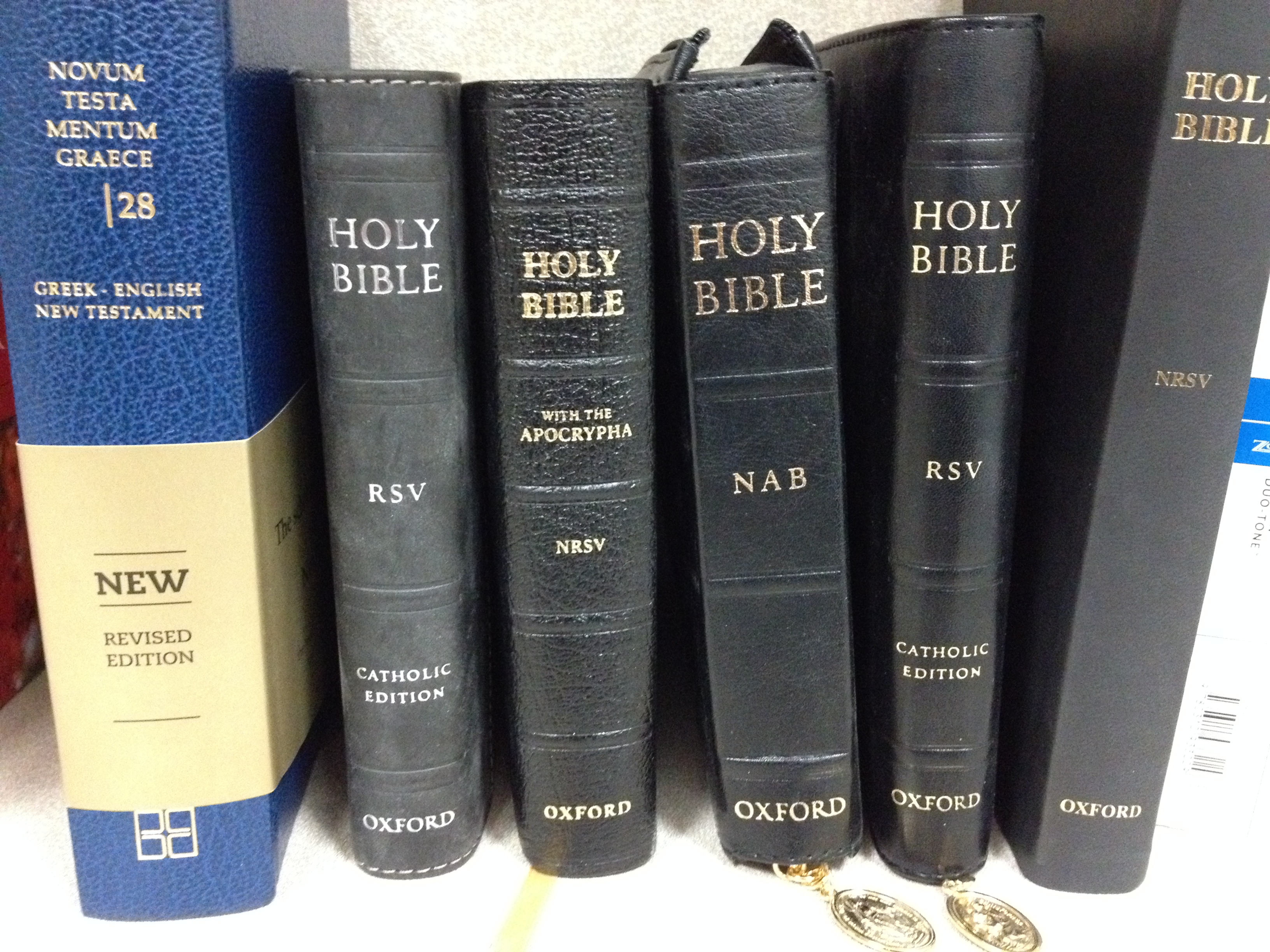
Working with Bibles can be a heady experience. I mean, the sheer numbers are staggering. A whole herd of cattle must be slain annually just to manufacture the covers for all the Scofield Bibles in the world. What is it about literalists that demands animal sacrifice to read the words of the Prince of Peace? Bibles, Bibles everywhere, and not a word to read! According to statisticbrain.com, there are over 6,001,500,000 Bibles in print. That’s closing in on a parity with the world population, only one billion to go. There are websites dedicated to selling only Bibles. Nearly any bookstore will have at least a shelf full of them. I even ran across the website of an enterprising individual who seems to have figured out that there’s a market for taking Gideon Bibles from hotel rooms and selling them online. The Bible business, in the words of Big Dan Teague, “is not a complicated one.” And every year more are printed. Full-text versions are freely available online at any number of sites, and still more can be sold.

IMG_1235

I often ponder the western love affair with the Bible. My entire career, with all its ups and downs, has been fashioned from an early intrigue with holy writ. In the beginning was the Bible. And culture followed in the footsteps of holy scripture. It’s not difficult to see why. Even further back than ancient Palestine, people worried about dying. Consciousness is funny that way—it has trouble conceiving of the world without itself. The Bible, for many centuries, offered the accepted solution to the death equation. You may have to die, but you don’t have to stay dead. Today we think of zombies as those refusing to remain lifeless. The Bible begs to differ, unless, of course, you’re reading the Zombie Bible. And still the presses roll on.

Considering the profit to be turned by selling Bibles, I wonder that more don’t show the cynicism of Big Dan. Is no one suspicious that printing the Good Book is called an industry? What other book, so freely given away, can sustain such a massive global market? I have to plead guilty myself to having a least a dozen different Bibles within easy reach every day. They even have their own separate labels at Barnes and Noble. So as I sit down planning on how to grow this ever-expanding market even more, I think of the many other industries that rely on mine. We have spun off worlds that orbit around the Bible. It is, despite the many nay-sayers, the cornerstone of modern Western civilization. If a tree falls in the woods, a Bible may be printed from it. Which of the 57 varieties do you take with your daily bread?


Tweeting the Bible

I have an underused Twitter account. My life isn’t so interesting that I need to give my few followers (fewer even than those who read this blog) updates throughout the day. In fact, I mainly use it to let my Tweethearts know what I’m blogging about on any given day. While reading a book on the influence of technology on religion (more anon) it struck me that one of the more interesting aspects of biblical studies is the fact that the well never goes dry. For those who read sacred texts, there is no end of interpretation. I’ve addressed this before on this blog—religion is as individual as each believer. The more I read biblical interpretations, however, the more I see the subtle textures and layers that readers find in the text, despite what most religious leaders desire. And I don’t restrict this to the Bible—any sacred text can be read in multiple ways. The Bible, however, has been foundational for this person that I’ve become, and so I’ve decided to do some close reading.

I’m going to tweet the Bible. (If you are one of my rare followers, don’t worry—read on.) I’m going to tweet the maximum 140 characters per message once a day. For this task I will be using the King James Version, arguably the most influential book ever written in the western world. Doubt me? Watch a presidential candidate debate. Or google Girl Scout cookies. Why am I doing this? Well, I wonder what the Bible says when it is broken down into byte-sized nuggets. At character 140 I will stop, and the next day I will begin where I left off the day before. This exercise will be a way of looking at the Bible from a fresh angle. Besides, it’s been a few years since I’ve read the entire KJV. I don’t pretend that nobody else has thought of this—I’m sure there are many Bible tweets out there. I’m curious, however, at 140 characters a day how long it will take, and what will emerge. Yes, I know that there are mathematical whizzes out there who could calculate the answer in a matter of seconds, but I just have to see for myself. The doubting tweeter.

A new look at an old book.

There may be occasions when I fail—isn’t the Bible about forgiveness anyway? In my job I travel quite a bit, and sometimes Internet access is dicey. Most hotels, however, still sport a Gideon Bible, so resources should be no problem. It will be an adventure, and the Bible could stand some adventure these days. Besides, interesting pericopes will give me something to blog about occasionally. For those who haven’t been subjected to years of higher education on the Bible (or other texts), a pericope is a passage cut out from its surroundings. It is the favorite of televangelists and other proof-texters who prefer to not to face the larger implications of reading the whole Bible in its context. I like to think of this exercise as Internet hermeneutics. So let the adventure begin. If you are really bored and want to follow a glacially paced Bible reading, my Twitter name is stawiggins. When interesting observations emerge, however, I will let my blog readers know as well. In the technical age, life is tweet.