Shaping Water

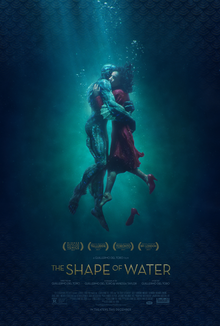
When I write fiction the genre’s difficult to define.  The other thing is I tend to be behind when it comes to pop culture.  It can take me years to find the time to watch a movie.  This preface is an excuse for why I’ve only just seen The Shape of Water.  Is it a horror movie because it features a monster?  It is, of course, primarily a love story.  As a parable the story has many gaps but it’s so enjoyable to watch that you don’t even mind.  In the rare event that you missed the hype, it’s a tale about a woman who falls in love with a somewhat more modern version of the Gill-man.  Indeed, one of the captors, Strickland, mentions finding him in the Amazon—certainly a nod toward the Black Lagoon.

There’s much you can say about a story like this, but one standout feature was that the antagonist (Strickland) frames pretty much the entire movie with the Bible.  He’s not a good man, but he uses the story of Samson to keep Zelda, the Black cleaning woman, in her place.  He uses her namesake Delilah (middle name) to note how she betrayed Samson.  He goes on to say that God is in the image of man, either him or her.  But then he adds, “Maybe a little more like me, I guess.”  This gives you an idea of his character.  He also notes that the creature was thought to be a god in the Amazon.  At the end, as Strickland sets out to kill the creature, he again uses Samson to tell Zelda that he’s going to bring “this temple” down on all of them.  That’s a healthy dose of religious imagery for a species of horror film.

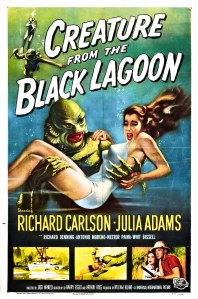
The Creature from the Black Lagoon also begins with a biblical quote.  And like in this movie, the real monsters are the white men who insist on destroying what’s not like them.  Monsters and religion have similar pedigrees and share a number of features.  A concern for those marginalized by society pervades true religion as well as monster movies.  Nevertheless, the academy has trouble giving awards to any movie labelled horror.  There are definitely elements of it here.  It isn’t unusual to see horror defined as a movie that features a monster.  This monster is a god. Interesting, how often that happens. The film’s mood, however, is also romance and a very real concern for the other.  We can all learn from movies like this, even if five years late.

Universals

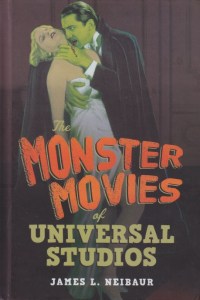
It was on television that I met them.  The Universal monsters.  The entire run of films from Dracula to The Creature Walks among Us had been shot, printed, and screened before I was born.  In other words, I’m a late monster boomer.  By the time I was old enough to handle monster movies, they were on television and my early memories of them are tinged with the nostalgia that accompanies what seemed like better times, although each era is about equally difficult.  When I saw James L. Neibaur’s The Monster Movies of Universal Studios I knew I had to read it.  Neibaur goes through all the films in the series, chronologically, encapsulating the Draculas, Frankenstein’s monsters, mummies, invisible men and women, wolf-men, and the gill-man.  As I child I never watched them systematically, being subject to television schedules, among other things.

Not understanding studios or business, and certainly not copyright, I never understood why other favorites such as Jekyll and Hyde, the phantom of the opera, and various assorted ghosts and ghouls weren’t part of the collection.  Nevertheless, this study in discrete, brief chapters, treats the official canon reasonably well.  The line between religion and monsters is sometimes crossed in these movies, which gets at an underlying theme of my own interest—how horror and religion interact—but that’s not Neibaur’s purpose.  That dynamic is, however, the driving force behind my two most recent books.  A tie-in to the paranormal may also be found there.

As I dropped off some promotional material for Holy Horror at an area bookstore recently, the events manager revealed her interest in the paranormal.  In my mental schematic, it’s wedged in there between monsters—which are fictional—and religion, the antithesis of fiction for most people.  What do we do with ghosts and others that don’t fit into the neat lines of a theology that draw a stark line between the supernatural and human?  Universal’s monsters sometimes ran into problems with the Production Code for stepping over that line.  Of course, the Universal monsters are pretty tame in comparison with today’s fare.  Still, they were the monsters who showed, in many ways, what it was to be human.  Neibaur isn’t going for an in-depth analysis here, and his treatment is readily readable by anyone interested in revisiting the monsters of yesteryear.  Some of the descriptions reminded me of movies from my childhood that I’d forgotten.  It is pleasant to relive them for a few moments while the real monsters in the real world lurk not far from my door.


The Lagoon

My current book project has me watching The Creature of the Black Lagoon again.  One of the Universal monsters—indeed, arguably the last of them—the Gill-man fascinated me as a child.  There was a strange contradiction here.  The creature had evolved in the Devonian Era and remained unchanged into the 1950s.  But the movie opens with a voiceover of Genesis 1.1.  There’s a mixed message here, appropriate for scriptural monsters.  Watching the film again brought back many of the innocent perceptions of youth, as well as the trajectory of my own life.  I don’t often get to the theater to see horror movies anymore, but at the same time the Universal monsters aren’t quite the same thing as modern horror.  As a genre it had to evolve.

Strangely, as a fundamentalist child, the evolution aspect didn’t bother me.  I was after the monster, you see.  The backstory was less important.  Growing up, at least in my experience, means that the backstory becomes more essential.  It has to hold together.  There are, of course, inaccuracies in the story—many of them, in fact.  Still, within the first three minutes Genesis and evolution are thrown together in a happy harmony that belied what I was being taught at church.  The Gill-man is a monster mainly for being a creature out of time.  When modern humans invade his lair, he defends his territory.  The story might’ve ended there, had he not spied Kay.  He doesn’t so much want to kill her as get to know her better.  For a movie posthumously rated G, it has a body count.  Five men die but the Gill-man apparently just wants to evolve.

There’s been a recent resurgence of interest in Creature from the Black Lagoon with both the publication of The Lady from the Black Lagoon and the death of Julie Adams this year.  The Gill-man seldom shows up in the same billing with Dracula or Frankenstein’s monster, or the Wolf-man.  He’s a bit more inaccessible in his watery abode.  Both cold and hot-blooded, he represents how science and Scripture might get along, at least on the silver screen.  The film holds up remarkably well, if a modern viewer can handle the pacing.  Underwater filming was pretty new back in the day, and watching humans swim in many ways suggests the truth of evolution in its own right.  These aren’t the childhood observations of the movie, but rather the reflections of a guy wondering if there might not be some hidden wisdom in the monsters of yesteryear.


Biblical Black Lagoon

During my summer-term courses I feel it is only fair to break the lecture time up a bit. Rutgers summer courses can run four hours at a stretch, and no matter how valiant the student, no one can pay attention to me for that long. I have long had an interest in the Bible in popular media, so for each class session I show a brief clip of a movie that features the Bible, often in a pivotal role. We then discuss how it is presented. As a personal pork barrel I give the students a multiple choice question on their exams as to which movies we have watched (it also gives them incentive to be in class, I hope). One summer, after sending the exam off to the print office, I realized I’d made a mistake. As usual, my interest in 1950s sci-fi flicks led to trouble. One film I hadn’t shown a clip from, and which I thought was Bible free (I hadn’t seen it in a long time) was The Creature from the Black Lagoon, a perennial favorite for both camp and kitsch.

Of course, The Creature from the Black Lagoon does have the Bible in it. The movie begins with a narrator reading Genesis 1.1. Well, I had to give all the students credit for that question, because there was no wrong answer. Nevertheless, the easy association between beginning the film with the Bible and its evolutionary plot-starter seemed worthy of comment. Back in the 1950s evolution was already a hot-button issue (so I’ve read). Forces lined up on the scientific and biblical fronts faced off like angry hockey players as they swung at that hard black puck of the truth. It does seem odd in a country so heavily reliant on science that the foundation of biology and its benefits (if scientists hadn’t recognized and reacted to the swift evolution among microbes I’d likely not be here typing this sentence) that one particular interpretation of a very small section of the Bible should have the power that it does. I’ve seen carnivorous, chrome-plated bumper Jesus fish eating the peacefully walking Darwin fish! Old metaphorical Moses would be scratching his head, I’m sure.

The Creature was, of course, also a metaphor (if I’m not shoveling out too much credit where it isn’t really due). The sequels to the original film grew progressively worse, but those who have the patience to sit through The Creature Walks Among Us discover that the gill-man is a man after all, under all that green rubber. The beast is us. Not too weighty of a revelation to be sure, but it isn’t too weighty a movie. Like any discriminating Bible reader I choose what to accept and what to explain away. When I watch The Creature from the Black Lagoon, it ruins the story for me to think ahead to the denouement of the gill-man being a real man. It is a passage I simply choose not to accept. (This is, of course, a metaphor.)

What might this be a metaphor for?

What might this be a metaphor for?