
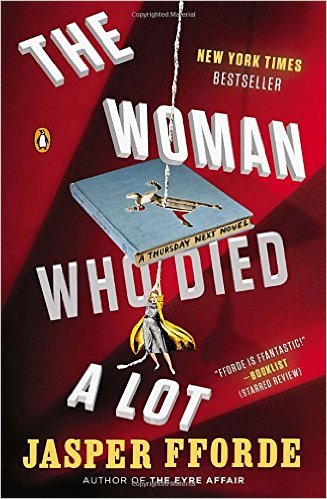
 Jasper Fforde is one of those writers who blends nonsense, deep thought, constant plot twists, and polished writing into compelling novels. His labors are always fun to read and often leave me with something profound to ponder. I haven’t followed his Thursday Next stories in any kind of strict sequence, but I figure that I can sacrifice a few of his abundant references to previous events to read through the latest installment I can get my hands on. The Woman Who Died a Lot was the most recent of these books for me. Thursday Next is a literary detective and her exploits often lead, certainly intentionally, to a feeling that in Fforde’s world libraries and reading are even more than fundamental. Everyone wants to be prided on literary achievement. His universe wouldn’t exist without books and those who love them.
In The Woman Who Died a Lot (and since I haven’t read all the books in the series I have to confess that this theme might’ve been developed earlier) in Fforde’s Swindon, religions have been united into the Church of the Global Standard Deity (GSD) and this GSD drives much of the plot. As Thursday races to solve the latest literary crime, the GSD has decided to smite Swindon. A number of global smitings have already taken place and everyone knows what to expect. A plasma-like discharge, of precise dimensions, wiping out a specified sinful part of the city. The sin here is greed and such smitings have lead to new kind of tourism where the morbidly curious gather outside the boundaries to watch the show, much like Jonah outside Nineveh. As in most Fforde novels there is both a touch of ridiculousness and social critique combined here. I can’t tell you how the smiting ends or you might not read the novel yourself.
The story is populated with peculiar religious orders that always evoke a laugh, and even a Ministry of Theistic Defense charged with finding a way around the smiting of a God willed into existence by the very people the GSD will destroy. I sometimes wonder if Fforde was ever a seminarian. We fabricate our own doom in this literary universe. It’s all in good fun and is reverently irreverent. Virtue is rewarded and in many respects the religion is conventional. The deity can be bargained with, but the law, once laid down, is inviolable. Casuistry is, of course, always an option. It’s a story told with tongue solidly in cheek, but also with brain fully engaged. Fforde is an author not afraid of religion. Indeed, he knows it can lead to a remarkable plot with consequences that will leave a reader scratching one’s saintly head.
 Steve A. Wiggins