Ancient Asherah

It seems like ancient history.  Actually, it is ancient history.  Ancient history with a new angle.  A Reassessment of Asherah is finally available in paperback.  Although my research has moved in a different direction, an author cares for all of their books and Asherah is my firstborn.  My doctoral dissertation originally, what separates it from many proposals I now see as an editor, is that it has a broad topic and some native sense of writing.  I have always eschewed technical jargon.  Academese obfuscates.  And is boring to read.  In any case, being young and naive, at the instruction of one of my doctoral supervisors, I sent it to the distinguished series AOAT (Alter Orient und Altes Testament), published in Germany.  It came out as an expensive hardcover and sold through its only print run.

Years later, evicted from academia, I found a foothold in publishing at Gorgias Press.  The owner of the press did something that even Eisenbrauns couldn’t, he talked what was then Ugarit Verlag into granting Gorgias the rights to republish my out-of-print book.  But he decided to do it in hardcover, so it was still too expensive for most potential readers.  Also, to make this a proper second edition, I added all of the articles I’d written about Asherah as well as the original text of the AOAT version.  If I recall correctly, it sold pretty well for Gorgias.  I moved on to other things.  Weathering the Psalms had been written before my career malfunction, but publishing that made me realize I could still write expensive books with low sales.

Four books further along, all on aspects of horror, a friend did the impossible.  He talked Gorgias Press into publishing a paperback of A Reassessment of Asherah, without my prompting.  For the first time in the thirty-plus years that the book has been available, it is now “individually priced.”  Please keep in mind, though, before emptying out your bank account, that “individually priced” here is still in the academic realm.  It seems the minimum price for books in this category is around $40, which is a bit steep for most of us.  But still, it is a new thing in the academic world.  I do hope that someone more persuasive than me might talk to Bloomsbury about a paperback of Nightmares with the Bible.  That has been, as far as I can tell, the poorest performing of all my expensive books.  It’s also the one that, I suspect, would have some individual readers.


Running on Irony

I recently remarked that my life runs on irony.  I was thinking back to when I was trying to get out of Gorgias Press (long story) and I was interviewed by Irving Louis Horowitz, founder of Transaction Press.  He listened to my account of myself and said, “What you need is a leg up.”  He didn’t offer me that leg up, but I always remembered his kindness in giving me a shot at a non-existent position.  As it turned out, I was hired a couple years later by Routledge.  Routledge is owned by Taylor & Francis, an Informa company.  Publishers grow in two main ways: by the volume of books that sell well, and by acquiring other companies.  While at Routledge we were encouraged to talk to those higher on the ladder about prospects for acquisition.  I made a small case to one executive about acquiring Transaction and was summarily dismissed.

Then I was actually dismissed.  For reasons never explained, I was handed a pink slip the day after returning from a business trip to Arizona.  So life goes.  I found another job, more stable, in the academic publishing world.  One day I was recollecting my conversation with Irving Horowitz.  I’d contacted Transaction out of the blue because it was based in Piscataway, New Jersey.  Gorgias Press was also located in Piscataway, and I’d moved my family to nearby Somerville so that the commute would be only fifteen to twenty minutes.  (I was so naive about commutes at the time.)  Besides, that semester I’d been assigned to teach on the Livingston Campus of Rutgers University as an adjunct, and Transaction operated out of a building either on or adjacent to Livingston.  It all seemed right.  Except it never happened.

After Routledge let me ago, I again contacted Transaction.  I knew that Horowitz had passed away but his widow sent me a packet of information that I never opened because a job offer had been made by my current employer by the time I received it.  After some time I’d heard that Transaction had been acquired.  The irony was that the publisher is now considered defunct because of the acquisition.  In my reverie, I decided to look up by whom.  Of course, Taylor & Francis had bought Transaction and rolled it into Routledge.  I am absolutely convinced my sophomore suggestion had nothing to do with this this.  Someone else, probably higher up, had noticed a smaller press ready for assimilation.  I’m pretty sure that I didn’t keep the somewhat hefty envelope I’d received from Transaction when I was again in need of a job.  If I had, and if it had contained an offer, I would’ve found myself again working for the company that had let me go.  My life runs on irony indeed. 


International Standard

Probably nobody gives them much of a thought.  ISBNs, that is.  International Standard Book Numbers.  An ISBN is a book’s unique identifier.  And they cost money.  I’m not sure how self-publishing works, but at some stage, whether it’s obvious or not, you have to pay for an ISBN if you want wide distribution.  And since they cost money, most publishers don’t assign an ISBN until a contract is signed.  If a deal falls through, hopefully they can recycle the ISBN and assign it to another book.  The system only began in the 1960s and not all books printed their ISBNs.  The thing about them is, the best way to find the book you’re looking for is by using the ISBN rather than the title.  Titles can’t be copyrighted, and that’s why you see so many books with the same name.  The ISBN won’t let you down.

My book, The Myth of Sleepy Hollow, now has an ISBN.  I just found out yesterday.  It’s 978-1-4766-9757-4, in case you’re curious.  It won’t lead to anything on the web yet since I haven’t submitted the manuscript and work hasn’t begun on the title.  It is, however, a step in that direction.  In the past, when I’ve signed book contracts, I’ve always felt a little anxious until the ISBN is assigned.  Is the publisher really sure about this?  Once they assign an ISBN they’ve started to invest in your ideas.  My book has existed in draft form for several months, but I’m going through it again, for the umpteenth time, to make it presentable to the world.

One of my jobs at Gorgias Press, my first full-time publishing gig, was to assign ISBNs.  They had to buy blocks of them and they came in a printout in a large notebook.  If a project with an ISBN didn’t materialize, some White-Out and a pen could save the company some money.  It was all very hands-on.  I imagine it’s gone electronic these days.  The ISBN is a technical code, by the way.  The 13-digit code, which is now common (it used to be ten), has a meaning.  The schematic below explains that.  The “group” section has to do with language and that’s followed by the publisher’s ID.  Simple deduction (and dashes) tell me that 4766 is McFarland.  That’s followed by the title identifier.  I’m not a numbers person, however.  Those of us drawn to the words part generally try to provide the inside content.  And since it’s a weekend I’d better get to it.  I have a submission deadline I’d like to meet. But I’m thinking about the ISBN.

Image credit: Sakurambo; via Wikimedia Commons, GNU Free Documentation License

In Praise of Libraries

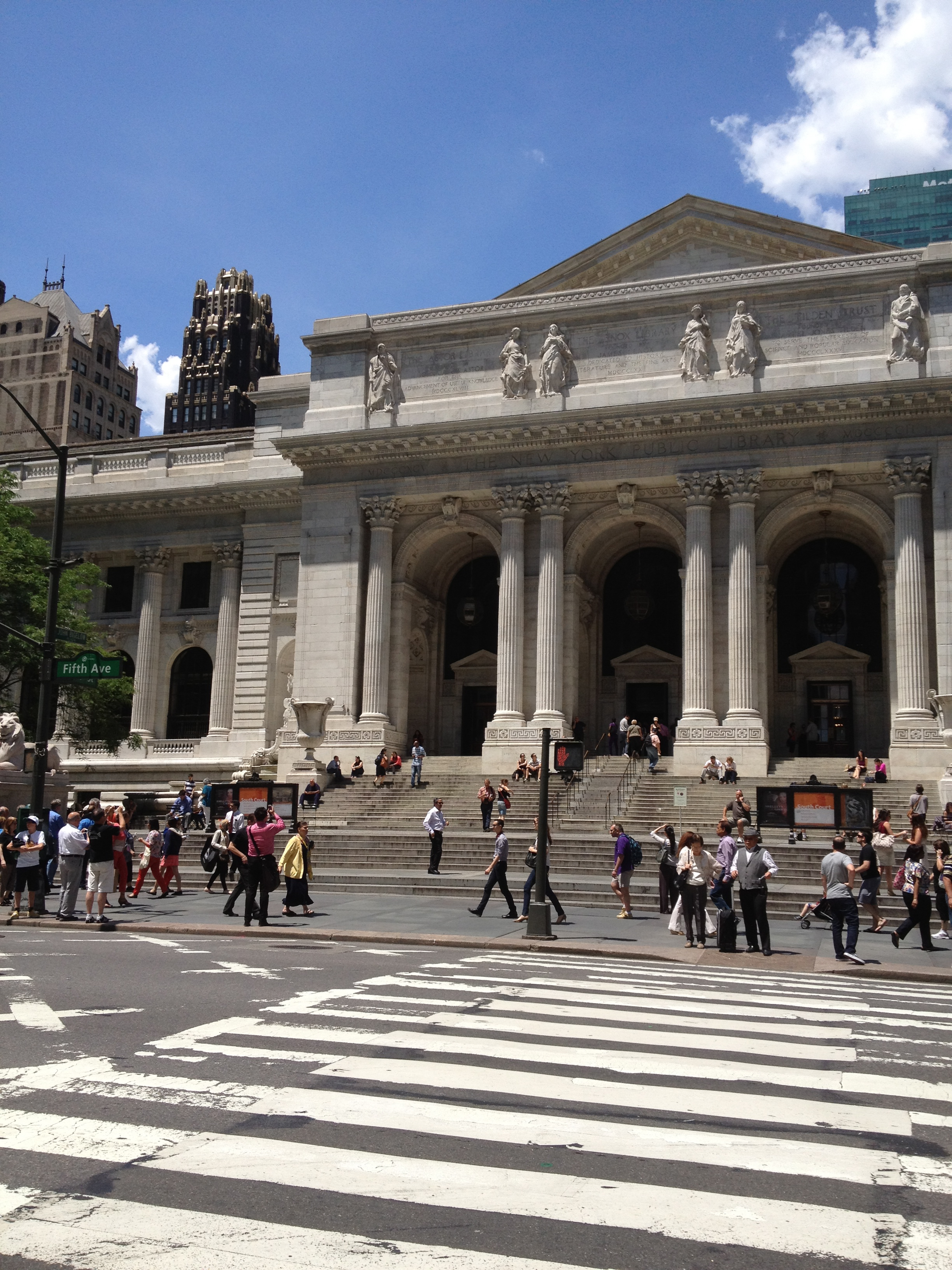
It felt like a rare, and momentous moment in a young writer’s life.  While working at Routledge I happened to notice that the New York Public Library did not have a copy of A Reassessment of Asherah in their catalogue.  The first edition was published in Germany, so I wasn’t surprised that it was not there.  Gorgias Press, however, had published a second edition and few people were citing it.  I contacted the office on Fifth Avenue and offered to donate a copy.  A librarian contacted me and we set up a time.  I went between the stone lions (Patience and Fortitude by name), met my contact, and handed my work over without ceremony.  He seemed genuinely glad to have the book and I felt like I’d made a small contribution to a big city.

When I need a pick-me-up I look at WorldCat.  WorldCat is a conglomeration of library catalogues where you can find just about any book, including obscure ones, such as mine.  I recently hopped on to see how many libraries had Holy Horror.  (The answer is 90.)  While there I decided to check my others.  Nightmares with the Bible registered 68.  These numbers aren’t bad considering neither publisher markets the books and they’re priced too high.  The Wicker Man is still new and is only in 42.  What surprised me was when I looked back.  A Reassessment of Asherah is in 305 (total for both editions, one being in the New York Public Library).  What really surprised me was Weathering the Psalms, which 324 libraries claim.  Since it’s priced under $30, maybe there is something to the idea people will buy books if they can afford them.  As an editor I know that sales of monograph over 300 are considered successful.  Two of my books qualify.

Publishers don’t share sales information.  I can look up those at my current publisher, and I can check some on Nielsen’s BookScan (now called NDP BookScan), the service publishers use to get an idea of other publishers’ sales.  That’s the same Nielsen that does television ratings, by the way.  Searching my own titles there is too depressing, so I stick to library catalogues.  Libraries are feel-good places.  (I couldn’t help but notice that Princeton has all my books—thank you, Tigers!  The seminary has my first two, but the university has my books on horror films.)  I can just feel all the ideas in the air.  And I’m humbled to have contributed to them in a way, no matter how small.


Here and There

There’s nothing like forgetting to make you remember.  Although we could scarcely afford it, we made many budget trips once we moved to New Jersey from Wisconsin.  As a family we used to keep detailed travel logs and we’d type up the results so that we could remember our trips.  For some reason, drifting about after losing a career, I stopped taking such notes.  Fortunately our digital camera time-stamped the photos.  I spent months organizing them only to have the external hard drive on which they were stored fail.  I’m now getting around to piecing together a bit of a chronology.  “Blog” was originally a portmanteau for “web log,” and since I’ve had no instruction on how it should be done, I mix an actual log with mental musings.  I’ve been doing so daily since 2009. Results may vary.

This blog has helped me keep track of travel, but those hazy days after the Nashotah House incident in 2004 up until blogging in 2009 remain undocumented.  Looking at the time stamps on those photos, it’s clear we traveled quite a bit.  Of course, New Jersey is a somewhat of a feast and it’s within easy reach of quite a few fascinating places.  Even a weekend was enough to explore someplace exotic, relatively local.  We used to make literary road trips on Memorial and Labor Day weekends.  Sometimes even later into the season.  Somewhere in that fog we made road trips to Maine, Connecticut, and upstate New York.  And although I grumble about technology sometimes, were it not for those digital timestamps the dates would be lost forever.  Of course, if we’d kept up our travel notebook…

As an historian, looking back comes naturally enough.  Gorgias Press downsized in 2009 and for a couple of years I made a living as an adjunct professor.  Even so, we managed a few trips (some of them mentioned on this blog).  Things must’ve been less expensive then.  Or else having a mortgage changes your perspective (the roofers are coming yet again this summer).  And the pandemic kept us at home for three years.  Whatever the cause, the urge to stretch wings and see new places remains.  Of course, it’s important to recollect where you’ve been.  In the meantime, I’m trying to piece together what happened those first few years in New Jersey.  That’s the historian’s task—putting together the events of the past from bits of evidence.  It’s pretty clear why historians get excited when they have diaries or notebooks from which to work.  We are, after all, the historians of our own lives.


Sunk Costs

The other day, in a fit of post-holiday tiding up, my wife found something that she couldn’t reach to put away.  As I took the thing and dutifully began to return it to its high cubbyhole, I realized that it was something we no longer needed.  Now, we’re very careful about not just throwing things away—this attitude of disposability has led to far too many landfills and rampant pollution.  So what was this thing?  It’s a dryer vent brush. After a couple years in our house, and with the awareness that the previous owners clearly ignored things like lint build-up in dryer vents, I purchased this brush to weasel in through the outdoor vent and try to get as much lint out as I could.  The old dryer died a couple years later, and we bought a more environmentally friendly heat-pump dryer.  Heat pumps require no vents, so the brush, in its high cubby hole, had simply been forgotten until it got in the way of something else.

This is an example of a “sunk cost.”  Economists, those purveyors of the dismal science, tell us never to worry about sunk costs since you can’t get your money back.  I suppose this is the impetus behind yard sales.  We’ve always been careful with money—we have to be—so purchases like this brush are calculated to meet a current need.  An investment.  Looking around, I see a number of sunk costs—there’s an extraneous office chair just a few feet from me at the moment, made superfluous when Gorgias Press moved offices and gave away office furniture that wouldn’t fit into the new place.  That’s the chair I’m sitting in at the moment.  The other, cheaper chair, however, is still functional.  Something’s telling me a yard sale might not be a bad idea.

But do I want neighbors to see the things we’ve accumulated over the years (and there seem suddenly to have been so many years)?  Some of the stuff obviously could have a future life.  The dryer vent brush was only used for a couple of cleanings and still has much life left, for an inanimate object.  Much of the technology that we’ve sunk money into would serve only as museum pieces, however.  And those costs tend to be much higher.  We try very hard to reduce, reuse, and recycle.  We give books away to little free libraries, if it’s clear they’ll never be opened again in this house.  But I can’t help wonder if sunk costs are a plague of capitalism and consumerism.  There’s got to be a better way.  And while I’m pondering it, I have a funky blue brush to use for scratching my head.


Weird Publishing

It’s a weird world.  Publishing, I mean.  In the early days of shock and angst after Nashotah House, when it had become clear that UWOsh—the University of Wisconsin, Oshkosh—wasn’t going to hire me full-time after a full-time year there, I considered that classic fall-back of the academic—publishing.  I wasn’t exactly clear on what an editor did in those days, but I was pretty sure I could learn.  Gorgias Press hired me and after just over two years, downsized.  I’d been in publishing long enough at that point to have learned about Transaction Publishers.  Housed on the Livingston campus of Rutgers University, where I’d been teaching for a few years at this point, Transaction had been founded by the sociologist Irving Horowitz.  Now that Gorgias was out of the picture, I contacted Transaction out of the blue and landed an interview with Horowitz himself.  Although he was most cordial, it didn’t lead to a job offer.

Eventually I was recruited by Routledge.  I was about to learn the nature of publishing in a whole new way.  Early in my time in the Taylor & Francis group (they had a letter signed by Walt Whitman in one of the board rooms) I learned that presses grow by acquiring other presses.  I suggested Transaction, only to be told it was too small of a “concern;” Taylor & Francis preferred larger fish.  When Routledge downsized I found myself again applying to Transaction.  Irving Horowitz had passed away by this point and before I could make an appeal, I was hired by my current employer.  There I have been ever since.

The other day I had cause to look up Transaction.  It was with some surprise that I learned they had been acquired by Taylor & Francis and merged with Routledge.  I’m sure that my suggestion of that acquisition had nothing to do with it, but I pondered what would’ve happened had I been hired by Transaction after Routledge cut me loose.  A few years later I would’ve found myself working for Routledge again.  And likely I would have found history repeating itself.  Publishing is a fairly small industry.  Books are a low-margin commodity (it pains me to type those words, but that’s the way the business world sees them).  Not too many people are interested in a company that has to sell lots of a specialty item in order to make them profitable.  Consumers tend not to buy books in bulk.  My time in publishing has been about connections.  And some of those connections are just plain weird.


A Kind of Happening

The roofers were here.  One of the things you learn only after laying down a ton of money is that those selling a house like to withhold information.  Moving during one of the rainiest summers in history, we naturally discovered leaks.  And so the roofers are here, like noisy angels banging above my head.  Given the orientation of our house, their access is outside the window of my work office.  I figured it was an opportunity to learn.  As the old shingles came raining down, however, I couldn’t help thinking of M. Night Shyamalan’s The Happening.  One of his more disappointing efforts, this horror film involved a memorable scene of mass suicide where people jumped off of a high building one after another.  Maybe other people would think of other comparisons, but the falling debris brought the film to mind in my case.

It’s a matter of framing, I suppose.  I’ve watched enough horror that it has become a framing device.  This is true although it has literally been months since I’ve seen a horror film.  (Moving proved to be its own kind of nightmare and one day I suspect we’ll be unpacked enough to watch movies again.)  Instead of losing the frame of reference, however, I find it intact.  If you spend long enough with Poe, he gets under your skin.  And changing states to M. Night Shyamalan’s eastern Pennsylvania might have something to do with it.  This is Bucks County territory, after all.  Another frame of reference, mediated by media.

As I watch the old shingles drop, I realize the window through which I’m witnessing this is another frame.  Like a camera lens, it limits my view.  At times it can be like Hitchcock’s Rear Window, seeing neighbors at their daily business.   Indulge me. For nearly the past five years I worked in a cubicle with no view of any windows whatsoever.  I was completely cut off from the outside.  (Which, for those of you who’ll admit to having seen The Happening, might not have been an entirely bad thing.)  Now that I have a window—my own framing device—I realize some of what I’d been missing.  At Routledge I had a window, but at such a level that the Manhattan outside seemed artificial.  You couldn’t see individuals down on the street.  The entire wall was a window—too much of a frame.  Gorgias Press involved working in a windowless room as well.  I’m professional enough not to let the falling material or the pounding distract me much.  There’s work to do because there are bills to pay.  And horror films prepared me for that as well.  It’s the ultimate framing device.


Book Recommendations

Working in publishing has its perils. One from my personal experience is that you run into many books you just have to read. Not necessarily for work, but because you want to. This varies from publisher to publisher, of course. There weren’t too many Gorgias Press titles I felt compelled to read, although there were a few. Since then, however, my employers have transported me back to that kid in a candy store feeling time and again. Friends will sometimes send me book recommendations—I always appreciate that. Often the books are from the very publisher for whom I work. In some cases I was actually in the editorial board meeting where the book was approved. It makes me feel like my small contribution matters when someone recommends a book on which I voiced an opinion.

In these days when thoughtful approaches to life are under constant duress, it’s nice to be reminded that people pay attention to books. Relatively few buy them, of course, but books are the storehouse of our knowledge. We all turn to the internet to get information quickly. If you linger, however, you find that much of the web fall into the “opinion” column rather than that of factual reporting. Books from established publishers are vetted on at least one or two levels before a press makes a commitment to print them. Self-publishing has muddied those clear waters a bit, but the seal of approval of a reputable publisher is what makes a book. For example, if a publisher discovers a serious error in a work it will often be pulled from the market. We don’t like to spread errors.

The problem is volume. We long ago surpassed the point during which one individual could read every known book in her or his lifetime. In fact, those who were credited with doing so in the past are given a pass because many ancient texts lay undiscovered under the soil during their times. For all our foibles we are a prolific species when it comes to writing things down. For academics, publishing is often a requirement for tenure and promotion. There are a lot of books out there. This is one surplus, however, that isn’t as celebrated as it should be. I have had people suggest we have too many books in our home. Unlike too much food in the fridge, however, these pieces of intellectual nourishment don’t go bad. And if you point me to a book about which I’m already aware, I always appreciate the conversation anyway. Of some good things you can’t have too much.


Rookie Mistakes

So now it’s got a stain on the cover. And it didn’t even come with a book jacket. Perhaps it’s symbolic? The year was 1993. I’d finished my doctorate at Edinburgh the year before, and, against all odds, had landed a full-time teaching position. That position was at Nashotah House, but never mind. Like all doctoral students I’d sent out my dissertation for publication. It’d been accepted by the prestigious series Alter Orient und Altes Testament, produced by the dual publisher Verlag Butzon & Bercker and Neukirchener Verlag. Most European houses print these books cloth-bound (mine in blue!), no dust jacket, straight to the library market. I was proud. I had my first copy in hand in time to show around at the American Academy of Religion and Society of Biblical Literature annual meeting. There I spied William Holladay, my Hebrew teacher, now deceased. He was sitting on the floor in a corridor, eating his lunch. I joined him and showed him my book. In his inimitable way, he snatched it (leaving a grease stain on the cover) and within seconds said, “there’s a word misspelled in your title.”

Crestfallen, I took my first copy back. I wrote to the publisher, but these things only ever receive one printing and I never heard back. How embarrassing! Your first foray into academic publishing, and you look like an idiot who can’t spel. Now, in my defense, the cover is simply what I thought was a photomechanical replication of the the title page. The world “Millennia” was spelled correctly where I’d proofed it inside. How they left out an “n” on the binding die is a mystery. I never got proofs of the cover. Besides, a book’s title is on the title page, right? Never judge a book by it’s cover! Mine has a stain on it.

The book, although on Asherah, never got much notice. It’s still routinely overlooked. One of the truly sad things, though, came from a senior scholar in the field, nameless here, who did mention my work. In his book he put a [sic] after the ailing word on the cover. That was an intentional slight. Had he looked at the title page—from which I’d been taught to take bibliographic references—he would’ve found the word spelled correctly. Many publishers do not let authors proof the binding die for their cloth-stamped covers. A senior scholar knocking down a struggling junior with an obscure three-letter word. Welcome to academia. The book did get a kind of second life when Gorgias Press reprinted it, with additional material. I still sometimes pull that first copy off the shelf, however, and wonder what can take the stain out of blue canvas. As long as someone can feel superior citing a mistake beyond a young colleague’s control, I suspect it will remain.


Vive la compagnie

I’m cleaning out the closet at work. I doubt that either J. C. L. Gibson or Nicolas Wyatt envisioned my future thus. Edinburgh University was exotic and optimistic, designed to make my curriculum vitae stand out. More like standing out in the rain. “We have to ask what’s best for the company,” I’m told. I’m not a proud person, but earning a Ph.D. to take out the trash seems like a strange allocation of resources to me. “Take one for the team,” we’re told, since we’re part of a company and when the company prospers, we prosper. On a pro-rated scale, of course. It’s not that taking out the trash is beneath me. I willingly do it at home; my first career aspiration was to be a janitor. Only now I’m dressed in work clothes for the City. And I spent nine years in higher education to get here.

Lately I’ve been pondering how this “for the company” trope is a one-way street. Knowing in advance that Nashotah House could be a Hindenburg career for a liberal, I gave it the old college try. Writing about 90 pages of class notes a week for my first year of teaching, attending mandatory chapel twice a day, I tried not to step on any toes. Even though the theology over which I was forced to chew smelled a bit like this garbage I am now carrying, I made no fuss. Don’t rock the boat, especially if it’s a garbage scow. Take one for the team. After fourteen years of not making a fuss, I was summarily dismissed. I found out, literally, how hard it is to get a job as a garbage man.

Portrait of a livelihood about to end.

Portrait of a livelihood about to end.

Eventually I landed a job at Gorgias Press. Neither prestigious nor lucrative, it was a job and I had already proven I could take one for the team. Positions evaporate around here like dribbles from a spilled cup of coffee. So I found myself at Routledge, jetting around the country, spending long hours on the bus, being told to think what was best for the company. Only don’t expect the company to do the same for you. Stoking egos, I tried to get people with qualifications I could match to write a book for me. At Nashotah House I played on the football team (don’t laugh, it’s true). We had only one game a year, against our rival—the now defunct Seabury-Western in Chicago. During practice one day, one of my students blocked me with a forearm to the chin that left me on my back, seeing stars. I can take one for the team. But sometimes the company needs someone to take out the garbage. Ask the guy with a doctorate in rubbish removal. He always thinks about the company.


Manuscript Madness

A friend recently pointed me to a story of a “new” manuscript, recently discovered, that portrays Jesus predicting the advent of Mohammad. The article on sott.net, suggests that the manuscript, wanting to be seen by the Pope, may be the Gospel of Barnabas. Of course, the Gospel of Barnabas is already known from a medieval Italian manuscript and a new, authentic discovery would be of great excitement to epigraphists and text critics, but few others. Barnabas is not a canonical gospel and is considered by the majority of scholars to have come from centuries after the fact. Quite apart from the sensational headline “1,500 year-old Bible found in Ankara, Turkey: Vatican in Shock!” (posted in September of last year, before Francis came along), the manuscript raises a number of questions concerning what one colleague calls “the iconic book.” To be sure, there are documents yet to be discovered. The Bible, however, will not be reconstituted and the door has long been sealed shut on written revelation. What remains is the perception of sacred books.

How many movies and novels are based on the premise that an ancient document has been discovered and suddenly everything about the world changes? It is a common enough theme. This idea is based on the magical concept of scripture—the hidden wisdom of the ancients somehow overrides all that we know of the world. It lies in some cave or monastery or synagogue, waiting to be discovered, unleashing divine power. No doubt the dramatic (and dramatized) discovery of the Dead Sea Scrolls plays into this mythos. Nobody knew they were there, but suddenly, new information! How many people on the street today, however, can say anything of what was contained in the Dead Sea Scrolls? They’ve been mulled over by furrowed-browed scholars for over half a century, but haven’t triggered any apocalypses, at least not yet.

There are hidden documents. Working for Gorgias Press put me in the place where I could learn about some texts kept under lock and key in remote monasteries in Syria. They are generally kept for their monetary value rather than their spiritual revelations. The manuscript on sott.net made me think of those manuscripts for the first time in years. In all likelihood, if a manuscript is being hidden it is lucre, not illumination, that is at stake. The Vatican library, researchers who’ve been there tell, requires immense patience and a willingness to be repeatedly turned away. There’s just something about those old texts. No surprise that the Bible and Qur’an lead to such fiercely protective sentiments in some believers. In the meanwhile, I wouldn’t advise selling all your possessions and anticipating the apocalypse. Unless, of course, you take some ancient documents literally.

An ancient manuscript (not the hidden one).

An ancient manuscript (not the hidden one).


Lost Professors

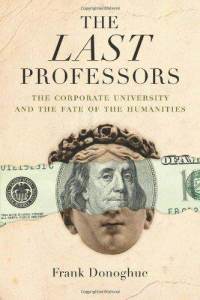
In front of my desk at home sits a chair.  That chair came to me when Gorgias Press was subleasing some of its office space and was necessarily divesting itself of unnecessary furnishings. Gorgias Press came to inherit the chair with the closing of the for-profit Katherine Gibbs School of Business, a branch of which leased half of the building.  I sit in that chair, contemplating the future of education.  I have just finished reading Frank Donoghue’s The Last Professors: The Corporate University and the Fate of the Humanities (as recommended by my friend Marvin).  Despite the fact that it is the first academic book I can recall leaving me in tears, it is a book every Ph.D. and potential Ph.D. in the Humanities should read and/or be forced to read.  Buck the trend!  Buy a book!  Donoghue is a rare individual who actually takes time to research what is going on in higher education and who has the courage to report it directly.  My regular readers will know that for nearly two decades I worked in higher education, spending every one of those years hoping that the next year things would get better.  Thank you, Dr. Donoghue, for speaking the truth.

I didn’t enter higher education as a child of privilege.  My career ambitions in high school were to be a janitor.  Encouraged along the way by well-meaning teachers and professors, I eventually found a job (lackluster as it was) in higher education.  What I didn’t realize is that the game had been rigged.  I recall being told with crystalline clarity that college and university positions were headed for a vast turn-over in the 1990s and jobs would be abundant.  Donoghue heard that story too.  His research shows that the writing had been inscribed on the wall as early as the 1970’s (before I reached high school) that this would not happen.  This is not hindsight either; studies were already indicating that higher education was going after the vaunted business model of the glitzy for-profit world.  Shiny baubles.  Worse yet, the roots of this inevitable transformation reached back to the Civil War and the nation that emerged from it—replace the dead on the battlefield with the dead in the factory.  Only only method of judging value existed: money.

The most disturbing aspect of all of this is the irreversibility of this trend: in today’s world only one value system is admitted, and it is purely material. No other way in higher education is capable of assessing worth. Rather, the alternate ways are being ruthlessly silenced by the transformation of university to corporation. That transformation was well underway long before the 1970’s, of course.  I had recognized at a young age that capitalism is a cancer that eats away the soul of people, convincing them that financial success is the only goal worth pursuing. I protested.  I spent years earning a doctorate in the Humanities to show that other values still throbbed away in the hearts of those who weren’t taken in by shiny baubles.  If you have any interest in resuscitating the human spirit, read Donoghue and weep with me.  The only consolation that I have is that I am sitting on a chair of a for-profit school that fell victim to the value system it once supported.  Capital and cannibal are too close for comfort.


Lower Education

Is there anything that can’t be sold? I think in the context of the free market, with its oxymoronic name, the answer must be a resounding “No!” A concept may be sold as a piece of writing or a patent or a trademark. Souls may be sold to the devil, at least according to the entrepreneurship of demons, if centuries of folklore are to be believed. A person who has betrayed his or her ideals is a sell-out. We can sell anything. Two related stories in the Chronicle of Higher Education confirm, in very different ways, this truth above all truths. The first piece, “More Notes on the Rise of Thrun Credits,” by Kevin Carey, notes how universities are in the business of selling academic credentials. Those of us who’ve gone through the educational grind-mill that leads one to poverty with the dubious benefit of a Ph.D. diploma to hang on the wall of our cardboard hovels, found this out the hard way. What matters is not what you learned or how well you learned it: where did you go to school? That is the most important commodity that a university sells—its name. It is sad that academia has gone after Wall Street, but there’s no changing the direction of this charging bull.

The second article, which I only spied because of a link on the first, was a tribute to Irving Louis Horowitz, world-renowned social scientist and founder of Transaction Press. In my days of desperation at Gorgias Press, looking for a new position that would make use of my editing and higher education (sales) background, I had contacted Transaction and ended up having three lengthy interviews with Dr. Horowitz. He was well known for his quirks, but he always had a kind word for me, and even read my book to find out more about me. Such determination and depth of investment are rare these days. In the end, I never did find a place at Transaction, although it was literally a ten-minute walk from where I taught my Rutgers classes on Livingston Campus. Publishers, it stands to reason, are also in the business of selling on the basis of reputation. Once Dr. Horowitz said as much during one of my interviews. “Without reputation, what does a publisher have to offer?” he asked.

Both of these ventures in which I have participated began as sources of disseminating knowledge. I was naïve enough to suppose that such ideals could survive the onslaught of that hissing serpent called finance, yet it is sad to be in a world where nothing falls outside its coils. Long before the birth of capitalism universities managed solvency and provided the intellectual inquiry that eventually led to its own demise. Publishers always sold their wares, but many pieces were published for the sake of their content, not their earning potential. That world no longer exists. In order to be paid you must have something to sell. All other transactions are null and void. We send our children to college to find jobs, not to learn. Maybe it’s just as well. Schools are busy with marketing and branding, so let our young ones learn the only system that works. For those interested, I have some swamp-land in Florida to sell…


Professor Little

There I was, some 3000 miles from home, in the office of a professor I’d never met before. On her desk a Gorgias Press catalogue. In that catalogue a miniscule picture with my diminutive face. Such are the little ironies of life. My ric rac career began when others started making suggestions about how being a janitor might not be living up to my full potential. Sometimes, often, I wonder if they were correct. Cleaning up after other people’s messes in the halls of our educational system seems like an incredibly honest career to me. Instead I have steered a course between the halls of academia and the halls of commerce. It is easy to suppose that I’m not really in control since even if I choose the general direction, I haven’t selected the specific circumstances. Recently I attended a conference where Gorgias Press had a booth. I looked over the tables, spying names of authors whom I had given their first start in publishing. With books struggling for elbow room in my own head, it is a bittersweet experience.

Watching the glacial ballet of higher education unfold, it often occurs to me that universities are not smart. Many brilliant minds work in them, and much light shines from them, but on an institutional level decisions are often made that jeopardize the entire enterprise. Over-emphasis on sports, over-utilization of adjuncts, over-payment of administrators—these are not signs of soaring intelligence. They are signs of institutions in a muddle as to their true identity. Are they businesses or centers of creativity and education? The basic business model is not “one size fits all,” and universities managed to maintain an enviable idealism until they began to emulate the corporate world. The tattered results lie all around us.

All through my educational journey, there was no guiding light. In my experience, higher education was a wondrous journey that suddenly terminated when I didn’t measure up to someone else’s standard of Christianity. By that point, I was ill-prepared for the savage politics of higher education. The transition from author to editor may sound simple enough, but things are seldom what they seem. Education may not make one smart, but it sure puts ideas in one’s head. Sometimes I reflect on those books that will never be written. I’ve never been any publisher’s darling, but here I am staring at a little picture of a little man. I’m sure there must be a lesson here somewhere, but I’m not smart enough to figure out what it might be.