Groan

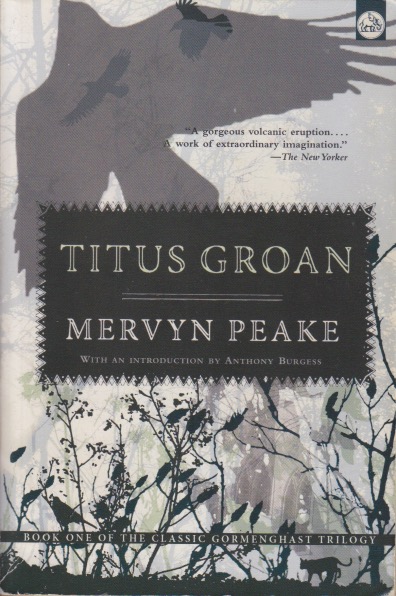
Authors are a peculiar but definite taste.  Some noteworthy voices have vociferated regarding the wonders of Mervyn Peake.  Mine has not been among them, but then, I’m not noteworthy.  Having read somewhere that the famous Gormenghast universe was one of the most gothic in mid-twentieth century literature, I read Titus Groan many years ago.  I understand the linkage between grotesques and the gothic, but this simply didn’t appeal to me.  I never felt interested in moving on to the second book of the trilogy.  At the same time, I held onto it.  Just in case.  Recently, I thought my younger self might’ve been prematurely harsh on the book and so I gave it a second try.  This time through, I appreciated some of Peake’s famous wordplay, but the novel, to me, dragged. The victim, perhaps, of the foreshortening of time, I just couldn’t get into it.

J. R. R. Tolkien once explained that he wrote The Lord of the Rings cycle to see if a really long story could be made interesting.  He succeeded.  I read the trilogy, after The Hobbit, when I was in college.  I really enjoyed it.  Titus Groan isn’t cut from the same fabric.  Peake’s thick description is sometimes a thing of wonder.  It is also very ponderous, to the point of being tedious at times.  The action is interesting enough, what there is of it.  The characters are well drawn, even if overdrawn.  And it’s clear by the end of Titus Groan that to make any sense of any of this you will need to commit yourself to two-plus volumes more.   Peake died before he could finish the fourth volume.  The first three are now solidly referred to as a trilogy, but I fear that if I were to force my way through the other two I’d still be left hanging.  I really do appreciate resolution.

It’s a personal failure, in my opinion.  I mean, Peake was obviously a talented writer.  The question is whether you can stretch a story out for too long.  Part of me wants to know the resolution, but not enough of me to get me through at least two more books like this.  I’m not sure that I’d declare this terribly gothic.  I can see why some would: castle, skulduggery, and one very well drawn villain.  Again, some of the characters are too comical to be effective gothic.  To me it felt like a mismatch between style and vehicle.  I realize that should any of his fans perchance read this, I’ll be declared a Peake imbecile.  I’ll admit that the fault is mine.  It’s a matter of taste.

Brutal Boys

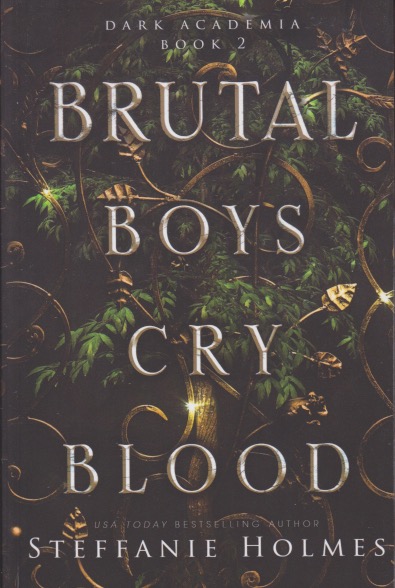
Some time back I posted about Steffanie HolmesPretty Girls Make Graves.  It was a first book in a duology and since I’d been trying to keep up with dark academia, it was a recommended exemplar.  As I mentioned in that post, the book ends with a cliffhanger, so I got to Brutal Boys Cry Blood as quickly as I could.  Holmes is a prolific self-publishing author and I found Pretty Girls much better written than the majority of self-published material I’ve read.  Brutal Boys picks up right where the previous novel left off, freeing George Fisher from her predicament and moving her into new ones.  At Blackfriars University, George is investigating the death of her former roommate.  The Orpheus Society, consisting of old money blue bloods, seems to be involved in more than wanton destruction of property and orgies.

Much of the first half of Brutal Boys sets the scene for a relatively happy period in George’s life.  She establishes a polyamorous relationship with the uberwealthy student William Windsor-Forsyth and Father Sebastian Pearce, a teacher and college chaplain.  The three of them are mutually in love, but even as George is admitted the Orpheus Society, a deeper part of the sect emerges.  This group is even more insidious and has designs on human sacrifice.  But I’ve already said too much.

Reading is, of course, a subjective exercise.  My personal experience of this duology is that the first book is better than the second.  It’s not that I feel Brutal Boys is a bad story—it keeps your interest pretty much the whole way through—it just seems to be far more improbable than the first novel.  It is fiction, of course, and there is nothing speculative here.  There are no ghosts or monsters or divine intervention.  Speaking strictly for me, it might’ve helped with believability if there were a little of this.  I was not one of those swept away by Donna Tartt’s inaugural dark academia novel The Secret History, but she did include just a little of a speculative element that allows for a reader to perhaps convince him or herself that this might just possibly happen.  Some writers and readers prefer not to use that escape hatch.  I’ve read good dark academia both with and without speculative aspects to the story, but to me, such mystery adds a little depth to what might be happening.  And I admire self-publishing authors who write well enough to draw you into a second book, which can be a rare thing.


Gothic Novelties

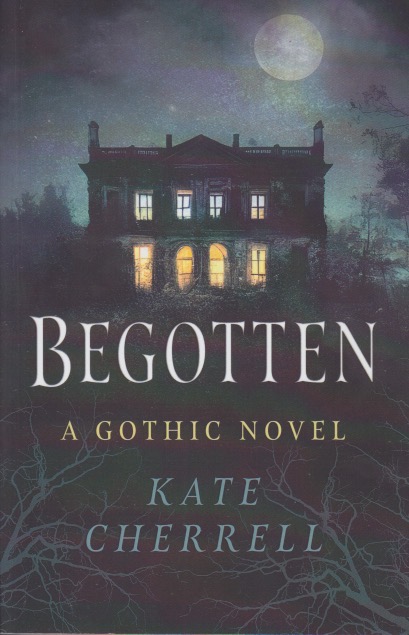
I’m a sucker for a good gothic novel.  Dilapidated houses on the moors, suggestions of ghosts, the kind of encompassing darkness that enfolds you.  Women facing a man’s world just as Victoria took to the throne.  Hints of the supernatural.  So when offered a review copy of Kate Cherrell’s Begotten, I jumped at the chance.  Gothic it is, that I’ll give you that.  Perhaps I’m getting more discriminating in my tastes, but the classics are hard to beat.  I’m particularly fond of Jane Eyre and Wuthering HeightsBegotten’s not up to that level, of course, but I found the pacing slow and the narrator difficult to sympathize with. It has the kind of ending that sets me off, as I’ve written about before. (No spoilers here!)   Given that I’ve never succeeded in having a novel published (not for not trying), I am impressed.  

Novel writing is difficult.  Let me qualify that—good novel writing is difficult.  It’s more than simply stringing a story out over two-hundred-plus pages.  There are so many things to keep in mind.  That element you introduced on page 50—was it necessary?  Does it show up again in some significant way?  Secondary or tertiary characters that you introduced; will readers wonder about them after they depart the story?  Have you given them too much emphasis and therefore you need to provide them with a proper send off?  Do the characters sound like they fit in the time-frame you’ve chosen into which to set the story?  The history element is crucial for me.  A book set in the early nineties that has characters using the world-wide-web is suspect.  Or in the case of a gothic story, did Victorians express themselves that way?

I’m struggling writing my current novel.  I’ve completed seven others, some of which have hung together better.  A wise man once told me that to write a novel you should write 100,000 words and throw them away.  Or maybe it was 200,000.  Or five.  In any case, I passed that benchmark decades ago.  The novels I think worth publishing are those I’ve gone over a few times, polishing and editing as I go.  Maybe someday they’ll be ready to face the blue pencil, but until then I keep working at them, making them as worthy of a reader’s time as possible.  Not all writers do this kind of intensive revision.  Tales with unreliable narrators are often very hard to pull off convincingly.  But I know what it’s like to have a story living inside you bursting to be spilled on paper.  And if it’s gothic, that can cover a host of sins.


Nightly Entertainment

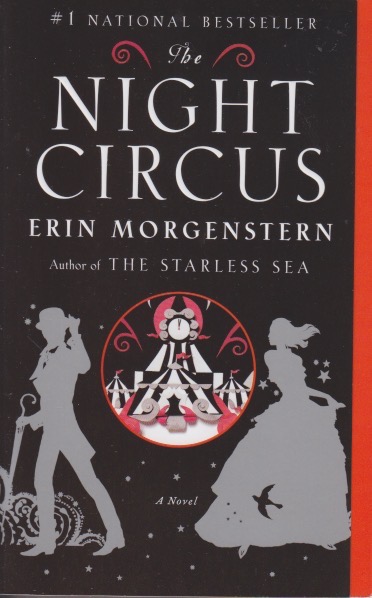
A list of most gothic recent books, I believe it was, that suggested The Night Circus by Erin Morgenstern.  It’s a big book—over 500 pages—so I decided I’d wait until autumn to get underway.  It ended up taking most of September and half of October to finish it.  Since I prefer to start fresh, I had no idea what it was about.  A night circus, of course, as the title indicates.  It is set in the late Victorian period, although I’m not sure all the turns of phrase in the book were current at that time.  There may be a few spoilers in the description, should you want to go out and read this yourself first.  I mention that because something that only becomes clear near the end is a pretty good starting place for giving an idea of what the story’s about.

A very old man (who doesn’t look or act old) is a very accomplished magician (not the stage variety).  One of his students becomes very proficient and the two begin a rivalry that involves each setting a protege against that of the other.  It is a contest, we eventually learn, to the death.  The younger magician selects a daughter he didn’t even know he had, while the original teacher selects a young man without prospects.  The battleground on which these two duel is the eponymous night circus.  Each tries to outdo the other in creativity and wonder.  The circus is open only at night (hence the name) and is fueled by actual magic.  A cast of characters gets introduced, and they’re very well drawn.  In my experience of reading the book, they drew me back in because you pretty much liked most of them and with magic involved, well, you never know.

The novel was gothic in the Victorian setting and in the sense that there is an ancient contest underway here that interrupts into the then present.  There aren’t spooky castles, however, or really even damsels in distress.  The women characters are all strong and resilient.  The writing is lively and the resolution is satisfying.  The real draw for this book is the writing and the complex story that doesn’t overwhelm or leave you feeling too lost.  It’s a magical realism with boundaries and offers a good message that magic is all around, if we only open our eyes to it.  It’s a good book to get lost in for a few weeks.  I appreciated the fact that the villains weren’t the focus and the violence was mostly implied.  It kept me turning pages, gothic or not.


Victorian Inspiration

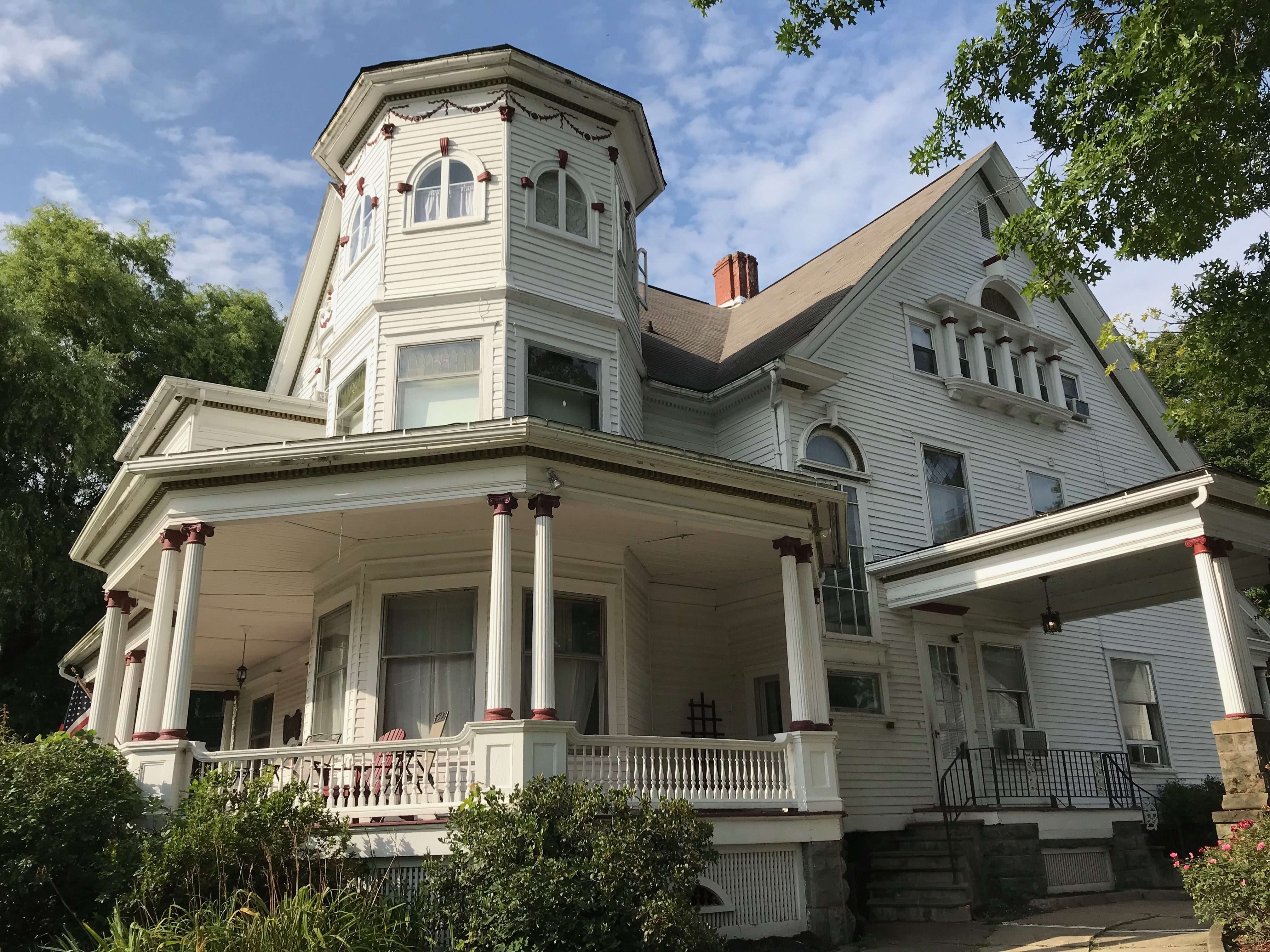
Some stereotypes hold the truth.  Since we couldn’t afford a vacation this summer, we arranged a couple of our versions of “staycations.”  For us that means driving some place a couple hours away, staying in a hotel for a night or two, and exploring a new place for the weekend.  We’ve done that to explore the Lancaster area and a couple of times to the Poconos.  When possible, and affordable, we like to stay in unusual places rather than the typical hotel.  For example, around Lancaster we try to book a caboose at the Red Caboose.  Since those are expensive over the weekend, typically we have to take a vacation day or two to do them before the weekend proper sets in.  On a trip to the Endless Mountains region, we stayed at the Victorian Charm Inn in Towanda.  This is a converted ten-bedroom house from the late Victorian era.  Not a typical hotel, it’s an inspiring place to stay.

What I mean by stereotypes is that such places inspire me to write in their genres.  After staying in the Red Caboose, I typically write fiction about trains.  I’d been on a gothic kick when we stayed at Victorian Charm and indeed, it inspired gothic writing.  Not that we could’ve afforded it, but when we were looking for a house, I really wanted to buy a Victorian.  We looked at a couple but neither one had been well kept up.  I thought they would inspire my writing.  Perhaps it would get old, living in such a house and reading Poe and other Victorian writers, but I wonder if it might have led to more gothic stories.  The fiction I do write tends to draw from my experience of living in various places.  Victorian mansions have a feel to them.

Writing is mostly a matter of discipline, rather than inspiration.  All writers, I suspect, crave inspiration.  I know that I do.  When I awoke to a thunderstorm in a Victorian mansion I experienced something that had never happened to me before in real life.  It made me wonder what it would’ve been like to have been able to live in such a place.  The cracked plaster, the faded elegance.  The nooks and alcoves.  An honest-to-goodness fainting couch.  And who knows?  Perhaps a ghost or two.  Our house was built in the Victorian Era, but by those of much more modest means.  It is an inspirational place to write, but it’s also the place associated with work.  That’s why, in stereotypical behavior, we need to get away on the occasional staycation.


Local Gothic

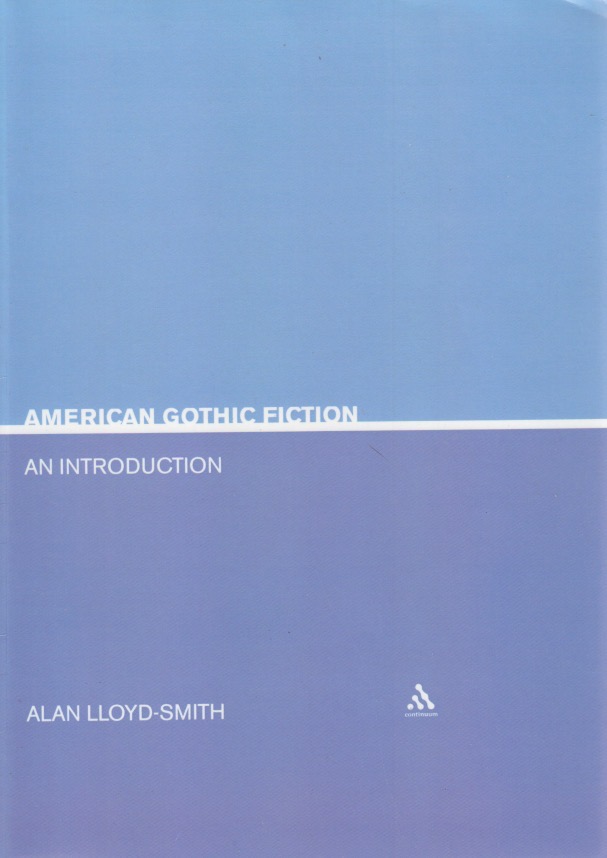
One of the most valuable aspects of the humanities is the range they give the imagination.  As an undergrad from a small town, I was astonished at the range of courses available in a liberal arts college.  Even so, I took only two in the literature department.  I wish I’d taken more.  You see, as someone who grew up poor, my reading has often been budget reading.  Used books found by chance and cheap editions in department stores of a town lacking bookshops.  I soon found that Gothic literature met my needs.  Alan Lloyd-Smith’s American Gothic Fiction: An Introduction is, as you might guess, a series book.  One of those books by an outsider analyzing a different culture’s literature, it is nevertheless quite good for the most part.  Until it decides, as many literary studies do, to go all theoretical.  Prior to that it’s very engaging.

For me it’s less the ideas than the mood of Gothic literature that I find engaging.  It creates a cozy feel, and when I read about Poe, Melville, and Hawthorne, I feel a sense of belonging.  Gothic transformed when it emigrated to America.  Lloyd-Smith does a great job of demonstrating how castles and cathedrals gave way to a landscape built by Native Americans, and an unexplored frontier.  How literature in America tended toward the Gothic from the beginning and even up to the point this book was written, hadn’t really effaced much at all.  Such things are inspiring to me.  It jumpstarted my own fiction writing again.  One curious feature, however, is that the book doesn’t discuss “The Legend of Sleepy Hollow” at all, other than a passing reference to Burton’s film.  There’s quite a lot on Poe and company, Charles Brockden Brown, and some of Charlotte Perkins Gilman.  Even Toni Morrison makes an appearance or two.  (He does cover Southern Gothic also.)

While this is clearly intended as a classroom book—wide, wide margins for note-taking, introductory level until chapter six—it is worthwhile reading for any curious adult interested in American literature.  My life has been a search for my tribe.  For many years it was a very religious search, that, unfortunately led to rejection that left me searching for a new home.  The horror community has been somewhat welcoming, and there’s something Gothic about that in its own right.  In any case, reading about Gothic brings its own melancholy joy.  I mostly enjoyed this book and learned quite a lot from it.  And, of course I bought it used.


Gothic Illumination

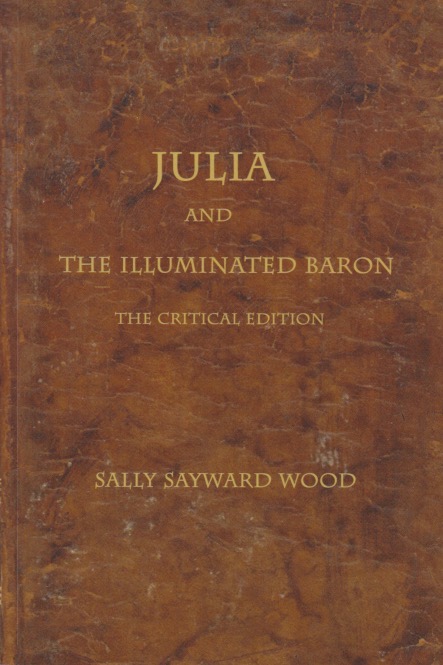
A mere month ago I had never heard of Sally Sayward Wood.  She has seldom received much attention, and it may be in part because her literary finesse wasn’t quite that of her compatriots.  Wood, however, was the earliest American woman to write a gothic novel.  She was also Maine’s first novelist.  I learned of Julia and the Illuminated Baron from a rather unexpected source, but my interest in the history of horror meant that I knew I would have to read it.  Original printings are extremely rare, but the University of Maine has brought them back into circulation.  Julia was published in 1800 and it is old-style gothic.  Set in France, among the aristocracy, it has gloomy castles, dastardly villains, and damsels in distress.  The story also involves an extremely complex set of titled gentry that end up being fairly closely related by the end of the novel.  Well into the story (after about 150 pages) it grows somewhat exciting, but the denouement is something you can see coming, though.

What is really striking about this gothic romance is the extreme vitriol served up to the Illuminati.  In particular, Wood seems quite affronted by their atheistic outlook, stating rather boldly that without Christian sensibilities that morals can’t be preserved.  This wasn’t an uncommon view around the turn of the nineteenth century, of course.  The Enlightenment had begun to take hold and not a few people were very concerned about the implications.  Social change must be slow, if it is to have lasting impact.  Quick change leads to reactionary backlashes, as anyone who looks at history knows.  Still, this makes Wood’s villain particularly nasty.  Perhaps even more surprising is that such biases continue today.

Gothic was an important part of early American literature.  It owes quite a bit to its European forebears, but it developed into its own form in the New World.  When she does mention America, Wood ladles praise on George Washington.  She was born, of course, before the Revolutionary War, when Maine was still part of Massachusetts.  All of this makes me feel somewhat less of a pariah, knowing that the early American tradition was part of the family tree for horror.  In today’s parlance gothic might seem far from the slasher, but without gothic we’d never have had our classic ghost stories that first gave people the frisson that begged for further expression.  Julia and the Illuminated Baron is a bit too satisfied with the wealthy overlords of the second estate.  It is a work of fantasy, however, of one of the earliest American women to try her hand at fiction.


Empowerment

Recommended as a worthwhile contemporary gothic novel, Alix E. Harrow’s The Once and Future Witches is a feminist tour de force.  Set in a world similar, or perhaps parallel, to ours, it follows three witch sisters in 1893.  The sisters are estranged, having been raised by an abusive father, and each has found her own way to New Salem.  The old Salem had been destroyed after the witch trials.  The three find their lives drawn together, not even knowing the others are there.  But there are also still witch hunters.  None worse than Gideon Hill, the leading candidate for mayor.  I’ve long known that books written after Trump are often fairly obvious for the hatred that oozes from political leaders.  This is one such case.  The story is one of female empowerment in the face of constant male opposition.  It goes fairly quickly for a book its size.

It’s an enjoyable read but it grows, well, harrowing towards the end.  You come to like these three very different sisters and appreciate the gifts they offer to their world.  Men, however, make the rules and often they feel that women have no place in making decisions for the public good.  I’m amazed at the number of people who still believe this.  It makes novels such as this so important.  Women with power are crucial examples to present.  The three sisters may cause mayhem, but it is generally good for the city.  When men are in charge, things tend to get repressive.  Sound familiar?

Conveying the gist of a 500-page novel isn’t a simple task so I’ll simply say that this isn’t a conventional witch story.  There’s never a question that witches are good, but capable of doing bad things.  In other words, they are pretty much like all of us.  That’s not to deny that some people become evil and that such people will gain ardent, blind followers.  The characters are memorable and likable in their very humanness.  As far as genre goes, this is a magical realism novel.  As you get drawn into Harrow’s world it becomes believable.  It’s a book that should be widely read and its plea for tolerance must be heard.  I can think of other comparisons—others have also conveyed that an unquestioning religion may become evil unintentionally.  Such conversions aren’t the kind publicly discussed, but they do fit with human experience.  I’ve intentionally left out spoilers since I want to encourage readers.  It certainly has left me thoughtful.


Mirror Gothic

I have a soft spot for gothic novels.  I get the sense that Rebecca James set out to write the most gothic novel ever in The Woman in the Mirror.  Although the supernatural persists in the background throughout the novel, it’s mainly the reflection of two women who encounter the mysterious Winterbourne Hall, high on a cliff over the Atlantic in Cornwall.  Rachel Wright, in the present day, is a self-made woman.  Overcoming the life of being raised an orphan, she has opened a successful art gallery in New York City when she receives an unexpected letter informing her that she’s inherited an expansive property in England.  Not knowing who her parents were, this is a world-changing surprise, so she heads to Cornwall to find her past and to figure out what to do with her inherited property.

Her story is intertwined with that of Alice Miller.  An English woman from two generations past (I’ll come back to that), Miller grew up with a bully for a father and a desire to make it on her own.  She’s hampered, however, by a past secret.  She takes up employment as a governess at Winterbourne where a Rochesterian Jonathan de Grey is lord of the manor.  His two children, fraternal twins, require keeping and the last governess threw herself off the cliffs—you see what I mean by most gothic—so Miller takes the post.  The massive house, however, has a strange effect on her.  Not only on her, we learn, but on most of the women who live there.  The final housekeeper, however, does seem to be immune, perhaps because she’s older.

The story is slow paced, with a fair amount of romance thrown in.  Both Rachel and Alice have lost lovers and are coping with their pasts.  They never meet, of course, being from separate generations.  Perhaps this is just the perspective of an old geezer, but putting Alice Miller in, presumably, her twenties in 1947 doesn’t really seem long enough in the past for the story to unfold as it does.  I couldn’t help but think that this makes her about my mother’s age and I would have to admit that my own daughter is old enough to inherit an estate while having already become a successful artist in Manhattan.  The timing just seemed a little off to me.  The perfect gothic novel seems to require some Victorian aspects, in my opinion.  Nevertheless, this story becomes quite gripping toward the end.  If you want a modern-day gothic romance, you’ll likely enjoy The Woman in the Mirror.


Witching Season

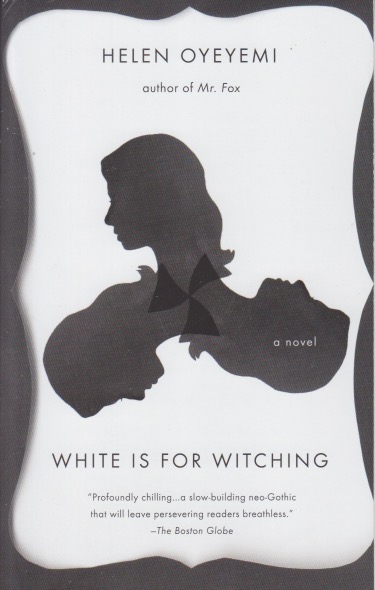
I can’t be sure I understood White Is for Witching, but Helen Oyeyemi’s novel grew on me once I started to piece together what was happening.  A long sit in a waiting room finally got me hooked.  This is an odd story that’s quite a bit about atmosphere.  Miranda Silver and her twin brother Eliot, live in the Silver family house (through her deceased mother’s side) with their father.  They run it as a bed and breakfast, but Miranda’s ill.  She suffers from pica—a disorder where a person eats indigestible items rather than food.  Her mother, who died young, and her mother, and grandmother, continue on in the house, but not as ghosts proper.  They are more a controlling presence guiding the way for the lost daughter who, it seems, is destined to join them.

Miranda’s not an unreliable narrator because she’s never the narrator.  Sometimes it’s her brother, other times it’s her girlfriend, and other times it’s the house itself.  Oyeyemi’s writing is compelling, and she’s great when she takes the narrative thread and runs with it.  The fault is entirely mine, of course, but I prefer a straightforward story where I’m not confused from the start.  I recently put a book down because I was confounded about the issues raised.  I’m flummoxed enough by life itself so that when I want to sit down and read I prefer something that makes sense.  Or that I can follow.  The novel has a wonderful gothic atmosphere and the tragic young woman definitely has shades of Poe.

My compulsion to read appropriate books in October led me to White Is for Witching.  It’s set in England, however, and having lived in the United Kingdom for three years I know autumn there is not the same as fall in North America.  That’s not the fault of the story, of course.  The tale is textured and complex, exploring avenues of madness and isolation (it’s set in Dover and Cambridge).  The part where Miranda falls in love with Ore, at college, becomes quite gripping.  There’s some confusion as to why her twin brother acts as he does, with one of the narrators suggesting that he’s unreliable.  There are speculative elements but no ghosts seen clearly.  And race is obviously an issue.  It’s not the central issue (beyond the author perhaps suggesting something by the title).  There’s a lot going on here.  Normally I don’t read synopses before reading fiction, but this is a case where that might be helpful before indulging in this moody, thoughtful tale.


Banned Monk

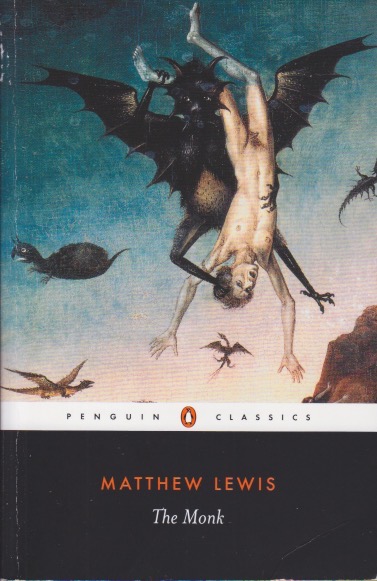
One of the strange things about gothic fiction is that, although often set on the continent, the early practitioners—inventors, if you will—were English.  Three names among them stand out in many treatments of the genre: Horace Walpole, Ann Radcliffe, and Matthew Lewis.  I’ve read the former two and have long supposed I should read the latter’s The Monk.  This 1796 novel made the author famous, but it is long.  And written in the often florid style of the age.  Still, there are plenty of swoons and thunder-plagued nights.  Set in Madrid with a cast of closely related characters, the novel has a twist ending that I did not see coming, which is pretty amazing considering that the book has been out for over two centuries.  (I may have read about the ending before, but had forgotten, if that was the case.)

The novel intertwines two stories that revolve around Antonio, the eponymous monk.  A paragon of righteousness, he heads an abbey in Spain and all are in awe of his piety.  Until sex breaks through his vanity (so we are told; his piety was based on too high a self-regard).  Once seduced, he can no longer maintain his status as chaste, and this sets in motion a tragedy that will leave innocent people dead and lives ruined.  Lewis, it’s famously known, used the novel to critique excesses of the church.  Its power, the novel demonstrates, corrupts.  Still, at the end I was left feeling sorry for Antonio.  He was set up by the Devil and his chances of winning were quite slim from the beginning.

Although PG-13 by today’s standards, the novel scandalized English society when it came out.  The sex scenes were too explicit for the day, especially since they involved the clergy.  The story has quite a leisurely layout, and only after 200 pages (in the edition I read) does the supernatural enter the picture.  Once it does the pace begins to pick up.  The weird thing is, despite its length, this story works.  It’s considered a classic—although often dismissed because gothic literature generally is—it nevertheless delivers.  Antonio is shown to be subject to weakness, and while vain, not inherently evil.  He’s a victim of human vulnerability.  Readers in the late eighteenth century couldn’t see beyond the sex, but there is a tragic human story here.  Castles, abbeys, ghosts, and subterranean passages, murder and torture, it’s gothic through and through.  Although it took most of September to get through it, it feels like I accomplished something worthwhile.  And I finished just in time for Banned Book Week.


Gothic Days

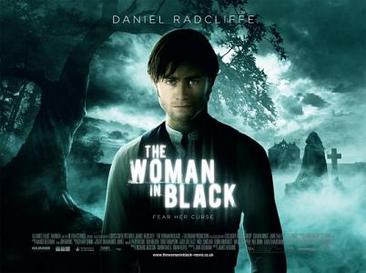
The tradition of telling ghost stories during the months of long darkness has evolved over time.  Since the time seems right, I watched a movie for which I read the book some years ago.  I recall that The Woman in Black is moody, and gothic.  What I don’t remember is how it ends.  More than one source—at least one from someone I know and one from a book—suggested I should see this movie, and I’m glad I did.  It’s a haunted house movie, set in a haunted village and the production values (unlike some movies I’ve recently watched) are quite high.  This film was a reboot in a couple of ways; there was an earlier film version, and it was also a new Hammer production.  In the latter capacity it broke records for Hammer box office earnings.

You see, Hammer, in its first incarnation, struggled for any kind of respectability.  The company almost single-handedly kept horror movies alive while US studios moved more toward sci-fi-themed projects, before the rebirth of modern horror.  Fans knew to go to Hammer for their monsters, but society folks (and those who wish to be society folks) don’t find horror worth any attention.  From my amateur point-of-view, such movies give the viewer a lot to think about.  The problem, as with most underdogs, is that a few bad examples tend to get all the attention.  Life is scary.  That doesn’t mean we shouldn’t try to live it, but it does mean that we might learn something from other people’s mistakes.  Or we might find ourselves haunted.

The Woman in Black is set in Edwardian times.  (I often ponder why we still refer to historical eras by the British monarchs—Elizabeth, Victoria, Edward, etc.—in a world finally moving away from imperialism.  Still, it’s convenient.)  Perhaps not quite as evocative as the Victorian Era, but still moody enough.  Although there are some disturbing scenes, this is no slasher.  Like the novel it’s the tale of a vengeful ghost, wronged in life and out for revenge.  While the end of the movie isn’t the same as the novel (okay, so I looked it up!), it’s similar.  And perhaps it’s best considered a parable of parenting.  No amount of training can prepare you for it, and although it’s supremely rewarding, it’s also very scary.  Susan Hill, the novel’s author, lost a child and that sense of haunting pervades both book and movie.  Gothic is often about grieving, and perhaps about learning something from it.


Carter’s Creations

Angela Carter was a novelist whose best known work is her short story collection, The Bloody Chamber.  Often acclaimed as both gothic and feminist, these repurposed folktales and fairytales leave the reader in a thoughtful state.  I have to admit to having not known of Carter or her work until quite recently.  I’d seen a biography about her, but there are so many writers and my time seems always so limited.  Then I saw The Bloody Chamber mentioned on a list of best gothic fiction.  I had to find out what this was all about.  The stories are indeed unlike much of the feminist literature of the seventies.  The stories are focused on women, often young, and how they deal with being treated as the property of men.

The first, and lengthiest story, “The Bloody Chamber,” is a retelling of Bluebeard from the point of view of his last wife.  It’s an extended reflection on feeling owned and boxed in—literally trapped—by men’s economic rules of property.  Carter keeps readers on edge, even if they know the base story.  This isn’t a simple retelling.  Nor is it a lament about the natural, biological unfairness of sexuality.  There’s an ambivalence here, an enjoyment tinged with melancholy that gives the story a gothic sensibility.  The women in the different stories here prefigure more recent Disney heroines that take charge of their circumstances.  And there’s also ambivalence about the setting of the stories.  There are contemporary appurtenances but still castles and baronial mansions.  You’re lost in time.

The collection has some stories, such as beauty and the beast, retold twice and ends with three versions of werewolf stories that play, to an extent, on little red riding hood.  Some were tales with which I had no familiarity.  The effect of the whole is thoughtful contemplation of the human condition.  Much of the world, it seems, has been unduly influenced by a kind of literalism—a story, whether biblical or traditional, is supposed to go like this—that has not only robbed great texts of their depth, but has entrapped human beings in a stone-chiseled certainty.  A self-righteousness, if you will.  Even writing a text in stone doesn’t prevent others from interpreting it, however.  Since none of us have all the answers, we are each interpreters.  There was no historical Bluebeard.  There have, unfortunately, been many men who embody his attitude towards women.  Carter’s genius is to remind us that every story has at least two sides.  And the woman’s side may well be the truer of the two.


Quiet Company

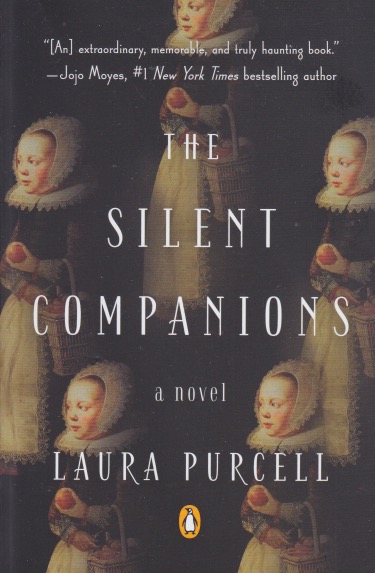
Even as a lifelong fan of speculative fiction, some of the most effective horror is that where a reader is kept guessing.  One of the acknowledged masters of this is Henry James, whose The Turn of the Screw is considered a classic.  There are perhaps too many writers active today to predict who will be considered authors of classics a century or two down the road—writing has to take a long view.  Nevertheless Laura Purcell’s The Silent Companions is, in this reader’s opinion, quite effective.  And ambiguous.  I’m on the constant lookout for gothic novels that work and this is one that surely does.  I’ll try not to give spoilers here, but I do recommend it for those who want a gothic atmosphere.  It is also genuinely scary.  A great deal of this is because the reader is never quite sure what has happened.

The eponymous companions are decorative curios purchased to impress royal visitors in the seventeenth century.  Life-like cutouts of people, they are silent.  Throw in an old, sprawling house in need of repair and a widow who had abusive parents and who’s inherited resentful servants and you’ve got a recipe for an eerie atmosphere.  The novel splits its time between the nineteenth and seventeenth centuries, focusing on the former.  Elsie Bainbridge is a protagonist with many secrets, and not a few skeletons in her closet.  The house she inherited also has a past that included accusations of witchcraft and cruel masters interested in self-promotion.  Told from the point-of-view of the women in a patriarchal society, there is an authenticity to the victimhood even of strong women.

It would be difficult to tell too much of the plot without giving away some of the creepier moments.  There’s a lot going on here and although it’s not a short book it doesn’t drag the reader down with filling too many gaps.  It’s also a novel that allows imagination to outstrip rationality.  Good speculative fiction will do that.  Even some of Poe’s work makes the reader wonder just what is happening—is this in the mind of the observer or is it objectively real?  Think “The Tell-Tale Heart.” Literature takes us into such places and gothic literature does so with more shadows and ambiguity.  Throw in some betrayals, and keep a few well-placed secrets and the recipe is in place for a creepy novel that will keep you reading.


Creepy Houses

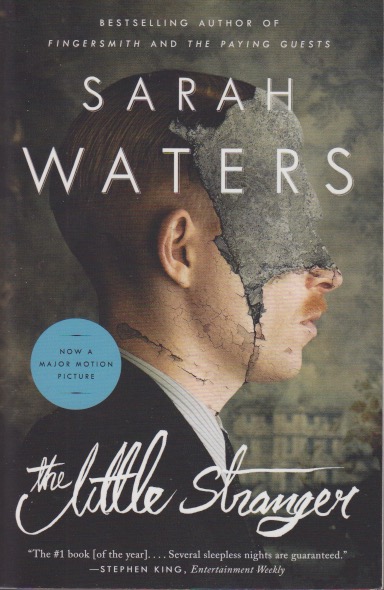
Definitions, I’m learning, are often a matter of one’s experience and taste.  I’ve read a lot of gothic novels and have tried to pinpoint what it is that creates a gothic feel for me.  I say “for me” because other people sometimes suggest works that I would put into a different category.  In any case, it’s clear that The Little Stranger, by Sarah Waters, is a gothic novel by any measure.  A large, isolated house.  A tainted family slowly fading away.  A remorseless, 400-page winter.  Inevitable decay.  The story is ambiguous and moody as Dr. Faraday, the narrator, falls in love with Caroline Ayres, the only daughter of an aristocratic family in decline.  The house may be haunted.  Or the family may be breaking down mentally.  Like The Turn of the Screw, it’s up to the reader to decide.

My preferred gothic has elements of the supernatural in it.  Melancholy without existential threat isn’t really enough to tip the scale for me.  The Little Stranger has enough of both to keep the reader guessing right up to the end.  Reader-response theory—the underlying basis for what’s being called “reception history”—posits that the reader assigns meaning.  The author has her idea of what happened in mind, but the reader contributes their own understanding.  This idea has influenced my own writing.  Once a piece is published the readers will make of it what they will.  In this way I can read Little Stranger as a haunted house story.  Although it was made into a movie I have to confess that I only heard of the novel recently while searching for gothic novels I might’ve missed.

The ambiguity fits the ambiguity of life.  The same circumstances can be interpreted by one person as entirely natural while another will add a super prefix.  No one person has all the answers and reality can be a matter of interpretation.  In that way Sarah Waters’ art follows life.  Interestingly, religion plays very little role in the story.  Church, when it appears, is perfunctory.  The source of tension here is on a rational, medical interpretation of events versus the gloomy lived experience of the Ayres family.  They believe themselves haunted and the scientific answers have difficulty convincing readers that there’s nothing more going on.  This is a gothic novel with a capital G.  Nevertheless, the debased cleric would have been welcome, but you can’t have everything.