Identity Crisis

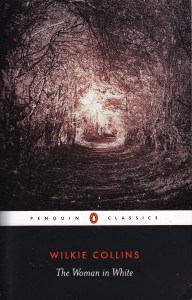
womaninwhiteSince at least my middle school days I have been in search of the great Gothic novel. I can’t claim to have found it just yet, but I’ve read many notable samples along the way. Somehow Wilkie Collins’ The Woman in White remained completely unknown to me until earlier this year. The title was evocative enough to make me pick it up, daunting though its 600 pages might be. Like many novels of its period it was serialized, which likely accounts for its length. Honestly, it took a while to get into it fully. Once ensconced, however, it kept me reading for over a month. (I took some breaks for work and sleep.) I wouldn’t say it was my ideal of the great Gothic novel, but the character of Count Fosco is amazingly drawn and seriously compelling. As the huge man lets mice run over his massive body and treats birds with conscientious gentleness, he is plotting ruin to his fellow human beings to benefit himself. He is an accomplished egotist.

What makes the novel so profound to me is the question of identity. One of the characters in the novel, the eponymous woman in white, has a double in the love interest of the protagonist. Doubles are common in Gothic tales, but in this instance when the woman dies and others believe her double to be her the question of identity is raised. Who am I, really? In the day before DNA evidence, it was impressively difficult to prove you were who you said you were, if your appearance was altered. Emaciated, abused, and drugged, Laura doesn’t look like herself and even her own uncle doesn’t recognize her. In the end her identity is established by legal testimony alone, without benefit of any biological proof.

Identity has been on my mind lately. Especially on a national scale. Brexit and Trump were both movements fueled by distrust and distorted notions of national identity. In short, Britain and the United States, so the reasoning goes, should belong to white men. As Monty Burns famously said, “Well, for once the rich white man is in control!” I personally like a little color in my field of view. I value deeply those I’ve met whose experiences and skin tones don’t match my own pallor. I want our national identity to include more than just fifty shades of white where women are objects and men are some kind of noble studs. Back when I started to read this novel I had a grip on that view of reality. Now that I’ve finally finished it, I wonder who we really are.

The Friar’s Tale

Being a fan of Gothic fiction, I recently read an anonymous story from 1792 entitled, “The Friar’s Tale.” Those who linger among Gothic conventions know that the monastery is a common trope in the genre, often with debased clerics who use their authority to make their charges miserable. (Hmm. I wonder why I keep coming back to this kind of fiction?) Literary scholars tend to point to the late eighteenth century as the origin point of Gothic sensibilities which coincide with the Romantic movement. This then, is an early example of what people feared as industrialism and modernity encroached on a world once natural and full of mystery. The tale contains nothing to frighten a modern reader, but it does offer compelling commentary on the one organization that would seem most to benefit from retaining a pre-scientific worldview—the church.

IMG_2009_1024

The story involves lovers separated by a cad who is after the lass’s money and who connives with the mother superior of a convent to lock the girl away from both her money and her lover. She comes to the realization that religion has ruined her prospects. The friar narrating the tale refers to religion as “that constant comfort of the good, and powerful weapon of the wicked.” Of course we had already experienced Reformation vitriol by this point in history, and rage against the use of religion as a means for personal gain had been thrown out for any who would care to utilize it. Clearly the author of “The Friar’s Tale” found it essential to the plot.

The truly interesting aspect of all this is how, in the intervening centuries, religion has continued to present this opportunity to the greedy and corrupt. Not all religion succumbs, of course, but when it becomes a hierarchy of any description there will follow those who find it a means of personal gain. The Prosperity Gospel movement comes immediately to mind. Those who putatively follow a man who is recorded as having said to give away all that you have in order to be his disciple have somehow missed the message and keep their treasure where moth and rust pose constant dangers. We think ourselves advanced since then, but the words of a fictional friar from centuries ago may still hold some wisdom for Gothic readers in the present.


Lost and Found

As a young lad I was fascinated by the supernatural. This may explain, but in no wise excuses, my choice of a career in religion. As I grew in years and skepticism, this interest began to feel like a security blanket in a college dormitory — an embarrassment to be jettisoned as quickly as possible. Along the way, of course, I’d given away what I thought to be the detritus of childish fantasy, including my collection of cheap, pulp fiction, tending toward the Gothic.

As I grow more ancient, and more observant, I see that sometimes the impetuousness of youth cradles a profound wisdom. Sometimes we do get it right the first time. I still haven’t figured out if that’s the case with me, but it seems to be a hypothesis worth the exploration. Part of my current search for reality is the reassessment of my childhood learning in the school of classical Gothic fiction. The books are no longer as cheap as they used to be, and when I take them out in public I hide them inside a larger, more academic book so that no one really knows what I’m reading. As a friend once observed, people think that those of us who hang out in the religion sections of Borders are immediately suspect. More so the adult toting a beaten-up paperback written for a teen readership a number of decades ago.

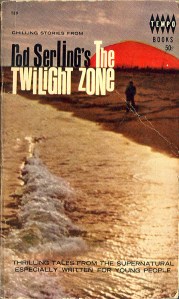
One of my lost memories was a juvenilized version of Rod Serling’s Stories from the Twilight Zone. I had shoveled my copy off to Goodwill along with many other shards of my childhood when I “grew up.” The memories of the angst that the very cover generated in me led to a frantic online used book hunt a few years back. Inside the stories seemed flatter than I’d recalled, but the larger ideas they generated were still worth paying attention to. Perhaps the real lesson is that childhood should not be dismissed as wasted time playing and indulging in carefree amusements. Our childhood proclivities, it now seems, preset the trajectories for our lives. So I still have a quasi-career in a religion department, and I have a copy of a book that started me asking the bigger questions.

Anybody else remember this?

Anybody else remember this?