Not Grant

Grant Wood’s painting, “American Gothic,” is undoubtedly his most famous work.  The image is so evocative and suggestive that countless interpretations have been offered for it.  The idea of debilitating isolation suggests itself.  An unhappy self-reliance that has taken its toll on an aging couple (some say the woman is his daughter) often comes to mind.  For some it suggests a movie.  Normally I like horror films from the seventies and eighties.  There’s almost an innocence to them that gets lost in the new millennium.  On a rainy weekend afternoon when I couldn’t be mowing the lawn I found American Gothic on Amazon Prime and it had received four stars and even IMDb showed it as better than average.  The longer I watched the more I was inching toward “bad movie” territory, but I had to see how it ended.
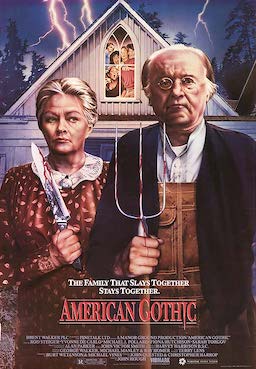
Six young people, four of whom are distinctly unlikeable, have plane trouble and get stranded on a lonely island in the Pacific northwest.  They discover a house furnished from the twenties and it turns out there’s an older couple there who don’t really cotton onto strangers.  As the plot unfolds it turns out they have three adult children who think they’re still adolescents.  And—this is the good part—they are a very religious family (in part.  Again, as often happens in such films, the writers really don’t understand religion).  In any case, the predictable killing off of the kids starts to happen when they continue to be rude and insult the family.  Since we’re in slasher territory here, there’s a final girl—one of the two sympathetic women—who ultimately takes over the house.

Part of the problem with the film is the utter paranoia with which it treats mental illness.  The family clearly has problems and, in a way typical for the genre, they turn toward killing.  Ironically, Pa, when he finds his family has been killed by the one mentally ill visitor (everyone with psychological problems in this movie turns to murder), renounces God and sells himself to Satan.  Interestingly, he doesn’t survive long enough to do anything about it.  Reading about this movie after watching it I came across a new word: hixploitation.  Exploitation movies are familiar to anyone who watches much in this genre, but I’d never considered that Deliverance and company exploit “hicks.”  It’s all about how others look at you.  And, as a movie made in Canada and the UK, it shows us what others see when they look at us.  There’s some ground to explore here in a sequel to Holy Horror


Gothic American

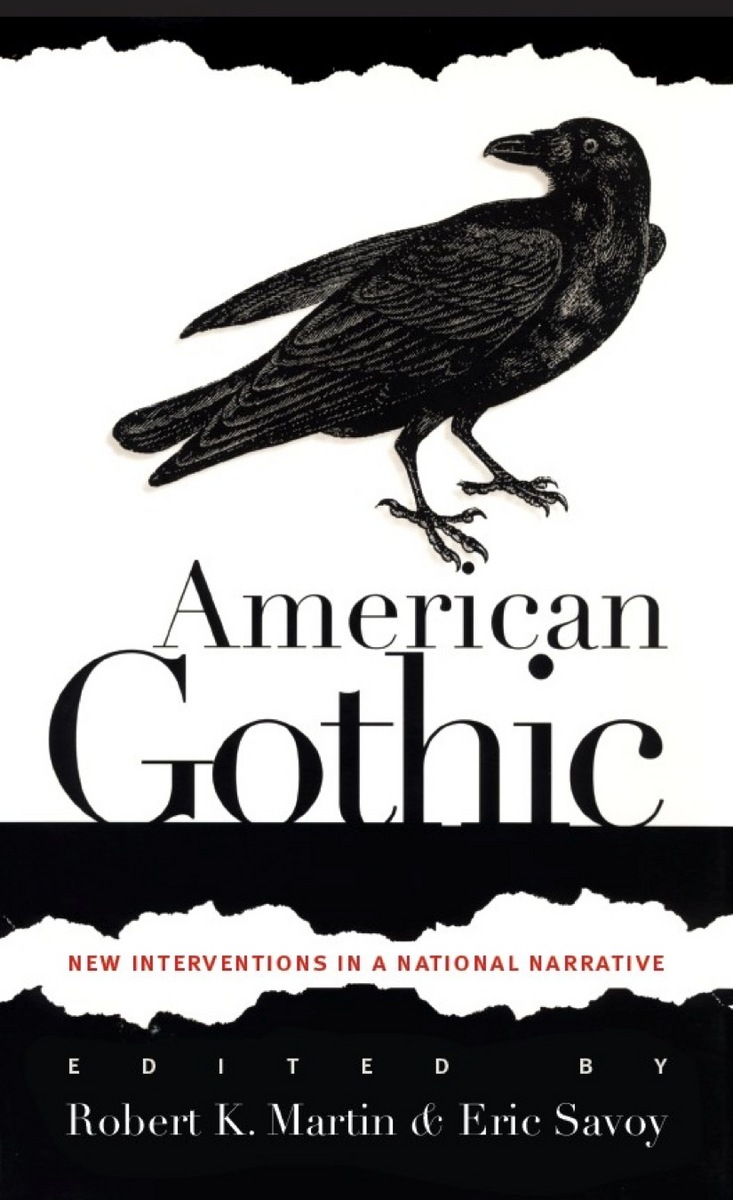
AmericanGothAmerican Gothic, the painting by Grant Wood, caused me trouble at Routledge. An author wanted to use the image on the cover of his book (we eventually managed it) but the choice was contested at every step. Along the way editors, editorial assistants, and marketers all told me what the painting represented and how it was inappropriate. I’ve learned, however, a few things from the post-modernist movement: nobody can say what an artwork means definitively. So when I read American Gothic: New Interventions in a National Narrative by Robert K. Martin and Eric Savoy, I was ready for a combination of po-mo and the macabre. Like post-modernism, Gothic is a difficult term to define. Indeed, the first set of essays in this collection struggle with definitions. Being literary criticism, the book points out that the novel and Gothic more or less developed together. When people read to be entertained, as early as the eighteenth century, they wanted to read Gothic tales.

Being a life-long fan of Poe, I was pleased to see that he made a good showing in the pieces contained in the book. What makes it appropriate to this blog—other than it being October, a comment that requires no explanation in the northern hemisphere—is a notion I found early in the book. People read horror literature for healing. Anthropologically, the wounded healer is a well-recognized figure. In a world where we expect opposites to go together health comes from disease and healing from being wounded. The gothic is a wounding of the mind to lend it healing. To be sure, many of us who read gothic literature do not relish scenes of violence or hurt. We do, however, find a kind of therapy within such darkness. In the darkness light is best appreciated. Who uses a flashlight outdoors on a sunny day?

As with most books from multiple authors, there’s some unevenness to the contributions here, yet more often than not, I found deep insight throughout its pages. Religion makes occasional appearances. Indeed, the figures of the monk and the debased church are stock images for early gothic literature. The sacred, if we’re honest, is a bit creepy. Having spent many nights in churches on retreats or for hospitality when youth groups couldn’t afford a hotel, I know that fewer places are scarier at night than an unlit, empty sanctuary. The gothic, following culture, has tended to move away from monasteries and churches into the more scientific spaces of the twenty-first century. Nevertheless, ravens and haunted houses still evoke the age-old fears of a coming period of darkness, the Halloween of the soul. And for those who want to know how a post-modern crowd scans the darkness, this book will not disappoint.


Whatever Happened to Whimsy?

American Gothic is one of my favorite paintings. I’ve never seen the original, and I know of no other paintings that Grant Wood produced, although I’m sure there are some. The mood in what has been called “the most famous American painting” is unsettled. There’s something not quite right here. When one of my authors wanted to use the image on a book cover, it led to quite a bit of serious discussion. I was a bit surprised by the negative impressions—not of the painting, but of its use on a serious academic book. The discussion seemed to turn on money rather than on wit and whimsy. I confess to being a dreamer, and I admit that the aspects of life that truly inspire me are never financial. When I crave wealth it is so that I might free up some time for creativity. That’s not the way business works.

Sometimes I feel a stranger in my own country. The unquestioned triumph of unbridled capitalism means that you can go from city to city to city and not really be able to tell much of a difference. If you want to buy a bit of tubing or a piece of wood, it’s Home Depot or Lowe’s for you. Office supplies—Office Max or Staples are your only choices. If you want to buy intelligent books, well, you’re just plumb out of luck unless you go to Amazon. The big financial corporations have won. Just admit it. Every time I visit my hometown I come away depressed at all the vacant stores and lost hopes of the small businesses that offered something just a little different. Something to tickle my fancy. Something to tempt me to wonder. Something with a tinge of American Gothic.

AmGoth

The messages we receive from every angle echo Madonna’s hit song, “Material Girl.” Only this includes all genders. Reductionistic materialism tells us that we’re just proteins walking. Mind is an illusion. Soul is a myth. I work a job where the money I’m paid is transferred electronically and if I want to see some of it in paper form I face a robotic ATM rather than a human face. I went to the mall last night and wept. Call it a mid-life crisis if you will. Say nostalgia has no place in a forward-looking society. I just want a few more options besides the plastic, the smart-chipped, and the sterile. The world needs more whimsy. Maybe that’s why I insisted on American Gothic on the cover of the first book I put under contract.