
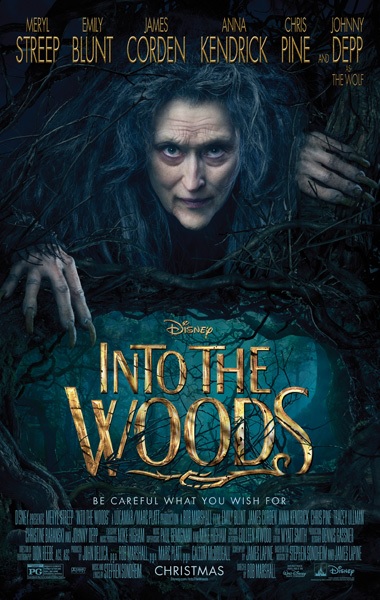
 I first learned of Stephen Sondheim’s musical Into the Woods while liking in the woods of Wisconsin. I was teaching a summer term course of mature students, one of whom used one of the songs to illustrate the point he was making during a presentation. Of course I don’t remember what the point was, but I did remember the movie. Then along came Shrek and fractured fairy tales were back in business. Enchanted brought Disney into the act, and a number of self-aware takeoffs from the brothers Grimm have followed. I’d seen the film of the stage show of Into the Woods before, but it had been a while. Over the weekend we decided to watch the new Disney offering of the story and as we did a couple of familiar, if obscure, ancient mythological motifs came to mind.
Cinderella, as we all know, was sorely abused by her evil step-mother and step-sisters. She seeks solace at her mother’s grave, in the woods, of course, in the movie version. While there, singing somewhere between a lament and a prayer, her mother appears to her in the tree that grew from a branch she’d planted there many years before. It’s a musical number, of course, but my mind couldn’t help going back to Asherah. Asherah is considered by many (without good reason, and I should know) to be the goddess of the trees. Yes, this was a mortal, a dead mortal at that, who spoke from the tree but the way she was presented in the movie was distinctly divine. Indeed, there is similar iconography from ancient Egypt. It was almost enough to make me go back on my own evidence that Asherah wasn’t a tree goddess.
The giant’s wife poses a real threat in this film. Jack’s beanstalk and the effects resembled those of Jack the Giant Slayer, a movie that I only vaguely remember as being one of many I watched with bleary eyes on a transatlantic flight a few years back. Nevertheless, Mrs. Giant is here stomping about the village when Jack and the baker decide to take her out at the tar pit, with the help of Little Red Riding Hood and Cinderella. The preferred weapon is a sling. As the giantess is pelted with stones, she grows annoyed until Jack, in the perfect image of David, strikes the giant between the eyes, slaying her. We all know the fairy tale version ends with the beanstalk chopped down. We’ve entered a new world, however. A world where Bible and fairy tale are harder to distinguish. And not only that, but even fairy tales no longer have the canonical status they once held.
 Steve A. Wiggins