Bible Use

In the current presidential race, it seems, the Bible hasn’t been as large an issue as it has been in the past. Bluff, bravado, and bullying seem more the order of the day. Goliath rather than David. This makes me think of the varied uses that the Bible has had in American life. It has been used as a spiritual guide, a textbook, a set of moral principals, a grimoire, and a science primer, as well as a political playbook. It is versatile, the Good Book. It has been prominent in American society from the very beginning, but clearly its prominence is starting to fade. Not likely to disappear any time soon, the interesting question is how people use the Bible, often without reading it. This is what scholars call the “iconic book” aspect of the Bible. It is performative—it acts in a way that has an outcome, no matter what the intent of the user. As I’ve argued in academic venues, it has become a magical book.
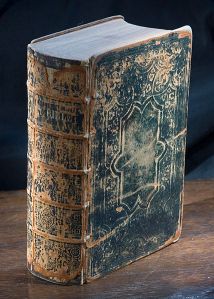
An iconic book (photo by David Ball)

An iconic book (photo by David Ball)

Wondering whether this is a new situation or not (I deeply suspect it’s not) I’ve been reading about the Bible in early America. Almost all the reference material points to the “official” uses of the Bible—that by statesmen and clergymen (both classes of “men” in the early days) with almost nothing of how it was used in private. This question involves some exercise of the imagination since there are few data. Would not a family, struggling to survive, see in the Bible a powerful book? And would not a powerful book be capable of subverting the laws of nature? Reading about the witch trials in Salem, we see that thunderstorms and other “prodigies” were considered magical. Surely one could use the Bible for unorthodox purposes? There’s little to be said in the absence of evidence. The use of magic in the colonial period, apart from the trails of witches, was not unusual.

How do we measure the ways the Bible was used when nobody beyond interested parties, such as clergy, wrote about it? Mr. Trump even tries to quote it from time to time, but since his citation that sounds like a joke opener, “Two Corinthians [go into a bar],” he seems to have let that hot potatoe drop. The Bible, seldom read, remains a powerful book. The source of its power, I suspect, is in its use by the common people. Many people are familiar with it, and believe in it. Some have even read it. It remains, however, one of the great mysteries among the early European settlers. We know they had their Bibles with them. How exactly they read them, when not under the eye of the preacher, we apparently have no way of knowing.

Grim Where?

An inordinate amount of my childhood time was spent on television. While the device of the day had been around for a decade already, I was among those who grew up learning that watching was easier than reading. Like most children, I took the path of least resistance. I watched. As a teen, however, I rediscovered reading and from that time television began to take a back seat to books. When the great switch-over to digital occurred we didn’t get a conversion box, and we could never really afford cable for as little TV as we watch. When a program gets commended, or if nostalgia takes too great a toll, we can always purchase programs—the price of watching television without the commercials. So it was that I began watching Sleepy Hollow. Very quickly in the first season the monster of the week trope was established as the plot grew more and more tangled. The Bible was so prominent in that season that I wrote an academic paper on it.

Sleepy_Hollow_-_Title_Card

Over the past few months my wife and I have been working through season two. The DVD version was delayed and we only watch on weekends. Recently we finished the eighteen episodes of the second installment. Clearly the budget had improved over the first season, but the Bible, it was also clear, had diminished. Throughout the first season the driving motif of the story was that biblical “prophecy” (from the book of Revelation) was unfolding in Sleepy Hollow. This is what one scholar has termed a “local apocalypse.” Throughout season two, however, the end of days is shut down. Molech, its architect, is killed. The headless horseman is less Death than a jilted lover. The second horseman, War, loses his armor and dies.

Magic, however, along with special effects, take on an increased roles. Instead of turning to the Bible to solve problems, the most helpful book to have on hand is a grimoire. Sleepy Hollow, which is anything but what its name suggests, is full of monsters. Powerful magic is required to contain them, and, it seems, the Bible is no longer needed as a tool to take down evil. Perhaps there is a parable at work here. I was drawn into the series by its biblical literacy, as well as its literacy in general. More action has been introduced, and fewer books. It’s a pattern I’ve seen before. I suspect I’ll watch season three presently. When I do I’ll be casting a wistful eye on the stack of books I have yet to read, and I’ll be wondering if reading may not have become easier than watching.


Ordinary Magic

ConjuringSpirits copyThe concept of grimoires, as well as being seasonal, has been on my mind as I finish up my paper for the Society of Biblical Literature annual meeting next month. Grimoires, books of magic, have eluded, for the most part, the interests of scholars. Who takes magic seriously, anyway? Slowly our gaze is working its way away from our noses and out to the magical world beyond. Conjuring Spirits: Texts and Traditions of Medieval Magic is a textbook example of what happens when you bring the two together (scholars and magic, that is). Like most collected works, the pieces range from fascinating to somewhat magical in their ability to cause the eyes to close. Nevertheless I learned quite a bit from this book edited by Claire Fanger. Magic is not nearly so rare as we like to claim it is.

Perhaps the biggest takeaway from these essays is that grimoires were not only written by witches. Indeed, in the Middle Ages many of them were written by clerics and monks. They were avidly used by doctors, as science likely has its roots in magic rather than in some sudden enlightenment that matter is all there is. Medicine was still beholden to Aristotle, Hippocrates, and Galen. Humors and stars could make you unwell, and the wise physician would do well to pay attention to magic as well. Today we’re too sophisticated for that, but we still call the unexplained the placebo effect.

Although the church became the great enemy of magic, it was also one of its main sources. The Mass, with transubstantiation, seemed alchemical. Miracles of healing, known throughout the Bible, suggested that the improbable was indeed possible. A number of grimoires contained instructions to work such wonders. One of the most vehemently condemned was a book informing how to attain the beatific vision—a worthy enough goal—but it did so in a way that circumvented the power of the church. Garden variety magic was also available, of course, as were recipes calling for brain of black cat and blood of bat. Witches, after all, were mainly sought out by the church. Those with power are not easily compelled to relinquish it. It should surprise no one then that magic continues to thrive.