Hungry Madness

It’s been on my wishlist of movies to watch for a few years, In the Mouth of Madness.  A tribute to Lovecraftian horror, as well as a probing of insanity, it is a heady mix.  In keeping with my usual rules for movie watching, I hadn’t pre-read anything about it that would give away the plot.  Coming to it fresh, a number of things stood out.  There were some very good scenes and parts of the movie made me want to like it a lot.  It is a great movie for religion and horror analysis, and in that regard it’s much better than Prince of Darkness (despite Alice Cooper).  In fact, had I been able to see it years ago, it would’ve been included in Holy Horror.  That itself is noteworthy since two of John Carpenter’s other movies were in it: The Fog and the aforementioned Prince.  I suppose I should provide a little summary (if possible) in case you haven’t seen.
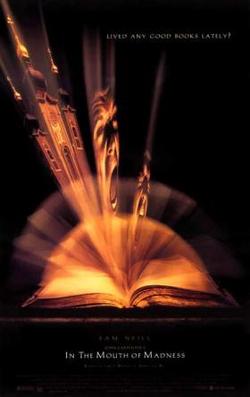
Trent is an insurance investigator, and a hardened skeptic.  A horror writer who outsells Stephen King, Sutter Cane, has gone missing and Trent’s sent to investigate.  He discovers that Cane is in a town that doesn’t exist (Hobb’s End) and that his books are not fiction.  In fact, Trent is a character in one of his novels.  When people read his latest book, In the Mouth of Madness (a title adapted from Lovecraft), they go insane and begin killing others.  The plot gets a bit busy because people are starting to transform into slimy, Lovecraftian monsters and this reality, if the book is read, or movie watched, will spread to all of humanity, leading to our extinction.  A bit too ambitious, the plot can’t hold all this weight, but it really isn’t bad.  There’s just too much going on.

The religion elements come in because Cane has holed himself up in an unholy church.  He refers to his latest novel as the “new Bible.”  “More people,” he says, “believe in my work than believe in the Bible.”  He later refers to himself as God.  I haven’t seen all of Carpenter’s films, but there seems to be a trajectory of his earliest major films being his best.  Halloween and The Thing are classics.  The Fog isn’t bad.  When he brings religion into his stories, as in The Fog, things begin to cloud over a bit.  Prince of Darkness doesn’t deliver a believable Devil.  In the Mouth of Madness doesn’t quite hang together well enough.  It’s not a bad movie, though.  It has given me some ideas for another book, if I can stay sane long enough to write it.

Dark Lovecraft

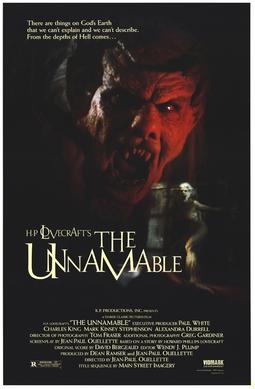
There is no shortage of Lovecraftian horror movies out there.  I watched The Unnamable because I found it on a list of dark academia movies.  And also, well, it’s horror.  I’ve most likely read Lovecraft’s original story at some point in time, but I didn’t remember it at all.  The dark academia part comes in because it involves college students and a haunted house.  A low-budget offering, this is hardly great cinema.  It’s not sloppy enough to qualify as a bad movie.  That puts it somewhere around “meh.”  The film opens with Joshua Winthrop being killed by the monstrous daughter that he keeps locked in a closet of his house.  Then, in the present day (the movie is from 1988) three college guys talk about it and the skeptic decides to spend the night in the house to disprove the monster tale.  He is, of course, killed.  Although his two companions don’t go looking for him, others end up in the house.

A couple of upperclassmen looking to score with freshmen coeds, talk two women into going to the house with them.  As they start to enact their plan, the monster kills them one-by-one, leaving the virginal final girl alive.  Meanwhile, the other two students whose friend was killed, also come to the house.  They manage to rescue the final girl and escape the creature by invoking the Necronomicon’s spells.  The music cues are often comical, suggesting that this isn’t to be taken seriously.  They also spoil the dark academia atmosphere.  For me, a horror film works best if it’s either clearly horror or clearly comedy horror.

It did, however, raise a question in my mind.  Dark academia and horror do have some crossover.  H. P. Lovecraft often had professorial types as his protagonists.  Was he writing a form of dark academia?  It’s difficult to say.  Lovecraft’s work was known as “weird fiction” in his time, and it has become its own kind of genre.  (Just try to publish in the rebooted Weird Fiction without your Lovecraft cap on and see how you fare.)  I’ve been pondering genres for quite some time, and since I watch movies because they’re free or cheap, often, I see some unconventional fare.  There’s no question that The Unnamable is horror.  When the movie ended I was sad for the monster.  She’d been living according to her nature, and really didn’t deserve the treatment she received from a bunch of trespassers.  Not a great movie, it nevertheless made me think.


Slimy Monsters

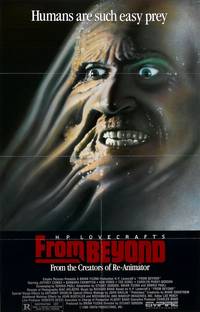
Stuart Gordon apparently had in mind to do an H. P. Lovecraft cycle, as Roger Corman did with Poe.  I first saw Dagon—clearly his best—and some time later picked up Re-AnimatorFrom Beyond was his second Lovecraft movie and it doesn’t have the visual appeal of Dagon, but it is certainly a passable gross-out for those who enjoy slimy monsters.  Gordon was pretty obviously of greater libido than Lovecraft ever was.  From Beyond puts sex in the spotlight’s periphery without making it absolutely central to the story.  A Dr. Pretorius has built a “resonator” that allows him to see extra-dimensional beings.  It does this by stimulating the pineal gland.  His assistant Dr. Tillinghast, is present when a creature from, well, beyond, kills Pretorius by wrenching off his head.  Tillinghast is suspected in his murder but is being held in an asylum rather than a traditional jail.

Dr. McMichaels, the love interest in the film, believes that Tillinghast is sane and that he actually did witness these beings from beyond.  As a scientist, she wants to see if the resonator really works.  It does, but in addition to providing the ability to experience the other realm, it also boosts the sex drive of those under its influence.  She decides, against the warning of Dr. Tillinghast, to try the resonator once more, but this time the other-dimensional Pretorius has become strong enough to prevent her from shutting the machine down.  Tillinghast is transformed into a modified human with an extension from his forehead and as she tries to explain what she witnessed, McMichaels is classified as insane.  She and Tillinghast escape the asylum and McMichaels manages to blow up the machine, ultimately going insane for real.

Lovecraft strenuously avoided sex in his written work, limiting the number of women characters who appear.  I suspect he would not have been pleased with this treatment of his story.  Gordon went on to make one more Lovecraft movie beyond Dagon, a television movie of Dreams in the Witch House (which I haven’t seen).  Of the three theatrical releases, I find Dagon the most convincing since the mood is serious and it seems to capture much of the feel of Lovecraft’s “Shadow over Innsmouth,” one of his best stories.  Lovecraft himself apparently didn’t care that much for that particular tale.  And he was critical of the conversion of stories into movies.  It’s a good thing that one doesn’t have to see eye-to-eye with Lovecraft to appreciate his works.  And some of them transfer to film reasonably well.  Especially if you’re in the mood for slimy monsters.


Lovecraftian Advice

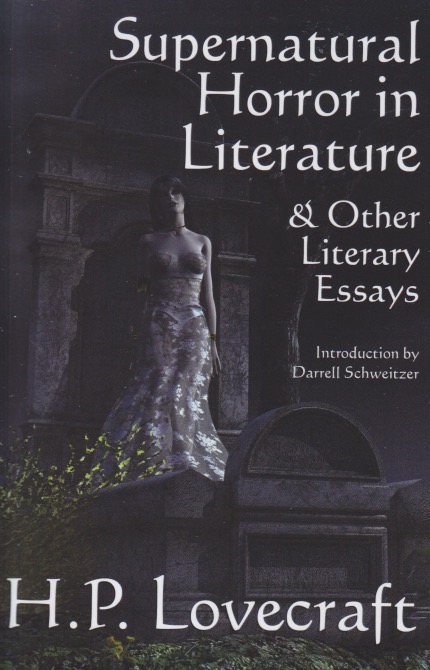
It seemed natural enough to follow up Stephen King’s On Writing with H. P. Lovecraft’s famous essay “Supernatural Horror in Literature.”  This piece, widely quoted, is available online but it is lengthy and I wanted the convenience of not reading it on a screen.  What can I say?  I like to turn pages.  I found a print copy, along with two other, shorter Lovecraft essays in Supernatural Horror in Literature & Other Literary Essays.  This was published by Wildside Press, which added a brief introduction by the speculative writer Darrell Schweitzer.  The text of the main essay was obviously computer-read—a couple reading errors remain—but it is clear enough to read.  Like Poe before him, and King following, Lovecraft put down some of his thoughts on the craft of writing.  Interestingly, Lovecraft is seldom considered as a producer of belles-lettres, but he is world famous as a horror writer now.

The essay itself is worth reading.  Mostly it is a summary of what Lovecraft felt was worthy weird fiction.  I tend to agree with much of what he says here, as would be evident were anyone to read my own fiction writing.  I can’t say that I learned this at Lovecraft’s knee.  I only discovered who he was when I was teaching at the University of Wisconsin Oshkosh.  I did not have literary friends growing up; my reading tastes were determined by myself, largely based on what was available at Goodwill any given week.  Nobody I knew read Lovecraft and although his books may have been in that bin, he wasn’t really someone I’d have known to keep an eye out for.  As a child I didn’t think of myself as a horror reader.  I liked monsters, and vampires were among the most immediately recognizable.  My brother, if I recall, got me started on Poe.

When I began writing fiction, probably around twelve or thirteen, it was weird fiction.  One of my other influences was Ray Bradbury.  I agree with Lovecraft that, to be interesting, fiction often requires a speculative element.  I do read realism, of course, but I really enjoy tales with a bit of supernatural.  It’s useful to read Lovecraft’s ideas about influential writers.  I’ve got my homework cut out for me.  I can certainly recommend this edition for anyone who wants to read this lengthy essay in print form.  The one thing that struck me as weird was the cover design.  It features a woman wearing a strapless dress in a cemetery.  Lovecraft famously didn’t really have women as one of his main themes, and his women characters are among his most inaccurately drawn.  Still, it’s best not to judge a book by its cover.


Suitable Genre

As I muse over genres, it seems that “low-budget Lovecraftian horror” might be an—ahem—suitable one.  This is perhaps because Lovecraft has trouble being taken seriously as a literary writer and his stories are so easily parodied.  I watched Suitable Flesh unaware that it was a Lovecraftian (low-budget) movie.  I’ve seen quite a few of these over the years and they can be pretty fun.  This one was somewhat enjoyable.  Based on Lovecraft’s “The Thing on the Doorstep,” it’s a body-swapping, possession fest that involves two psychiatrists who have been friends forever but who both become victim of a nameless possessing entity.  It took some adjusting to believe Heather Graham in her lead role here—she doesn’t strike me as the Lovecraftian type.  She does seem to enjoy her role, nevertheless.

Lovecraft famously didn’t write many women.  He was xenophobic and a racist.  He didn’t much enjoy being married.  Modern films (and even novels) based on his works tend to redress this situation, sometimes creating a little disconnect with the white-male Lovecraftian universe.  Still, the story is fun.  Dr. Elizabeth Derby (Graham’s character) encounters a young man whom she supposes is schizophrenic.  In actuality, his body is being taken over by an entity that had possessed his father.  While possessed, the patient begins an affair with Dr. Derby and that leads to her also being a target of possession.  Although not considered a comedy it does seem that part of the story has an inherent humor about it.  Some consider it camp.  Lovecraft’s mood is difficult to translate to film.

Although cinema existed during Lovecraft’s lifespan, his writing wasn’t influenced by the possibility of film conversion.  The monsters are too enormous and the concepts too broad.  The real fear here, apart from the gross-out effects, is that of losing your identity.  The whole centers around a psychiatric ward where the supernatural events aren’t really accepted by the science that reigns.  People end up dying because the supernatural is inadmissible.  In this aspect, it shares some of the overarching concepts of some great horror.  The Exorcist, for example, derives a great deal of its energy from the fact that modern people have great difficulty in accepting that a demon could actually exist and science doesn’t seem to be working.  There are plenty of other examples of this.  Lovecraft’s stories bring us close to this realm, although Lovecraft himself was an atheist.  Maybe that’s one of the reasons his works are difficult to translate to film.  Or maybe something larger is going on.


The Cycle

The last of the Roger Corman Poe cycle was The Tomb of Ligeia.  I haven’t seen all eight films in the set, at least I don’t think I have.  A couple don’t sound familiar to me but I didn’t keep track of all the movies I watched growing up.  Although critics were, well, critical of a number of the films, at least three of them weren’t bad.  In that number I would count Ligeia.  The usual problem with making Poe films is that Poe wrote short stories.  Getting them to the length necessary for a feature required padding, sometimes by borrowing against some other Poe tales.  Ligeia isn’t too far off from Poe’s original and although Corman reportedly didn’t want Vincent Price in the star role, because of his age, he pulls off what seems to me a winner.  Atmospheric, and well-acted, the story is a touch slow, but manages to bring in some solid horror themes.

I’ve been pondering Poe as a horror writer lately.  I suspect that the master himself would’ve been surprised, and probably not pleased with the characterization.  Yes, he wrote stories that would become horror hallmarks, but his fiction output included detective stories (a genre he invented), something akin to science fiction, drama, and comedy.  Some of his funny stories retain their humor today.  I suspect that one reason he became remembered as a horror author was H. P. Lovecraft’s adoration of him.  Lovecraft wrote mostly what we consider horror today, although there’s variation there too.  But since Lovecraft saw the horror, so did others.  When Corman began shooting movies he soon fell into the horror trend and, known for that genre, incorporated Poe.  By the end of the sixties, Poe was a horror writer.

What makes The Tomb of Ligeia work is Price’s tormented performance of Verden Fell.  His Byronic character is caught in the realm between death and life.  Unable to free himself from Ligeia, and she, unwilling to renounce her will, they are caught in a belief that a local declares blasphemy while Verden calls it “benediction.”  The theme of resurrection—presented mostly in the form of Egyptian artifacts—is an inherently religious one.  The setting in a ruined abbey—original to Poe—also plays into the sublimated resurrection theme.  Critics didn’t care for the movie, but separating Corman’s Poe cycle out over time allows a viewer to consider each piece separately.  In this light, this appears to be one of the best three.  Of course, I haven’t seen all of them yet.


Filming the Void

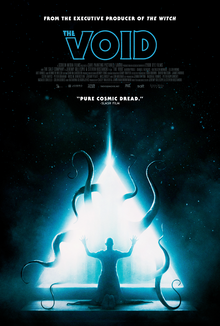
Once you move away from major studios, it turns out that Lovecraftian horror is rather prevalent.  Seeing that The Void was rated higher than many offerings on FreeVee, well, why not.  It was compared to the intellectual works of Benson and Morehead, but to me it matches more closely with Older Gods.  Like many movies in this genre, The Void isn’t easy to follow and having commercial interruptions doesn’t help.  (In movies made for television, directors know to offer cues at specified times to allow for a break.  I’m not sure that those at FreeVee, or Tubi, or Plex, or their ilk, or even Hulu, know how to do this well.)  So there are these mysterious cultists—somehow “new religionists” just doesn’t seem to cut it—who apparently want to bring about the apotheosis of their leader in a rural setting. 

Meanwhile a local sheriff finds a young man fleeing from a couple of guys who are killing people and takes him to the hospital.  This hospital, however, is being closed down and there’s only a skeleton crew there to handle emergencies until it can be decommissioned.  Once the guys trying to kill the young man arrive, the hospital is surrounded by the cultists.  By the way, there will be spoilers—just saying.  It never is adequately explained how these killing guys know who these cultists are, unless it happened so fast that I missed it.  In any case, all trapped in the hospital there’s the problem with a monster that has tentacles (Lovecraftian) that takes over the body of a nurse, then a tries to get a state policeman.  Lots of axes and gunfire, and the numbers in the hospital are reducing.

It turns out that the kindly old doctor is the leader of the cult and he’s trying to raise the old gods so that he can bring his daughter back to life.  The sheriff, who’s been the protagonist all along, knocks said doctor into the eponymous void, leaving only two people alive in the hospital.  It’s not really explained where the cultists, who made it into the hospital, went.  Nevertheless, this is a good example of horror and religion (which is ironically Lovecraftian).  The doctor’s unconventional religion is the cause behind the hospital mayhem, and, apparently the killings being conducted by the interlopers are attempts to stop it.  As a horror film it’s effective, if a bit disjointed.  It seems that there’s still a lot to unpack from films that try to bring Lovecraft’s ideas onto the silver screen, major studio or not.


Not Handel’s Messiah

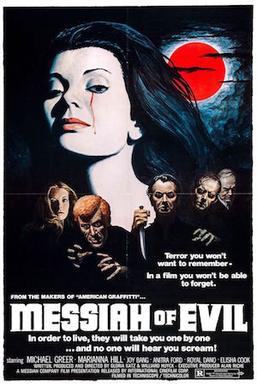
It’s polarizing.  Even now, nearing fifty, Messiah of Evil is either adored or excoriated.  So it was at its release.  I was pointed to the movie by an adorer—a somewhat unexpected New York Times seasonal article.  Suggesting that there’s nothing else like it, the article recommended it for autumnal viewing.  So, what’s it all about?  I’m not really sure, but that won’t stop me from trying.  Arletty is a young woman who wants to find her father (with you so far).  He’s moved to New Bethlehem, California, now known as Port Dome.  She finds his house abandoned, and the locals decidedly unfriendly.  Her father’s diary explains that he’s transforming into something inhuman.  The locals are cannibals, it turns out, awaiting the return of, well, the messiah of evil.  (The title is never used in the movie.)

Although I learn more towards the excoriating opinion of things, this is a great horror and religion film.  The original messiah of evil was a preacher stranded with the Donner party.  He started a new religion and, wanting to spread it, went to California.  Now, whenever a blood moon comes, he arises from the sea and his followers become aggressive.  The movie is set a century following this first appearance, and the dark master is due to return.  His followers await him on the beach, and Arletty is their intended sacrifice.  Elements of Lovecraft are clearly evident—people transforming, old gods, evil emerging from the ocean.  Yet, there are many things unexplained.  Or maybe I’m just naive.

The male lead, Thom, travels with a mini-harem.  He’s in Port Dume because he likes to gather folktales—like the blood moon—and he likes Arletty’s father’s art and came to buy some locally.  The movie features a blind art dealer, cops who apparently know nothing about the infestation of ghouls in their town, and a guy who could drive away from the attacking hordes who decides to run instead.  The directors (Willard Huyck and Gloria Katz) were a talented couple, but this wasn’t their best collaboration.  Still, many recommend this as an overlooked horror gem from decades ago.  Others not so much.  I’m glad to have seen it, although I fall into the latter camp.  Mainly because it continues a theme that I’ve tried to pick up at several points on this blog—that horror and religion have a great deal in common.  Even if one (or both) shows its age and fails to impress.


Thoughtful Transformation

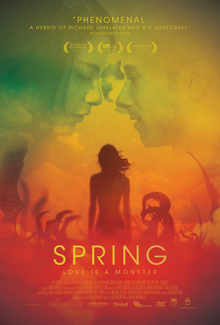
Philosophical horror’s a thing.  A friend introduced me to Moorhead and Benson films—these aren’t major studio productions—and I’ve been watching them as I can find time.  They’re intelligent and tend away from heavy gore, which is fine by me.  And they leave you with plenty to ponder.  I recently sat down with Spring, an unusual movie that sometimes gets classified as science fiction, probably because the lead actress plays a science student.  There will be spoilers here, so if you have plans to watch, please stop and do so now.  Here goes:  The story follows an aimless young man who’d given up college to take care of his dying mother.  To get away, he heads to Italy with no particular destination in mind.  He ends up in Polignano where he meets and is smitten with a young woman.  At least he thinks she’s young.

From the privileged point of view of watchers, voyeurs perhaps, we come to see that Louise isn’t who Evan thinks she is.  She’s a two-millennia-old woman who has to regenerate herself every twenty years to maintain her immortality.  When the twenty years wind down, she transforms into other creatures on the evolutionary scale on the way to humans.  Since she lives on she’s not really seeking a long-term relationship.  This leads to some discussions of religion, which I find intriguing.  Louise is a scientist, however, and even when she transforms into a monster, she refuses to call it supernatural.  Rather, she claims it’s just something that science can’t yet explain.

This perspective really does get at the heart of the debates between science and religion.  Are there things science simply can’t explain?  I.e., are there things beyond science?  Or is science really the panacea for all things?  The problem is that the human mind cannot sense or detect all things.  We don’t even have a clue as to how many things there actually are to detect.  How can one method be used to encompass everything?  Not a bad set of questions to be raised by a somewhat Lovecraftian movie.  Lovecraftian, by the way, due to its focus on the sea and some of Louise’s atavistic transformations.  Spring is an unusual and thoughtful movie.  It’s a love story as well, about willingness to face the unknown for love, and trusting evolution.  The characters are likable and you want them to thrive, which you don’t always get in this genre.  It’s one of the reasons I keep coming back to Moorhead and Benson, and always being glad I came.


Earth Colors

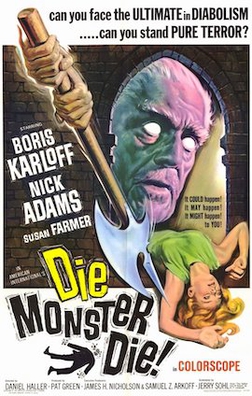
Bad movies can be therapeutic.  While trying to find hope it sometimes helps to see that others are even worse off.  This isn’t exactly Schadenfreude, but rather an awareness that your own efforts  at self-righting aren’t so bad.  Then there’s the hopeful monster theory, but that’s something different.  Already the title of Die, Monster, Die! warns the viewer that this won’t be Oscar-worthy material.  And despite his fame by 1965 Boris Karloff was still landing sub-par roles in such movies as this.  Both the directing and editing are noticeably lacking, evident even to an amateur.  A step backward may help; this movie is based one of my favorite H. P. Lovecraft stories, “The Colour out of Space.”  This is, to me, his most Poe-like tale and could well serve as the basis for a film.  Too much is changed here, however, to make it work.

Arkham is transplanted from its native New England to the old one.  The love theme manages to interrupt the mood of dread Lovecraft used in his story.  Nahum Witley’s use of the meteorite runs counter to the family’s reaction in the original.  The screenwriting doesn’t build much confidence either.  On the positive side, it feels like a fine little haunted house film from time to time, when the plodding plot doesn’t get in the way.  For a scientifically aware visitor, Stephen Reinhart has no concerns about lingering, unprotected, around a major source of radiation.  Although a few of the jump-startles work, the whole ends up feeling just a bit silly.  Of course, I was watching to escape, for a moment, what life throws at you.

Like reading poorly written books, watching bad movies can teach you mistakes not to make.  Movies can be an education rather than simply entertainment.  Cinema is one of the great myth-making vehicles for modern culture and, unfortunately, big budgets are often (but not always) necessary to make them believable.  Here is the hidden element of optimism, perhaps.  H. P. Lovecraft stories can sell films.  They also attach those who may be excluded from studio A-lists because, let’s face it, Lovecraft appeals only to a specific demographic.  The title of this particular film buries the lede, however.  No Lovecraft keywords (Dagon, Dunwich, Arkham, Cthulhu, or any of a host of others) clue readers in to what they might expect.  Learning the film business from Roger Corman might’ve steered director Daniel Haller is this direction, I suppose.  Whether he intended to or not, he produced a therapeutic result.


Not Dagon

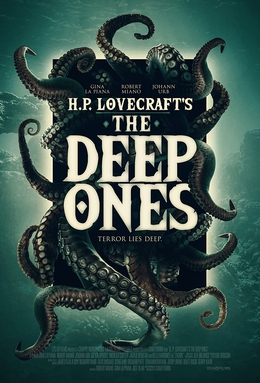
There’s an aesthetic to bad movies.  And when your production company is Crappy World Films you’ve got to wonder if it’s intentional.  Chad Ferrin’s H. P. Lovecraft’s The Deep Ones, which was released in 2020, isn’t a great movie.  It is kinda fun, though.  I’ve had a weakness for explicit Lovecraft films ever since Stuart Gordon’s very moody Dagon.  That film was clearly the inspiration for this one.  With the “low” budget of only a million dollars (it feels strange to write that), it nevertheless has a clean cinematography that shows some artistry.  The story just isn’t that good.  A young couple is seeking a getaway at an oceanfront AirBNB only to discover it’s part of a “gated” community.  Their hosts, who are living in the boat down at the marina, keep on stopping in, not leaving them much privacy.

The set-up is very much a Rosemary’s Baby scenario.  The community, as the title suggests, worship the Old Ones.  They introduce Cthulhu early on, but the young man of the couple has never heard of him (he obviously doesn’t spend much time on the internet).  Speaking of the internet, the film makes the point that everyone spends too much time on it, and there’s perhaps some truth to that, but, if you’re streaming the movie you’re also participating.  In any case, the community wants women to offer to Dagon—and the monster here is clearly low-budget—so they can bear more children for the Deep Ones.  Well, not so much bear children for them as to be pregnant with tentacles that can somehow convert newcomers.  Once you’ve been tentacled, it seems, you’re a member of the community.

There is a kind of Lovecraft vibe to the film despite the often wooden acting and throwaway dialogue.  One thing Lovecraft had learned from Poe was the consistency of mood.  It’s here that the movie runs into some trouble.  At times it’s a little scary, at times dramatic, but too much of it just feels silly.  The case could be made that Lovecraft’s writing tends toward the puerile and there’s some truth to that.  It is never silly, however.  Sometimes when translated to the screen the outlandishness of Lovecraft’s view of the world comes across as so weird as to be funny.  It takes an able director, and a strong writer, to adapt him to cinema successfully.  It’s no accident, then, that the movie is dedicated to Stuart Gordon, whose Dagon is still difficult for me to watch, so full of Lovecraft as it is.


Lovecraft’s Palace

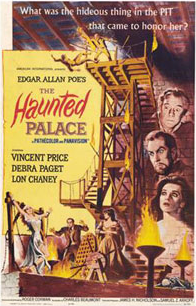
So, to see Witchfinder General I had to buy a set of Vincent Price movies.  Complex copyright deals mean that not everything can be streamed—there’s a movie I’ve been waiting months to see because Amazon Prime says “not currently available in your area.”  That word “currently” tells you that it’s a rights issue.  In any case, that box of Price movies contained a few goodies I’d never seen and had wanted to.  And one that I hadn’t heard of: The Haunted Palace.  Legendary producer Roger Corman had Price star in a variety of Edgar Allan Poe adaptations.  (Witchfinder General wasn’t one of them.)  Corman wanted to make an H. P. Lovecraft movie, but the studio insisted it stay within the identity of this Poe series.  This movie is an adaptation of Lovecraft’s “The Case of Charles Dexter Ward,” but titled after a Poe poem, “The Haunted Palace.”

Suffice it to say, I knew little of this before I sat down to watch it.  I didn’t know, for example, that this was the first big-time movie based on Lovecraft’s Cthulhu mythos.  I didn’t realize it would involve the Necronomicon and perhaps the first, blurry—to preserve the sanity of viewers—view of maybe Cthulhu.  The movie doesn’t specify which of the Old Gods is kept in this pit, so it could be Yog-Sothoth instead.  You see, as a child I watched some of the movies in this series.  They would’ve had to have been the ones showing on television, likely on Saturday afternoon.  The one that I clearly recall, and remember thinking “that’s not how it goes!” was The Raven.  And as a child I had never been exposed to H. P. Lovecraft.

Some of us have our own brand of cheap or free entertainment.  The small number of friends I had growing up didn’t care to read.  My family wasn’t literate, and most high school teachers couldn’t suggest much to a kid who’d somehow found Poe and liked what he read.  As I’ve said before, Goodwill was my bookstore.  I discovered Lovecraft on the internet during a lonely stretch of teaching at the University of Wisconsin, Oshkosh.  Like many visionaries, Lovecraft didn’t achieve fame in his lifetime, but is now considered a bizarre American treasure.  The Cthulhu mythos is everywhere.  Even my auto-suggest is quick to fill in his name as I type.  The Haunted Palace isn’t a great movie—this is Roger Corman—but it’s a pretty good movie.  And its history in the cinematography of Lovecraft makes it worth part of a Saturday afternoon.


H. P. Luca

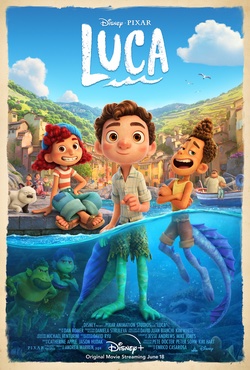
Disney has a lot of cash lying around, which means they can buy things.  One of those acquisitions, some years ago, was Pixar.  In my mind Pixar is now Disney, but in fact it does have a different aesthetic.  One of Pixar’s recurring themes is acceptance of those who are different.  Luca is Disney with a touch of Lovecraft.  This Pixar animation feature is about sea monsters acclimating to human culture, only they turn back into sea monsters when they get wet.  Kind of a combination between The Little Mermaid and Splash.  Even the Italian village in which Luca and his friend Alberto show up looks like the Imboca of Stuart Gordon’s Dagon (yes, I know Imboca is in Spain and I also know it’s fictional).  The villagers are, predictably, terrified of sea monsters since they earn their living from the sea.

In Luca once sea monsters come onto land they become human.  In fact, their culture below the surface is pretty much like human culture above.  The Lovecraftian element comes in the sea “monsters” (those in Luca are generally cute) coming to live among humans.  Lovecraft was, somewhat infamously, a racist.  While there’s no excusing that, there’s also no question that his fear of “the other” often develops the creepy atmosphere for which he became posthumously famous.  Cthulhu and many of the other great old gods dwell beneath the sea.  Human interactions with them generally lead to the humans becoming insane because of the implications.  Here Pixar adds its own twist—maybe humans are insane already.  What we permit in our societies is often less than humane.  At least with Lovecraft we could blame monsters.

Monsters are a reflection of humanity.  We take what we least like about ourselves and project it onto often fictional creatures that dwell beyond the bounds of human habitation.  We fear those who are different.  In more current thinking, that means humans should be accepting of other humans who don’t conform.  Those who think different, or, more especially, those who look different.  Sea monsters, at least hominid ones, hold great symbolic value.  They live in a world we barely know and to which we have little access.  Their lives under the great pressure of all that water must be very different from ours.  It’s only when we get beyond seeing them as monsters that we grow as humans.  If you follow the Creature of the Black Lagoon series to the end you see this playing out in black and white.  Sea monsters have much to teach us.


Eerie Weird

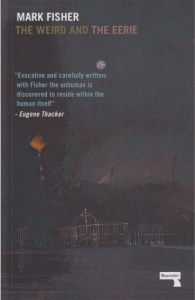
We each approach the world from a unique angle.  It’s bewildering if you stop and think about it—billions of individuals (more by orders of magnitude if we add animals) looking at the world like no-one else.  Given the numbers it’s no mystery that some individuals will share fascinations, and I was glad to learn of Mark Fisher’s book The Weird and the Eerie, since it tries to capture the essence of these two terms that characterize so much of my reading.  The introduction explores what these words might mean in regard to Freud’s unheimlich, a term with which many writers are familiar.  What makes many stories interesting is their unusualness.  Fisher considers what it means to be inside or outside, and these categories often play into our perceptions of the weird and the eerie.

The study is divided into two sections (weird and eerie) and explores these concepts through a variety of media—literature, film, and popular music, especially.  Here’s where the unique angle comes in.  While I’ve read quite a bit of “weird fiction” and certainly eerie tales, Fisher has a different spectrum of materials than I do.  We share some resources, of course, such as H. P. Lovecraft, but The Weird and the Eerie gave me a new set of books to read and movies to watch.  Or read and watch in new ways.  Fisher’s reading of these various sources is sharp and perceptive, and he has a wealth of experience on which to draw.  The intertextuality here is rich.

When I think of reading for leisure or pleasure, it occurs to me that without something unusual happening in a tale, I have little with which to gain a grip.  The unheimlich makes for compelling reading.  Fisher sheds considerable light on this—what is it that we mean by saying something is weird or eerie?  It’s not that we should avoid them.  Humans are innately curious creatures, and we’re drawn to the strange in a way that we can seldom help.  Learning to avoid the weird and eerie means missing out on opportunities to learn.  And stories that we might tell to reflect our individual experience of the world.  This brief book contains more than first appears from a cursory glance.  There’s depth here, and for those of us individuals drawn to these aspects of both human and literary expression, much to mine.  The Weird and the Eerie is a flashlight for going into areas sometimes considered dark and learning much along the way. 


Contrariwise

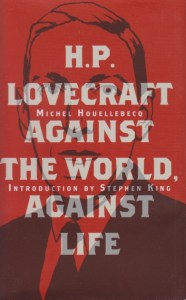
When you set out to research a topic, reading is the first step.  These days you can’t possibly keep up with everything that’s written—particularly on the internet with its endless iterations and reiterations, and incipient plagiarism.  Even books often come at you in great numbers, from angles you don’t expect.  Apart from holidays, daily life doesn’t give much time for reading.  So how does one get a handle on H. P. Lovecraft?  I’d been aware of Michel Houellebecq’s essay, H. P. Lovecraft Against the World, Against Life for some time, but as always, finding time is the trick.  This short book, however, is profoundly insightful.  Not a biography and not literary criticism, it is more an appreciation of a misanthrope.  One of the things that Houellebecq makes clear is that Lovecraft was a man out of his time.

Continuing the tradition of French writers appreciating the more macabre of American writers (Poe was celebrated more in France than his native country), Houellebecq pays tribute, but doesn’t fawn over, Lovecraft.  In this series of brief essays he manages to highlight much that might remain hidden to those who know H. P. from either only his writing or from the somewhat small circle of experts on him.  Sometimes it helps to break away from the experts to get a fresh view.  I’ve read quite a lot of Lovecraft’s fiction, and when you do this you tend to think you know the author.  You may or you may not.  To know is to delve.  And delve Houellebecq does.  

Serious reflection is too often considered a luxury.  With the exception of a few privileged occupations, think of what would happen at work if you took to reflecting while on the clock.  Those who dole out the lucre prefer to see signs of busyness—fingers clacking keyboards and numbers being lined up, preferably in the black.  Time thinking, so capitalist thought goes, is time wasted.  If you can sell enough copies of your book to afford a little time off for reflection you can make connections, I presume.  You can see things that those who are too busy cannot.  There are many astute observations in this slim volume.  While not making excuses for Lovecraft’s faults, Houellebecq doesn’t attempt to correct him either.  That’s difficult to do with a person, if the author is correct, who hated life itself.  Books like this also demonstrate that a huge word count isn’t necessary for erudition.  And it is still possible to learn, even with limited time.