Halloween in December

The wind was frigid.  We were still in the cold snap that layered the northeast in its gelid blanket for the first part of December.  We had advance tickets for Christkindlmarkt, a Bethlehem tradition.  As we wandered through the tents I was thinking of one of the few Facebook groups I follow, Halloween Madness.  Most of the posts are repurposed from the internet but the last few weeks, since Thanksgiving, the offerings have been blending Halloween and Christmas.  Most people don’t stop to think how closely related the two holidays are.  (I devote a chapter to Halloween in Sleepy Hollow as American Myth, where I explore this connection in a preliminary way.)  But in this bleak December—we’ve seldom seen the sun for more than a couple hours at a time since the aforementioned Thanksgiving—my thoughts emigrated towards horror.

For those of you who’ve never been to Christkindlmarkt, it’s a germanic themed market consisting of four (or more) large tents, full of vendors.  Many of them are Christmas themed, but not all.  Those that are Christmas themed tend toward the Currier and Ives version of the holiday, but some consider the more ghostly side of the season.  Although I didn’t see any booths explicitly devoted to horror themes or monsters, a few of them had a bit of this aesthetic to them.  I’m no fan of capitalism, but I have to wonder if this isn’t a missed opportunity.  I think there’d be some fans.  I do enjoy Christmas for its symbolism and optimism and coziness.  I really do.  But when I have a few free moments in the holiday season I sneak in reading a scary book or watching a horror movie.  There is a connection, but you have to study the holidays to see it.

I fear that this year I was trying pretty hard to preserve any bodily warmth between the tents and didn’t really have much time to think about it until the next day.  I’m always mindful that Edgar Allan Poe’s “The Raven” is set in December.  And that both Charles Dickens and M. R. James associated Christmas time with ghosts.  I suspect most people, however, prefer the cheerful, happy side of the holidays.  I don’t blame them.  Life can indeed be harsh, as harsh as this windchill, for much of the rest of the time.  There are some of us, however, who do find a little lift by peering into the darker corners, even at this festive time of year.  And with natural light in such short supply, there are a lot of shadows about this chilly December.


Woodwork

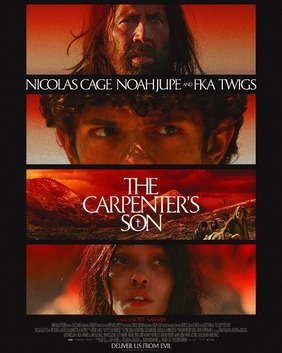
It’s not often that I get to see a new horror movie on opening day, but I managed to swing The Carpenter’s Son with a screener, courtesy of Horror Homeroom.  I’m not going to say much about the movie here, because you should go there to read my response—I’ll let you know when it appears.  But I should try to whet your appetite a bit.  Among those of us who read and write about horror and religion this was a much anticipated movie.  A horror movie about Jesus.  Such things have been done before, but this one is played straight with an interesting premise.  It’s based, loosely, on the Infancy Gospel of Thomas.  This isn’t to be confused with the Gospel of Thomas.  Early Christians, it seems, favored the doubter’s point of view.  The Infancy Gospel is the story of Jesus’ miracles between the ages of five and twelve.  Even among early Christians these accounts weren’t taken as gospel truth.  They make for an interesting movie, however.

I think about horror and religion quite a lot.  Since the late sixties the two appear together frequently and, according to many surveys, make for the scariest movies.  Religion deals with, not to sound too Tillichian, ultimate concerns.  In the human psyche you can’t get much larger than death and eternity.  These are the home turf of religion.  Of course, death can be handled in an entirely secular way, but there’s a reasons hospitals almost always have chapels in them.  Eternity may be slotted in cosmology, but what it means comes from religion.  Forever seems pretty ultimate to me.

One thing I didn’t give in my Horror Homeroom piece about The Carpenter’s Son is my thoughts as to whether it’s a good movie or not.  Did I like it?  To a certain degree, yes.  Although I’ve been impressed with Nicolas Cage in horror movies lately—he can really rise to the occasion—sometimes, as in The Wicker Man, he just becomes, well, Cagey.  This happens once in a while in The Carpenter’s Son too.  When he’s questioning Mary about where “the boy” came from, his voice gets the wheedling, whining, kind of mocking tone that doesn’t set him as his best.  Likewise, when he tries to instruct young Jesus in various ways, it seems far too modern to fit the palette of a period drama.  I watched it a couple of times to write the article and I have my doubts that I’ll watch it again.  I did think the portrayal of Satan was good, and appreciated some of the dialogue about evil.  It wasn’t my favorite horror movie in recent weeks, however, even though I saw it before it opened.


The Prom

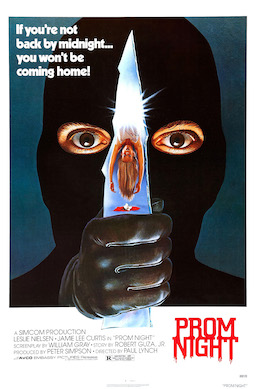
I had always assumed Prom Night was a knock-off of Carrie, and in some ways it is.  The story is significantly different, however, and the impetus to watch it came from Scream, where it’s referenced a few times.  In case you’re under the same delusion I was, here’s how it unfolds.  Jamie Lee Curtis, after starring in Halloween and The Fog, takes the role of Kim Hammond, older sister of a girl (Robin) accidentally killed at the start of the film.  A kids’ game at an abandoned building leads to the death, in which four children participated.  Six years later, it’s prom night.  The kids present at Robin’s death all receive mysterious phone warnings that they dismiss as crank calls.  Meanwhile, a Carrie-inspired sub-plot is introduced as Wendy, the leader of the killer kids, is outvoted as prom queen by Kim.  She gets a local thug, Lou, and his buddies, to plan a disruption to the crowning of the king and queen.  No pig’s blood, but this isn’t Stephen King.

Meanwhile, yet another subplot is introduced, riffing on Halloween, of an escaped psychopath as suspect.  The police are fearful after finding the body of a nurse he kidnapped at the site of Robin’s death.  He was falsely accused of Robin’s murder and was disfigured in a fire.  They fear he may be targeting the kids there that fateful day.  Nobody except the four kids know what really happened.  There’s a hint that someone saw the accident, however.  If you’re getting confused, apart from my faulty summary, it may be because the movie goes to great lengths to misdirect your suspicions of who the murderer may be.  Since the movie is over 45, there will be a spoiler in the next paragraph.  You are warned!

The killer is Robin’s twin brother, who is also Kim’s younger brother.  He witnessed Robin’s death and tries to murder those he holds responsible on prom night.  He succeeds in killing three of the four.  I’ll leave it at that.  This is one of those teen movies and a fairly early slasher.  The plot is too complex to hold up, however, with characters simply dropping out because the action shifts focus.  Too many false lead-ons and too much disco music make it less than stellar.  Of course, as a very religious kid shy around girls, I never attended my high school prom.  I guess I may have missed out on what was, by then, becoming a night of horror.  At least in the eyes of those exploring the emerging slasher genre.  


Louder

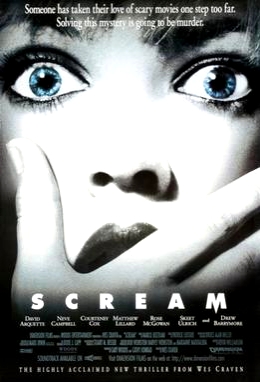
Scream is one of my old movies.  I saw it several years ago but the details had grown hazy so I dusted off the DVD to give it another go round.  I’m glad I did.  This Wes Craven classic was one of the first horror movies to rock the critics because it parodies so many other horror films while remaining a scary plot line.  And it’s intelligent.  I liked it so much that I’d watched Scream 2 as well, and the two had jumbled up in my mind.  In case you’re still in a Halloween mood, here’s the basic premise (I won’t spoil the ending): the opening sequence is so well-known that I’m tempted to skip it, but it sets the scene remarkably well.  A teenage girl home alone answers the phone to find a stranger on the line.  This stranger is watching her as he calls, eventually breaking into her house.  Using horror movie clichés, the ghost-faced intruder catches and kills her.

After that, Sidney Prescott is having trouble getting over her mother’s murder the previous year.  The recent murder triggers her.  When her father has to leave town on business, she decides to stay with a friend.  Ghostface attacks her, leading to the arrest of her boyfriend, who shows up after the slasher attack.  Along with her friends, of which the guys are all horror movie fans, she plays out various scenarios of who the killer might, or “should” be, according to the rules of the genre.  This is very effectively done, keeping the first-time viewer guessing who the killer might be.  When school is suspended because of the killings, the kids have a massive party (of course).  The killer’s there, however, for the most part following the rules.  But the instructions are subverted, making for a wild ride.

Clever and satirical, the movie strikes the right tone.  One thing I noticed the first time was that Ghostface is a little too fast for a psychotic killer.  He runs.  He’s also quite vulnerable, but then again, he’s not a supernatural villain.  After seeing Scream again, I realized that there are still some classics that I’ve missed.  One reason is that I’m not really a slasher fan.  Throughout the movie they avoid using the word “horror,” preferring “scary movie”—the original title for the film.  Scary Movie was picked up by a horror parody that I watched shortly after seeing Scream for the first time.  In many ways Scary Movie is a parody of a parody.  Horror is endlessly self-referential, of course.  And sometime an old movie is just what you need.


Little Girl

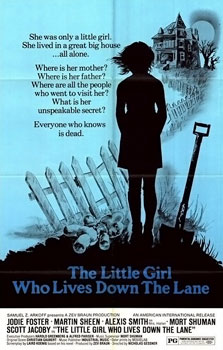
It might be inferred from the fact that I’ve mentioned it once or twice that I’ve seen The Little Girl Who Lives down the Lane before.  On a rainy autumnal afternoon it’s the horror movie that most often comes to mind.  While some find the “horror” designation overkill, it is the genre under which I bought the DVD many years ago.   Besides, it won a Saturn Award for best horror film.  I picked it up at a two-for-one sale not knowing what it was about but I was immediately taken by the atmospheric setting and weather.  A proper New England fall, after the leaves have come down.  It opens on Halloween with one of the most cringy openings ever.  Charlie Sheen plays a pedophile asking 13-year old Jodie Foster (Rynn) probing questions of where her father is when he finds her alone at home.

There will be a spoiler later in this paragraph.  Rynn lives on her own after her father dies by suicide and she murdered her mother and put her body in the basement.  Frank Hallet (Sheen), and his insufferable mother, own the Maine town where Rynn lives.  Befriended by Mario, a high school student who discovers her trying to drive, she eventually confides that Hallet’s mother was killed going down to the basement.  Meanwhile her son Frank keeps trying to insinuate himself into Rynn’s life, and, strongly implied, bed.  The story has some improbable plot elements and a few surprising moments, but not any jump startles.  It’s a slow burn, building to where Rynn attempts to poison herself, but Frank, not trusting her, drinks her tea instead.  Moody, rainy, and played out on a carpet of dead leaves, this is one of those horror movies that gets the season right.

Ironically for October nights, there aren’t a ton of horror films I know of that manage to capture this feeling.  I suppose that’s why I’ve seen this one a few times before.  I’ve gone through many lists of “October movies” and come out thinking that few people must think about this season the way that I do.  Or at least I haven’t found many horror movies that allow the season to pull its own weight.  Little Girl wasn’t welcomed with open arms when first released, but it has become a kind of cult classic.  Foster’s acting is pretty amazing considering her age at the time the film was shot.  But the autumnal weather does it for me, every time, even as we slip into November.


Shaping Halloween

Halloween is the favorite holiday of many.  I suspect the reasons differ widely.  Although the church played a role in the development of this celebration, it didn’t dictate what it was to be about.  It was the day before All Saints Day, which had been moved to November 1 to counter Celtic celebrations of Samhain.  Samhain, as far as we can tell, wasn’t a day to be scared.  It commemorated and placated the dead, but it wasn’t, as it is today, a time for horror movies and the joy of being someone else for a day or a few hours.  There isn’t a preachiness to it.  Halloween is a shapeshifter, and people love it for what it can become.  If December is the month for spending money you haven’t got, October is the month for spooky things.  Halloween is the unofficial kick-off of the holiday season.

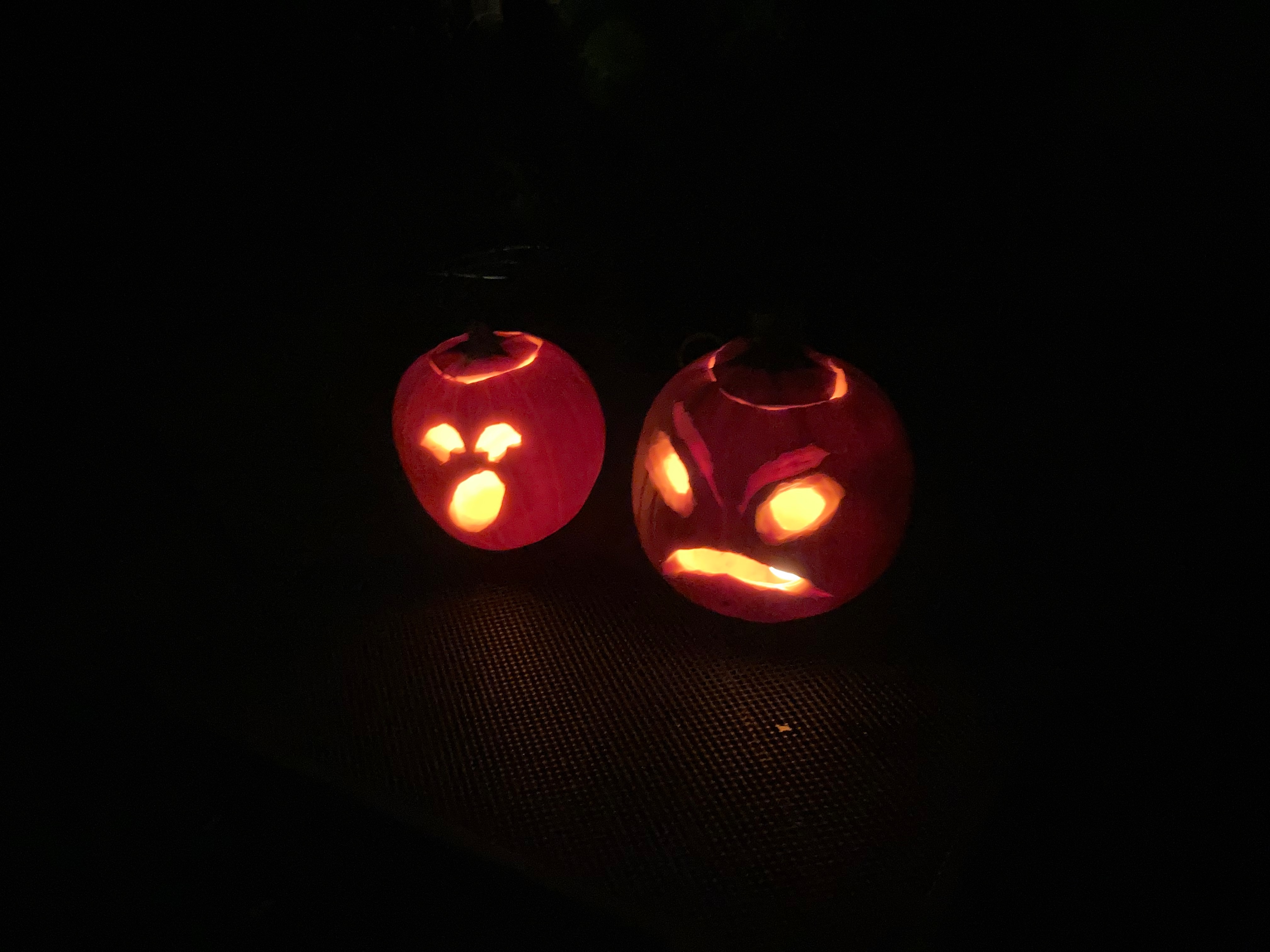
For me, it’s a day associated with dress-up and pumpkins.  Both of these bring back powerful childhood memories.  The wonderful aroma of cutting into a ripe pumpkin can take me back to happier times.  I remember dressing up for Halloween as far back as kindergarten.  I could be someone else.  Someone better.  It was a day when transformation was possible.  I’m probably not alone in feeling this, although I’m fairly sure that wasn’t what was behind the early use of disguises this time of year.  I’ve read many histories of Halloween and they have in common the fact that nobody has much certainty about the early days of its inception, so it can be different things for different people.  Even within my lifetime is has moved the needle from spooky to scary, the season of horror movies and very real fear.

There’s a strange comfort in all of this.  A knowledge that if we can make it through tonight tomorrow will be somehow less of an occasion to be afraid.  It is a cathartic buildup of terror, followed by the release of being the final girl, scarred, but surviving.  And people, from childhood on, enjoy controlled scares.  Childhood games from peek-a-boo to hide-and-seek involve small doses of fear followed by relief.  The future of the holiday will be open to further interpretation as well.  As a widespread celebration it is still pretty young.  And like the young it tests its limits and tries new things.  At this point in history it’s settled into the season of frights and fears in the knowledge that it’s all a game.  I wonder, however, if there isn’t some deeper truth if we could just see behind its mask.


Halloween, Disney Style

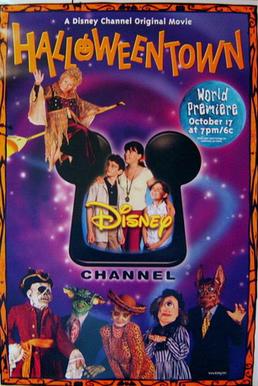
I really don’t spend much time on social media.  It’s literally just a few minutes a day, half an hour at most.  I’m too busy to spend more.  I tend not to join groups because, well, I don’t spend time there.  One group I did join on Facebook is for Halloween fans.  I believe that’s where I heard about the movie Halloweentown.  I was surprised that, as a fan of Halloween for pretty much all of my life, I’d not known about this 1998 movie.  Watching it, it became clear why not.  It is a Disney television movie.  In the nineties we didn’t have television (a few channels from a snowy aerial at Nashotah House) and certainly didn’t subscribe to the Disney channel.  While the movie failed to penetrate my consciousness, it went on to start a franchise.  Once I heard of it, I decided I should see it because I’m interested in the darker side of Disney.

Television movies, with their comparatively small budgets and limited viewerships, don’t have the finished feel that theatrical films possess.  This is the story of a family of witches, three kids and a mother, living in the human world.  The children don’t know they’re witches.  Then when their grandmother visits on Halloween, they sneak into the eponymous Halloweentown with her.  This is where witches and other monsters live because humans fear them.  The “monsters” mostly consist of obvious humans wearing masks and makeup.  There are a few mildly frightening moments as the evil Kalabar tries to take over the human world by persuading his fellow monsters to join him.  But this is Disney where threats are gentle and good fairly easily defeats evil.  While the movie isn’t even as scary as Hocus Pocus, some people watch it to get in the Halloween mood.

One thing that I’ve noticed about many movies that try to capture the autumnal feeling while being shot in California, is that they miss the more dramatic temperate shift in seasons.  This annual outdoors Götterdämmerung resulting in the colorful dying of leaves and the surrender of summer to the inevitable chill to follow is integral to my experience of Halloween.  In fact, one of the few criticisms I’d make to John Carpenter’s Halloween is that Haddonfield, Illinois was shot in Southern California.  Other movies make a similar gaff.  I’m always on the lookout for movies that manage to emulate that Halloween feel.  The film that perhaps does this best, in my experience, is The Little Girl Who Lives Down the Lane, shot in Canada and Maine.  I’m still searching, however, for my own Halloweentown.


Booking Halloween

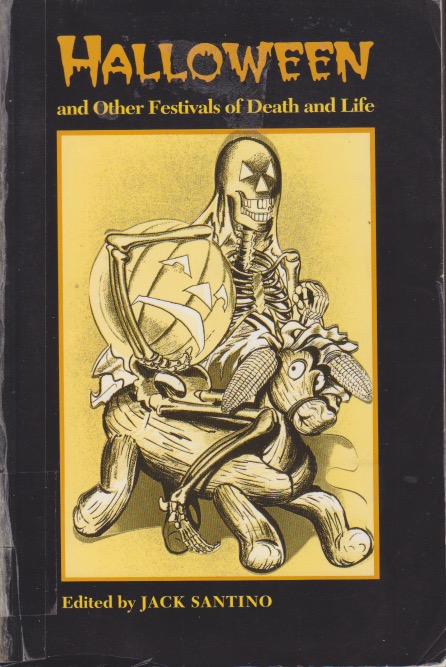
I’ve met several people who say that Halloween is their favorite holiday.  One of the (likely commercially-driven) realities, however, is that not many nonfiction books on Halloween exist.  I mean the kind with a known publisher behind them, the sort that have been vetted.  My recent book, Sleepy Hollow as American Myth has a chapter on Halloween in it, and I’ve often considered writing a book on the topic.  Halloween and Other Festivals of Death and Life is an edited collection brought together by Jack Santino.  It is one of the (few) academic books on Halloween that I hadn’t read.  Although I learned a lot from it, it suffers that inevitable trait of books that are assemblages of essays: they are uneven in focus, scope, and execution.  Santino is known for a couple of influential articles on Halloween, so editing such a book seems a natural development.

Some of the essays in this book were quite helpful to me.  The problem with drawing together anthropologists, however, is that they have discrete regional as well as thematic interests.  In some ways this is very appropriate for Halloween.  The holiday, as most holidays, has regional variations.  Reading about how it’s celebrated elsewhere, or elsewhen, gives you an idea just how lacking it is of any kind of “top-down” authority.  For all of its variations, Christmas has a somewhat “canonical” narrative (although this isn’t the full story).  Halloween grew from folk traditions and when the church got ahold of them it tried to focus them on All Saints Day, and later, All Souls Day.  But Halloween and it adjutants comes the day before All Saints, thus allowing the varied influences of the day to come to light, if they can be found.

The part of this tradition that I’ve always found disturbing, highlighted in this book, is the pranking.  I suppose that growing up poor, the idea that someone could damage your stuff when it’s really what you feel you need to survive, is quite distressing.  A light-hearted prank feels less insidious, but reading what some regional celebrations in North America included made me realize why many local authorities have tried to contain and control celebrations.  Nobody wants to lose everything due to a thoughtless prank.  Trick or treat was sometimes trick and treat.  I recall being in a crowd in England celebrating New Year’s.  Some partiers threw lit firecrackers into the crowd.  My only thought was to the damage or injury this might cause.  Halloween is that way, however.  And it is likely impossible to write a book that captures it in its fullness.


Painting Sleepy Hollow

Not being an art critic, I’m in no place to analyze John Quidor’s The Headless Horseman Pursuing Ichabod Crane.  Having written a book about Sleepy Hollow, however, there are a few things I might point out.  I should begin by noting that this post was spurred by a jigsaw puzzle.  Normally I only work on said puzzles around Christmas time.  Several years ago friends told us about Liberty Puzzles.  They’re made of wood and are heirloom quality.  My wife took the hint and she generally orders one, on behalf of Santa Claus, each year.  We have a few now but since we only do them once a year (and usually only one of them at the time), I had forgotten that we had a Liberty Puzzle of Quidor’s painting.  The original is located in the Smithsonian and I really didn’t discuss it in my book.  The painting is dated 1858, almost forty years after the publication of Irving’s tale, but while Irving was still alive (he died the next year).

John Quidor, The Headless Horseman Pursuing Ichabod Crane, public domain via Wikimedia Commons

The painting is correct in displaying a pumpkin that isn’t a jack-o-lantern and it presents one of the obvious difficulties of painting a nighttime scene.  The painting is fairly dark.  One of the benefits of working on a puzzle like this is you look closely at the scene.  My first thought was that it seems odd that the lightest part of the painting is Gunpowder’s rump. Next is the path.  The path draws the viewer’s eye back to Gunpowder and an understated Ichabod Crane.  I realized that the lighting is meant to reflect the moon’s rays, as the orb is just peeking through the clouds at the upper left.  And, of course, Quidor was not painting from real life.  On the right lie some small buildings, including the Old Dutch Church.  The Headless Horseman blends into the dark, which is exactly how Irving describes him in the story.  There’s no bridge, however, at least not yet.  All of this matches the wording of the legend.

Quidor painted mostly scenes from Washington Irving’s works.  Having been born in Tappan, during Irving’s lifetime, that makes sense.  He was also painting before the Disney cartoon came out.  One of the cases I make in Sleepy Hollow as American Myth is that the image most Americans have of the story comes from Disney.  The painting has no sword, and indeed, neither does Irving.  The one dramatic effect Quidor allows is the raising of the pumpkin before the bridge.  That takes place later in the chase.  In a sense this painting is perhaps the most authentic visual interpretation of Irving’s story before it made the transition to celluloid.  It’s puzzling.


Naming Sleepy Hollow

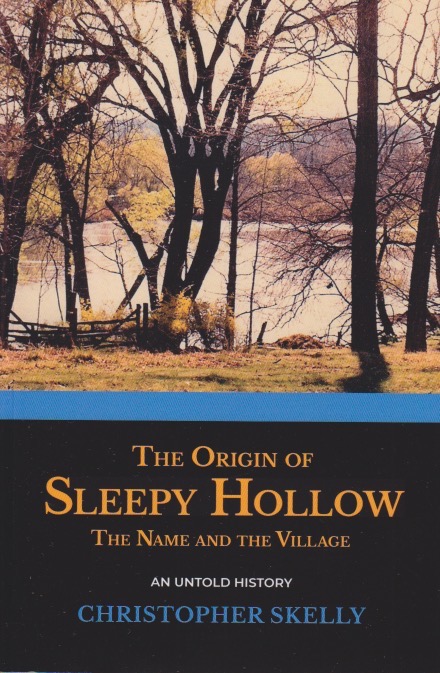
Local history has always been an interest of mine.  Although I’ve never lived in Sleepy Hollow, my book on “The Legend of Sleepy Hollow” is due out this week.  I try to keep an eye out for further information on the region.  Christopher Skelly’s The Origin of Sleepy Hollow: The Name and the Village, an Untold History appeared after I’d submitted my manuscript to McFarland, but I wanted to read it regardless.  A new father living in Wisconsin at the time, I was not aware of the name change in 1996.  I do remember looking at a map after we’d moved to New Jersey and seeing, for the first time, the name Sleepy Hollow along a route we planned to take to a point further up the Hudson.  I remember thinking, “I didn’t know there was an actual place called Sleepy Hollow.”  Well, that may have been because prior to 1996, there wasn’t.

This self-published account of how the name came about is valuable local history.  Not exactly belles-lettres, it nevertheless begins at the earliest Dutch naming of the area as the Dutch version of Sleepy Hollow.  By the time Washington Irving wrote his story around 1819, the area had already gone by several names but the village of Tarrytown was well established.  And, over time what was vaguely called Sleepy Hollow by the Dutch became North Tarrytown.  I learned here that the haven, or harbor on the Tappan Zee that was first called some version of “Sleepy” had been the victim of landfill so that a railroad could be put in.  The author is clear that the “Hollow” is still visible if you know where to stand and look.  He also explains the motivations behind changing the village name that began in 1988. 

One things I learned in my own study of ancient history is that place names tend to be remarkably resilient.  European settlers ignored much of the indigenous nomenclature, but did adapt many examples of it.  Our species needs to reference where things, or other people, are over very large distances.  We know where Edinburgh is, even if we live in Australia.  Names are important.  Personally, I’m glad that some citizens of North Tarrytown decided to change the name of their village to Sleepy Hollow.  And not just because I have a book coming out on the topic.  I’m sure the change has boosted tourism immensely, even if that wasn’t the initial motivation.  It’s nice to know that the change was actually back to the first Dutch ideas about the place.  And that a visit to Sleepy Hollow is possible because of one influential little story.


Dead, Not Sleeping

A Nightmare in New Hope is a fairly intimate space.  The owner told us that the collection will change and grow, given that he’s still collecting.  Having a particular interest in Tim Burton’s Legend of Sleepy Hollow—having a book (ahem) on the subject coming out soon (cough)—I was particularly anxious to see what props they had.  To make sense of this it helps to have seen the movie, but you’ll catch on, even if you only know the Disney version of the story.  There were three main items from the movie that they have on display.  One is the wax seal used for the Van Garrett will, used as the movie opens.  The seal is quite large.  Of course, movies substitute props from time to time, blended by celluloid magic.  CGI doesn’t leave as many tracks.

The second artifact is one that wouldn’t have occurred to me to have even existed.  This was the animatronic horse’s head for Daredevil, the Headless Horseman’s mount.  There are a couple scenes in the film involving horse acting, and I’d just assumed that trained animals were used.  Being up close and personal with this artificial head, a couple thoughts came to mind.  One is that right next to it, it’s quite obvious that it’s artificial.  The second thought was just how much thought and effort goes into a big-budget movie.  For a few seconds of a close-up horse head, this model had to be constructed and used and then set aside.  I asked the owner about how such things were acquired, and he noted that production companies don’t keep everything.  He also noted that movie artifact prices have skyrocketed.  Both because horror is now popular and because CGI, as noted, doesn’t leave tracks.

The third, and most proudly displayed Sleepy Hollow piece is the Headless Horseman’s sword.  This appears in the movie far more often than either Daredevil’s head or the wax seal.  One of the aspects of Washington Irving’s story I discuss in Sleepy Hollow as American Myth is that the Horseman’s weaponry changes over time.  I won’t say more since, like museum owners, those who write books hope that they well sell a few copies.  I’ll be revisiting A Nightmare in New Hope from time to time.  For the items on display, I’d seen probably 90 percent of the movies, and a few of them I’d discussed in some detail in either Holy Horror or Nightmares with the Bible.  Of course, the Sleepy Hollow book is forthcoming (ahem).


Good Hearts

If you’re looking for more religion-based horror, you might try the 1987 film Angel Heart.  As I’m discovering quite a bit lately, I could’ve used this one in Holy Horror as well.  The religious elements are pretty hard to miss, beginning with the protagonist’s name, Harold Angel.  (Hark the, any one?)  A private detective, Angel is hired to find a missing person for a Louis Cyphre.  His search takes him from New York (where a guy keeps a pistol in a Bible (there’s maybe an entire book in this trope), down to New Orleans.  First he meets Cyphre in the back room of a black church but soon he starts getting chased out when he starts to uncover any clues.  Time to head to the Big Easy.

In New Orleans he finds all kinds of occult practices taking place.  And the folks are none-too-friendly when he starts making mention of the guy he’s after.  He ends up witnessing a voodoo ritual and complains about the bad religion he encounters.  The big reveal indicates that there’s been a case of mistaken identity.  Louis Cyphre (Lucifer) has actually been setting an elaborate trap all along.  The portrayal of the Devil as a sophisticated gentleman isn’t new, of course.  There is a scene where Angel and the Devil are in a church and Angel, being a detective, uses inappropriate language.  Lucifer (not yet revealed as such) has to remind him a couple of times to watch his tongue while in a sacred place.  Satan is more pious than Angel.

The movie has multiple issues, but it has become a cult film over the years.  Like many others that I’ve discussed on this blog, the entire plot draws its horror from religion.  Angel has a difficult time with the non-Christian worship he witnesses.  But really, it is the Christian Devil that’s the antagonist here.  Quite often in movies like this, fear of other religions is based on the supposition that Christianity is correct.  That’s been a broad American trait for centuries, and it gives horror room to run.  The idea of a generic Christianity (which is probably what most Christians hold to) overlooks the doctrinal differences, often quite significant, between denominations.  This particular avenue isn’t much pursued in horror films, at least in my experience.  Interestingly, like Cat People (1982), it places this religion-based horror in New Orleans.  There’s plenty to explore in that connection as well.  Angel Heart is not a great movie, but it can lead in some interesting directions; a holy sequel may be necessary.


More Rats

I’ve asked other survivors of the 1970s if they knew that the Michael Jackson hit “Ben” (his first solo number one recording) was written about a rat.  Most had no idea.  The song is the theme for the sequel to Willard, namely, Ben.  Now, I have a soft spot for seventies horror movies.  Before the days of streaming I repeatedly looked for Willard in DVD stores and never did find it.  I eventually found it on a streaming service and even wrote a Horror Homeroom piece on it.  One winter’s weekend with not much going on, I finally got around to seeing Ben.  Neither are great movies, but I’ll give them this—people in my small hometown knew about them.  Everyone I grew up around knew that “Ben” was a song from a horror movie.  In case you’re part of the majority, Ben is the chief of the intelligent rats who turns on Willard at the end of his movie.

An incompetent police department and other civil authorities can’t seem to figure out how to exterminate rats when they begin attacking people.  A little boy, Danny, has no friends.  He is apparently from an upper-middle class family, and he has a heart condition.  Ben finds him and the two become friends.  Danny tries to get Ben to lead his “millions” of rats away from a coming onslaught, but for some reason Ben decides to stick around and nearly get killed.  In the end, badly injured, Ben finds his way back to Danny.  Cue Michael Jackson.  It really isn’t that great of a movie—the number of scenes reused during the tedious combat scene alone belies the pacing of a good horror flick.  I felt that I should see it for the sake of completion.  Check that box off.

It’s a strange movie that ends up with viewers feeling bad for the rats.  They’re not evil, just hungry.  They do kill a few people (poor actors, mostly) but it’s often in self defense.  The best part is really the song, and the premise behind it—boy meets rat, boy falls in love with rat; you know how it goes.  Michael Jackson famously loved horror movies, and as many of us have come to realize there’s not much not to like.  This movie is pretty cheesy (with the rats attacking a cheese shop, but only after an unintentionally hilarious spa scene) but it has heart.  And it has a fair bit of nostalgia for those of us who grew up in the seventies.


Shivering Vampires

When casting about on free movie streaming services, you occasionally stumble across something odd.  It doesn’t take a rocket scientist to figure out that I’ve been favoriting vampire movies the last few months.  I’d not really heard about The Shiver of the Vampires, perhaps because it was a French movie, or perhaps because there are just so many vampire films out there.  Well, it had the desired monster in the title, and it was free (costing only a few commercials).  As might be expected for a European movie, there’s a bit of nudity involved.  A fair amount of that is appropriate for vampire films, it seems.  This one involves a newly married couple going to visit her cousins who live in a castle in the country.  These cousins are groovy vampire hunters, but unbeknownst to her, have become vampires themselves.

The young couple arrives to be told that the cousins have died, but they are welcome to stay.  Soon, the vampire that turned them shows up and begins visiting the bride.  The groom is slow to catch on that there are vampires involved, although he fairly quickly finds out that something’s the matter with his wife.  Then the cousins show up alive.  Well, technically, undead.  They don’t reveal themselves as vampires, but their cousin, the bride, is being turned as well.  The poor groom sees odd rituals being enacted, and a couple of familiars decide to help him destroy the vampires in the hopes of rescuing his wife.  Stakes, crucifixes, and sunlight are all effective against these vampires, but they don’t seem especially evil.  In fact, there’s a kind of self-loathing among them.  The ending isn’t exactly cheering.  

A little shy on depth of story, the film does feature an impressive castle and some strong seventies vibes.  Interestingly, the Wikipedia article on the movie refers to the familiars as “renfields.”  This term, derived from Bram Stoker’s Dracula, was one I’d never come across before.  Renfield’s Syndrome now seems to be preferred to Clinical Vampirism, although neither has much scientific standing.  “Familiar” is, of course, a term adapted from the witch craze of Early Modern Europe.  Vampires need a living helper since they are vulnerable in the daytime.  The director of Shiver, Jean Rollin, was known mostly for his vampire movies.  They’re not easily found, at least at this point, on streaming services.  Shiver has an arthouse film feel to it and it makes me curious about how vampires cross cultures, even if the results are a little odd.  


Book Stages

Books appear in stages.  All publishers are different.  These platitudes encapsulate my experience in finding a venue for my ideas.  Sleepy Hollow as American Myth has just appeared in McFarland’s spring and summer catalogue.  I haven’t seen the proofs yet, but I suspect I will before too long now.  What’s with the spring and summer catalogue?  Well, believe it or not, books are seasonal.  Publishers go by seasons.  For many academic publishers there are two seasons: Spring/Summer and Fall/Winter.  The timing of certain books may fall in a specific place within those seasons but many academic books are aimed at classroom adoptions so early spring and early autumn are the most popular times.  It’s no coincidence that academic conferences also cluster around the semester system, the big ones being either autumn or spring.  Academics have a migratory instinct.

Personally, I’m hoping Sleepy Hollow will be out in late summer.  I don’t have any control over that, but it’s about then that normal people’s thoughts start turning toward falling leaves, long nights, and monsters.  Every year there’s a day in August when I step outside and literally smell autumn in the air.  As a kid seasons seemed like something as rigid as a biblical law: spring was March through May, summer June through August, and so forth.  The older I get, the more I realize how negotiable seasons are.  The Celts celebrated the start of spring in February.  Yes, there are lots of cold days yet to come, but the early signs of spring have begun.  For early risers, we finally start to observe earlier sunrises.  (These technically start around January 10, but they’re slow getting out of bed.)

You might think the ideal season for a book on spooky stuff, like Sleepy Hollow, would be timed for release in the fall/winter cycle.  Not necessarily.  Both Holy Horror and Nightmares with the Bible hit the market after Halloween.  Normal people’s thoughts had shifted to Thanksgiving.  I’m pleased that Sleepy Hollow will be released a bit earlier.  Summer is ideal for Halloween-themed books.  And yes, I devote a chapter to Halloween and the Headless Horseman.  They are closely related.  So I was glad to receive McFarland’s spring/summer catalogue and find my book on page two.  I don’t have a publication date yet, but I’m looking forward to being part of the discussion about one of my favorite ghost stories of all time.  Speaking of which, it’s almost time to begin gathering firewood for next winter, or at least it will be in summer.  And it’s not that far away.