
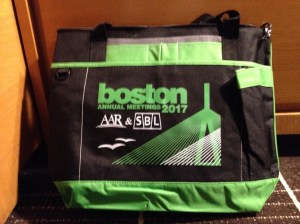
Proselytizing comes in many forms. It can be what you say to people, or how you treat them. It can even come down to what you wear. Every year I’m struck at the AAR/SBL annual meeting some attendees wear religious garb. I’m not criticizing it, please understand, simply observing. This is an academic gathering. Participants represent many different religions, and few, I suspect, are here to outright convert others. Seeing clerical collars and Buddhist robes, however, it becomes clear that what we wear says quite a bit about what we believe. Most attend this gathering vested in mufti. Should anyone in the tweed industry be reading this, I would humbly suggest not having a booth here is a missed opportunity. You are what you eat. You are also what you wear.
I was thinking just the other day how people used to be recognized by their clothes. In the days before consumerism, it wasn’t unusual for people to have just one or two sets of clothes. You knew who was coming, it seems from reading these older accounts, by recognizing the clothes before the face. Religious vestments are a signaling device somewhat akin to animal breeding displays, I suspect. The priest dresses differently to let you know that this person can be approached for true spiritual advice and consolation. Did your paper not receive the accolades you expected? Is there a clergy-person in the house? For sure there is. You’re never far from a practitioner here. As one of those who is unaffiliated, perhaps I’m just jealous.
What do my togs say about me? I tend to wear the same old clothes here year after year. Tucked somewhere in the furthest reaches of my closet are those duds not touched since last year. Publishing, for those who only see it in movies, is a very casual business. We don’t dress up, and I have to stop a moment before the mirror to remember how a half-Windsor goes. I’m guilty of donning aforementioned tweed from my teaching days. Students used to say I dressed like it was the 1970s. I didn’t have the heart to tell them that the clothes were often of precisely that vintage. Long after I’m gone, and AAR/SBL carries on without me, I wonder who might bear the uniform of this peculiar office I occupy? Not priest. Not professor. Not mere participant either. The name tag may say “Exhibitor” and that’s only part of the story, but it’s the pectoral cross I wear.

 Steve A. Wiggins