Life After

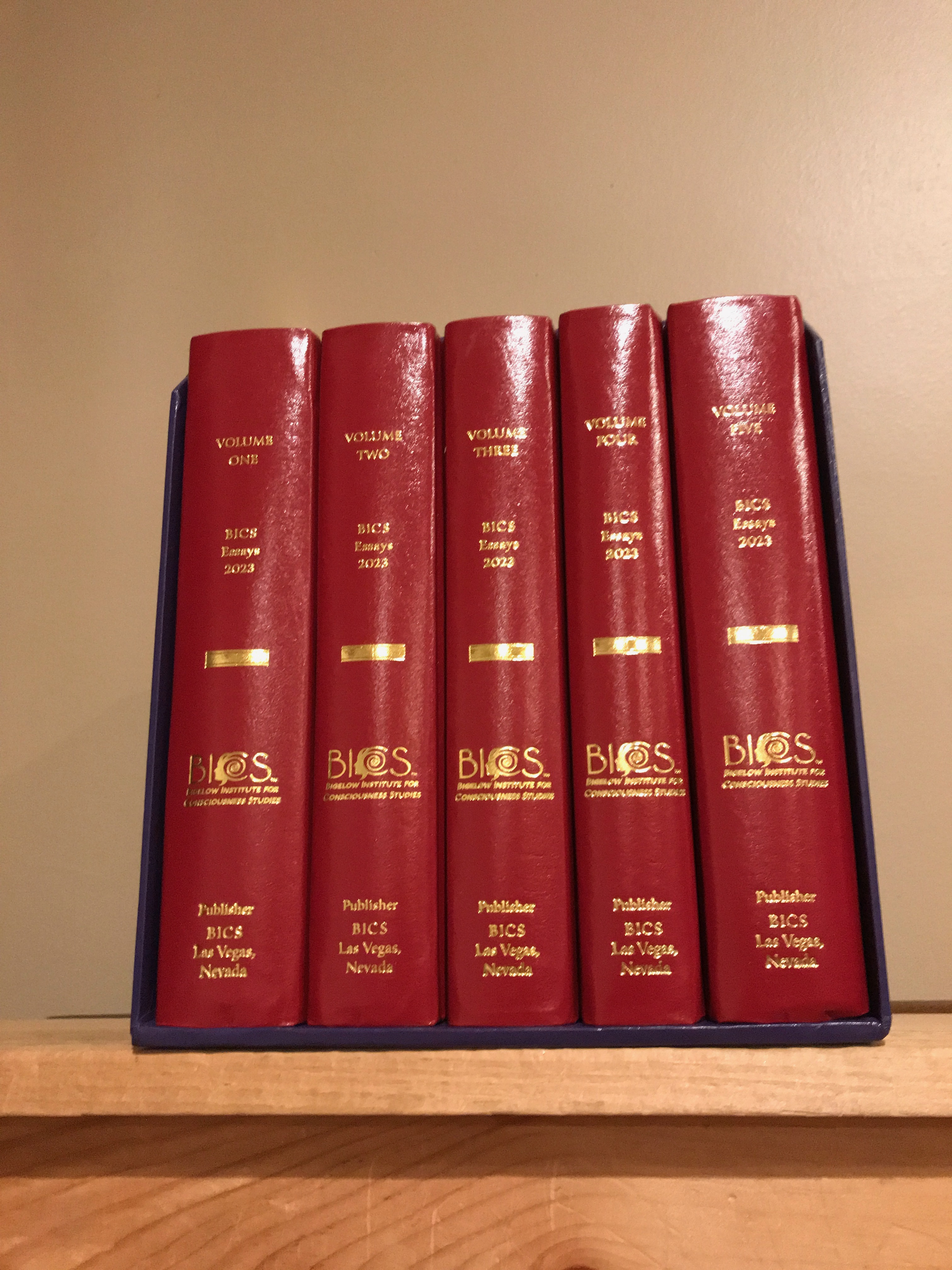
Robert T. Bigelow is wealthy enough to speak his mind.  A hotel and aerospace entrepreneur, Bigelow has made no bones about his belief that aliens are among us, for example.  After the death of his wife in 2020 he initiated a contest for essay writers to give their best proof that consciousness survives death.  The results took the form of a five-volume, twenty-eight essay collection that, according to those who’ve read all, is impressive.  Having spent my life studying religion, I can trace my motivation back to this basic concern.  As a child I was terrified of Hell—a fear that has never abandoned me—and consequently studied religion as a means of reassurance.  I’m not alone in this; the whole Methodist movement began because of John Wesley’s similar concern.  Most of us don’t have the money Bigelow has to attempt reassurance.

Having said that, some time ago, the Bigelow Institute for Consciousness Studies—the organization behind the essay contest—offered $500,000 for the first place essay.  The second received $300,000 and the third $150,000.  Those who were selected for publication received a copy of the five-volume set.  Then, the Institute made an announcement: while supplies lasted, anyone with a legitimate interest in the subject could write to them for a free copy.  I’m not of the intellectual caliber of these essayists, but I have studied religion my entire life.  And I am quite interested in what the BICS is calling “absolute proof of life after death.”  All it cost was an email.  They even paid for shipping.

The set arrived yesterday.  The postal worker at the door seemed apologetic (I had to sign for it), noting the package was heavy.  Now, this is going to take some time to get through.  The five volumes are handsomely produced.  The hardcovers are printed in full color (I know from work this is quite costly).  They have gilt edges and ribbon markers.  And a wealth of thought within.  I guess you’ll need to stay tuned here to find out, after I finally finish, if the results are assuring.  Glancing through the table of contents, and having looked over the judges of the contest, I’m optimistic.  Although Robert Bigelow stands at the opposite end of the political spectrum to me, we both understand that deep-seated human need to know physical death is not the end of who we are.  Even the famous skeptic Harry Houdini wanted the answer to this question as he debunked mediums in search of someone legitimate.  In any case, I’ve got years of interesting reading ahead of me.

First Look

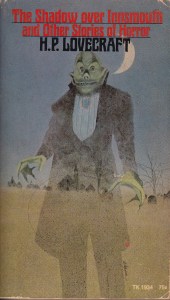
Youth might be described in a number of ways. One, of course, is in biological years. Another may be in exposure to experiences which change your life. There was a time, for example, when you can’t believe you were ever so naive. No matter how youth might be defined, a patina of fond memories tends to cling to images from that time with the passage of years. For me, unsurprisingly, those images are frequently books. I still recall the cover images of books from my tweenage years, and often think that if I found such books in a second-hand store, I would buy them for their ability to conjure past times. One such book comes not from my physical youth, but from my days teaching at the University of Wisconsin, Oshkosh. It was at that time, when the internet was also still young, that I began to try online research into H. P. Lovecraft. I found an edition of his stories titled The Shadow over Innsmouth for sale on a used book website. I was under-employed, but it was cheap and my curiosity inflamed.

Mainly I was interested in what I would now call the reception history of Dagon. Dagon is an ancient Mesopotamian deity mentioned briefly by name in the Hebrew Bible. He is also part of the pantheon of gods borrowed and invented by Lovecraft to populate his eldrich, watery world. I purchased this book for the titular story, where Dagon doesn’t actually appear, but his worshippers do. It is often claimed to be Lovecraft’s best story. As I sat down to read the whole book, however, I was struck by the strangeness of the collection. This edition, from 1971, included such unusual choices as “The Transition of Juan Romero,” “In the Walls of Eryx,” and “The Festival.” Also bundled here was the Houdini ghostwritten “Imprisoned with the Pharaohs.” When I first purchased the book I’d only read “The Shadow over Innsmouth” and “The Colour out of Space.”

As my interest in Lovecraft grew, I acquired other, more representative editions of his work and have consequently read most of his oeuvre. It was that sense of yesteryear, however, that led me back to this browning, aged collection. It was, in truth, the cover. Looking at it brings back that very office in Oshkosh where I sat as I found the edition online for less than five dollars. No doubt, I was younger then. The call of Cthulhu has echoed across the web since then. For me, however, the first exposure will always be a beat-up paperback that I ordered secondhand.


Religious Democracy, Media Style

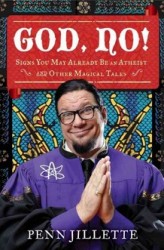
A delightfully witty book review appeared in yesterday’s newspaper introducing Penn Jillette’s book God, No! Signs You May Already Be an Atheist and Other Magical Tales. Having just learned of the book I’ve not yet read it, but I am intrigued. Penn Jillette is best known as the talking portion of the magic-debunking duo Penn and Teller. Having forged a career of exposing false claims to the supernatural mystique of stage magic, Penn and Teller delight in bucking the orthodoxy of the guild and showing that anyone clever enough can fool many people into believing what they know can’t be true. They are exploiting, of course, a phenomenon that neuroscientists have been exploring for a number of years: human brains retain belief even in the face of disproving evidence. Many religious believers call it “faith.” According to Hank Gallo, author of the review, Jillette uses his book to endorse atheism as the only real option for a thinking person. The book is generally categorized as humor.

Although Bill Maher’s Religulous makes many good points from a similar perspective, one of the haunting realities poised for religious specialists is almost a chiaroscuro with excessive contrast. It takes no special training to be a religious specialist. That is hard news to hear for those of us who’ve spent over a decade of our lives and thousands of dollars learning the trade. Comedians and others who are famous will impact far more people than this little blog ever will. Rick Perry can call together thousands to pray to pave his way to the White House. Maher and Jillette can poke fun at religious yokels and scholars will sit at their desks ignoring the crude efforts of those who have no training. There is no doubt, however, as to which will reach a wider audience.

Harry Houdini famously debunked spiritualists in his day. Like Penn and Teller, he was a stage magician who recognized that people could be easily fooled. He was able to expose mediums that scientists and academics of his day failed to uncover. It seems that those with access to the most basic of human desires—the will to believe—gain credibility more readily than an erudite yet obtuse specialist with several odd initials after his or her name and several obscure books to his or her credit. Those in the media have direct access to the mind of the public. If the tent is big enough the whole town will show up for the circus. The truth may be out there, but the minds of the public are won over by those who entertain, not those who bury themselves in dusty tomes and seldom see the light of day. The fact is people want to believe. Until a better alternative is offered, we might prepare ourselves for a long round of Texas Hold’em and a Tea Party or two.