
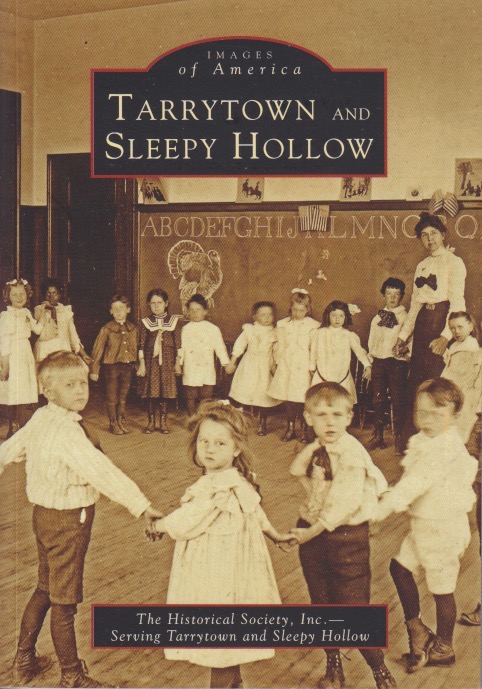
Old photographs are haunting. One thing I’ve long noticed about high school pictures from the early twentieth century is that those kids look much more grown up than today’s graduating seniors. (Or even my graduating class, for that matter.) We’ve extended childhood since then, now stretching it into young professional stage. Who doesn’t want to be forever young? It seems to me that those who spend time in bookstores know about the Images of America series of books. These record what local historical societies collect and put them out there for public consumption. Some day I’ll get them for all the towns I’ve called home. For now, however, I wanted a peek at the early days of Tarrytown and Sleepy Hollow. If you’re by chance not familiar with the series, these books have captions and brief introductions to chapters so there’s context to explain it all. But the pictures are the draw.
One of the other features I noticed was that in a number of group photographs, a person or two is often listed as “unknown.” It’s a fair bet that the other people in those antique images knew who these forgotten individuals were. Photography, however, doesn’t really help those born before the mid-nineteenth century. The photograph has a mysterious power. It preserves a moment in history and as soon as the shutter clicks we’ve already become an older person. In my work I have to locate people and I do so on university websites. I’ve discovered that most faculty are far older than their pictures suggest. Who has time to update the incremental changes every year? Before you know it, your hair’s gone gray and you’re struggling to keep the pounds off. We look at our younger selves and wonder.
At least I do. I see pictures of a younger me and wonder what he might’ve done differently if he could see a picture of a present-day me. One thing he would appreciate is my beard, such as it is. Neither father nor step-father wore a beard, but young me always wanted one. As life would have it, I couldn’t manage a passable one until after seminary while guys I knew in high school had heavy beards even then. But this is a small thing. The real changes take place in our heads. Each day, each second, is a learning opportunity. That’s perhaps the reason I like books like this. Photographs of a place of fascination, even though I know none of the people or their families, are a real draw. And they’re a form of haunting.
 Steve A. Wiggins