Evolution of Psychology

We are a fragile species.  Those of us who experienced childhood trauma carry it all our lives, even if it only seems to pop out unexpectedly from time to time.  This gets me to thinking about the evolution of psychology.  Not the discipline psychology, but of the human mental map.  Things that can upset a roomful of people these days would’ve washed over an entire village unnoticed yesteryear.  Did people then really feel as angry and breakable as we do now?  Please understand, I’m not advocating the view that people of previous ages were better, or even stronger than we currently are.  I just wonder if their circumstances made it so that what we think of as therapy wasn’t really necessary.  For one thing, much of human history has been dominated by short lifespans.  Historically, many women died in childbirth in their twenties.  The majority of men, until modernity, didn’t make it to fifty.  Sitting here musing, I’ve got ten-plus years on that and yet I wonder.

Those facts of life would’ve had to have affected people’s outlooks.  Our extreme squeamishness around reproduction also didn’t exist in antiquity.  Privacy, as we know it, wasn’t part of their world.  How many people see a therapist these days because of sexuality issues?  When did this turning point take place?  If we go back to early Cro-magnon, perhaps living in caves, did they come back traumatized from the hunt?  Surely they must’ve seen death on a nearly daily basis.  Today it’s difficult to get anyone to consider the mortuary sciences for a career.  We don’t like to think about death.  We pick up the phone and dial our therapists. 

When I was still teaching I thought often about how differently people framed their lives in the past.  It’s only now, however, that I’ve come to wonder about the psychological support we require.  I suspect life was, for most people, a literal daily struggle to survive.  Agriculture tamed the environment somewhat, and if current evidence is taken into account, religious gathering looks to have developed even in advance of that.  Perhaps the larger issues, what we still recognize as religion, helped to cope with the constant uncertainties of life.  Unfortunately, there’s no way for us to really get their mental maps.  We can read ancient writings, many of them pro forma or religious in nature.  We start to get some insight in pieces such as the Gilgamesh Epic, but that is so very brief.  I wonder when we started to require help going out the door in the morning or facing another day of the same old, well, you know.  Psychology had to evolve but it left so very few traces.  I, however, have an advantage in years great enough that I ponder our mental states.


Self-Correcting

A comment by a friend regarding Wikipedia recently got me thinking about self-correcting systems.  When I was teaching, I didn’t eschew Wikipedia like many of my colleagues did.  In case you’ve been living in a cave the last two decades, Wikipedia can be edited by anyone.  When I had more time than I do now, I used to correct errors I found there.  The thing is Wikipedia shouldn’t be used as the final word.  It’s a good place to start and, if you’re concerned about the truth, you’ll follow up by checking footnotes and looking up the references.  (Standard operating procedure for academics.)  Readers always need to keep in mind that what they’re reading may have been manipulated and distorted, which is why you want to check with established sources—some of us still prefer print, which isn’t so easily altered.  Still, Wikipedia is self-correcting and it works fairly well.

This got me to thinking about other self-correcting systems.  Those who know me know that I take criticism pretty hard.  That’s because I was raised with a crippling fear of Hell that let me to self-correct whenever I discovered an error.  And to scan my thoughts and motivations constantly for mistakes.  Sensitive bosses know that I only need to learn about an error I made, even obliquely, and that I don’t need to be told to fix it.  Of course I don’t!  Hell awaits those who let mistakes fester.  I’m not sure this is a good kind of self-correcting system, but it keeps me on my toes, and at times, even on my toenails.

The human body is often a self-correcting system.  We need the help of physicians when disease or injury occurs, but healing is part of a self-righting system.  (I’m indebted to an episode of Northern Exposure for reminding me of this recently.)  On an even larger scale, life on earth is self-correcting.  We humans have done more than our fair share of damage, and the self-correction (e.g., extreme weather because of global warming) may not be to our liking, but it is a system doing what it does best—righting the ship.  This kind of self-correction is inspiring and inspirational although we often take it for granted.  If healing didn’t occur none of us would be here to notice just how remarkable it is.  I don’t dismiss Wikipedia just because we can’t be sure everything’s written by experts.  Self-correcting systems are often the way of the world.


Getting Exorcise

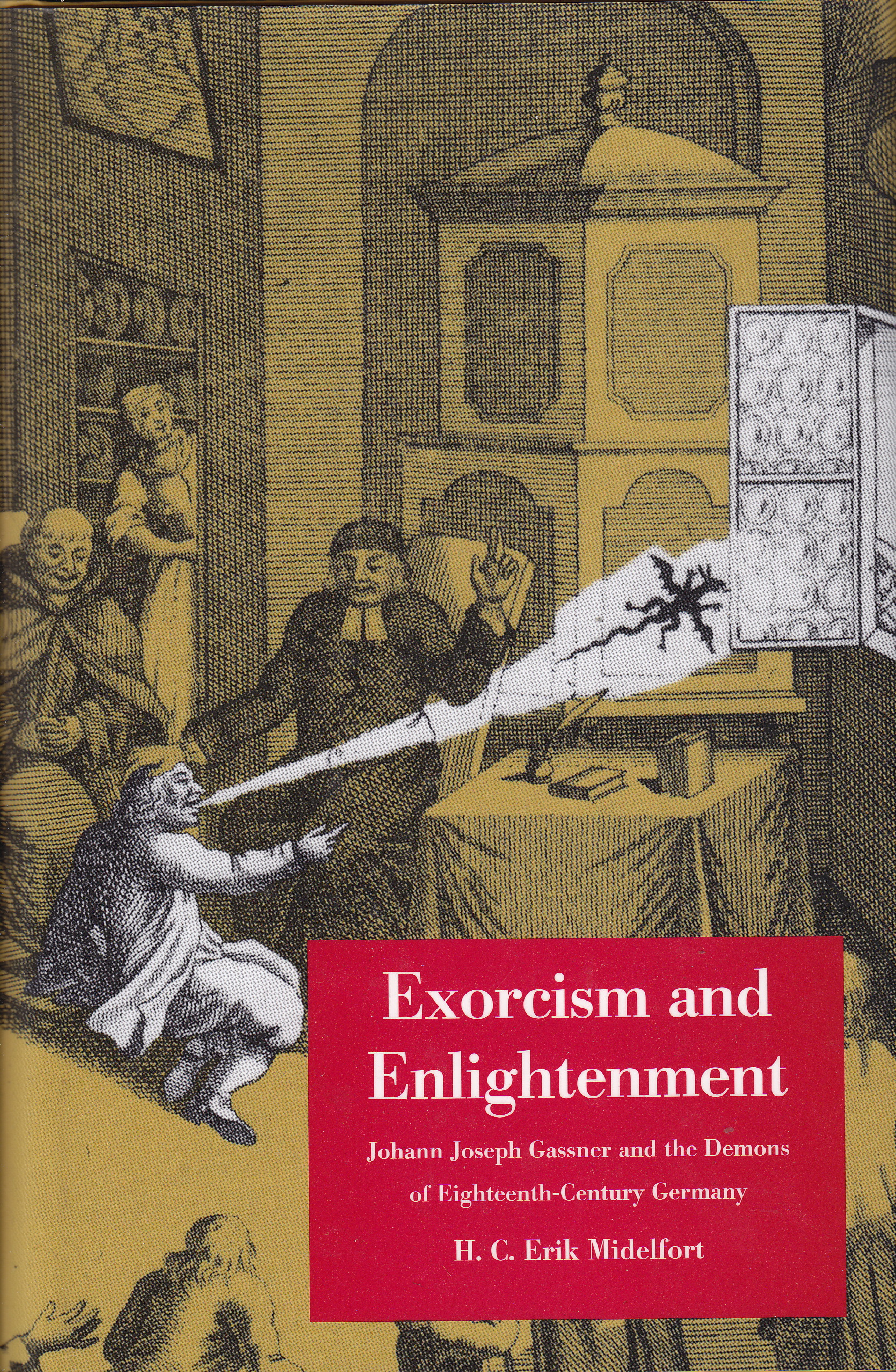
ExorcismTo be honest, I can’t recall having heard of Johann Joseph Gassner before. Given his role in the European witch-hunting culture, however, I must have read his name a time or two. As with most names out of context, it was quickly forgotten. H. C. Erik Midelfort, therefore, is to be congratulated with bringing out not only Gassner’s name, but his remarkable career. Exorcism and Enlightenment: Johann Joseph Gassner and the Demons of Eighteenth-Century Germany, like so many other books, came to my attention in a bookstore. Books on demons have a strange kind of draw to someone interested in both religion and monsters, and since it was on an overstock shelf, I found it impossible to let it lie. This proved to be a wise decision.

Midelfort proves himself one of the rare academics who doesn’t talk down to his readership, yet makes what could be a complex topic understandable. Complex is about the only word to describe what would become Germany in the Eighteenth Century. The remnants of the Holy Roman Empire left a divided region with prince-bishops—clerics with political control outside their own dioceses—vying for all kinds of authority. Although the Enlightenment was well underway, the region was embroiled in the controversy of a priest by the name of Gassner. Gassner was a healer, but also an exorcist. Believing that many torments suffered by the populace were demon-spawned, he used highly public and, to some, incredible exorcisms before healing those in need. His success was unquestioned, but the church, struggling between Catholicism and Lutheranism, as well as struggling to find a place in the Enlightenment world, found Gassner a bit of an embarrassment. What do you do with demons in a world where science says they don’t exist?

One of the most notable takeaways from Midelfort’s book, for me, is that the Enlightenment did not suddenly change the world. Even fully aware of empirical experimentation and the use of reason, the scholarly world did not utterly acquiesce to a subdued materialism. It still hasn’t. As the case of Gassner demonstrates, our comfortable, physically predictable world holds some surprises for us yet. At least for Gassner, believing demons don’t exist doesn’t stop them from tormenting people. As he cured his thousands, skeptics gathered (including his contemporary Franz Mesmer) to explain away what was happening. Even today, as Midelfort points out, we can’t explain the placebo effect. There’s no question, however, that it works. As does, if the media is to be believed, the occasional exorcism in the twenty-first century.