Which Witch?

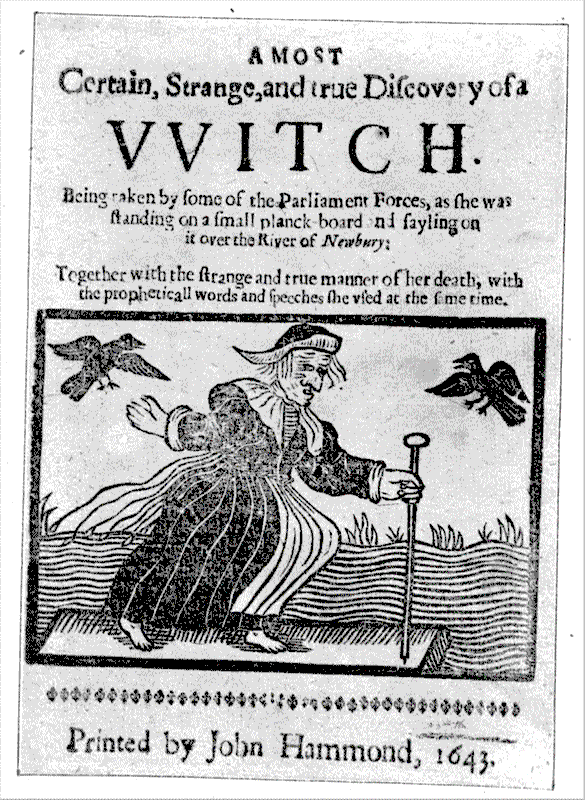
Witches have been flying all over the Internet the last few days. A story from AP Online, picked up by several websites, reports that witches in Romania are planning to cast spells on the government. Now, I have to admit to having been tempted to cast a few spells myself during the Bush years, but since I don’t believe in magic the desire simply fizzled. These witches, however, are serious. Cat excrement in hand, the carcass of a dog nearby, these witches are outraged. Perhaps even more surprising is that some government officials are taking it seriously too, according to the article. The reason for the hexes? Romania has just started charging witches income tax.

Romania is a nation that evokes the darkness of primal forests haunted by werewolves and terrorized by vampires. The one-time domicile of Vlad the Impaler, the region has retained this mystique into the twenty-first century while elsewhere rovers roll around the surface of Mars and instantaneous world-wide communications are available at the press of a button. I am nevertheless encouraged by this display of activism. These supernatural citizens are challenging what they perceive to be unfair government practices. Statesmen wear purple on auspicious days to mitigate the effects of enchanters who are in touch with the financial struggles of the vast majority of religious specialists. Most of us just sit back and take it.

Meanwhile, as thousands of blackbirds fall from the sky, members of our own government are posturing to take back the modest health care improvements President Obama has helped to institute. Emotional Republicans are getting ready to strike back at programs designed to help those less fortunate than they are (apparently so they’ll have someone to pray for at grace over meals). “Are not two sparrows sold for a farthing? and one of them shall not fall on the ground without your Father” (Mt 10.29). Never mind casting spells, the government will always find ways of making life less comfortable for those they see as threats. Which witch would you choose? I’d select the one with a moral compass, even if she has cat excrement in her hand.
Thoughts Off de Waal

Although Frans de Waal’s Our Inner Ape was published half a decade ago, the monograph remains terribly relevant. I gave some primary impressions of the book last week, but one section has remained firmly in my head and has mingled with all the harsh rhetoric in the news about health care reform in the United States. Asking the question of whether Homo sapiens are still evolving biologically, de Waal withholds his final opinion on the matter, but he points out that statistics indicate Americans are falling behind much of the rest of the developed world in terms of general health. This he ascribes to the competition inherent in a free market economy that favors the best health care only to the wealthy while the average citizen is offered substandard options. The numbers bear him out on this – he notes that on the standards utilized to measure general health, the United States is not even in the top 25 industrial nations.

With the conviction of a true prophet, de Waal notes that privatization of health care has led to a precarious imbalance in medical care in the United States, where the top 1 percent of citizens has more income to spend than the bottom 40 percent combined. This, he believes, is because we have lost sight of the altruism inherent in apedom. Although the great apes are endangered (ironically, by their overly greedy genetic cousins) their societies show no such disparity. An ape family will assist a weakened or feeble member and give it extra care to ensure that it is offered a life as comfortable as possible. They do not discard the fragile and “expendable” members. Republicans, however, wave placards trying to shout down basic health coverage for the poor.

Does biological evolution continue among the human species? Have we stopped natural selection’s eternally ticking clock? Only time will tell. It does seem, however, that the very Bible pounded by the Religious Right (health care reform’s greatest opponent) would argue that the apes got it right. We should care for the poor, disadvantaged, and underrepresented. While the Tea Party belles are busy trying to rewrite history with America founded as a Christian nation they daintily wipe their mouths on the pages of the very book they treasure so deeply and claim as their authentic heritage.


Transformations

Last week my colleague James of Idle Musings sent me a review of Stephen Asma’s On Monsters that I’ve been meaning to incorporate into a post for several days now. Since New Jersey has been buried under more snow than it’s seen since the last Ice Age, I’ve been busy shoveling and navigating icy roads to class and only now am finding the time to respond. (Still, I have to say that the snow we have here now is no comparison to good old lake-effect snow where I grew up. Of course, the population back home was much smaller so the media never made a circus of it. After all, it is just winter!) In today’s paper, however, there was a review of The Wolfman that graciously affords me another opportunity to address one of my favorite, if under-represented, areas of religious studies: the monster.

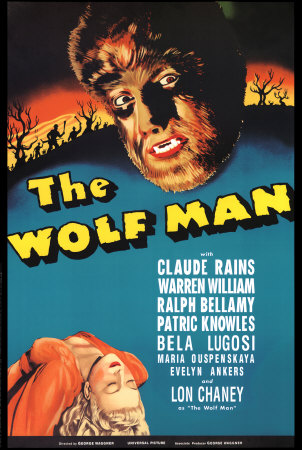
Local film critics haven’t exactly panned the remake of the 1941 classic, although it is noted that the new version tries to avoid the essential subtexts of “alpha-male dominance, sexual repression, compulsive behavior and father-son feuds” (from Stephen Whitty’s Star Ledger review; Whitty also notes, on the cheerful side, that Universal is trying to revive its monster franchise). The werewolf has always been my favorite monster character. Aside from the negative aspects noted by Whitty, the werewolf also represents transformation from the helpless, lost, and confused Lawrence Talbot to a purposeful, confident, and unambiguous wolfman. The werewolf is everyman/everywoman pressed to the limits by a demeaning, heartless society until individualism breaks out in all its savagery and power.

Apart from the religious elements in all monsters (is the werewolf not a paragon of spiritual transformation?), a political subtext also emerges. While the front page declares the financial woes of the state and the continued trouble trying to pass any healthcare reform, page 3 declares “Top 5 health insurers post soaring profits.” One person’s cancer is another insurer’s boondoggle. Meanwhile the Larry Talbots of the world are being told, “give a little more – everyone’s got to share this burden.” Eventually, however, there will be a full moon and transformations will take place. As a student of religions, I can recognize the werewolf as more than a monster and as containing far more symbolism than a Robert Langdon could ever untangle.

Who's not afraid to look in the mirror?