Forever Jung

A funny thing about aging is that you recollect your youth, but you find yourself less able to do the things that seemed so easy when you were more spry.  We live in a world where the elderly are coming to outnumber the young, and that means a lot of memories of “the time when.”  This thought confronted me when reading a story about two missing patients from a nursing home in Germany.  Authorities were frantic to find them until they were spotted at Wacken Open Air, the largest heavy metal fest in the world.  The news stories seemed bemused—it was cute, in a way, wasn’t it?  Two old guys trying to recapture their youth, like salmon swimming upstream where they were born.  I’ve got to wonder if there’s more to it than that.

Music has a way of touching us deeply.  While I prefer my rock on the harder side, I’m not exactly a metal-head.  There’s something, however, in the rage of metal that resonates with some of us when we get older.  It’s almost religious.  You see, I recall hearing the music from my brother’s room when I was growing up.  As a naive fundamentalist, I sometimes went downstairs shaken, as if my virginal soul had seen some image it shouldn’t have.  Some teens reach a level of maturity before others, and metal speaks to them.  Let’s face it—life is unfair.  We see that every single day.  Music can help us cope with such unfairness and there are times when John Denver and James Taylor seem downright gullible.  Ask the elderly.
Our society harbors many myths.  One of them is that evolution doesn’t occur.  Not only is it a biological fact among species, but it’s also, on a macro-level, something that happens as we age.  Perspectives shift.  We come to see the wisdom of Heraclitus—no one steps into the same river twice.  Especially when it’s Styx.  Technology keeps us alive longer now, and sometimes it seems that it does so just to tell us what we can no longer do.  I’ve got, I hope, a number of miles left on the odometer, but my focus is on the car’s stereo system.  When driving to Wacken Open Air to pick up two men trying to plug into either the rage or the euphoria that heavy metal means to the elderly what comes through your speakers?  What would the “sweet Psalmist of Israel” have wanted to hear when not even Abishag could keep him warm?  Yes, Herman, there is a wisdom that is woe.  And banging your head may not be the worst option at such times as these.

Lost Supper

Culture, for better or worse, involves a deep connection to religion. No matter how secular we suppose the world to be, profound connections to belief surface in the most unlikely places. Time magazine’s culture section this past week has a brief blurb on “Burger Blunders.” Having been a vegetarian for a decade-and-a-half, this short story might not have caught my interest had my wife not pointed out “the Ghost,” a burger offered by Kuma’s Corner, a heavy-metal band-themed bar in Chicago. “The Ghost” comes with an unconsecrated communion wafer on top, and this has raised some spirits, according to Time’s culture team. Even Protestants recognize the power of the symbol of the wafer, even if they can’t accept transubstantiation. In Catholic belief, however, prior to consecration the sliver of bread is just that—a bit of pressed wheat product. The wafer came to be preferred because it was more easily contained than the crumbs of a regular piece of consecrated bread.

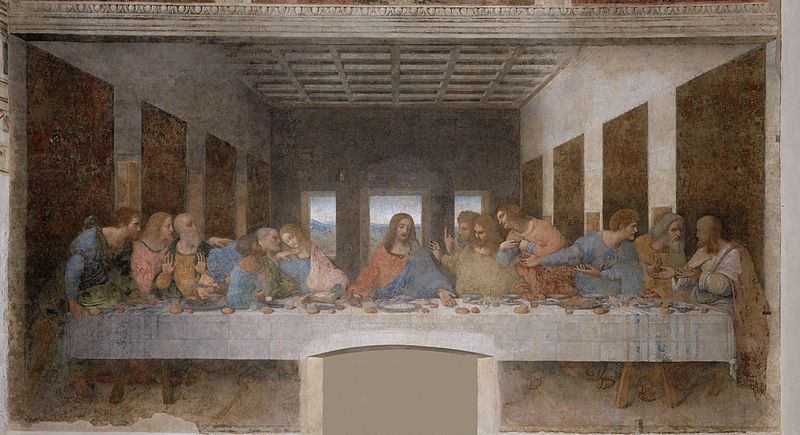
Communion, or the Eucharist, is a ritual meal based on the Jewish Passover. According to the Gospels, it was during the “last supper,” a Passover seder, that Jesus instituted the ritual. Early Christians ate together, and, recalling the symbolism, gave special prominence to the bread and wine. Bread, however, produces crumbs. When theology got ahold of bread it became a sacred object, after it was properly consecrated. It was believed (is still believed by some) to be very powerful in that state since it had become the actual body of Christ during the ritual. Wafers, technically unleavened bread, had many advantages to the emerging theological sensitivities. Portion control, symmetry, and virtually no crumbs. I’ve attended many masses, and the extreme care for particle control is everywhere from ciborium to patten to sacred linens that cover the altar like a liturgical table cloth. They are all accessories to the containment of broken bread.

Última_Cena_-_Da_Vinci_5

Communion wafers, however, when unconsecrated are just bread (if even that). They are not made palatable as snacks, but are more easily available online than basic gears or recordings of your favorite musical. Heavy metal has always enjoyed its blasphemous image as one of the most in-your-face counter-cultures possible. It is also profoundly religious. (Note, I am not saying that heavy metal is Christian or even Judeo-Christian, but it does participate deeply in religious symbolism.) If robbed of its shock-value, it is just loud noise. By association, however, many people mistake the wafer itself for what it represents. Without the added ingredient of consecrations, however, the liturgical churches tend to say it’s just bread. If you’ve ever eaten it, you’ll know that that assertion requires faith sufficient to move a Big Mac.


Beside Metallic Waters


My brother recently pointed out the story of Rev. John Van Sloten, a Canadian pastor who has written a book about how he’s come to see the gospel in the songs of Metallica. Yes, Metallica. Even the members of the 1980’s hard rock band found the association a little surprising. It all came about, it seems, through an open mind. The story is narrated in basic form on the Gibson guitar website. Young parishioners at Van Sloten’s church suggested he should listen to Metallica. Perhaps aware of the principally negative conservative Christian reaction to rock in general and hard rock in particular, the pastor says he ignored the advice. Then the minister was presented with Metallica tickets. A divine mix was in the works.

At the concert the pastor had a revelation: the issues wailed against by the band resonate well with the concerns of Christianity. In fact, some of the band’s concerns sound downright prophetic. The concept of prophecy today often revolves around a prediction of future events (à la Harry Potter). Prophecy in the Hebrew Bible far more often concerns social justice, speaking out against the oppressor. Metal bands, from their inception, were vehicles for protest. Disillusionment against a system that perpetuates unfairness either at a governmental or a cosmic level. When I sat down to listen to the lyrics of Black Sabbath for the first time, I was surprised how biblical many of them were (don’t tell Ozzy).

Many religious folks prejudge heavy metal as “satanic” and evil without even listening to it. I have always been struck by how much these groups frequently draw on bleak biblical images. Today we treat biblical characters as paragons of emulation. The Bible does many of its characters no such disservice. Prophets are to be heard, not emulated. We think of Isaiahs or Jeremiahs as pleasant supper guests who happen to have a divine word inside. In the Bible their actions often lead to recriminations, but their uncomfortable message is sound. I grew up in a tradition that discouraged heavy metal, as if something in the music were inherently evil. I applaud Rev. Van Sloten for approaching one of the formative bands of the genre with an open mind. Truth may be found in some very unlikely places.