Headliners

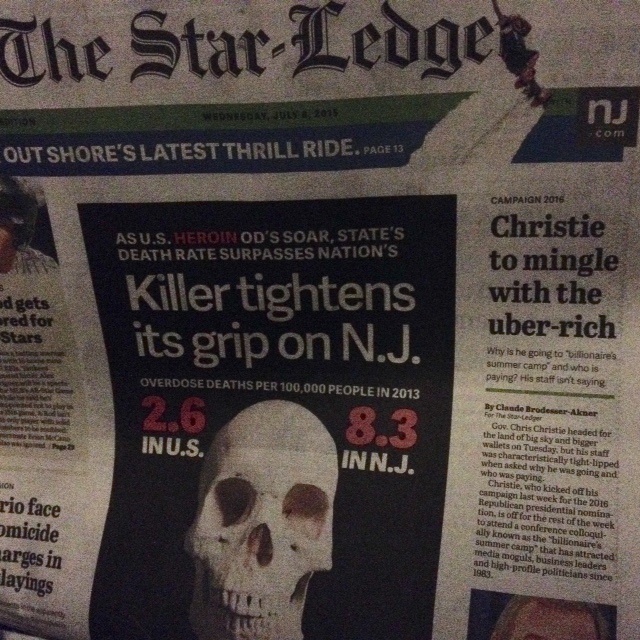
I sometimes wish I was a journalist. Just this past week a couple of people questioned my journalistic skills for an opinion piece I wrote for Religion Dispatches. I’m fully capable of professional research, but who has the time? Still, being a journalist might be fun. Thinking up clever headlines would be challenging day after day, but nevertheless, it might be enjoyable. Editors who lay the articles next to each other on the page must have a sense of irony. This past week in the New Jersey Star Ledger the central headline read “Killer tightens its grip on N.J.” The column to the right began “Christie to mingle with the uber-rich.” Having lived in New Jersey under Christie’s entire reign, I’m no fan. I’ve despised bullies since I was a kid, and rich bullies are worse than the working class variety. New Jersey certainly seems no better off to me. Now he wants to be President.
FullSizeRender

The real headline, however, about the killer in New Jersey is not yet another prison-break story. It deals with heroin overdose deaths. According to the article, per 100,000 people in the U.S. 2.6 deaths are from heroin overdose. In New Jersey the figure is 8.3. New Jersey, as the most densely populated state (1200 people per square mile, I once read) has its share of problems. Most of us like to pretend that drugs are somebody else’s issue, but I’ve known addicts and they are not evil. When life offers you unrelenting recession after recession and all attempts to better yourself run up against the 1 percent, frustration is inevitable. Even earning a doctorate will only lead to jobless misery. What more can you do than get an education? Heroin is dangerously addictive and it makes the user feel great, I’m told. Society doesn’t offer many other options. At least in Rome they had bread and circuses.

He who would be President, however, can’t be concerned about that. The uber-rich must be fed. And fed. And fed. Those whose ambition to high public office is naked power would be foolish to ignore their fellow plutocrats. Down here on the streets, things look a little dicier. Although I think I understand why many turn to chemical relief, I’ve never been tempted by drugs myself. One of the reasons I turned to religion was the prevalence of drug use in the town where I grew up. There seemed to be no future in substance abuse. I may not have chosen the most promising of ways to move ahead either, in retrospect. Now I find myself living with a governor who represents all that’s wrong with government. And if you’re going to die of drug-related despair, it seems like his particular state is the place it’s most likely to happen. Long live the king!


No Song for Old Men

Succoth in Waukesha, Wisconsin. A pillar of the local synagogue had invited me to come to his booth with some of my seminary students to let them celebrate an ancient tradition and talk to a Jewish believer about it. We were all having a good time, and someone mentioned Leonard Cohen’s song “Hallelujah.” One of the seminarians, brash as always, spoke up and admired “Rufus Wainwright’s cover in the movie Shrek.” Although I’d corrected many students before, I let this faux pas ride. Music is very personal to me, and the cover played in the movie Shrek was John Cale’s version, although the soundtrack substituted Rufus Wainwright’s cover of John Cale’s cover. And this student was far too young to have appreciated the Velvet Underground. I was a little surprised, then, when my wife pointed me to a CNN story this week about the thriving popularity of the song. Instead of putting my paltry words out there on CNN for all the world to see, I decided to address them here, to my private audience.

Velvet_Underground_and_Nico

Leonard Cohen has been described as a man who writes songs with a prayerbook in one hand and a picture of a naked lady in the other. He has spent time in monasteries and his lyrics have a very serious edge to them. What the many self-proclaimed experts commenting on CNN seem to have missed is that Cohen’s song is a song for old men looking backward. Yes, it is rife with biblical imagery, but no, it is not a religious song. Not in the sense that it is often used today. John Cale got that. When I hear his early work with Lou Reed or even his first cover of “Hallelujah” that managed to capture something even Cohen hadn’t (no mean feat, that), I can hear the aging Cale casting a glance back to the same place that Cohen saw. We are all aging and we all remember the vitality of those years when possibilities seemed endless. No, it takes decades for a hallelujah to become broken. All the versions by popular artists trying to breathe soul into a tragedy have missed the point. It’s a cold and it’s a broken hallelujah.

I only listen to this song when I’m alone, preferably with John Cale. When Leonard Cohen sent him the lyrics there were 15 pages of them. The CNN report cites the 75 or 80 verses that Cohen wrote. That’s because the song is a life. The biblical images of the song first captured my attention, but I also realized that it was a song about something that’s gone and that’s never coming back. Not for guys my age. Not for guys who can still remember being eighteen and feeling like life hadn’t even begun yet. Now I look back over five decades. I hear “Heroin” seeping from my brother’s room, somehow knowing the dissonant chords would stay with me for the rest of my life, although I have never personally used drugs. There is a longing there, a longing for something that life offers maybe once, for a few short years. Age and inevitability catch up with everyone, and breathy young artists think they’re chic when they cover a song that is meant for old men who remember what glory used to feel like. Only those with experienced ears can really hear Leonard Cohen’s hallelujah.