
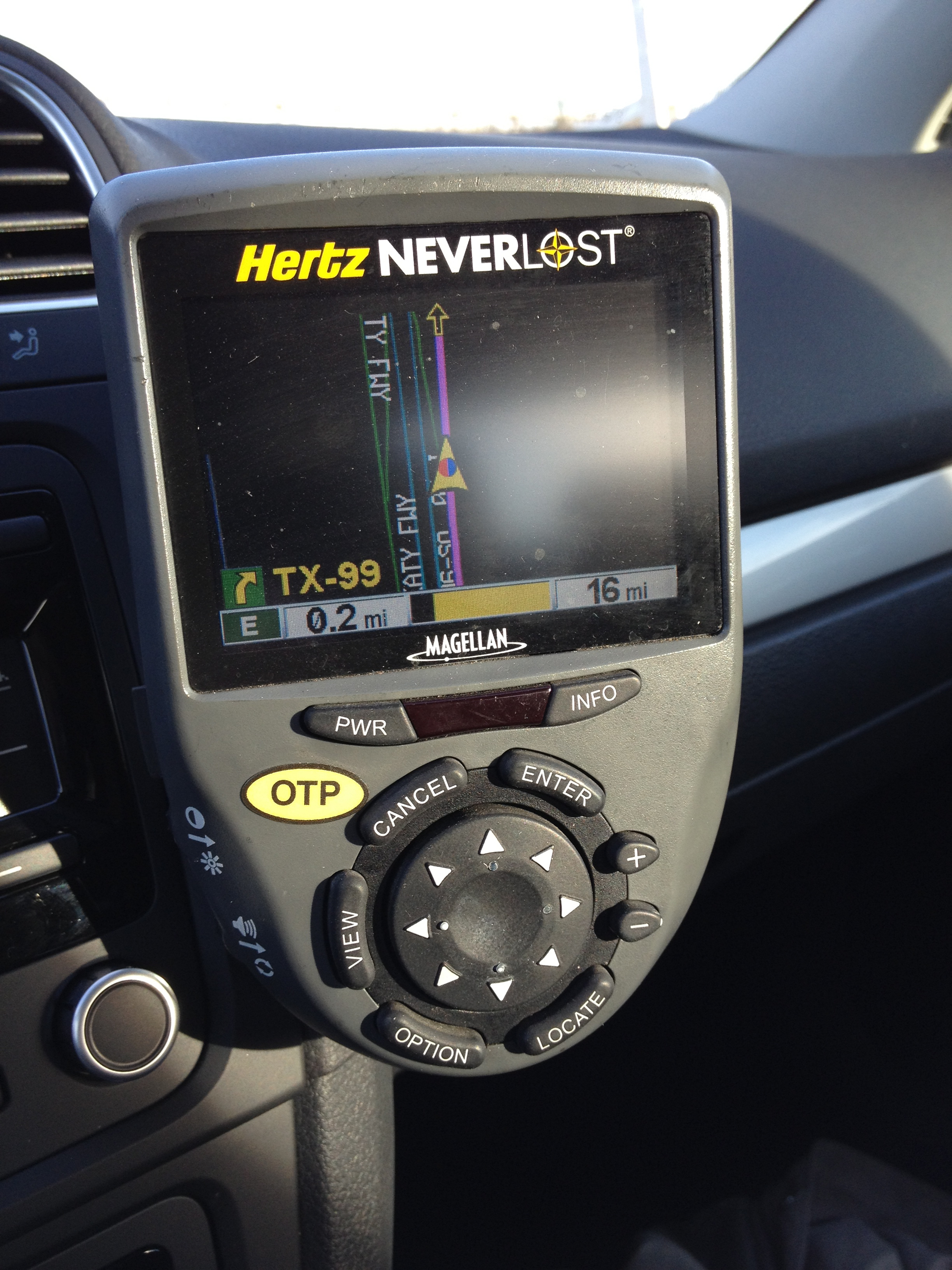
My relationship with Shiri is a love-hate relationship. Shiri is what I called my “Neverlost” GPS in my rental car in Texas. My iPhone has a female voice called Siri, so I figured my talking navigator must be her electronic kin of some sort. Finding my way around has been a lifetime vocation, but it is job most of us are never paid to do. I learned the trade using maps and the occasional compass. What a God-like feeling to look down at a map and visualize it from way up in the sky—it’s a kind of power-rush. Seeing the country, state, or city laid out below you, knowing that you want to travel particular roads based on traffic, tolls, or scenic beauty. Shiri and I had our first argument just after I disembarked in Houston. I’d never been to Houston before, and, being parked in a concrete bunker of a parking deck, Shiri was a little groggy and unclear about where she was when I spelled out that I wanted to go to Austin, avoiding major highways and tolls. Do I turn left or right out of the garage? She still hasn’t decided.
Shiri likes highways. Not a fan of urban driving, I’ll take a smaller road if possible. My first appointment wasn’t until the next day anyway. I can’t help attributing personality to Shiri. Was that a hint of disappointment in her cheerful voice as my driving made her recalculate the route yet again? Shiri has trouble determining if I’m on an interstate or a parallel access road. She sometimes sees roads that the naked human eye can’t discern. We fight, but she does eventually get me there. I have a feeling that she crawls into the back seat and weeps when I lock the doors and stagger to my hotel. It’s not that I don’t love Shiri, but she doesn’t respond quickly enough to real life conditions. A “slight left” across four lanes of rush hour traffic is purely academic to her. To me it is impressions of my fingers deeply embedded into the plastic of the steering wheel.
Shiri doesn’t understand that Houston’s many toll roads only accept EZ Tag and, being a visitor, I don’t have said tag. On the way to the airport—do I really have to see George Bush again?—she keeps trying to steer me onto roads that state “EZ Tag Only.” Texans are swearing at me as I suddenly change lanes and Shiri doesn’t help by repeating “At soonest opportunity, make a legal u-turn.” Shut up! Shut up! Where is the airport? I should be able to see it by now. Did I really leave the hotel two hours ago to travel this forty miles into… where? Is that a tumbleweed? When I see the Hertz rental return sign I break into spontaneous prayers of thanksgiving. I poke Shiri’s power button and leave without saying goodbye.
But now, a thousand miles away, secure in my own home, I miss her electronic voice.

 Steve A. Wiggins