Wasps

I just finished reading Iain Banks’ The Wasp Factory. It is a disturbing novel on many levels; even the back-cover comments warn against reading it. The reason for mentioning it on this blog, however, is that it is so full of religious ideas that it would be a shame not to address them here. I won’t put in any spoilers for those who might, even with adequate warning, want to read the book.

The wasp factory of the title is a divination device. The narrator, Frank, does not believe in God because of the unfairness and cruelty in the world, although he is also a frequent perpetrator of cruelty. As he seeks revenge on animals other children, Frank views their suffering as a form of punishment from the God he disbelieves. At one point, after his brother Paul dies, Frank compares him to his old dog Saul, also unfortunately deceased. At this point he reveals, “Paul, of course, was Saul.” Death is the Damascus Road experience in this world devoid of a deity, but one where death is considered far more certain than life. At one point Frank declares the sea to be a mythological enemy, a point of view shared by the Bible and many ancient societies.

Frank is a neurotically ritual-bound individual. No matter how gruesome, his tasks are part of an elaborate system that must be repeated in order to maintain its efficacy. At one stage Frank declares, “this is like intellectuals in a country sneering at religion while not being able to deny the effect it has on the mass of people.” This statement is more insightful than it first appears – it is the dilemma of many who attempt to understand religion who are considered a luxury not to be afforded by society. Frank is a paradigm: people are religious, even in heterodox belief systems. The Religious Right has understood this for decades: talk religious talk and they’ll vote for you. Most people have no way of checking out what form this religion might take. It makes me almost as nervous as The Wasp Factory itself.

Ortho-right or Ortho-wrong?

As a child reared in a seriously religious household far, far away from anything with even a whiff of orthodoxy about it, my first encounter with this traditional form of Christianity involved more curiosity than fear. What was this religion that claimed to go back to the very earliest apostles? Did Jesus wear one of those unusual hats? I never recalled seeing paintings of Peter, or Mark, or even Thomas wearing a medallion of the theotokos. Apparently I’d been routinely misinformed. The haunted, deeply spiritual grimaces on the faces of orthodox students my age were almost intoxicating. It was all new and exotic to me.

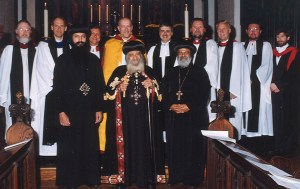
Several years later I find myself having been subjected to a variety of orthodoxies and the only thing they seem to have in common is the conviction that all the others are wrong. I once had a boss who was enamored of Greek Orthodoxy. (I later learned that this is the gateway orthodoxy, leading to more foreign strains.) Presently his interest shifted to the Russian variety and I eventually found myself cowering in the glare of the Coptic Pope Shenouda III’s eminence. How had a kid from humble beginnings come so far? A couple jobs and a few hundred miles later, my new boss turned out to be Syriac Orthodox. Phone calls to the office would come in languages I’d never even heard before. Being a northern European mutt, maybe I was simply jealous of the pride of ethnic purity. No fancy traditional dress to haul out for exotic dances at annual celebrations of mutthood (Lederhosen and stuffy tweed, anyone?)

Basking in the eminence of the Coptic Pope

Basking in the eminence of the Coptic Pope

All of this exposure to orthodoxy has led to heterodox thoughts in my heretical brain. It seems that the basic premise of orthodoxy is that the final truth was revealed just once, up front, and it left no room for growth. The expectation that Jesus would shortly be back didn’t leave much space to consider what complications would set in once people developed nuclear weapons, landed themselves on the moon, or devised genetic engineering. Complexities and complications that early Christianity could never have foreseen chaw like ravenous beavers on the stilts propping up this edifice. I am a firm believer in religious freedom and have never urged anyone to change her or his personal faith. But I do seriously wonder how any religious system, in the light of our limited brains, could ever expect anyone to believe that it had comprehended the whole of all truth for all time. It is all too wonderful for one condemned by a birth outside of ethnic Christianity.