Making Sense

Science is more than meets the eye. Even since I was a child I’ve tried to follow what I can of science without a real microscope or telescope and a doctorate in some incomprehensible subject like chemistry. I guess that’s why I’m a fan of popular science—the kind that is written so a layperson might understand, or at least pretend to. Indeed, one of the complaints from scientists and others alike is that science has become so complex that only a specialist can really understand. I suspect that’s one reason religion continues to thrive; anybody can be an expert in religion, even a scientist. Nevertheless, science is based on empirical observation, now with instruments fine tuned to receive data better than human senses. So I sometimes watch Through the Wormhole to find out what is happening in the realm of pure knowledge. Although simplified to the digestibility level of the laity, Through the Wormhole tries to stay on base with interviews with mainstream scientists who are working at the cutting edge of what’s out there. I recently watched the episode entitled “Is There a Sixth Sense?”

I have no way of knowing what scientists think of such things, but I was glad to see the everyday experience of normal people addressed in this particular episode. Who hasn’t felt that weird pre-cognition from time-to-time, or felt like they were being stared at only to learn that they were? These might be the spooky effects at a distance that so unnerved Einstein, but they are part of human experience. We all go through it, but mainstream science comes up with a convoluted scheme whereby our brains project what actually happened back in memory before it happened so that it just seems like we knew something was about to transpire. Of they point to false positives—how many times did we think something was about to happen and it didn’t? We just don’t remember those. Still, this particular show brings together mainstream physicists and theorists usually considered outsiders, such as Dean Radin and Rupert Sheldrake (strangely omitted from the IMDB cast list). Several smart people, it seems, wonder if we are really all connected.

Mainstream science has grown terrified of metaphysics. The suggestion that anything might be remotely like the world of religion is frightening to those who believe we just need more precise calipers and higher resolution imagery to explain an entirely physical universe. This little universe we carry around in our skulls, however, is attuned to what we might just have to call the “spiritual” or some such moniker, just to differentiate it from the particles that we are told make up everything. Or is it strings? Don’t ask me; I couldn’t tell an up quark from a down quark. Interestingly, one is even called a “charm.” And then there’s the God particle, the Higgs’ boson that briefly reminded the world that Edinburgh is a top-rate university, although, as we all know, there’s no place like Harvard. For the rest of us, however, there’s the everyday business of work to face. And if I try to read a blog while on the clock, I definitely have a sense of being stared at, even when I’m alone in here.
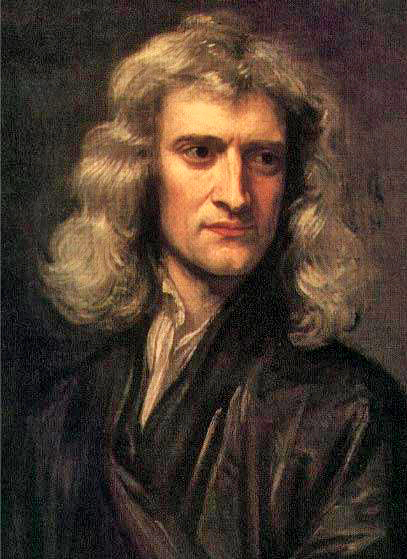
One of the last fearless scientists
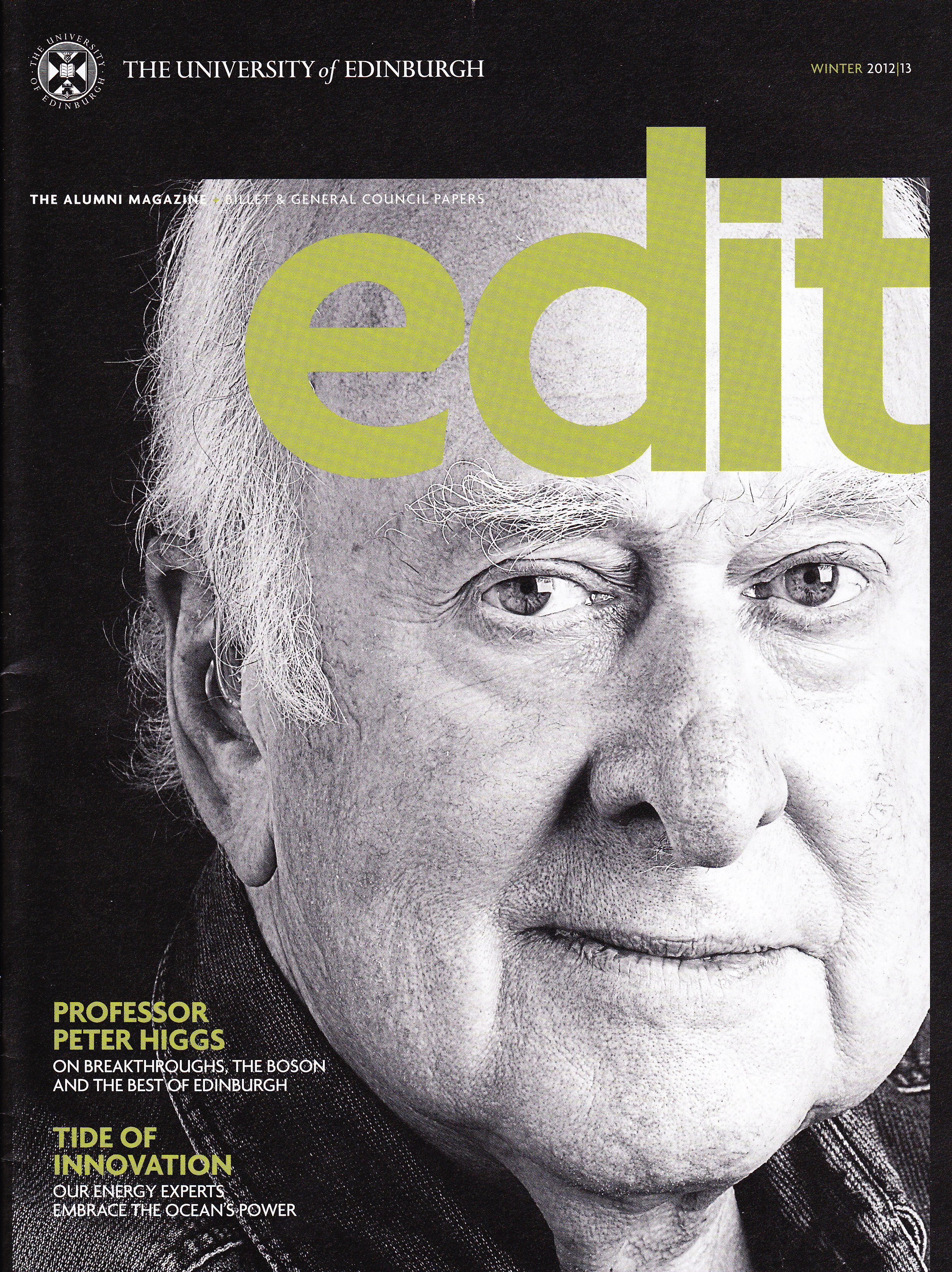

One of the last fearless scientists
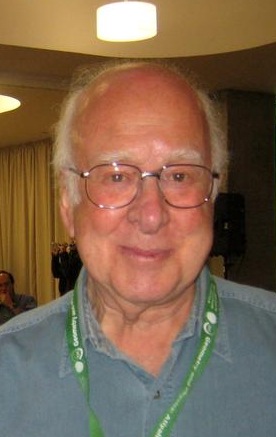

AP Physics

AP Physics. Few words strike terror into high school students like these initials and scientific surname. As a student I didn’t really comprehend AP, and never took any Advanced Placement courses, but I enjoyed physics. It was by far my favorite science class. Even as a Fundamentalist, I saw that here was the explanation for the entire universe, as we knew it. Laws deduced by people far smarter than I could even dream of being could explain everything. But then Heisenberg. And Schrödinger. And quantum mechanics. I remember being taught that nothing was smaller than an atom. (Primarily school teachers in the early ‘60s can easily be forgiven the generality.) Still, on my own I read about protons and neutrons and electrons with wonder. When physics and chemistry brought these to the level of reality, it was like we really understood that each atom was like a solar system and boy didn’t it look intelligently designed! But then we looked closer. Quarks, in a Life-Saver array of juicy flavors, string theory, and the God particle itself, the Higgs boson, coyly showed their elusive faces and physics got weirder and weirder.

Edinburgh does physics (and God) proud

Edinburgh does physics (and God) proud

When my daughter told me about AP Physics recently, I was reacquainted with this world where apparently conscious beings have their choice about reality. The observer bends the results of the quantum experiment. And yes, particles can be two places simultaneously. When a friend pointed me to an article on Quantum Reality in The Waking Times, I was ready to throw open the doors of perception and celebrate life in a universe so strange that the very concept of reality itself is up for grabs. Some physicists now believe the entire physical universe is constructed of energy and that it flashes into and out of existence at a staggering speed that makes me feel a little perpetual-motion sick. Reality is, literally, what we make it.

I have to admit just a little bit of pride on the part of having chosen to study religion here. The more we learn about the quantum world, the more religious it becomes. There will be hard-core reductionists who dispute this, I know. Those who’ve spent any time among the mystics, however, will know what I mean. Back beyond the singularity the laws of physics are so stretched and protracted that even Stephen Hawking can’t sort them all out. And we find ourselves daily living in a world that we help create, on a sub-atomic level. Reality may not be what it seems. I learned this in high school physics. Now that my brain has ossified into patterns that don’t admit much of calculus or accounting any more, I’m beginning to realize that physics is suggesting that reality may be consciously constructed after all. Only this time we’re the gods. And that’s a really weird concept.


Just You Wait, Professor Higgs

They finally found him. Peering deep into the invisible world of the sub-atomic universe, his hiding place has practically been discovered. I knew that when it happened my alma mater, Edinburgh University, would be part of the equation. That’s just the kind of thing you know deep down in your sub-atomic parts. Scientists are now coming very close to announcing definitive proof of the “God particle,” or Higgs boson. Named for theoretical physicist Peter Higgs, who predicted the particle, this elusive piece of physics has been nicknamed the “God particle” by journalists who want to express just how great its explanatory value is. The average citizen knows very little about the inner workings of science—thus we have Creationists and Tea Partiers—so we require striking neologisms to help us comprehend that this is not only important, but really, really important. For explaining the way the universe works, the Higgs boson has been likened to Newton’s discovery of gravity, although apples had always fallen from trees even before he learned why.

I have always found it curious that when we need a superlative we dash back to the biblical worldview. As John Heilprin and Seth Borenstein of the Associated Press make clear, “God particle” is not utilized by physicists (although coined by one), but is used “more as an explanation for how the subatomic universe works than how it all started.” To get us to read about science they have to use mythology. The more we understand about science and the way our minds work, the more perplexing it becomes. Humans are meaning-seeking creatures and we often find story more meaningful than fact. Facts, however, determine what actually happens or what actually is. The Higgs boson is getting close to facticity. We whimsically call it the “God particle.”

Could the great gulf between science and religion, I sometimes wonder, be bridged by good, liberal arts education? The liberal arts, particularly the humanities, are all about understanding what it is that makes us, well, human. They aren’t precise like science, or profitable, like business. At the end of the day, however, in those few quiet moments, don’t we dwell among the realm of humanity? When we stop posturing for our co-workers, the media, or our neighbors, when we are who we truly are—then we are engaging in the humanities. Education can be in the service of becoming human as well as becoming rich. In one of its latest triumphs, it has produced physicists who have discovered the footprints of the Higgs boson, potentially revolutionizing the universe as we know it. And many of us would have never even heard if they hadn’t called it the “God particle.”

Like atoms over our heads


God Particle

Over the last couple of days the Higgs boson has been in the news. Although I seldom ventured too far from New College and the faculty of divinity at the University of Edinburgh, it makes me glow with a special pride knowing I inhabited a small corner of the university of Peter Higgs. (And many other luminaries, including Charles Darwin.) My hopes of understanding the Higgs boson are more remote than even finding a university post (very long odds indeed), but I know that it is so important to physics that it has earned the moniker of “the God particle.” I first learned of the Higgs boson through Morgan Freeman’s Through the Wormhole series. At that stage it hadn’t yet acquired its divine status. Godhood must be earned, after all, at least in the eyes of humans. It is the proposed particle that stands to make sense of quantum physics, the world of the very small and the very weird.

There is an object lesson hidden in here. When even scientists get pushed to the limits of human knowledge, superlatives grow diminished. What can we call such a radical, powerful force in human thought? The particle itself, the boson, is not inherently stronger than a proton or electron, but its divine designation comes from its ability to, dare I say, replace god. In other words, it is the particle that explains so much that it is like the new god. News stories do not tell us where the nickname arose, but the best guess seems to be that some journalist with a flair for the dramatic brought God into the equation. God sells copy. But has the name also got enough room for a snake around the tree—or rather, around the nucleus?

In America, where science is under siege, any claims for God will be taken literally by some. We have witnessed again and again sheer silliness being paraded as “science” by Bible “experts” who take nearly half the population with them. The mental gyrations of the intelligent design crowd as they try to force God back into the equation should be warning enough. The God particle is baiting them and most Americans are ill-equipped to decide for themselves what is actually science. No sooner do we get a grip on nanotechnology than we begin building nanocathedrals. In that cathedral if scientists find the Higgs boson, it will not be god. It will, like god, open the door to many more unexplained phenomena, for god is not an explanatory principle. If we need a name to convey the great, rational explanatory power of such an elusive sub-atomic bit it seems to me—and I may be biased—that we call it the Edinburgh particle instead.