Not Enceladus

I’m moving.  It turns out that transport companies don’t offer service to Enceladus, and inter-planetary moves are expensive, so we’re moving just one state over.  If, by chance, you know me from work you need not worry—my job will remain the same but the commute will become tele.  Over the past several weeks my wife and I have been sorting through the accumulated effects of thirty years of married life.  Our current apartment has an attic.  Uninsulated, there are few days when it’s not too hot or too cold to stand to be up there for very long—kind of like other planets, come to think of it.  Also neighbors don’t appreciate creaking floorboards over their heads the hours I’m awake.  Going through things that were hurriedly packed to get out of Nashotah House was quite poignant.  That’s the way fragments of past lives are, I guess.  You see, that was an unexpected move.  Life has a way of being complicated.

One of the more remarkable discoveries was how much we used to put on paper.  As a scholar of ancient documents, I have an inherent distrust of electronic media.  To be written means to appear on a permanent—as much as material things can be permanent—medium.  Back in my teaching days assignments were handed in on paper.  Grading was done on paper.  Teaching evaluations were distributed on paper.  Academic publications were done on paper.  In order to be a professor you needed a house.  I taught at five different schools over a span of nearly two decades.  There was a lot of paper to go through.

The academic mindset is seasonal.  I kept waiting for summer to come to have time to sort through everything.  Outside academia, I’m still learning, summer is just another series of work days.  Yes, you can cash in vacation time, but you’ll not have that entirely sensible canicule hiatus that allows you to examine what you’ve accumulated and determine if you’ll ever need it again.  It was like archaeology in the attic.  When volunteering at Tel Dor in the summer of 1987—summers were like that, as I said—I learned that by far the majority of pottery found at digs is discarded.  There are literally tons of it thrown away.  You can’t keep it all.  So the attic was a kind of triage of memories.  Not all of this was going to fit in the new house.  Decisions had to be made.  I guess I was thinking that if a company could take us to Enceladus they’d have figured out how to transport everything.  It turns out that to escape earth’s gravity, you have to get your ship as light as possible.  With over half a century of memories, however, there’s bound to be some weight to be left behind.



Academia Dot

The marketplace for ideas is just that. A place of commodity and exchange. We pay our professors good money (and our administrators even better) so that we can be given “goods.” The same is true of the publishing industry. Those of us who write books primarily (I think) think we are expressing ideas we have that we suppose are worthy of discussion. The book comes out. We await reviews. Citations. Exchange of ideas. Oh yes, and royalties. Only the naive think academic publishing will lead to much of the latter in the greater scheme of things. And so many of us turn to for-profit sites like Academia.edu to pedal our wares for free. After all, Academia is offering us a free service, isn’t it? (At least if you can ignore the constant sell-ups to find out who’s been reading your stuff.) But Academia isn’t non-profit. There’s money to be made here among gullible academics.

Oh, I have a page on Academia just like everybody else. Several of my papers, long out of the payout stage for their journals or parent books, are there for free. Academia frequently asks me if I’m sure I don’t want to upgrade—increase my visibility. Make them a bit of lucre on the side. So the other day I was flattered when I received an email about my dissertation from another vendor. I didn’t recognize the sender, but the content of the email made it clear they didn’t recognize me either. It was an offer to publish my original research done at the University of Edinburgh. Problem is, it’s already been published. Twice. Both editions beyond the purchasing power of mere mortals, but still, it’s out there. Academics, I expect, are some of the favorite targets of the entrepreneurial. We, after all, don’t speak that language. We trade in the currency of ideas. We’re easy marks.

I think Academia.edu is a great idea. Often it’s possible for those of us who are unaffiliated to find papers that journals insist on selling for fifteen bucks a pop—considering I can buy an entire book for that much, no thank you—for free. There may be hidden costs involved, but some days I do miss Robin Hood. No matter how many years I’ve been an editor, I can’t stop thinking like an academic. It comes with the territory. You can’t simply forget all that graduate school taught you. One thing most academics haven’t learned, however, is how to interpret the web. Long before our government allowed the freedom of the web to end, not all sites were free.


Knowing It All

Reading about the Trump administration underscores once again the traditional American contradiction of, love of, but mostly hatred toward, experts. When you’re lying on that operating table, you stake your life that an expert is going to perform the surgery. When you buy that airline ticket, you’re banking that the pilot will be an expert. If you’re electing the most powerful individual in the world, you’ll excoriate experts and defer to the guy with the weird hair that says whatever he pleases and has never been a public servant a day in his life. This observation isn’t original with me, of course. I’m only an editor. Nevertheless, the same dilemma comes down to my little world of academic publishing as well. Most academics don’t understand this business—I was an academic at one time and I certainly didn’t—and yet don’t like to bow to the expertise of those who do.

Please don’t misunderstand. I’m making no grand claims to understanding this industry into which I unwittingly stumbled. I have been involved in it for over a decade now and I’m still learning. One of the things I’m learning is that many academics don’t trust experts. In part it’s academic culture. A doctoral program, if it’s a good one, will make you question everything. Sometimes even experts forget when to engage the brakes. When dealing with the experts at a publishing company, many academics doubt the expertise of those who do this day in and day out for a living. Books, however, have measurable sales records. There’s hard data for analysis. Not that it’s foolproof (but what is?), such metrics are time-tested and based on reasonable data sets. Often that’s not enough to convince an expert that other experts know more than they’re revealing. A personal philosophy, but one which I pursue with appropriate skepticism, is that other people should be left to do their jobs. As I frequently note, those who talk to the bus driver, freely giving advice, often make the situation worse for everyone.

The case of religion, however, is a special can of worms. There are no experts in this field, even among those of us who are experts. Had I realized this when I was younger, I’m not sure it would’ve made much of a difference in what I ended up doing with my life. You see, religion is all about ultimates. The big questions. The sine qua non of every single thing. When I read about things like politics, or entrepreneurship, I think to myself, “That’s all fine and good, but at the end of the day, is it what really matters?” If life is a search for meaning, why not grab it by both hands and try to become an expert at it? Some would say that’s the job of the philosopher, but let’s face it, religionists and philosophers deal in the same currency. One is more abstract than the other, to be sure. Still, don’t take my word for it. Please consult an expert.


Americanism

I’m a bit too much of a contrarian to be a regular bestseller reader. I do occasionally bow to curiosity though, and I do have a lot of time on the bus. But that wasn’t the reason I turned to Michael Wolff’s Fire and Fury: Inside the Trump White House. Purchasing this book was a statement. Another in a long line of protests in which I’ve taken part since January of 2017 (and even before). You see, I mourn. I mourn what our country has become. My first indication that I should write (which I of course ignored) was the winning of a statewide essay contest my senior year in high school. The topic of the essay was “Americanism.” My piece was respectfully cynical; I was surprised I won. This was in the days before personal computers and I didn’t think to keep a typed, or even hand-written copy.

The essay was cynical not because I don’t believe in America, but because I do. I’ve been confronted on this issue concerning my blog occasionally. My jeremiads. You see, you only get this fed up with things when you love them deeply. I sometimes rail about higher education, for example, because I care about it. Fire and Fury created in me a—to borrow from the book’s vocabulary—Kafkaesque bewilderment about how a nation based on high principles could possibly sink so low. Politicians are perhaps the most self-serving of human beings, but at least they try to make sure the country doesn’t go off the rails. This train leapt the tracks months ago, and our elected officials refuse to do anything about it, each playing their own angle, hoping personally to come out of it ahead. Worth a jeremiad, I’d say.

I was a Republican in high school. I wasn’t old enough to vote, so that party affliction was never official. When I did register at 18 it was as an independent (remember, contrarian). As a Fundamentalist I was ahead of the Tea Party, at the time. Even with this level of patriotism I wrote an essay taking my country to task. I was raised in a poor family. Told an education would improve my chances, I found myself facing predatory loan officers and others eager to wring my blue collar until it was possible to twist no further. If I had no money, my future money would do. I’d already had a taste of that as a high schooler. That was three-and-a-half decades ago now. I kinda hoped the country might improve in all that time. And I kinda wish I’d kept a copy of that essay as a memento of more optimistic days. Fire and Fury sells so well, I suspect, because I’m not really alone in feeling this way.


Always Have with You

The place wasn’t meant for a family of six. Properly speaking, it was a one-bedroom house, or hovel. The attic, from which we could see the sky through the roof, was divided into two rooms, with no doors. You had to pull down the stairs in order to climb up there and that trapdoor had to be kept closed in the daytime. The house was heated by a single, oversized gas stove that sat in the middle of the living room—no ducts, vents, or radiators here. The bathroom had only a sink and a toilet. No tub. No shower. The only window that opened was the kitchen window, and before we moved in my mother insisted that my step-father pull out the nails that held the vinyl blinds permanently closed over the windows that would never open. The only reason we weren’t called “white trash” is that we lived above the Mason-Dixon line.

Reading Nancy Isenberg’s White Trash: The 400-Year Untold History of Class in America was, therefore, a little bit uncomfortable. First of all, bullies who care only for the wealthy are nothing new in American politics. Second of all, it reminded me of how, when I was found without a job, no college or university wanted to hire a guy with no connections, despite the Ph.D. That’s business as usual in these United States. What I have realized is that in this nation of self-made individuals, those allowed to make it often start from a class higher than my own. I was a first generation college student, and once my step-father gave in to the pressure to put a proper bathtub in his house, I’d come home to find carp swimming in it. White trash and ivory towers clash, don’t you know.

The saddest part of this book is that nothing has changed. Four centuries on and we still treat the poor with contempt. We love rags to riches stories because they’re so rare. The vast majority of the poor have a very hard existence. Even though, according to government statistics, we were considered a poverty-level family, we had it better than many. True, there were too many cars in the driveway, all of them used—very used, and the house was bulldozed as unfit for habitation immediately after we moved out, but many have it far worse. This book opens some old wounds, but it should be required reading for all politicians. Not that it would make much of a difference, though. The suffering of the poor is just far too easy to ignore as long as there is money to be made off of anyone less fortunate than yourself. That’s the American way. It always has been.


Hey Jude

Reading Jude the Obscure was, at times, like reading my own biography. Authors strive for that effect, to be sure, but Thomas Hardy hits close to home on this one. I don’t mean in the aspect of marrying the wrong woman and losing his true love, but rather in the sense of what Jude was meant to and couldn’t be. For any readers behind on their Hardy, Jude Fawley was an orphan who grew up with scholarly abilities but no connections to university folk. Teaching himself Greek and buying what books he can afford, he eventually moves to Christminster (Hardy’s version of Oxford) in order to begin his studies at the university there. His application is summarily rejected because he is a working-class nobody who would be happier not overreaching himself. He then decides to try to become a parson only to find that path blocked to him as well.

Okay, so that’s a bit brief for a 400-page novel, but you get the gist of it. Hardy, according to the introduction, added the university theme later since the novel’s main focus is on the hypocrisy of the church regarding marriage. Both Jude and his true love (and cousin) Sue end up marrying other people who make them miserable. They each separate and then live together and raise children until tragedy causes Sue to have a religious conversion and return to her first husband. Jude dies in obscurity, as the title warns. Hardy was famous for his anti-church sentiments and Jude the Obscure was one of his most criticized works. The university theme, however, was the part I just couldn’t let go.

Being from the working class you may not have any idea how higher education functions. Even with raw talent and ambition, there are so few places available that you can easily find yourself in the rejected pile. Jude fatefully moves back to Christminster, hoping on some deep level that he’ll be accepted. That never happens although his fellow stone-cutters know that he is just as learned as the professors who regularly parade through town. The author didn’t intend to write cheerful stories. The friend who first suggested I read Hardy’s work knew about that tendency. The world is a place of comfort for some and struggle for others. Like Jude, those on the outside just can’t see what’s wrong with their own earnest application to be counted among the educated. Like any country club, however, the real point of it all is to learn how to game the system. Like taking a sad song and making it, well, better.


Setting Terms

I never met Jonathan Z. Smith, although he was hard to miss at conferences. By the time I was a doctoral student his writings were deemed essential reading in several areas of religious studies. Smith, like a few renegade scholars, had doctoral training in one area but went on to teach himself far more diverse subjects, earning him rare accolades as someone who understood a vast amount about religion. That’s something you can do if you have a university willing to back you up. The usual formula for academic success (degrees from Ivy League schools, one of which must be Harvard, dissertation published by Oxford University Press, and letters of recommendation from one or two key players) encourages extreme specialization. Siloed thinking. Only when you’ve found a school that believes in you can you branch out like Smith did. Like most people in my field, I’ve read his stuff.

Scholars can be remarkably naive about how “the system” works. Most, for instance, don’t know that Academia.edu is a for-profit website. Not that there’s anything wrong with that; most of my old papers are available on Academia. The thing is, publishers may not want you to post your research there. You see, academics often believe the results of their research should be free. Thing is, someone has to pay for publishing it. It’s not cheap to publish books or journals. Undercutting a publisher may seem like fun, but then the book prices go up and everybody’s mad. These things are interconnected. Jonathan Z. Smith would’ve understood that.

For reasons poorly comprehended, some academics get publishers’ eyes and they want to build this person up. It may be—more than likely is—that an early book sold well. Nothing says academic veracity like lucre. The more books printed with one’s name on them, the better known said scholar becomes. Some even make it to the level of public intellectuals. It’s not a journey over which an individual has much control. Quite often it’s the support structures offered—steady, tenure-track job, ready acceptance at prestige presses, media exposure. Smith, like my doctoral advisor John C. L. Gibson, never used a computer. Try to get a university post today with that stance. I dare you. He set his own terms. In a world where being an academic means knowing an awful lot about a very little, the shadow of those who’ve earned the right to say a lot about a lot lies long on the ground. But it’s a good idea to ask your publisher before you decide to post things on Academia. Be informed about this little bit.


Who Can You Call?

They’re scratching their heads. The media, I mean. In this distorted world of Trumpism, newspapers have rediscovered religion. Some say Trump is the altar boy of the evangelical right with people like Franklin Graham wetting himself over the president. Others say evangelicals want to change their name to distance themselves from Trump. Everybody seems to want to know who evangelicals are, but they’re afraid to ask. The weird, or perhaps expected, thing is universities decline to help. For years now they’ve been cutting positions in religion, a topic no longer relevant or of any interest. Academics aren’t always good at seeing what’s right in front of them, of course. So it is that the media’s scratching its collective head. Is he or isn’t he? What can you say about a man who’s so clearly heathen and yet a sparkling example of Christ-like compassion and values?

It’s doubtful whether any university administrator or televangelist could finger Jesus of Nazareth in a police line-up. They have no idea of who he was or what he taught. All that matters is he was God and he protects unborn babies so that he can arm them with automatic rifles when they’re of age. Oh, and he’s definitely not a woman. Or gay. Is that about it? Just in the past week major media outlets have run stories about the evangelical relationship to the commander-in-thief who’s told more lies in his first year than all other presidents combined. Who said Jesus of Nazareth was honest? He just stood for the right causes.

Having grown up evangelical, studied religion with evangelicals, and having been fired by evangelicals, I know them well. They have a mental capacity for biblicism that’s nearly incomprehensible. The Bible is so sacred that no other book should be placed atop it. It should never be set on the floor. Memorizing chapter and verse is more important than knowing what they might mean or how to live by them. This is old-school blind faith. And proudly so. Trump doesn’t know the Bible but he says he does. His actions resemble the carpenter from Nazareth’s about as much as Joseph Stalin’s. He was a good Christian, too, wasn’t he? After all, the Bible says Russia is our ally. Reagan—another evangelical—may’ve said they were our worst enemy, but one thing we know for sure about the Good Book: it never lies. For that it takes evangelicals and politicians.


Spirits and Souls

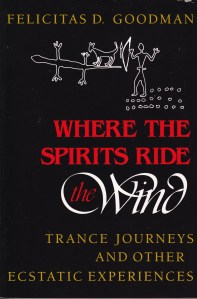
I first became aware of the work of Felicitas D. Goodman because of her classic text on spirit possession. Published by the reputable Indiana University Press, that book has become a standard for anthropological understanding of a strange phenomenon, which includes demonic possession. I found Where the Spirits Ride the Wind: Trance Journeys and Other Ecstatic Experiences in a used bookstore. Recognizing Goodman’s name, and always eager to learn about spirituality, I picked it up, It’s one of those books that makes you wonder. In an effort to experience trance states, Goodman began to experiment with various posture represented in the archaeological record. When she taught classes where students had no foreknowledge on the postures, she found they they reported similar visions during their trances while using the same posture. Matter, it seems, can effect mind.

I couldn’t help but wonder, as I read her account, what Indiana University Press must have thought about what they were publishing. This could be some serious woo, depending on how far you’re willing to go with Goodman. She was a doctorate-holding professor, so academic convention suggests she should be taken seriously. The BISAC classifications (those categories that often appear on the back cover of a book) tell the reader that this is Anthropology and Psychology of Religion. Neither field tends to give a whole lot of credence to the supernatural. At least not necessarily. And yet, there it is. Neither field really captures what Goodman describes in this book. Nobody really doubts that trances can happen; alternate states of consciousness are acknowledged phenomena. What we don’t have, however, is an explanation of what’s really going on.

A good deal of the this book consists of her students’ accounts of their visions. Although a native of Hungary, Goodman, through fieldwork and experience, became quite adept at Native American and other indigenous religious practices. The images that suggested the postures to her come from archaeological contexts around the world. This suggests that, according to Goodman’s worldview, these are some universal experiences. Attaining trance states, like meditation, takes practice. They can shift perceptions of reality. We tend not to hear too much about religion faculty who explore such things too openly. It’s a dangerous move in academia. Ironically, the institutions we build to understand our world tend to restrict themselves to the physical world or those fields that make ample lucre. I’m impressed that, even if by labeling it anthropology or psychology of religion, at least one university press took a chance at offering an exploration that might have some real world consequences.


Contracting Something

Book contracts make me happy. After slipping from higher education into the limbo of editing, it took a few years before realizing that not all books have to be academic monographs. For the past couple of years I’ve been silently writing a book intended for general readers. The subject will remain hidden for now, but a contract for the book has arrived and I’m happy. As my friend Marvin says, “for a man being published is about the closest you can come to giving birth.” There’s a bit of truth to that. Several months of thoughts growing in your head finally culminate in a full developed form, capable of surviving outside the confines of your protective mind.

The motivation for many academics to write is “publish or perish.” In my career track I both published and perished. The thing is, I write because I read. It seems unfair to read so much and not to share a bit of what I’ve learned. If you read this blog regularly you know that I have a restless intellect—the kind of thing that in the old days would’ve made you a professor. I no longer have access to university libraries with their arcane journals and massive collections, but reading on the bus is its own kind of research. (Anyone who’s tried to write notes on a bus, however, knows that the research is limited strictly to what can be remembered after a wearisome 90-minute-plus ride in stop-and-go traffic.) A few years back I decided to start writing up what I’d been observing. Slowly a book was formed. The process is not a swift one.

Many people question the ability of editors to write books. No, seriously. Agents are generally only interested in professors, celebrities, and journalists, not those who may have been one of the above once upon a time. That’s why this book contract feels like a small victory. Weathering the Psalms was written for other professors while I was still one myself. A lot has happened since then. I’ve read hundreds of books in the intervening years. Slow study that I am, it took some time before I realized I could begin to analyze all of this and write it in a way the average educated reader could find engaging. Agents declined the project, but now I’ve found a publisher who believes. When you work on your own, like many authors do, finding just one believer is sometimes all that it takes.


The Struggle for Relevance

Futility is a specialization of those of us who consider ourselves fans of Ecclesiastes. Thus it is that the blog of an editor gets so little attention among academics. Since you’ve been kind enough to drop in, I’m going to share some secrets with you. Make sure the door is closed. Ready? I want to talk about academic publishing. If you, like me, have written academic monographs, you’ve probably figured out that we aren’t famous yet. What’s going on here? What happened to the day when “I wrote a book” meant something? Like all organisms, academic publishing evolves. Many academics want to write for a wider audience, but sometimes miss the bigger picture. Here are some tips to help out:

If you want to write for non-academics get to know some. A good first step is ditching the jargon. “Prosopography” wasn’t on many people’s SAT vocabulary flash cards. Even if you know how to use a thesaurus to find an archaic synonym to use, don’t assume your reader will do the same. Try reading a novel once in a while. They can teach academics quite a bit about how to communicate. Learning to speak the vernacular is only part of the battle, though. The larger part is learning what is of interest outside the academy. Some things, such as Ecclesiastes, aren’t. Oh, I know, I know! Five years of your life spent on some obscure topic should be worth publication. It probably is. A handful of people will read it (print run numbers would only make you weep). If you want to reach a wider readership, you have to go where people actually live. What’s of interest to them? Hoi polloi. They won’t bite. To write for a wider readership you need to learn what people find interesting and what they simply don’t.

An editor can be your friend here. You see, editors are measured by how well their books sell. We can usually tell at a glance if a topic is in the “less than 200 copy” camp or not. I know that you were taught in your doctoral program to find some abstruse subject never before addressed and research it from every possible angle. Write up your results and publish. A far better way to write for a wider readership is to begin a conversation with your editor. Are you thinking of a book on a specific topic? An editor can tell you if it’s likely to work or not. The idea of writing the book your colleagues said would be hot and then finding a publisher seldom works to everyone’s satisfaction. It’s all about communication. And you, dear readers, now know something most professors don’t.


Bible Belts

The Bible’s been back in the news. Specifically the Bible and politics. Like twins separated at birth. Jeff Mateer, Trump’s nominee for a federal judgeship, has gone on record saying Satan’s plan is working. Perhaps even more stridently, Roy Moore down in the Sweet Home state has been quite vocal that the Christian God is the one who makes America’s laws. Standing on “biblical principles” that have nothing to do with the actual Bible, politicians have found a biblically illiterate population a field of white-headed grain ready for the reaping. As sure as the sparks fly upward. The response in the educated class is predictable. Cut any funding for departments studying religion. Haven’t you heard? It’s dead!

Having grown up in a conservative, religious family, and working my way through a doctorate in a closely related field, I’ve been watching in dismay as the past quarter-century has been marked by decreasing positions in religious studies. If you can pull your eyes from the headlines surely you’ll agree that religion is something we just can’t afford to study. Wasting resources, it is, since if you teach economics you have an actual shot at the White House. Yee-haw! Pull out your six-shooter and celebrate! And no, “yee-haw” is not etymologically related to the name of the deity of ancient Israel. It’s only a matter of time before discovery of who’s been uncovering whom’s nakedness becomes public. Then you just need to say the Bible says nothing about divorce. It’s okay, nobody will bother to look it up. Intellectuals will scratch their heads—why didn’t somebody tell us religion actually motivated people?

Universities (consider the name!) used to be places where the value of all subjects was acknowledged. Of course, where there’s knowledge there’s money to be made. Once you’ve gone to the dark side, there’s no coming back. Departments that don’t earn mammon must go the way of the mammoth. Times have become so hard it’a almost like schools want to open Religion Departments just so they have something to shut down. We’ve got to keep those fields that are actually important going. Never mind if your funding depends on a government increasingly elected on the basis of perceived religious faith. Since the Prosperity Gospel is now in vogue, economic departments are always a safe investment. Slap a copy of the Ten Commandments on the courthouse lawn and follow the crowds to DC. Good thing none of this matters, otherwise me might be in real trouble.


Voting Belief

No one knows the origins of religion. Before the advent of writing we can only guess, based on artifacts. Even in the era of scriveners, nobody jotted down the origin of belief until modern times, long, long after it began. Once writings about religious practice become reasonably clear, we find temples in the service of palaces, and vice-versa. Monarchs needed the validation of deities and priests required the support of the crown. Together they brought the two swords together and managed to keep the unruly masses in check. This isn’t cynical, not necessarily, since it reflects, the best we can reconstruct, how western organized religions began. Power was always part of the picture.

A recent Washington Post story, “The stark racial and religious divide between Democrats and Republicans, in one chart,” by Christopher Ingraham, shows the diametrically opposed pie-charts of self-identified white Christians (Republicans) versus non-white or non-Christian (Democrats) Americans. Such survey results tell us much about ourselves. We vote with our faith (or lack thereof) and not with our rationality. This has long been the piece of the political puzzle that Democrats have failed to comprehend. Not to take away from Barack Obama’s charisma, but people were afraid of Mormon Mitt Romney in 2012. Although conservative, white, and evangelical, Mormons have long been questioned as to their Christian identity by other evangelicals. It would seem, in the light of present circumstances, that understanding the “white Christian” mindset might be the only way out of the morass.

Typically self-defeating, academic institutions have shown little interest in understanding religion among hoi polloi. Long ago they bought into what Peter Berger admitted was his biggest blunder, the idea that religion was dying out. By the time he made that admission, academics had ceased to pay much attention to religion. It has, of course, come back as the ghost that haunts us. Or is it a zombie, once dead and now back to life? The fact is religion was never dying. It is as much of being a human as is driving a car or owning a cell phone. When times are uncertain, we turn to what is perceived as unchanging—religion. In truth, religion is constantly evolving to fit outlooks influenced by science, technology, and social progress. Worldviews change. Our culture is becoming more diverse. Republicans have a natural voting bloc that identifies itself by race and religion. Information about the former is readily available. You’ll need to look a bit harder to find quality information about the latter, no matter how important it may be.


The Rights and Privileges

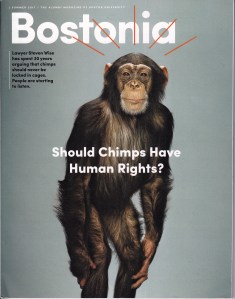
Bostonia is but one of several alumni magazines that makes its way to our humble apartment. Between my wife and I we have many colleges and universities begging us for money while offering us no jobs. Despite being a denied professor I have little time for magazines. I’ve always been a book man. If I’m going to put time into something I want an ISBN to claim at the end of the day. Still, the cover of the Bostonia asks a relevant question: “Should Chimps Have Human Rights?” I have long argued, based on books I’ve read and on personal experience, that animals are conscious beings, like we are. If consciousness evolved, it has to have its roots in other animals, otherwise scientists are positing “special creation,” call it what you will. If animals share consciousness, they should share rights.

People have used animals for as long as they could figure out how to do so. It may have been a two-way street at first, since we’re pretty good at protecting critters we find valuable and who doesn’t like a free lunch? They stick around us. The earliest domesticated animal seems to have been the wolf, which we made into a dog. Other common mammals joined the mule train after that. Humans: they treat you rough, but they’ll make getting food a snap. There’s a kind of consciousness involved already, don’t you think? If they can’t figure out that we’re not going to harm them (at least not yet) then they’re smart enough to keep their distance. Not all wolves became dogs.

Primates, however, are a special case. They sort of look like us. Chimpanzees, especially, act like us. They don’t get human rights because those are reserved for others of our own species. I mean, consider those in charge of the free world! They believe in the right to acquire as much of the world’s resources as they can for themselves. They guard the use of those resources so they can live in unutterable luxury and make everyone else pay through the nose for the very necessities of keeping alive. The masses pay taxes while those who have more than enough do not. We are a domesticated species, it seems to me. Don’t get me wrong—I do believe chimps should have human rights. Other animals too. We’re all connected. But the real question I have, looking at the headlines from Washington, DC, is turned the other way around: should humans have the rights of chimps? Don’t ask me; universities won’t hire my likes when others will bring them greater glory. They’ll gladly accept my money, however. It’s their right.


Average Reality

One of the stranger dynamics of higher education is its unquestioning acceptance of a one-size-fits-all methodology. Don’t get me wrong—the empirical method works. The only real problem with it is that not all phenomena in the universe cooperate with human observation. It’s something I call the problem of occasional phenomena. Perhaps because of the rancid taste left in scientific mouths by lingering creationism, anything that isn’t slow and regular enough to be directly or theoretically observed simply can’t fit in this old world. The weird, the anomalous, the strange—these open the door to possible spirits and spirits have no way of being measured. At least not yet. The most convenient way to deal with them is to call them superstition and end the discussion right there.

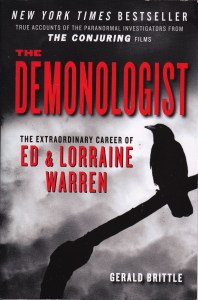
The larger problem is that people see things. Unless said people are scientists, they are considered amateur observers, liable to mistake what they see. The classic example of this is ghosts. From the beginning of recorded history people have claimed to see them, or hear things go bump in the night. Some of the first modern people to make a profession out of exploring such things were Ed and Lorraine Warren. Unfortunately, they didn’t write books about their experiences. Largely because of movies made about some of their high profile cases, there has been a resurgence of interest in the couple and the books originally published by other presses, such as Prentice Hall and St. Martin’s, have been reissued by Graymalkin Media. These are co-written tomes of uneven quality. They’re also like candy—once you start on them it’s hard to stop. Gerald Brittle’s The Demonologist is one such book. More than others in the collection that I’ve read, it concentrates on a single phenomenon that overlaps with the world of religion—demons. Unlike trained religion scholars, however, the Warrens aren’t shy about declaring what demons are (fallen angels) and how they differ from devils (it’s all about rank).

What makes these books so interesting is the dispassionate description of the cases the Warrens investigated. Unless they are pathological in their connection to telling untruths, there’s some very odd stuff that goes on out there. Although they declare once in a while that other religions and their practitioners can also deal with demons, there’s a simple kind of black-and-white view of morality that fits what you might have learned in Sunday School. One of the reasons for this, I suspect, is that most academics don’t take an academic interest in demons. Once they’re filed in the mythology folder there’s no reason to try to figure out what they might “really be.” The Warrens’ outlook, therefore, has become canonical among ghost hunters. They certainly have more credibility in that crowd than most Harvard Ph.D.s. It’s funny what can happen when you refuse to explore what the average person considers to be just as real as the physical world we all think we know so well.