Editing Sheep

Many academics I know dismiss editors as just another species of laity put on earth to serve the guild. There’s perhaps some truth to that. Without people to write books—and few beyond the professorate are granted the time and leisure to do so—we’d be without a job. One of the more hidden aspects of being an editor is, however, its prophylactic role. One thing that those of us who’ve written books know is that we get pretty close to our subject. We have to. Writing a book while viewing your topic from a distance is possible, but not desirable. Being too close to your subject, however, often leads to extreme myopia. Many are those who are quick to dismiss editorial suggestions wonder later why their books didn’t do better. Think about it. Editors, by definition, read all the latest stuff.

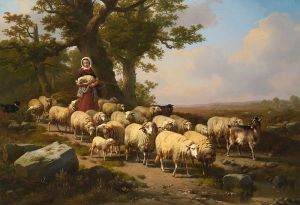
We’re kind of like shepherds, my fellow editors and me. We try to keep the ideas in order. We’re not the owners—the authors are—but without an able shepherd you soon find yourself lacking the sheep that make you wealthy. The benefit of an editor is having dispassionate eyes—often knowing eyes—viewing a nascent book without the love of a parent. Don’t get me wrong—we often have great fondness for those books we didn’t write. We can tell the author something s/he is too attached to the text to notice. We can help the writer avoid mistakes. Not that we’re perfect, but we are critical because we’re rooting for you. Facilitators.

It used to be common for editors to be authors. With the growing atomization of specialization, however, this is fairly rare these days. As a colleague of mine once put it, editors are more like deans than faculty. We look at book budgets and statistics. We face the harsh realities. And some of us were once faculty. I receive dismissive notes now and again, supposing that I’m an English major who made it good. Unlike many editors, however, I write. I’ve sat on both sides of this desk and when I offer advice it’s for your own good. Academics and publishers need each other. For one, without books there’s no promotion. Without books, for the other, there’s no paycheck. Like any shepherd, however, we know that the sheep are the important assets. We shepherd ideas into books. But you have to trust the shepherd to do the job.
Viewing Religion

Scholars employed by the academy sometimes fall under its privileged bubble. In that rarified space, the classics, the Bible, and even serious contemporary literature can be parsed and prodded until it’s no longer recognized and everyone thinks it’s normal. Out on the streets (for some of us taste the outer darkness) people have a difficult time with such minute attention to detail. People like movies. They’re visual, colorful, and they meet deep human needs. Scholars were slow to take cinema seriously, though. It was one of those passing things. Ephemeral. Shadows flickering on a screen. Never mind that the budget for a single Hollywood blockbuster could finance an entire humanities department for years. This is a strange dynamic when you stop to think about it.

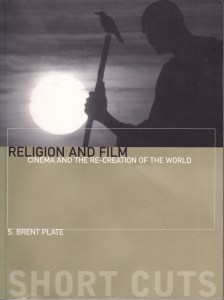
S. Brent Plate, in his book Religion and Film: Cinema and the Re-creation of the World, addresses in a very intelligent way, how film is like religion. Of course, religion is often on the university chopping block these days, so it is perhaps no surprise that among the first academics to pay serious attention to movies in their discipline were religion scholars. What is truly surprising is the depth of that connection between movies and belief. For such a brief book, Plate dives deep and quickly. In a society that seems to have outlived its need for structured religion, movies have managed to hold on through recessions and depressions and terrorist attacks. Indeed, they often provide meaning during those very times. They have a ritual form that meets the kinds of needs religion has traditionally filled. Movies are well worth the time we spend getting to know them.

Sometimes, under the barrage of rhetoric that says all answers are physical, we forget that humans are meaning-seeking creatures. If there’s no purpose to life, our wellbeing suffers. Nobody looking at modern civilization objectively would say that we’re an overwhelmingly happy bunch. One way to understand the popularity of movies is to see them as venues of finding meaning. For 90 minutes to 2 hours we’re shown some version of modern mythology (at least in some cases) that serves many of the same functions as a sermon or scripture. Although Plate hyphenates the word, it is worth pondering that this is for more than mere recreation. The Sabbath idea always involved more than just a day off work. Movies offer us a way toward meaning. So naturally, the academy tends to ignore them. There are, it seems, more important things to do.


Becoming

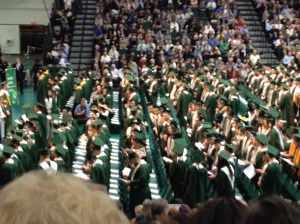
It’s pretty difficult to summarize the feelings when watching your own child graduate from college. Of course, she’s not a child any more, but that’s always the way you’ll think of her. Binghamton University, a “public ivy,” is a competitive school to attend. Hard to get in, and hard to get out. And you know that there were serious struggles to get to this point. Courses conceptually impossible for a humanities ex-professor to understand marked the trail to this point. The academic robes, the positive energy, and the overall sense of accomplishment make this one of those joyous occasions that mark the transition from being the instructed to becoming the instructors. It’s a time unlike any other.

Most of my collegiate thoughts, despite my three degrees in religious studies, have focused on science and engineering. It’s not that the basis of truth has shifted, but the practicalities of “finding a job” have to take precedence these days. The STEM universe may be the only real one, according to those smart enough to know such things. It’s difficult not to feel that studying religion was chasing a chimera, if not a little deluded. Tomorrow, though, the college of arts and sciences will send forth even more graduates into a world where employment itself may be a reverie. Still, I can’t help but think these engineers from the Watson School are just a little brighter than their more humanities-inclined classmates. Parenting is its own kind of bias.

Commencement is a singular moment. Parents sitting in the crowd want to attract their child’s attention for just a moment. Each one down there is a star. You want to be seen by them, recognized if only for a fleeting smile or subtle wave. They’ve accomplished something and everyone is here to cheer them on. Your meaning is tied up in being associated with that person that you’ve coached through so many aspects of life, and you hope you’ve done it well. They’re ready to leave academia behind and experience a bit of the wider world. It’s a cycle as old as this planet’s first molten rotations as it revolved around a distant star. And as those walking across the stage are growing in magnitude, those of us cheering them on try to recollect what it was like to have so much loving goodwill focused on us. It’s difficult to summarize these feelings, but I’m pretty sure I’d call them religious.


Trusting Truth

How do we know what’s true? For many the answer is what your experience reveals. If that experience involves being raised as a Bible-believer, that complicates things. A friend recently sent me a New York Times piece entitled “The Evangelical Roots of Our Post-Truth Society,” by Molly Worthen. For those of us raised in Fundamentalist conditions, this isn’t news. Then again, those raised Fundamentalist assume that everyone knows the truth but others have blatantly decided to reject it. It’s a strange idea, inerrancy. It’s clearly a form of idolatry and its roots can be traced if anyone wishes to take the time to do it. Inerrancy is the belief that the Bible is correct, tout court. It’s right about everything. If it contains one error, so the thinking goes, it topples like a house of cards. (Cards are sinful by the way, so get your hands off that deck!) If that’s your starting point, then the rest of the facts have to fall into place.

As much as I wish I could say that this simplistic outlook may be corrected by education, that’s not always the case. Many children of inerrantists are raised to question what they learn in school. Worse, many are home schooled so that they never have to be exposed to the sinful machinations of others until they try to enter the job market and are utterly perplexed by the fact that they don’t even speak a common language with the rest of society. Key code words don’t mean the same things outside that safe, withdrawn community where everyone knows the Bible and understands that to know it is to love it. Science doesn’t love the Bible, they’re taught. So science is wrong. It’s quite simple really. You already have all the information you need in one book. If science disagrees, then, well, you already have all the information you need.

There’s an internal logic to all of this, and dismissing the heartfelt beliefs of Fundamentalists only gets their backs up. It’s not about logic, but the emotion of belief. Some neuroscientists have been suggesting that we reason not only by logic but also with emotion. That complicates things, for sure, but it also explains a lot. For example, in a world where religion drives nearly all the major issues facing society, logic would dictate that universities would build up religion departments to try to understand this very real danger. Instead we find the exact opposite. Withdrawing into your own little world occurs on both ends of the spectrum. Dr. Worthen is to be applauded for bringing this out into the light. If society wants to benefit from this knowledge, it will need to stop and think about what it really means to be human. Fundamentalists, for all their foibles, illustrate that nicely.


Publisher’s Breakfast

I recently had the opportunity to discuss publishing to a room full of academics. (Ooo, I can feel the envy rising already!) Although I discuss books quite frequently on this blog, I generally don’t discuss publishing much. One of the reasons is that publishing isn’t easy to tie into religion sometimes. Another—and this may be the bigger factor—is that publishing is work. This blog, which is technically a form of publishing, is more for letting my mind wander outside the paddock after being penned in at work for too much of my adult life. Still, I’m glad to give publishing advice for those who want it.

The focus of these talks (of which I’ve given precisely two) is how to get published. My main approach to this question is to point out that higher education and publishing are diverging rapidly. The reasons for this are complex, but simply put, publishers need to make money. Having been on the receiving end of tuition statements for a good deal of my life, I have no doubt that institutions make ready money. They may have trouble meeting the costs of all those administrators for whom they keep creating positions, like any good business, so each semester the bill creeps up a bit until suddenly you realize your bank account’s empty and you’d better get to commissioning some more academic books. After all, this is all about money, is it not?

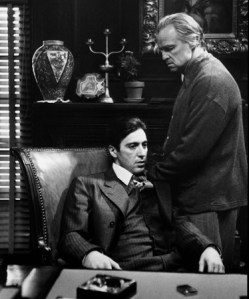
Like many in higher education, I courted academia as a hopeless romantic. I believed that love of subject and ardent devotion with ample proofs of said love would woo the academy into a permanent relationship. I’ve always been an idealist. Now I’m on the side of the desk where colleagues approach me to ask favors. It’s kind of like The Godfather, really. Only those who kiss Don Corleone’s ring tend to do so knowing that favors require some kind of reciprocity. The academy may not welcome you but would you mind helping us out now that you’re in a position to do so? No fear of horse heads here. Perhaps by now you understand why I don’t write much about publishing on this humble little blog. The focus of The Godfather, after all, is really young Michael Corleone and his devolution from an upstanding citizen (shall we say “academic”?) to a mafia crime boss. I’ll leave the other side of the equation blank. Trade secrets, after all, are worth money.


Palms and Thorns

“Holy Week” affects only some. That thought may be disturbing to those who still think of religions as a one-size-fits-all phenomenon. So, although today is Palm Sunday for many, for others it’s just Sunday. Not even all Christians recognize the same Palm Sunday. The question that interests me, though, is the one regarding which religion is the right one. I personally suspect this is the behind the rise of the Nones, but I’m getting ahead of my story. How did we come to this impasse? How did we come to believe that only one winner takes it all, spiritually speaking? The answer may lie in evolution.

I don’t mean biological evolution. Borrowing a principal for how this factual occurrence works, however, may help to understand the diversity of religions. For species to differentiate, they must be isolated from each other somehow. Groups that are available for interbreeding will do precisely that. When populations are separated, subtle changes add up over the passage of time so that when they come together down the road mating’s simply an impossibility. Religions behave the same way. The difference, apart from biology, is that many religions allow multiple gods. They aren’t so different from each other. In fact, we’re not even sure if gods are sufficient to define “religion.” People from diverse cultures in ancient times, the evidence seems to indicate, tried to match up their gods. Your Zeus is our Odin kind of thing. Monotheism—the main form of religion that has a problem with evolution—is the ultimate exceptionalist belief system. Our one deity is the only deity and everybody else is wrong. When populations come together we can’t even agree that the God who’s historically the same is in reality the same. Ours is slightly better.

Amid all the chaos created by religions, academics have decided they’re a phenomenon not worth studying. Academics often lose sight of the larger picture. What happens outside the classroom or laboratory is real life too. And outside the walls of the ivory tower the faithful are gathering. Some today are doing it with palm branches in hand. Others are looking on, bemused. The important thing is we don’t talk about it because talking might lead to understanding. And understanding might make us concede that others have some good points to make with their religion as well. How can you feel special in the eyes of your own god when other people suggest other truths might also apply? No wonder someone will end up crucified by the end of the week.


Ready, Ames,

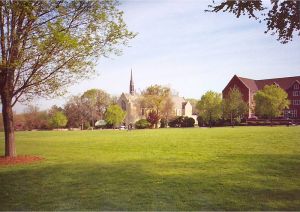
Ames, Iowa is famous for many things. Not only is it where my wife grew up and where we were married, but it’s also the home city of Howard Bannister from What’s Up Doc? and it served as the staging ground for the crew of Twister, which includes some scenes shot in the area. Probably its greatest claim to fame, apart from the sadly defunct Do-Biz Cookies, is being the location of Iowa State University. Often I lingered near campus during family visits, wistfully hoping that someday someone in the religion department would welcome me among the faculty. My academic curse, however, is a powerful one. And that brings me (finally!) to the topic of this post—the haunted history of ISU.

Even the first president had a biblical name.

The website onlyinyourstate (we’re evolving out of the need for a spacebar) has a whimsical story about the hauntings on ISU’s main campus. The story isn’t scary at all, but it does raise that interesting specter of the ghosts of higher education. I’ve read a few of Elizabeth Tucker’s books about haunted campuses (Tucker teaches at another family school, Binghamton University) and, having spent a good deal of my life in academia, I’ve heard many tales first-hand. The very institutions that repeatedly bash our heads with facts can’t escape their own spooky pasts. Even conservative Christian Grove City College had its share of hauntings that we all knew about. You know, the Ketler ghost, and the spirit of the basketball player who broke through a glass door and bled to death right there on campus? Every campus I’ve known has had its baleful wraiths.

Sometimes I wonder if such stories aren’t a natural reaction to having the wonder excised from the world as we mature. Most of us can make it through high school somehow believing in the real possibilities that the world might offer, only to graduate from college to a 9-to-5 existence robbed of any supernatural splendor at all. Is it any wonder coeds see ghosts? Just the other day I read that a tree trimmer with a high school education in Iowa makes a much higher salary than I do with a Ph.D. working in New York City. Maybe that’s why I enjoy the movie Ghostbusters so much. When the reality of higher education and its politics and cruelty become clear escapism can be your best friend. And if you find yourself in Ames, you might want to avoid Friley, just in case.


Alma Mater Matter

I was a teen-age religion major. Okay, that’s a bit dramatic, but I did start college at 19 and, being a first generation matriculant, had no idea about majors. No idea about colleges either. The school you choose stays with you for your life—especially if you decide to go into academia. A couple of recent events brought this home to me again. Grove City College is stridently conservative. Since I was raised Republican, it felt like a good fit at the time. It was cheap and close to home, and since my parental contribution was a total sum of zero, both of these factors counted heavily. Overlooked by many a hiring committee, it was also academically rigorous at the time. For better or worse, it’s now on my permanent record. Enough ancient history.

Recently a colleague asked me about an author, noting his undergraduate degree was from a school not unlike Grove City. I saw myself from the outside (yet again). Conservatism can be a lifestyle choice. My fellow religion-major grovers mostly went on to Gordon-Conwell Theological Seminary or other bastions of further conservative thought. Their minds were already made up. In their early twenties, no less. I headed to Boston University, at the time the most liberal of the United Methodist seminaries, by reputation. But still my record says “Grove City.” My academic writings should leave no doubt as to my scholarly outlook (most of these papers are available on Academia.edu), but there is always a shadow of suspicion over a former grover. You can’t change your alma mater, no matter what the next decision you make says about you.

Then I came across a recent writing sample from one of my Grove City professors who’s still on the faculty. This piece showed that as this faculty member was in the early eighties, so he is still today. Biblical literalism all the way down. With over three-and-a-half decades to read, that’s incredible to me. I guess I just don’t share the kind of arrogance that declares you got it right the first time and that everything you read confirms a literal Adam and Eve. And a snake and a tree. What am I to think when I see a conservative undergraduate school on someone’s academic record? I would hope that I would know to look at the next step to see what that reveals. I am a grover, but a bad grover, I guess. You have to know how to read a permanent record.

Photo credit: The enlightenment at English Wikipedia

Photo credit: The enlightenment at English Wikipedia


In Poor Taste

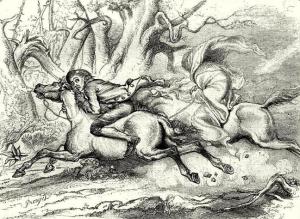
I remember seeing a television commercial once (not during the Super Bowl) where an older guy, a lawyer, complained at the camera, “It used to be that lawyers didn’t advertise.” He went on to say that he felt uncomfortable promoting himself since it was in poor taste, but since the legal profession had swung that way he was entering the game. I know how that guy felt. I grew up with the firm notion that self-promotion was in bad taste. If my career has taught me anything, it’s that unless you’re born well connected, if you don’t promote yourself nobody else will. Still, it rankles. With that hearty introduction, I would, in poor taste, point out that my latest article has been published. Those of you who keep an eye on this blog will know that I gave a paper about the Bible in Sleepy Hollow to a learned society a couple years back. That paper is now available in the Journal of Religion and Popular Culture.

ichabods_chase_crop

Doing research is difficult when you don’t have institutional support to carry it out, but doing such things as an independent scholar can be kind of liberating. I used to research, write, and get published an article a year, back in my teaching days. Nashotah House didn’t have the greatest library, but they did have interlibrary loan and, towards the end of my time there, internet access. More than that, life wasn’t measured in increments of nine-to-five. Living on campus, commuting could be measured in seconds rather than hours. Although publication didn’t bear the weight there that often pressures academics elsewhere, like that lawyer whose name I can’t remember, I wanted to be in the game. I guess I still do.

In these days of uneducated government, if you don’t do it yourself nobody’s going to do it for you. It’s what I once called “the educational imperative.” We are duty-bound, as conscious beings, to move knowledge forward. How many apocalyptic scenarios are there where, when the powers that be devolve into inanity, the monks in their cloisters have to keep knowledge alive? (The question’s rhetorical.) I’m reminded of Station Eleven by Emily St. John Mandel since there women do a good bit of keeping the culture alive when society collapses. Or, to put it another way, like Sleepy Hollow. When the forces of evil break into the world, it’s an African American woman who saves it. If your school has access to JSTOR, you’ll be able to find out more in my paper.


I’m Saying Nothing

It used to be called argumentum e silentio, the argument from silence.  It didn’t take very long into my post-graduate reading to learn that arguments from silence were very rarely admitted in the academy as any kind of evidence at all.  In fact, argumenta e silentio are generally considered a logical fallacy.  The idea is fairly simple: an argument from silence is when a source (often an ancient one) doesn’t mention something.  That lack of mention is sometimes used to argue for the absence of the thing not mentioned.  For example, some first century writers in the region of Roman Palestine did not mention Jesus of Nazareth.  This has led some to suggest that Jesus never existed.  The evidence is an absence of evidence on the part of certain important historical figures.  There are obviously lots of problems with this.  I’m a modern person and there are plenty of people I never write about.  It doesn’t mean that I don’t know who they are (although in my case, it might!).
 
Why am I concerned about arguments from silence?  Lately I’ve noticed quite a few scholarly tomes coming out on the topic of silence.  I’m not referring to Susan Cain’s excellent Quiet, but to scholarly monographs that explore the silence in ancient texts about certain subjects.  In my more curmudgeonly moments, I feel that perhaps when we have nothing left to explore but what a text doesn’t say maybe we’ve explored that text enough.  Younger scholars, casting about for something new to say about the Bible, look to what ancient sources don’t say to give them a research topic.  Back in my own academic days you’d receive a stout scholarly rap upon the pate for even including an argument from silence in your thesis.  Now you can write entire books about what someone didn’t say.  What’s more, you’ll likely find a publisher.
 
I’m at times a bit fearful for the future.  Although my academic work approached the Bible critically it wasn’t because I didn’t like or didn’t respect the Bible.  Hey, it’s far more famous than I’ll ever be, and in fact, more people have heard of it than have even heard of Trump with his endless tweets. No, the Bible is an endlessly fascinating book.  It’s just that if you can’t find something to say about it, why write about what ancients didn’t say?  Maybe it’s time to move on to a sacred text that hasn’t been probed for a couple of millennia.  I have no vested personal interest in this, having been excluded from the academy by biblical literalists and having had the rest assent to that decision by silence.  Ah, but there’s the rub.  That phrase, by the way, doesn’t occur in the Bible.  I wonder if that’s significant.

dscn4370


Hopeful Horror

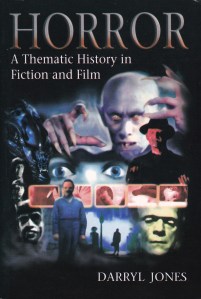
joneshorrorI don’t make New Year’s resolutions. To my way of thinking, if I’m aware I’m doing something wrong, I try to change it at that point, rather than waiting. Needless to say, then, I’m up to my old habits of reading about horror movies. Actually, Darryl Jones’ Horror: A Thematic History in Fiction and Film goes a bit broader than just the cinema. As the subtitle indicates, this charming book also addresses narrative fiction as well and the result is quite engaging. Divided thematically, Jones considers the various types of horror without delving into pretentious theorists to give him academic credibility. Here is a true fan who’s capable to sharing the excitement of the genre. Along the way, accompanying the usual observation that horror and religion share considerable conceptual space, he makes the point that in movies horror is one genre that makes use of academics as characters of authority. Sure, there are others, but in this realm to be educated is a benefit, whether the plan is to take over the world or to stop some evil force from doing the same.

I’ve been watching movies that can be broadly classified as horror since I was young. And I had admired—emulated to some extent—the professors and scientists I saw in those presentations. When a monster was on the loose, you went to find an expert to learn what to do. At the risk of contradicting myself, theorists have been suggesting that one of the problems with post-truth is the death of expertise. Anyone can be an expert these days. The question, “Why should I listen to you?” is on every self-appointed smarty’s lips. Earning a doctorate, the horror world tells us, gives you access to some kinds of knowledge that others don’t have. Problem is, zombies don’t respect such learning. They only want brains to consume.

It never seemed to me that watching horror was a means of learning. As a kid escapism is part of everyday life—taking things seriously is for adults. Growing up, however, I kept my love of scary movies in reserve. Little did I realize that it was a form of training. Now university-affiliated academics are finally able to begin admitting that they find monsters compelling. More than that, they actually learn something from them. Although not a resolution, I see myself reading further books about horror movies this year. It may be a naive hope, but it would be wonderful if they were all as insightful as this one has been.


Solstice Blues

The relief is so real that you can feel it with your fingers. Or brushing your cheek. The feeling of being done with another semester, and knowing you’ve got some time for recovery after the intensity of going flat-out for months at a time. I miss that feeling. As a guy who has often been accused of being “too intense” I tend to run pretty near the red line all the time. Pit stops are few and very far between. Once this vehicle’s in drive, there’s no stopping until the destination is reached. What do you do when there’s no clear destination? That’s what working for mere money is like. How do you know when you have enough? Just ask Mr. Trump. Too much is always too little. That’s the kind of world we live in.

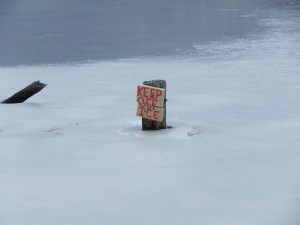
Higher education, it used to be, was a place for people who believed in higher values than mere lucre. There was a time, historically, when we took transcendence seriously. The price (if you’ll pardon the analogy) that we’ve paid for letting transcendence go will become apparent. Those who believe only in what they see miss most of reality that swirls by them like a river under the ice. Yes, it still flows. Just ask the fish. There’s a wisdom outside our paltry economic efforts, if we’d only just get out to inquire of it.

Work is built around the foolish concept that you can never have enough. I have to think that our fear of a year of drought has deeply impressed itself on our psyche. Back in biblical times and up until just a couple of centuries ago people considered work to be farm work. Growing your own food. Building your own house. Knowing what to do in an emergency. If nature didn’t cooperate with that scheme what choice had you? Now, however, we labor for a concept as abstract as transcendence. When’s the last time you were paid with actual cash? What wouldn’t you pay for a little more time off? Time to stay in your pajamas all day and ponder what’s really real? Perhaps sleep until you’re not tired rather than awaking at the sound of a factory bell? The sun hasn’t risen by the time I reach my windowless office. When I step out again it’s already set. The solstice reminds me of the semester break that no longer exists. I have to believe, however, that under the ice the river’s still flowing.

dscn5944


Identity Crisis

It’s starting to feel like Groundhog Day. The movie, I mean. As a child I was taught never to talk to strangers, but that’s a little hard to maintain in New York City. You’re never really alone there. Standing in line for the bus, I read. The Port Authority Bus Terminal is a crowded place around rush hour and I try to spin my literary cocoon so that I can get some reading done and so that I can have a little alone time. Introverts are like that. When the guy standing in front of me is confused, however, I like to help. There are three different bus lines that get mixed at my gate, and since I do this nearly every day I usually have a pretty good idea where to stand. I pointed this young fellow in the right direction. “Thanks,” he said. After a pause he asked, “are you a teacher?” I get this a lot, actually. By everyone but deans and search committees.

The writing on the wall.

The writing on the wall.

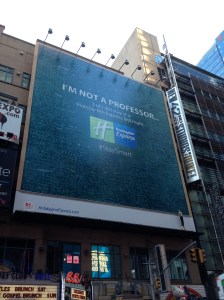
I was out for a walk in a city I’d only been to once before. Some guys were setting up for an outdoor function (the city was in the south). I was actually using my phone for geocaching, so I wasn’t paying too much attention to what was going on around me. One of the guys stopped me and said, “Excuse me—are you a professor?” Some might accuse me of cultivating the look—glasses, beard, slightly puzzled expression most of the time—but the reality is the look is simply who I am. There are those who are professors because they want to be. There are those of us who should be because we can’t help it. I read as if books were food. When somebody asks what the weather’s like, I’m wondering if this world is reality at all. Thing is, academics too are busy finding jobs for their friends to care.

“I’m sorry to disturb you,” he went on. “I mean, I’m a complete stranger.” Actually he’s not. He’s a student. I don’t know him. I’ve never had him in class, but he needed some information I had readily available. I shared it with him. No, the fact is I’m not a professor. Professors are paid (much better than editors) for dispensing what I’m glad to give away for free. A teacher, you see, teaches. The best teachers I ever had were those who continued the lifestyle outside the classroom. They were never arrogant or privileged. They simply shared. Every day, in this situation, begins to look like the one before.


Radio Nowhere

Those of us who somehow managed to be educated without the use of computers, at least nothing more advanced than a TI-30 calculator, fumble our way through the world-wide web. I’ve got this blog, a Twitter and a Facebook account, and I’m on Google + and Medium, and I really don’t know how any of these things work. One of my motivations for starting this blog was to continue the tradition of speaking to audiences that I used to have in my lectures while I taught. I was told that such a format was known as a podcast and I found a host site where I could leave my recordings for free. I could then make a link and bring them onto the podcast page of this blog. How any of that works, I have no idea.

img_2855

Recently a few would-be listeners have asked what has happened to the podcasts. Since I don’t really know where they were in the first place, I’m not sure how to send a map to them now. One of my readers, however, has kindly set up a new webpage where all 23 podcasts are available. You can find it by clicking on this link. My thanks to Ahmed Fasih for setting this up. The podcasts cover various aspects of ancient religion. Even now, every great once in a while, a world-recognized name in academia will ask me about some of these topics. When you’re an academic you have the opportunity to spend vast amounts of time focusing on a single subject. The only subject you have that privilege with outside academia is money. I do hope my friends in the academy realize just how lucky they are.

In any case, the podcasts are back. Maybe now that they’re not invisible any more, and since in coming days it may be important to remember when things were better, I may find time to add to them. Blogs—at least those that are regularly read—are locations for discussion. I’m always glad to answer questions that are posted here. During the work week my time is constrained, so you might need to wait for a weekend, but I will respond. I know religion is passé. I know people have better things to do with their time. I also know that for the vast majority of humankind religion remains a vital and integral part of their lives. Exploring it seems to make sense to me. For those who’d rather listen than read, the podcasts are once more available.


Paying off College

img_2985
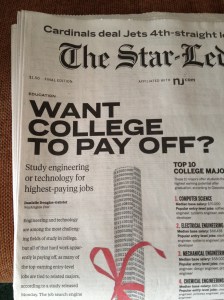
“Want College to Pay off?” the headline asks. It depresses me. I’m an unapologetic idealist. Cost-benefit analysis has its place, but that’s not all there is to education. Or better yet, cost-benefit analysis isn’t just about money. The article has suggestions for finding good paying jobs, which is what higher education is all about these days. Getting an education to increase knowledge and to benefit society in that way has become the mark of true naivety. We tell our kids not to study the arts, humanities, or literature since there are no jobs in these fields. We want them to be able to survive in a culture that has cool devices but which has lost its soul. Pretty strange for an institution (or “industry”) that began primarily to study theology.

The earliest universities focused on the then-related fields of law and theology. Since people took religion seriously, this was not the mere diversion that it is today. There are those counter-cultural warriors who study theology to take parishes to combat their increasing irrelevance, but really, the study of law and theology parted ways long ago. Neither one guarantees the return on investment that they used to. Society’s interests are in racing ahead with technology—discovering even faster ways to text while driving, or better ways to ignore those walking down the street with you. Or making money so you can build large towers in major cities and name them after yourself. We call that success. Thinking deeply about an issue, looking at it from multiple angles, and critically assessing it, these are “luxuries” that aren’t “worth” studying. College must, as the headlines say, pay off.

The rapidity with which this has transpired is truly amazing. We allow electronics to drive our culture. Who has time to keep up with all the posts, tweets, and grams that populate every second of every hour? We crowd-sourced knowledge into some great wikipedia of human experience that substitutes for taking time to look closely and think through the implications. It’s not that I despise technology—I use it quite happily daily—it’s just that I think there’s something more. I studied ancient religions and I see many of those archaic patterns beginning to repeat themselves in electronic format. It’s as if by replacing theology with technology we’ve lost sight of just a piece of what kept progress moving forward. Maybe I need to go back to college. I’m just not sure of the cost-benefit analysis.