Childhood History

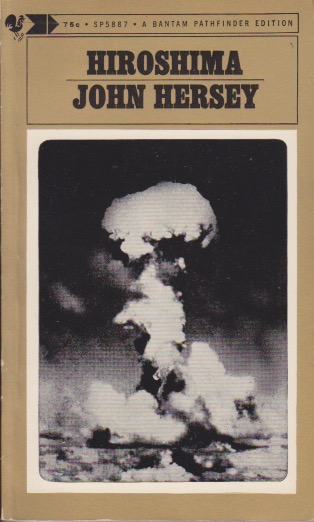
It looked just like I remembered it.  Having recently read the account of a Hiroshima bomb survivor, I had a hankering to read it.  John Hersey’s Hiroshima was my brother’s book, growing up.  He read it and told me about it, but I’m not fond of war stories or accounts of human suffering.  Still, having read a contemporary account at work I realized how little I knew about what had happened to the survivors.  So when I saw this little book at a local AAUW book sale, I picked it up.  Even after all these years it’s still a page-turner.  In my mind, ever hoping for merciful resolutions, the atomic bomb had killed just about everybody instantly.  A lifelong pacifist, I believe war morally unjustifiable (prisons should be for autocrats, not for minor offenses).  Those who start wars, such as Vladimir Putin, should be required to read this book.

I wasn’t really quite sure of what to expect.  I’d heard that the account involved the interwoven stories of six survivors.  It wasn’t quite as complete as I supposed it would be.  Of course, it was published in 1946, after appearing as a New Yorker article.  As I came to the end, I wondered what had happened to these people.  None of the six, a year later, had any semblance of a normal life, and scientists even then didn’t understand the consequences of what might happen to those the bomb didn’t directly kill.  I guess, in my mind, the city had become an irradiated wasteland.  I didn’t realize it had been rebuilt and that over a million people now call it home.  The was a blank in my mind after the dropping of the bomb.  Hersey’s book has started to fill in that blank.

My mind tends to trace things to their origins.  I’ve always thought that way.  Those who enter into politics ought to be required to pass a test on corruption.  They should be required to study diplomacy.  They should have to read books like Hiroshima to see what the consequences of their selfish acts can do.  Considering the real life horror of Hiroshima and Nagasaki, it is important to me to see that the cities are rebuilt.  It’s like looking up the bio of an actor who dies in a movie, just to make sure s/he is really okay.  Why is it so difficult to treat other human beings as human beings?  Why do we still allow war mongers to become national leaders?  Have we learned nothing since 1945?

Near Earth Objects

Even before the Chelyabinsk meteor, Time magazine had committed to the printers with a story on asteroid 2012 DA14. From our terribly parochial viewpoint, such cosmic invaders are in our airspace (or at least in our satellite zone), as if we owned the very heavens above us. They are somehow an affront to our religious sensibilities. Many religions revolve around a celestial orientation. We all know that God is “up there” and the Devil is “down there.” What we’re discovering “up there,” however, is scarier than the Devil for many people. Space rocks are just part of the debris from the messy business of universe creating. Although space may be mostly empty (but dark matter has us reevaluating even that), it is far from tidy. Rocks rain down on us every day, and our user-friendly atmosphere that we’ve polluted so badly still begrudgingly incinerates those that enter at the wrong angle, brightening many a night with spectacular meteors. I’ve even seen some bright ones while driving in traffic in New Jersey. Wondrous indeed.

adoration-of-the-magi-1306

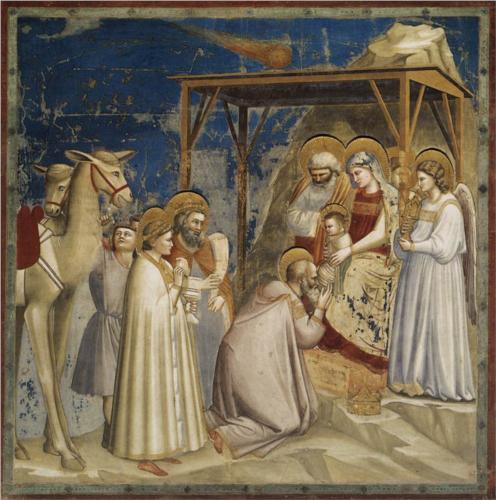
Back in seventh grade I did a science report on comets. This was a fascination that led me to take astronomy in my Sputnik-era high school—complete with planetarium—and in my older, more conservative college—sans planetarium. Comets were, until fairly recent times, religious harbingers. The Time story even has a detail of Giotto’s Adoration of the Magi from the early fourteenth century, complete with Halley’s Comet hovering overhead as the ersatz Star of Bethlehem. In a pre-Copernican universe signs in the sky had to be divine. There was no other logical way to explain them. Of course, in science class I stuck to the facts. As a religious kid, however, I knew there was something more to it.

Our skies are not our own. The universe isn’t here for us. These scientific revelations are frightening on a religious scale. We haven’t quite gotten to the point where we’re ready to let go of the Heaven above that no telescope can see. We don’t even have any way to spot hunks of rock the size of Chelyabinsk’s unbidden visitor with any kind of accuracy. We don’t even know how many there are. Before the second Russian explosion, Time prophetically noted that about a million stones of a hundred feet or more are near our planet and that one 150-footer could be 180 times more powerful than the bomb dropped on Hiroshima. Our recent brush with God’s dropped stone was only about 30 times the size of the terrors unleashed on Japan. According to ABC a Father Dimitri of Chelyabinsk said, “This event happened the day of the big Orthodox holiday that means meeting with God and this has to make people think.” I know I’m thinking. I sure hope his aim is good.


Darwin’s Descendents

The plague that goes by the name of Creationism has been attempting to spread its reach to the shores of Britain. Proponents of a biblical literalism, whether overt or covert, have championed the idea that the world is terribly young—a mere cosmic toddler, in fact—compared to the vast geological ages of actual fact. When I unfolded my first ten-pound note and found Charles Darwin on the back, I smiled. England may claim a lion’s share of the heritage of one of the great unifying theories of science. In my brief jaunts between bouts of work I came across the tombstone of Herbert Spencer, the man who coined the phrase “survival of the fittest.” On a visit to Kew Gardens I strolled through the Evolution House. When I paid for my lunch, Darwin passed hands as the common currency of the realm.

Ten pound note

A school of thinking exists among many religious believers that insists that if science makes its claims justly then God cannot condemn them. Evolution runs as close to fact as does atomic theory. Those who doubt the latter should visit Hiroshima. Or Three Mile Island. Our literalist companions certainly don’t doubt nukes, but then, the Bible is mum on the subject of what things are really made of. Well, almost. According to Genesis 1, everything is made of chaos and divine words. The Bible doesn’t describe the origin of chaos—it is the natural state of things. God’s word, when it generates uranium, can be very deadly indeed.

Evolution House

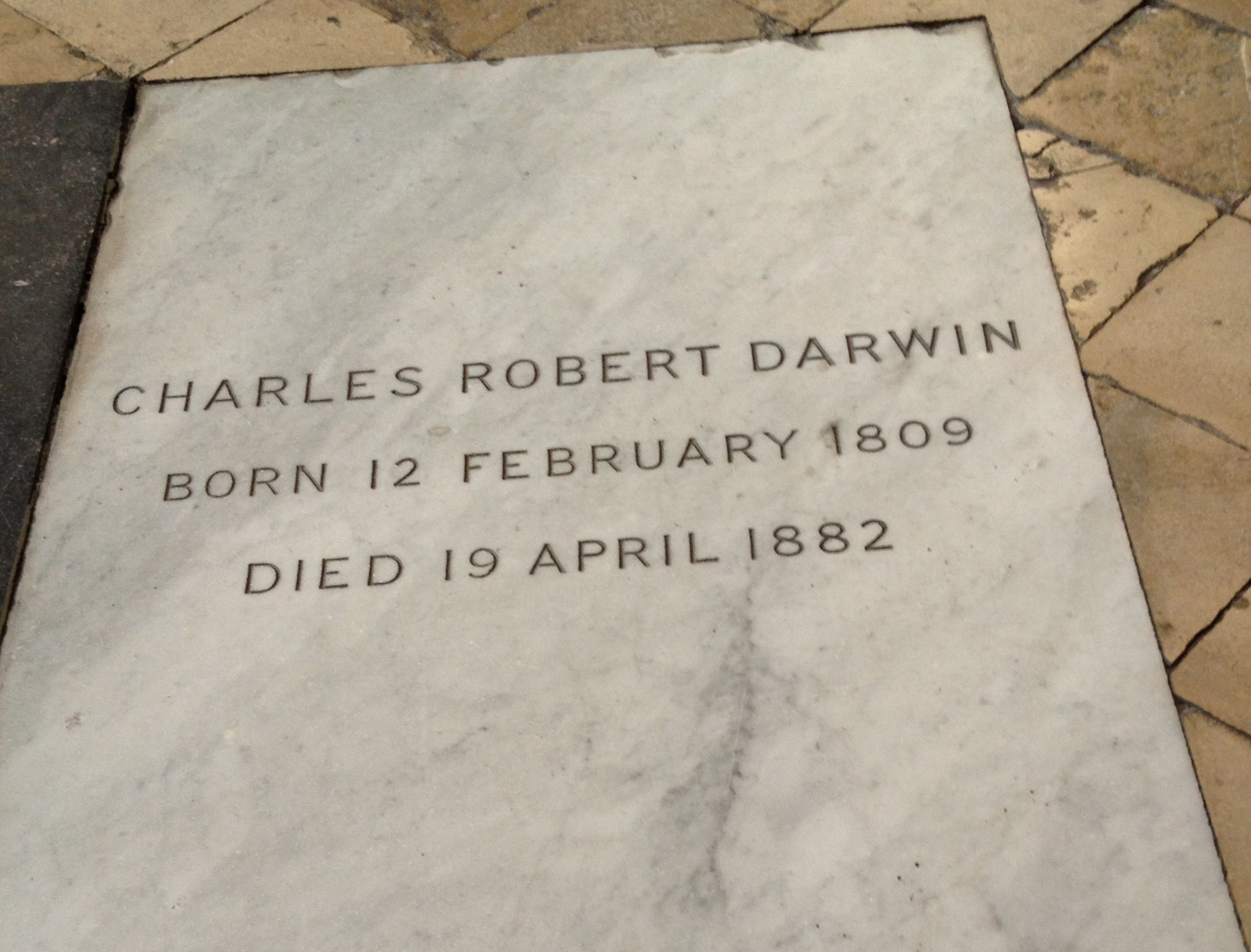
Creationists selectively choose which science to believe and which to reject. Fundamentalism can trace its origins to Britain, but the culture rather quickly outgrew these childish fantasies. In America literalism sank deep roots, roots deep enough to withstand the hurricanes of reason that would otherwise clear the air. Can an American imagine Darwin sharing the money which reads “in God we trust”? And yet, Darwin lies scarcely two meters from Isaac Newton in England’s holiest shrine of Westminster Abbey. Science and religion have here embraced one another. Perhaps when we put all the monkey business aside, we will come to realize that we may still have a thing or two to learn from the nation of our founders. Literally.

Darwin at rest