Big Bites

Although Jaws takes place on or near the fourth of July, it’s not holiday horror.  Holiday horror draws its source of fear from the day, and although Mayor Vaughn—like many politicians—insists holiday income is more important than a few lives lost, the fear derives from the shark.  I can’t remember when I first saw Jaws.  It couldn’t have been during its initial theatrical release (I was too young), I do know that I read the book first.  I wasn’t expecting Hooper (then my favorite character) to survive.  I was also surprised when I heard people starting to refer to Jaws as horror.  When I first saw it, whenever that was, I wouldn’t have called it horror—it’s just a movie about a shark.  Since thriller and horror bleed into each other I’m more open to the designation now.  Besides, animal attack horror is its own well-established category these days.  Jaws, half-a-century old this year, is experiencing a comeback but the shark never left.
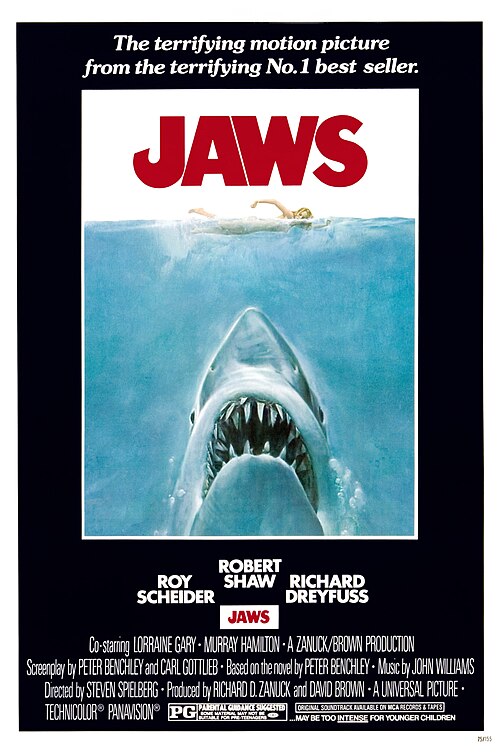
JAWS, 1975

My wife surprised me by suggesting we watch it last weekend.  We’d seen it together on television many years ago.  A number of analyses have been appearing in the media, highlighting the importance of the movie, and I noticed a few things watching it again.  Probably the most obvious shift, for me, was finding Quint the most engaging character.  I don’t know how many times I’ve read Melville’s Moby-Dick, but it’s been at least two times since seeing Jaws the last time.  The connection was much clearer with this viewing.  Quint is after sharks because of their attacks on crewmen of USS Indianapolis in World War II.  Quint was a survivor but his life’s mission is revenge on sharks.  So much so that he smashes the radio to prevent Brody from radioing in an SOS.

So here was a confluence.  I watch horror movies.  My favorite novel is Moby-DickJaws falls somewhere between the two.  The mainstream success of the latter may have been an early contributing factor to the grudging admission that horror can be good cinema.  Just in the past two or three years standard media outlets have been valorizing some horror and in this summer’s movie season, eyes have turned back to Amity and its local Captain Ahab and great white.  The great white shark, mainly feared because of this movie, is considered a vulnerable species.  As with Moby Dick, I felt sorry for the animal, watching the movie.  Both seem to have revenge on their minds as well, whether it’s a holiday or not.

Shifting Gears

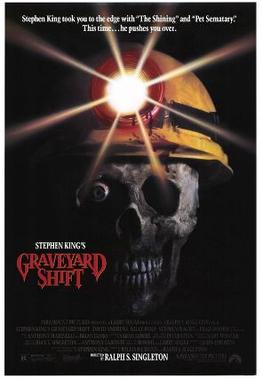
The question’s very basic: do you pay with cash, or by watching commercials.  When it’s the same three commercials the whole way through—for products you’d never buy—just paying the cash may seem the better option.  But it’s too late for that.  It’s the Graveyard Shift.  There’s no doubt  that Stephen King is responsible for the ideas for more horror movies than probably any other single individual.  I’d read his story, “Graveyard Shift,” many years ago.  I was warned, though, that this was one of the least favorite of his adaptations, and that’s a pretty low bar.  Still, it was just a matter of sitting through the same commercials over and over.  And one of them was more entertaining than the movie.  Of course, I don’t really watch for entertainment.  This is a learning opportunity.

Let’s start with the basics: You need at least one sympathetic character.  Okay, you kinda like Jane, because she shows basic humanitarian traits.  And Carmichael.  Then you want a plot that makes some sense—what is Warwick’s motivation?  The writing is particularly bad.  If there’d been a bit more intentional camp, this might’ve made a reasonable horror comedy.  I mean, you’ve already got the empty aluminum cans being fired by slingshot.  As it is, it’s played straight with an evil foreman, rats everywhere, and a giant bat in the basement.  By the end you’re kind of rooting for the bat.  And whose idea was it to use voiceovers of the sub-par dialogue over the closing credits?  Is this so bad that it’s good?  I’m having trouble deciding.

Although set around the fourth of July I wouldn’t call this holiday horror.  Nevertheless, there are some moments of religious imagery that pop out.  The graveyard sinking in the river has a listing statue of Jesus near the start of the film.  And the exterminator—the only real camp in the flick—narrates how in Vietnam they pinned victims down, like Jesus, to feed them to the rats.  The final couple of minutes—well earned, I assure you—have Hall fighting the wicked foreman with the jawbone of an animal (one has to assume an ass), inexplicably among human bones (some still in their coffins).  And his slingshot ultimately killing the giant (bat).  The references are to Samson and David, respectively.  Perhaps this movie’s an indictment of capitalism, since the basement cleanup is on Independence Day.  Or maybe it’s just tired horror tropes on a break.  (Having one of the characters reading Ben in the diner was a nice touch.)  It may become a holiday tradition after all.


Happy Beltane!

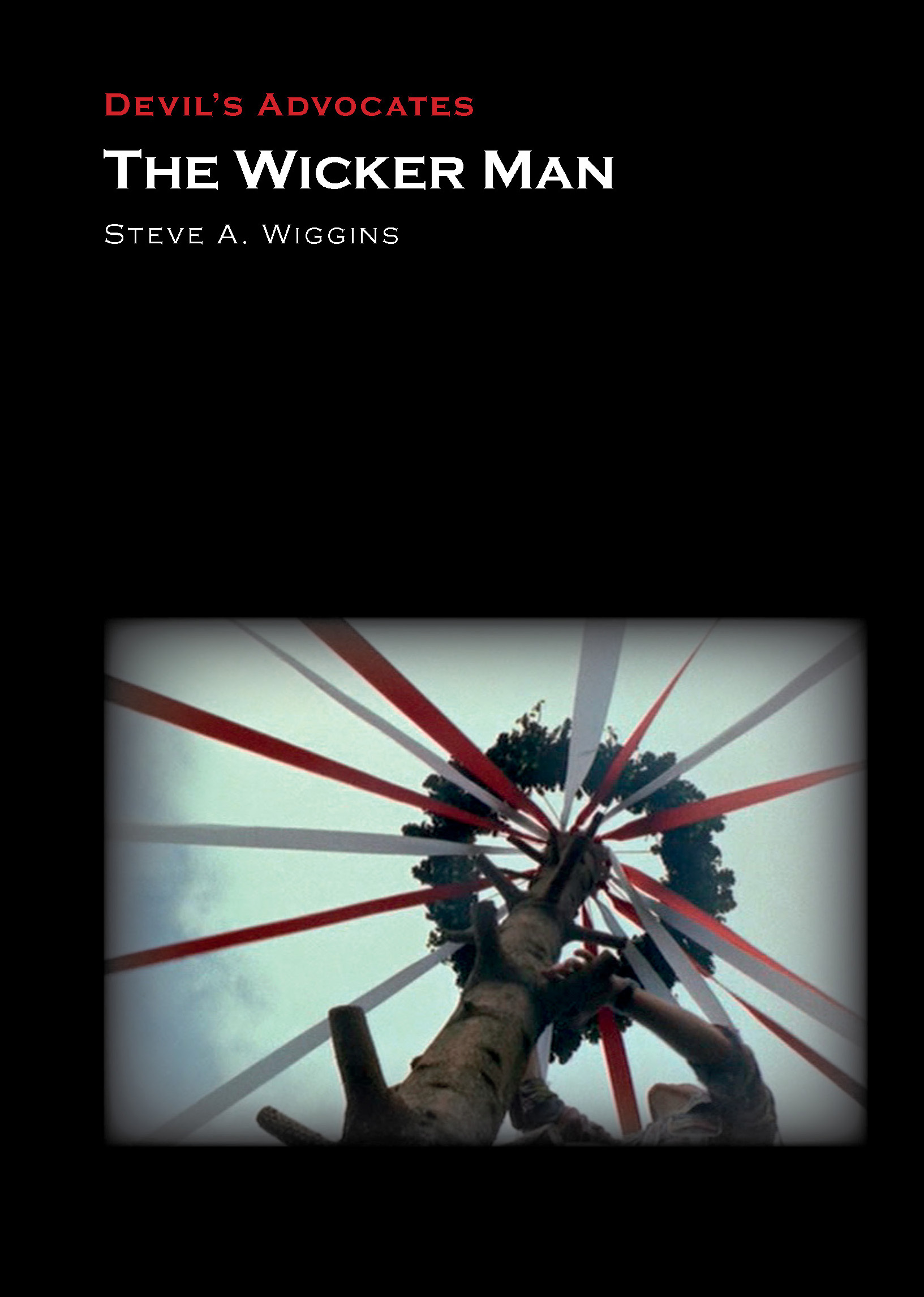
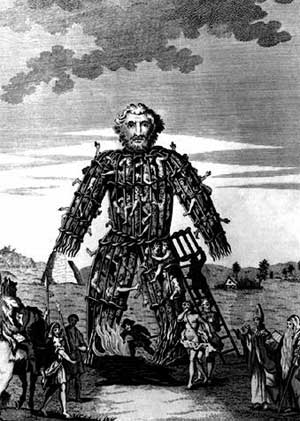
They creep up on you, these holidays with no official recognition.  I’ve been so busy that it didn’t even occur to me that today was Beltane—May Day—until my wife mentioned it to me before I headed up to bed last night.  Why is that important?  It’s not a day off work, so why bother?  Well, for one thing it’s the fuel behind my book published in the summer of last year.  Or, according to the Celtic calendar, the fall (just before Lughnasadh).  In other words, this is the first May Day for The Wicker Man.  I should’ve been trying to drum up a little interest, but things have been busy.  Besides, my profile hasn’t grown since its publication.  Nobody even cites it on the Wikipedia page for the movie, although it takes a distinct angle.  So I’ve been busy with other things.

I’ve been trying to find a publisher for my next book.  A couple friends know what it’s about but mostly nobody else because it’s time-sensitive.  Agents haven’t nibbled.  Well, one did.  He had me rewrite the book and then decided he couldn’t sell it after all.  Back to square one.  Even presses that publish mostly non-PhDs weren’t even interested enough to respond to queries.  Nothing like writing a book to make you realize how insignificant you are.  Like Sgt. Howie, I’m caught on Summerisle.  Ironically, I didn’t even think of writing a post for my book today when I was jogging yesterday and a haze over the moon (I know the movie ends with the sun—I’ve seen it a time or two) made me think, “That sky looks like the ending of The Wicker Man.”  Well, when I get back from my jog I have to start right in to work.  And Beltane’s not a holiday in these parts.

May Day used to be celebrated, even in the United States.  Now it’s just disappeared into the haze of work days.  And we don’t have time even to watch movies on work days.  That’s a weekend activity.  Of course, my weekends are full of trying to find publishers.  Two are currently considering my unagented book.  Four have already rejected it.  I’m thinking that I could use a trip to the Green Man with Howie.  At least on Summerisle they know how to celebrate May Day.  Of course, it’s the ending that makes it horror.  And Beltane snuck up on me this year.  Without it, The Wicker Man wouldn’t even exist.


Christmas Monsters

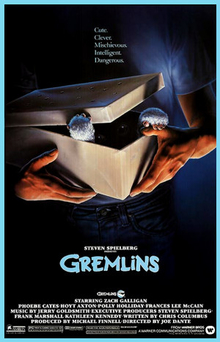
Gremlins holds up pretty well with the years.  My renewed interest was sparked by holiday horror—I had last seen the movie in a theater in 1984, when it came out.  Having grown used to CGI, I was surprised to re-learn that the gremlins were puppets but that it was so obvious was also a surprise.  Although comedy horror, or horror comedy, had been around for years at that point, as critics pointed out, the contrast here was stark.  This could be a kid’s movie (and was one of the reasons behind the shortly new PG-13 rating) but the nasty gremlins could be unexpectedly brutal.  I’d forgotten that Billy’s mother was so effective—killing a gremlin in a blender and another in a microwave.  The story has been retold and/or parodied often enough that a summary isn’t necessary, but given my recent interest in both gremlins and holiday horror, it’s worth a few moments’ reflection.

Holiday horror is more than a scary movie that happens to occur on a holiday.  In my definition, the horror has to derive from the holiday itself.  In Gremlins the gift of Gizmo is based on the fact that it’s Christmas, otherwise Rand wouldn’t have been looking for a gift for his son, starting the whole chain of events.  More than that, the reason I didn’t go back to the movie again in my college and grad school years was the story Kate tells about her father on Christmas.  Like some parents, I felt like what was a fun little story was a bit too distressing given the holiday setting.  Would the story have worked set at a different time of year—remember, it was released in summer—with the commentary that it makes about consumer culture?  No, this had to be a Christmas movie and the fear comes from that fact.

The gremlins are given minimal backstory here, although Murray Futterman tells Billy and Kate  that gremlins come from foreign merchandise and they tinker with machines.  Gremlins had been used in horror before, and given that the canon of classic movie monsters was being set from the thirties through the fifties (gremlins appeared as monsters as early as the forties) they fit right in.  They’re inspired monsters.  People naturally feel vulnerable on planes and monsters in the atmosphere can be particularly frightening.  And the fact that technology frequently malfunctions, well, wouldn’t it be nice to have a monster to blame?  Reading up on the movie made me curious to see the sequel, which, it seems wasn’t too badly received.  I’m glad to have used a small portion of the holiday season to have refreshed my memory.


Reflecting Thanksgiving

Thanksgiving, the newest holiday horror movie, was released last Friday.  No, I haven’t seen it—I barely have time to do whatever it is that I do normally.  I suspect, however, that many will object because Thanksgiving is still a quasi-religious holiday.  If we’re giving thanks we must be giving it to someone, or something, that may or may not govern our lives.  Ironically, in many business calendars it is the only annual four-day weekend.  Christmas could come on a Wednesday, so we can’t go giving time away!  Ironically, Thanksgiving was fixed as the fourth Thursday of November (moved from the last Thursday) to ensure about four weeks of shopping time before Christmas.  Me?  I’m just glad to have a couple days off.  2023 has been a challenging year on a personal level and having a couple days out of the office is just what the doctor prescribed.

Photo by Priscilla Du Preez on Unsplash

It may seem strange to be thankful for horror movies, but I know I’m not the only person whom they help.  I also believe that the genre has been misnamed.  When you think of all the different kinds of films that get lumped under the moniker it really is odd that we have any idea at all what we’re talking about.  What are horror movies, then?  The common equation with slashers is patently wrong.  There’s nothing slash-like in the old Universal monster movies that started the whole thing.  Time and again critics point out that “horror” is generally intelligent, and often funny.  And not infrequently therapeutic.  Yet it has a bad name.  Some even consider it satanic although it produces good.  Being satanic is a matter of how you look at things.

Thanksgiving is a time for reflection.  Reflection without the distraction of work constantly trying to poke holes through our concentration.  The holiday season properly starts at Halloween and sadly ends at New Year.  It’s our reward for having made it through another one.  The holidays that fall into this season all have a great deal in common.  Early Americans celebrated Independence Day, Thanksgiving, and sometimes Christmas and New Years.  We’ve reached the point now where we have a distinctive string of holidays like stones across a rushing river.  We can just make it from one to the next.  From Halloween we can see to Thanksgiving.  From today Christmas is on the near horizon.  New Years follows only a week after.  And it’s a time for reflection and thankfulness.  Even if what we appreciate isn’t the same as everyone else.


Not Quite Christmas

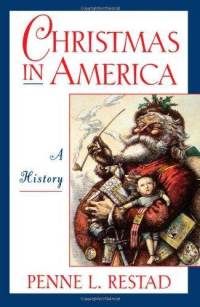
Holidays have always fascinated me.  Although we grew up poor, I always have cozy memories of childhood Christmases.  It was a combination of things—being out of school for a couple of weeks.  Presents.  Christmas trees.  Time outside ordinary time.  I’d read Penne L. Restad’s Christmas in America: A History years ago.  So many years, in fact, that I forgot that I wrote a blog post on it before.  That was back in 2012, in my early days of commuting to New York City, and early days of blogging.  Sometimes I have to come back to a book, however, and rereading this one reminded me of why.  There’s a lot of good stuff in here.  It mostly focuses on the nineteenth century, but it does go back before that and steps into the twentieth century (when it was written) toward the end.  I’d forgotten a lot of what I’d learned before.

This time through, having worked as an editor for a decade and a half now, I could tell that it was originally a dissertation.  It’s pretty hard to remove that completely from any book project.  Nevertheless, it’s engagingly written and full of facts.  I’d forgotten that Santa’s red clothes were not, in fact, Coca-Cola’s invention.  And that Washington Irving played quite a role in introducing Americans to the holiday.  And just how interconnected Christmas is with Thanksgiving, New Years, and yes, even Halloween.  Of course, no book can be adequately summarized in a brief blog post.  My previous one highlights some of what I found here, but this reading brought out other interesting features.  I spend quite a bit of my energy anticipating holidays.  Some years they’ve been minimized due to circumstances, but they are definitely the fixed points around which my life revolves.

One of the interesting things I noticed this time, introduced literally on the second-to-last page, was that the book mentions holiday horror.  Restad’s focus is on America so she doesn’t really delve into the British tradition of telling scary stories at Christmas.  (I do discuss this in The Wicker Man, I would note.  Although set on May Day, it was released in December, fifty years ago.)  These kinds of interconnections fascinate me.  Our culture reflects who we are and American culture includes Christmas for any who want to take part in it.  In fact, the book makes the point that becoming secular helped Christmas spread goodwill to people of all religious persuasions, or none at all.  It’s not really even a Christian invention.  It’s a blending of traditions that bring light to the darkest time of year.  And here I am like a kid, eagerly awaiting it again.


Squidish

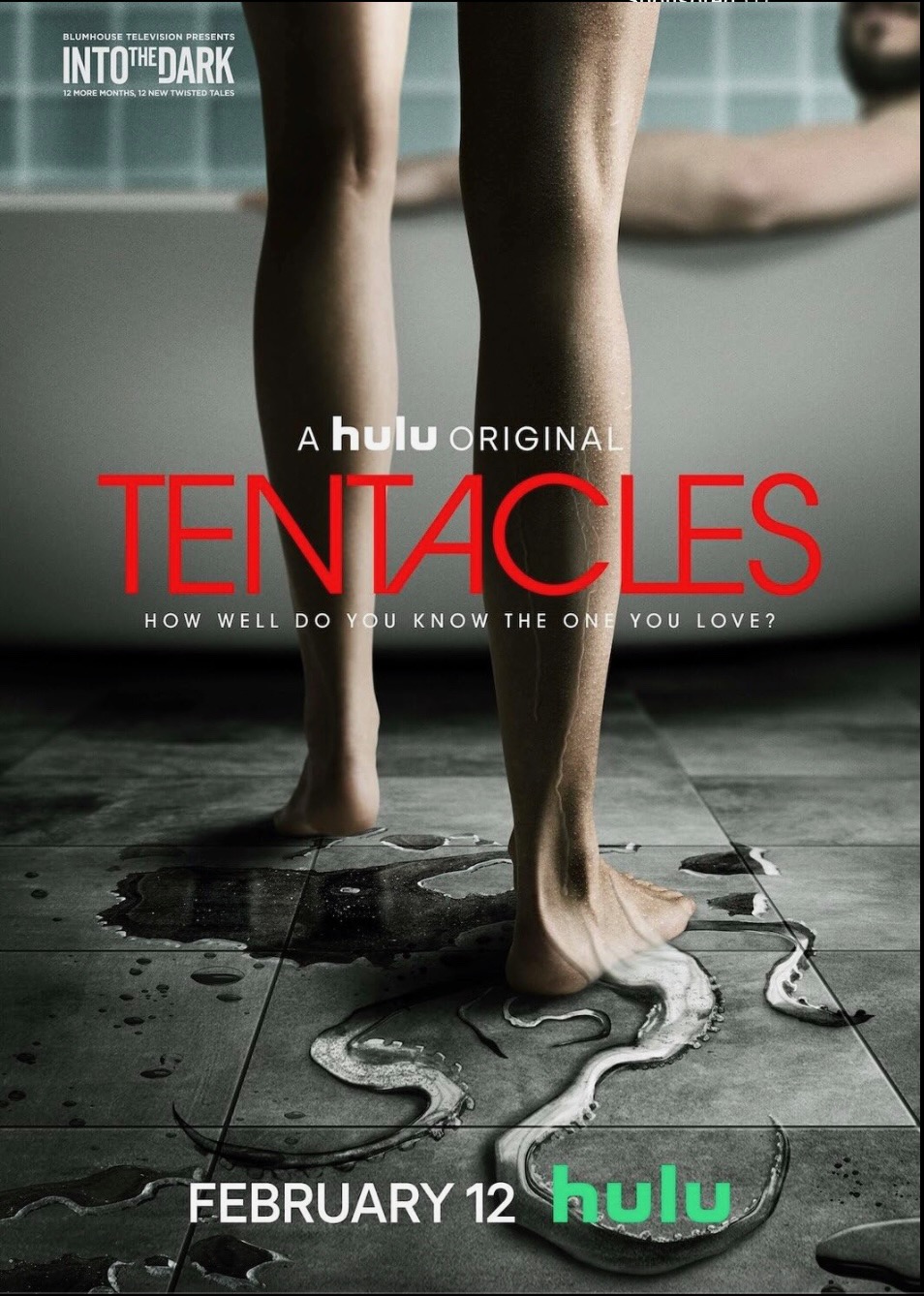
I was attracted to the Lovecraftian aspect of the title.  Of Tentacles, I mean.  I wasn’t aware that Into the Dark was a Hulu series of television shows based on holiday horror.  I watched Pure without realizing that.  Movies these days are complicated.  In any case, Tentacles caught my attention and although it isn’t a tier-one horror film, it’s fun in its own way.  Tara, a desperate young woman, is looking to buy a house.  She finds Sam, who’s trying to sell his parents’ place and seduces him into letting her renovate it.  The two fall in love and Tara reveals she’s being stalked by an ex.  Sam has, however, come down with an illness that doctors can’t identify.  Something is putting tentacles into his ears as he sleeps.  It doesn’t take long to figure out that Tara’s not what she claims to be.  She’s some kind of creature that originated in the ocean, but survives on land by taking part of her victims and slowly becoming their double.  The original, of course, must be disposed of.

This is a serviceable little movie.  The acting is good, particularly on Tara’s part.  There’s enough mystery and energy to keep viewers engaged, despite the commercials.  It also made me realize that Into the Dark might be worth exploring a little more intentionally.  When I went to my usual places to find out more about what I’d just watched, it was a little tricky.  To find the write-up on IMDb you needed to find the series title first so that you could click onto the individual episode.  This is so different than either the major studios or independent filmmakers.  Streaming services, however, have been offering some good home-grown horror.  I’ve seen some notable examples from Netflix, Amazon, and, of course, Hulu.

Anything with tentacles seems to have a tangible Lovecraft connection these days.  In large part it seems to be because of the internet success of Cthulhu.  Those who spend lots of time online know who the Old One is without having ever read H. P. or having watched horror.  He’s become the monster with tentacles, something my college sci-fi professor would doubtlessly have commented upon.  Lovecraft himself would have, I suspect, enjoyed the notoriety but would likely have felt some disappointment regarding the point he was trying to get across.  (That’s more evident in Older Gods.)  The vacuousness of being alone in a meaningless universe was more his aesthetic.  Still, it inspired some fun films for a sleepy weekend afternoon, and its tentacles keep on reaching.


Hoppy Fourth

Today is the one of the relatively rare summer holidays.  Modern industrialized nations tend to take a more relaxed view toward summers without having to give out too many prescribed company holidays.  This seems to follow on from school schedules because the kids are out in summer and adults need some flexibility when work demands collide with family needs.  The internet has made work-life balance a little tricker to achieve since work is always just a click away.  Some more generous employers gave yesterday as part of an extended four-day weekend, which is rejuvenating in a way that’s easily forgotten until you start to feel it.  The sense of obligation takes a couple of days to wind down, and then on Monday you realize “I’ve still got another day off!”  It’s a sublime feeling.  Why not watch holiday horror on it?

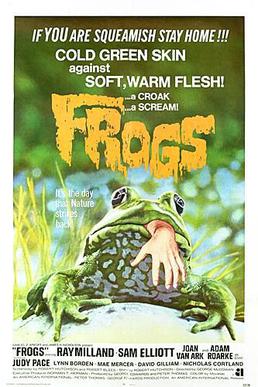
The Wicker Man is a holiday horror movie.  One of my arguments in the book is that holiday horror has to derive its energy from the holiday, and not just be set on it.  For example, I Know What You Did Last Summer and Return of the Living Dead are both set on or near Independence Day but the movies don’t really draw their horror from the holiday itself.  It falls into the same category.  Frogs?  Well, maybe.  Perhaps holiday horror, it’s definitely in bad movie territory.  A rich southern family is dominated by a Trump-like grandfather who controls the money and measures everyone by loyalty to him personally.  On his birthday, the fourth of July, nature revolts and his adult children and grandchildren (apart from one granddaughter), are killed by animals in this eco-revenge groaner.  But is it holiday horror?

One scene may suggest that perhaps it fits the category, but the real significance of that day is that grandpa won’t let it be celebrated any way other than by his prescribed plan.  Even as the estate is overrun by frogs (mostly), snakes, lizards, alligators,  tarantulas, and even some birds (thank you, Mr. Hitchcock), he insists that everyone do what they always do on the fourth of July/his birthday.  The only scene that suggests holiday horror is where the eponymous frogs hop onto a cake decorated like an American flag.  I normally like nature-revenge films, and this one starts out well but quickly goes downhill.  The environmental message is there, but underplayed.  There are some firecrackers and a number of dead rich folks, but otherwise the film seems to have no message at all.  It’s a bad movie.  Holiday horror?  Not really.  Something to watch for a day off work?  Definitely.


Wicker Wondering

Why The Wicker Man?  It’s a fair question.  My book is now starting to appear on Amazon and other venues (it’s on Goodreads!), so it’s time to try to get the word out.  The BBC ran a recent story, “Why The Wicker Man has divided opinion for 50 years,” and that offers a springboard into the “why” question.  I’m not Scottish, but my wife and I lived in Scotland for a little over three years.  That’s one reason.  While there I did some research into Scottish folklore—historians of religion are curious people—and traveled widely, and that’s another.  As one of those writers who’s never been able to break out of the academic market, the third and most direct reason is that I’d begun a book on holiday horror.  A friend pointed the series Devil’s Advocates out to me.  Back then the series books were priced in the twenty-dollar range, but the pandemic put an end to that!

I’ve always thought The Wicker Man derived its fear from the strangeness of the holiday.  I’ve also often wondered why Anthony Shaffer and Robin Hardy didn’t make more use of “Beltane” in the dialogue.  Maybe the unfamiliar was too unfamiliar?  I suggest a different reason in my book, but I won’t reveal that here.  Writing a book on The Wicker Man would allow me the opportunity to share my thoughts about holiday horror without trying to convince an agent that people actually do like to read about horror as well as reading horror itself.  Come on, agents!  It’s called pop culture because it’s popular!

I pitched the idea and the series editor liked it.  So did the reviewers.  They were tired of hearing/reading about The Wicker Man as folk horror, as if there was nothing more to the movie.  Like most films that grow an afterlife, this one is complex and can be approached from many angles.  In fact, there’s another book, one by John Walsh, coming out on the movie just weeks after mine.  I wasn’t the only one who knew the fiftieth anniversary was on the horizon like a Beltane sunset on Summerisle.  For those who prefer a more television-like explanation, I’ve posted a video on The Wicker Man on my YouTube channel.  This blog, I realize, doesn’t get enough hits to drive traffic that way, but it’s nevertheless part of the package.  Why The Wicker Man?  The answers likely lie in several posts on this blog, a few years in Scotland, and a love of strange movies.


Holiday Horrors

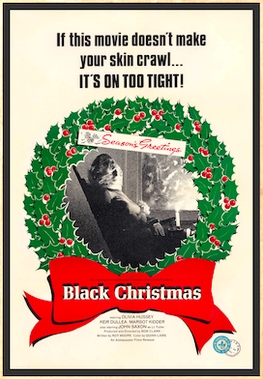
Holiday horror is a genre—really a sub-genre—that is still being explored.  It’s the subject of my my latest YouTube video.  Typical definitions suggest that it builds on a haunted or inauspicious history of the day.  I tend to think that really to fit the category that the holiday can’t be simply incidental.  It has to contribute to that fear that the movie brings.  The most popular holiday for horror films has long been Christmas.  Halloween may be starting to catch up, but Christmas has a long head start.  I ask myself if Black Christmas fits.  The title suggests as much, but how does it derive fear from the holiday?  It is, like When a Stranger Calls, one of the early cinematic renditions of the urban legend “the babysitter and the man upstairs.”  Yes, the calls are coming from inside the house, but there’s more going on here.  The sorority house is invaded during a Christmas party.

The fear, however, comes from both the juxtaposition of the cheerful holiday and the ambiguity of a slowly emptying residence.  Coeds are leaving for the holiday.  Or are they?  The bleakness of the weather adds to the dreariness of the plot.  The function of holiday horror is to make viewers address what’s really important about the occasion.  Tragedy can strike any day of the year—it’s no respecter of birthdays or other holy occasions.  John Carpenter got his idea for Halloween from this film, so in many ways Black Christmas does fit the sub-genre.  Its titling, however, complicates this.  Originally called Stop Me, the movie was to be set on Christmas break but the focus was not to be on the holiday.  Even as it was released the title continued to change, in America it was first called Silent Night, Evil Night.

Like the remake of Invasion of the Body Snatchers, critics initially didn’t like this movie but time has shifted that.  It is an effective horror film and probably part of the objection (I’m psychologizing here, without a license) had to do with implicating a holiday—a happy holiday—with horror.  Christmas is, for many, a stressful time of year.  Instead of quietness and relaxation, it’s a season of intense socializing and measuring one’s generosity against that of others.  We try so hard to make others happy with material things.  Holiday horror need not add to that stress.  In fact, it can make you stop and think about what’s really important.  There’s a reason that Christmas was long the holiday associated with scary stories before Halloween really took off.


Hallowed Tradition

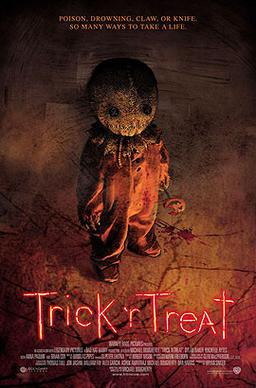
The more I learn about the movie industry the more complex I realize it is.  Take Trick ‘r Treat, for example.  It was released to some film festivals—and backed by a major studio—in 2007.  I wondered why I’d never really heard of it, and the reason seems to be that it never had a theatrical release.  Until this month.  It is now playing in theaters.  The thing is, it’s already available on streaming services because it gained a cult following when it was initially released fifteen years ago.  I came to know about it by wandering into one of those Halloween pop-up stores recently.  There were plenty of Sam costumes so I did a little research and discovered a Halloween movie I’d never seen.

I have to say, the first time watching it was confusing.  I didn’t realize it was four or five separate, but interlaced stories.  I kept waiting for a central plot to emerge, but it didn’t.  At the same time, I wasn’t aware that it was a comedy horror either.  I have no problem with comedy horror, of course.  I just like to know that before I get into it.  Once I’d figured these things out, I could see the draw.  It is fun and seasonal.  Clearly it’s holiday horror.  In fact several websites list it as being essential October viewing.  It’s certainly different from many Halloween movies in refusing to be taken seriously.  It’s like adults having fun instead of kids enjoying the holiday.

Perhaps the most self-aware Halloween film, it constantly reinforces that you need to obey Samhain etiquette.  Those who are killed (and there are many) die for having violated the rules of the holiday.  I appreciate the fact that it insists that we do these things for a reason.  Wearing costumes, handing out candy, carving and lighting jack-o-lanterns, these all serve a purpose.  The movie suggests we need to do these things to stay safe from Sam.  Sam, of course, can’t be killed which means that a sequel may be in the works.  Trick ‘r Treat gets full marks for staying focused on the holiday.  Holiday horror has been a fascination of mine for some time and this movie has it in spades.  Even if it’s a little confusing at times, it’s a fun way to celebrate the season.  And this year you have your choice of seeing it in the theater or streaming it on your most convenient device.


Next Trick

Book contracts make me happy.  For my next trick, I’ll be writing a book on The Wicker Man for the Devil’s Advocate series.  This will be a short book, and hopefully priced down where individuals can afford it.  The Devil’s Advocate series was initiated by Auteur Publishing some years ago.  The series covers individual horror films in about 128 pages.  I pitched the idea of The Wicker Man for a couple of reasons.  One, Auteur didn’t have one in the series.  And two, I’ve been working on holiday horror for some time.  Holiday horror encompasses movies where a holiday features in the story, generally in a significant way.  Think Halloween, or April Fool’s DayThe Wicker Man takes place during a pagan celebration of May Day, falling neatly into the category.  You may see, in coming weeks, posts about various Wicker Man books.

While still in the horror genre, this next book will be a departure from the supernatural horror of Nightmares with the Bible.  Demons are frightening, no doubt, but Wicker Man is more about how religion can motivate people toward evil.  It is part of what has been termed the “unholy trinity” of early folk horror, classed with Witchfinder General and The Blood on Satan’s Claw.  This “unholy trinity” overlaps in time another famous threesome: Rosemary’s Baby, The Exorcist, and The Omen.  There can be little doubt that modern horror really began in 1968, which also gave us Night of the Living Dead.  Folk horror utilizes both folklore and the landscape—generally rural—as the basis for its fear.  And you can’t get much more isolated than Summerisle.

The hope is to get this book out in 2023.  That will be the fiftieth anniversary of the release of The Wicker Man.  Although it came out when I was eleven, I didn’t see it for another thirty years at least.  By that point in time I’d watched and read about enough horror to find out about and appreciate this particular, indeed, peculiar movie.  I was blown away the first time I saw it.  It is quirky but stunning.  Christopher Lee maintained throughout his career that it was his best movie.  I haven’t seen all of Lee’s movies (who has?) but I’m inclined to agree.  I’ll be getting to know this movie in some depth over the next several months.  Having watched it many times already, I’m drawing a map for a journey to Summerisle. You’re welcome to come along.


April Really Fools

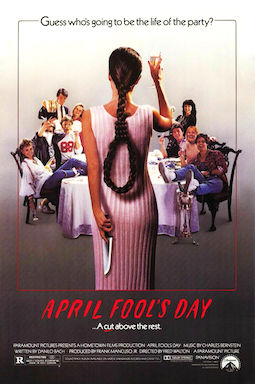
What’s the best kind of April Fools’ Day prank?  What about one that occurs nowhere near April first?  Actually, I’m no fan of practical jokes.  They usually come at the expense of someone and really aren’t that funny.  And where does that apostrophe really go anyway?  Still, because of a project I’m working on, and because it was available on a streaming service I use, I watched April Fool’s Day in July.  An example of holiday horror from the 1980s.  Although moderately successful at the box office, the movie never took off to become a cultural icon like, say, Halloween did.  In fact, I only recently heard of it.  Part of the reason, I suppose, is the ensemble cast is pretty large (nine friends together for a weekend) and none of them played by big names.  In case you don’t like pranks, there will be spoilers below.

The trope of a number of young people—often college students—isolated in some inaccessible location is common enough in horror.  The optimal number seems to be five, otherwise an hour and a half isn’t really time to get to know everyone’s character well enough.  Of course, one by one they get killed off.  Since it’s set on April Fools’ Day you’re led to think some kind of serial killer is loose on the island, but in the end the entire thing turns out to have been an elaborate prank.  Nobody has really been killed and the audience is on the receiving end of an extended practical joke.

As I try to catch up on horror movies I missed I quite often have to rely on those that come with one of the few streaming services I use.  When I was myself a college student I couldn’t afford to go to the movies often.  Home video hadn’t really become affordable yet to people of my economic bracket, and besides, I spent a lot of time studying.  As the only one in my family that watches horror, finding the time to do so remains a challenge.  And there is quite a backlog.  I’ve been trying to watch horror set on specific holidays as a way of keeping myself honest.  Even that can prove a challenge, however.  I can justify the time, however, and the somewhat modest cost, as research. Hey, somebody has to do it.  And that’s as good an excuse as any for watching April Fool’s Day in July.