Post Thanksgiving

Yesterday morning, like many others mesmerized by the commercialization of holidays, I had the Macy’s Thanksgiving Day Parade on the television.  I can only speak from my own experience, of course, but I know that growing up poor we used to watch this, and that my wife’s family, from different circumstances, also watched it.  The friends with whom we ate our main meal watched it, and given the advertising revenues, I imagine many other people tune in every year as part of the holiday tradition.  What struck me were the testimonials just before or after the commercial breaks.  Celebrities shared what they liked about the holiday and many of them, unsurprisingly, focused on food.  Many indicated that overeating was pleasurable.  I began to think of what it means to be a nation of foodies.

Not everyone is of a cenobitic sensibility, but focusing on the food seems to be paying more attention to the finger pointing at the moon than to the moon itself.  Commercials for television shows of sweaty, nervous chefs wanting to be recognized as the best cooks in the world struck me as somewhat decadent.  Like many professionals I’ve had occasion to eat in “fine restaurants” from time to time.  Do I remember the food for long afterward?  No.  More often I recall the people I was with.  What we talked about.  The food, chefs may be pained to hear, was incidental.  There were deeper issues afoot.  If the internet’s any indication, I’m in the minority here.  Foodies rule.
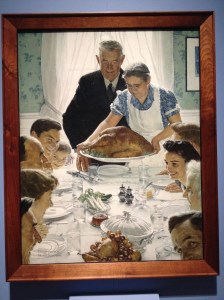
Special foods on holidays are, naturally enough, a holiday tradition.  Many have their origins in the changing foodstuffs available as the seasons wend their way through their invariable cycle.  Thanksgiving is like the ancient festivals of ingathering—the celebration of plenty ahead of the lean months of living on what we’ve managed to store for the season when winter reigns.  Some animals cope by hibernating until food becomes available again.  Others scavenge their way through chilly, snow-covered days.  Gluttony, however, isn’t primarily a sin against one’s body; it’s the sin of taking more than one’s fair share.  Unequal distribution of wealth is a national sin that grows worse each year.  On Thanksgiving there are many people who don’t have enough to eat.  Jobs can be lost through no fault of one’s own, and want can haunt late November just as readily as jouissance.  Driving home we passed a shopping mall brimming with cars after darkness had fallen.  The larger holiday of Black Friday had begun.
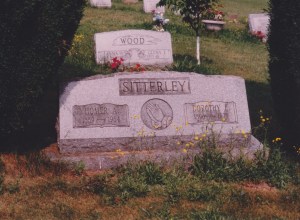

Day of Memorials

I admit that I’m as guilty as the next guy of thinking of holidays primarily as a day off work. A boon from the gods of capitalism so that we can come back to the job rejuvenated and more productive than ever. It doesn’t matter the occasion—I don’t have time for things like haircuts and dentist appointments with the usual round of early to rise, early to work. Holidays become islands of blessed respite in an endless ocean of labor for the man. So I wanted to take a moment to reflect on Memorial Day. Memorial Day is a time to remember those who have died—grandfather, grandmother, America. We take a moment to consider what we have lost. Then it’s back to business as usual.

My father was a veteran. He died many years ago now and I don’t write much about him because I really didn’t know him at all. That doesn’t mean I didn’t want to please him. Any boy wants to make dad proud. I tried the hard work route, and even gave Boy Scouts a try. The things of my youth have been slowly dying. Democracy is merely the latest victim. I shouldn’t be surprised—when it no longer becomes profitable, even the least offensive system of government can be bought and revamped to fit the needs of the greedy. Never mind the will of the masses. They’re the ones who lie under the gravestones for which today stands. No one can be rich without great numbers of poor against which to measure himself. Remember that; it’s Memorial Day.

Since Memorial Day doesn’t lend itself to commodification—let’s face it, outside Halloween death’s a downer—we can make it a day of sales. While you’re earning money without working, why not spend some of it? We seem to have lost the gist of holidays. Those who’ve died in vain believed in a democracy that their heirs have thrown away in scorn. If that for which we say we believe has become moribund, it appropriately becomes the focus of Memorial Day. My grandparents lie buried far from here. They were Evangelicals who wouldn’t recognize their faith reflected in those who still cling to the brand. I remember grandma sending money to Oral Roberts. She didn’t live to see him claim God would take him unless he had even more money. Now we hear the same thing from Pennsylvania Avenue. And tomorrow we all go back to work.


Indie Bookstore Day

Although a year can seem like a long sentence, holidays are the punctuation marks that help us make sense of and organize it. Ordinary time, such as time at work, or commuting, can be endlessly tedious. Holidays, some personal, some local, others national or international, help us break up the time. Give us something to look forward to. My pity goes out to those religions that recognize no holidays and face time with a grim, Presbyterian determination to get to judgment day. The rest of us like to celebrate once in a while. So what’s today? It’s Independent Bookstore Day! Anyone who reads more than a post or two on this blog knows that I’m a lover of books. I first started taking solace in reading when things were difficult in my younger years, and reading has never let me down. In fact, I’ve often told myself that I could put up with just about any job as long as I could write.

It’s because of being in publishing that I learned about Independent Bookstore Day. Yes, it’s a promotional holiday, but it’s also a genuine celebration. As the outside world daily reminds us, those of us who read are a minority. The realistic author knows that the reading public is a small fraction of the whole. The number of people, percentage-wise, who spend their money on books is minuscule compared to those who fling their lucre elsewhere. But those of us who read appreciate the depth and reflection of each other. We may read different things, but we read. And that’s why I don’t mind going to an indie bookstore today and buying something.

One of the simple pleasures in life—call it a punctuation mark, a comma maybe—is being surrounded by unfamiliar books. Oh, I often worry what happens when we decide to move; we have lots of books at home. The last time the movers actually complained in our hearing that we had too many boxes of books. Talk about me at the bar afterwards, but don’t castigate my simple pleasures to my face, please. Books are the rare opportunity to commune with others on a deep level. How often have you put down a book and felt that you knew the author? Their soul was revealed in their writing and you had touched it. Just being in a bookstore is cause for celebration. If you have no plans for today, why not make your way to your local indie? Stand up and be counted as the literate resistance. It’s our silent Bastille Day, after all.


All Hallows Eve

I can tell that I’ve been far too busy when I don’t have time to prepare for Halloween. I don’t mean commercially—running out and buying decorations and the like—but mentally. For reasons perhaps only understood by psychologists, Halloween is my favorite holiday. I love the comfort of being with my small family on Thanksgiving and Christmas, huddled inside while the cold whistles against our windows. The sense of relief at not having to go to work even though it’s a weekday, and that increasingly rare luxury of simple breathing space. Still, Halloween takes me back to a childhood with which I resonate in a way against which other holidays only vibrate in sympathy. The days are undeniable darker. My fears, I’m told, are not unfounded. I wear a mask and am free to be myself.

Commuting prevents me from getting out to see the decorations for which some neighborhoods have become notorious. The large, billowing, air-filled frights, however, are just hot air. Even the younger generation at the office, whispering among themselves that this is also their favorite holiday, decorate their cubicles in a way that’s more cute than chilling. No, I’m not a fan of gore—this is more subtle than that. Those who’ve long dwelt with existential angst are connoisseurs of dread. We know, for example, that it will be many months now before we step out into the morning light or come home from work able to see our way clearly. The shades of darkness aren’t always the same. There’s a texture to them. To prepare properly, you need time. The very commodity of which I’m being drained.

Those who know me as a mild, “uncomplicated” sort of person don’t know me. They’ve only become accustomed to the Halloween mask that I wear almost constantly now. Life can do that to you. Instead of the creepy novels which generally crowd my autumn, I’ve been spending time with the existentialists, listening to them reflect on death and its meaning. Or lack thereof. Religions, of course, hurl themselves into that void offering plans of escape. And yet in October that man who walks his dog before dawn wearing a white bathrobe sure looks like a ghost to me. And I’m standing on this street corner utterly alone as the wind blows down the avenue, chasing frightened leaves past me, sending a chill down my spine. I’m looking forward to sitting on a bus to get out of the cold. I’m complicit, I realize, in the death of Halloween.


Happy World Book Day

In times of distress, as well as of joy, I turn to books. Since about November there have been more of the former than the latter, so I’m cheered that today is World Book Day. The United Nations Educational, Scientific and Cultural Organization has designates World Book Day to promote literacy internationally. If only the White House would pay a little more attention to the UN maybe the world situation would improve. In any case, books are always worth celebrating. At any given time I’ve got three or four book-reading projects going on simultaneously. Well, not literally simultaneously; I have books I read in the morning, different books for the bus ride, and books I read before bed. Often there are others scattered in there as well, such as books that I take with me in case I get unexpectedly delayed somewhere and want something to read. It’s a life full of books. It’s a wonderful life.

I can’t imagine enduring the mental vacuity that must come from not reading. It sounds like torture to me. Yes, I’ve occasionally been caught up in the action-packed episode of travel and adventure (or what passes for adventure for a guy like me). Hours spent with other people in locations not at home when there’s something to do every minute of the day. But then, when the fun’s over, I open a book. I read before bed even when I’m traveling, and since I’m an early riser I read before anyone else is awake. It’s a form of communion. Having access to the intelligent minds of others is a rare privilege that shouldn’t be scorned. World Book Day should be an international holiday.

Books, strictly speaking, didn’t necessarily originate as sacred texts. Very early in the process of writing, however, such holy documents began to appear. Civilization itself grew through the cultivation of writing. Bibles, Qur’ans, Books of Mormon—for all the troubles sacred texts may cause, they’re reminders of the importance of reading. And once reading starts, it’s impossible to stop. Reading is resistance to the Zeitgeist that’s haunting the politics of the day. Had voters been informed, it is absolutely certain, neither Brexit nor Trump would have happened. We need to read, and be seen reading. Ignorance is the final enemy to be defeated. Celebrate World Book Day. Wish people happy World Book Day. And for the sake of civilization itself, get caught reading.


The Morning After

dickens_gurney_head

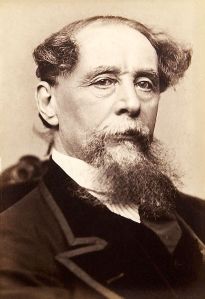
Quite apart from seeing a live performance of A Christmas Carol, Charles Dickens has been on my mind a bit this Christmas season. I suppose that’s not surprising since it has been suggested that Dickens “invented” the modern Christmas, but it is really, I think, because of how the wider world seems to be spinning backwards. The poor have always been a personal concern of mine. I grew up poor and I know how much suffering it entails. My case was a rather mild poverty—we were never out on the street, and we didn’t actually go hungry. We had nothing in the way of luxuries, though, and I could see the possibilities even as I could see the sky where the boards on the roof were pulling apart. It wouldn’t have taken much for us to have been cast out in a cold Pennsylvania winter. Others have it much worse.

On my daily walks to work, I see the homeless. Some sleep in cardboard boxes, some in tents. Others are out under the stars. One morning I walked by a particularly creepy and sad sight of a person sitting, shrouded in a blanket over his or her head, on a subway vent to catch some of the ambient heat. I know that I don’t have the means to buy each one a meal. Their number has been going up, not down. And I think of Bob Cratchit, threatened and bullied by Ebenezer Scrooge. He will lose his job if he’s not in early today, the day after Christmas. Because of his change of heart, Scrooge buys his clerk a pot of “smoking bishop.” And herein lies the only possible cheer.

My wife got me started on Dickens. She also sent me a story from NPR on smoking bishop. It seems, according to the story by Anne Bramley, that British Protestants delighted in making fun of church offices by naming their tipples after titles. Churchmen (and they were men) were largely exempt from being poor and, according to historians, often supported the Poor Laws that made the fate of the poverty-stricken even worse. In a kind of perverse revenge against privilege, drinks were named after various ecclesiastical offices. There’s little that the poor can do, except to try to find the scant humor in a situation where no one has the reach of a Charles Dickens anymore. Ebenezer, unlike Bob, is a biblical name. It means “stone of help.” In these chilly days dare we hope that help may come, even from a stone?


Charlie Grinch

There were probably about half-a-dozen animated Christmas specials I recall watching as a child. The two that became fixtures, and remain part of my present holiday ritual, are It’s Christmas Charlie Brown and How the Grinch Stole Christmas. I remember watching them from early days—of course you had to wait until their respective channels announced their advent in TV Guide (just writing that makes me feel older than the Grinch). Commuting wasn’t an issue then, so watching television was as common as candy canes and hopeful stockings. As an adult, though, you see things you overlooked, or simply accepted, as a child. I guess that’s what “believing in Christmas” is all about. The willful suspension of disbelief.

I’ve commented on these Christmas specials before. Charlie Brown has so many inconsistencies that an old biblical scholar can’t help but think of J, E, D, and P. What does the signage on Lucy’s Psychiatric Help booth really say? How many branches are on Charlie Brown’s Christmas tree? How does Sally get to the school before her big brother? The animation is clearly a little off—Lucy appears to emerge from the center of her booth’s wooden top as she gives advice to the woeful Charlie Brown with his Trump’s-been-elected-type depression. Still, Linus’ rendition of Luke’s Christmas story brings it home every time. Compare that with the Grinch.

Those who see a war on Christmas (there’s not) seldom cite the Grinch. How the Grinch Stole Christmas is entirely secular. No mention of a special birth. No angels or shepherds. Just a mean old man and his dog. The Grinch shares with Charlie Brown its message of looking beyond the commercialization of Christmas. In the case of the much better animated Grinch (although I still can’t figure out why that one Who’s hat repeatedly flashes from white to blue and back) it would seem that religion matters less than spirit. The Who’s Christmas song with its strange, non-English words, is a celebration of difference. Diversity. Even that angry old man who would steal Christmas itself is welcome in the end. The only war on Christmas is one that has been spawned in the imagination of those who fit the Grinch’s description in Thurl Ravenscroft’s rendering of Dr. Seuss’s lyric. Those my age will understand, and unless you were born yesterday, I suspect that you’ll get my meaning.


Abundance

img_2996

A few weeks before Leonard Cohen died I saw a story on how his song “Hallelujah” had been done to death. Covered and recovered, it seemed to be on every cover artist’s playlist. It is a haunting song, however, and the notion of a cold and broken hallelujah feels somehow appropriate this Thanksgiving. Don’t get me wrong—I am thankful for more things than I can name or would care to share with complete strangers on the internet. In fact, when I literally tried to find a job in Canada in anticipation of a horrible November surprise, one of my immediate regrets was that I’d no longer have American Thanksgiving to celebrate. Thanksgiving, to me, has been images of a cozy indoors with special food while the chill takes over outside. Two days in a row off of work. Sleeping until I’m not tired any more rather than waking according to schedule, no matter how troubling the night might have been. In short, feeling safe and secure in a world growing colder.

Since the first week of November the iciness has been growing more intense. I know it’s the circles I go around in—and perhaps they are small enough to call them semi-circles—but I have seen more sad and depressed and scared faces in the past weeks than I have seen in my previous half-century on this planet. It’s Thanksgiving Day, and even vegetarians look forward to something special by way of fancy nourishment. But it feels like a cold and broken hallelujah to me. Entrepreneurs have already been reminding us that tomorrow is Black Friday. We should get our game-faces on and our credit cards out and head to our favorite retail establishments. Pack up our troubles in the old plastic bag and spend, spend, spend.

Thanksgiving, of course, was an originally generic religious holiday. It’s hard to give thanks without someone to, well, thank. You could be Muslim, Jewish, Christian, or even one of those who thanks dharma, karma, or chance. Just be glad that we’re here right now and even though the wind is gusting and there’s perhaps a bit of snow in the air, we have an indoors where nobody hostile is looking for means to exploit us any further than we wish to be exploited. That our planet, for the time being, still supports human life. And that by any measure other than the Electoral College we all really want progress and fair treatment for all. I am thankful and mindful of those who had to sacrifice to allow us the privilege of being here today. It’s Thanksgiving, and I’m thankful.


For the People

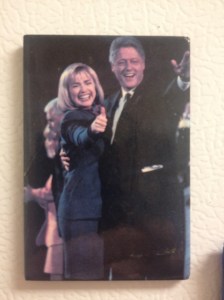
The complex of holidays that make up the transition from light to darkness represents a different mix, depending where you are. Life on the equator, for example, experiences no real variation in daylight hours and I would expect that equinoxes and solstices are relatively meaningless. Or at least less so than where darkness encroaches. For those of us in temperate zones the difference in day length can be quite dramatic and our holiday calendar guides us through it. Getting through the darkness. So this weekend, on Bonfire Night—also known as Guy Fawkes Night, or November 5—I watched V for Vendetta again. This isn’t actually an annual practice, but some years the need to remember the fifth of November is quite strong. This is one of those years. I can’t remember having ever been this anxious about a presidential election. Tomorrow we are voting on whether we want democracy to continue or if we want a dictator who can stir hate like no candidate I’ve ever seen. He even makes Ronald Reagan look tolerable.

I’ve posted on V for Vendetta before, so I need not go over the story. The theme, however, that governments are to serve the people is a message that bears repeating. Governments are to serve the people. We’ve come to a crises point in self-government. A vote for Trump instead of Hillary is saying “I give up, I want Big Brother to take over.” Perhaps the movie I should reference is 1984. Orwell may have got the year wrong, but the story right. Make people afraid, stir the pot of negativity and they will act in desperation. Reactionary governments quickly become dictatorships and that message, mean-spirited and full of ugliness, has been placed squarely in our faces.

The point of V for Vendetta, and the point on which the movie ends, is that V is each of us. We have the ability to make smart choices just as we have the ability to act out on irrational hatred. Who would’ve thought that election years would become days of such terror? I’ve always felt strongly about social justice, and I always vote with a conscience. I have never voted for a hate-monger or someone who believes the way to help the poor is to give the rich even more. There is a deep perversity here, a cultural psychosis. And the problem is we’re locked into four years of the result. For the sake of human decency and sanity, we all need to get out and vote. And I sincerely believe that pulling that lever is a choice for self destruction (Trump) or a future of new potential (Hillary). I just hope we’re smart enough to make the right choice.

img_3024


Hallow’s Eve

img_2982

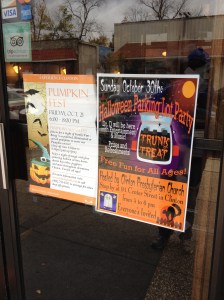
Halloween is finally here, and I’m on my way to work. Over the weekend I noticed youngsters about in costume, heading to a local business that was holding, apparently, some kind of ghostly do. For me it’s just another day—Halloween isn’t an official holiday in any government’s book. Business as usual. Still, I can’t think of Halloween without recalling Nashotah House. I began, and effectively ended, my academic career at Nashotah. Idyllically located in the woods, it was a seminary that knew how to celebrate Halloween well. We were expected—required, actually—to be in church for a good part of the next two days for All Saints’ and All Souls’ days. But Halloween night we were allowed to be afraid.

Gothic writers often used to focus on places like monasteries and churches for moody frights. Nashotah began its life as a monastery, but soon turned into a seminary. The stone buildings were old—for this country—and gothic in design. We had an on-campus cemetery with a bona fide black monk. Students reported seeing ghosts, and with such a small population of religiously devoted people the imagination grew like toadstools. One morning at around 5 a.m. the door handle to my apartment rattled loudly. I’m sure it was just someone trying to get into a forbidden chapel whose only access was through my rooms. Thunderstorms echoing through the kettle moraines that surrounded the Wisconsin campus could be impressive indeed. On Halloween the maintenance man drove a hayride through harvested corn fields and the cemetery where opportunistic ghouls would pop out to frighten the slow-moving, exposed riders.

Since those days Halloween has instead become just a day of work. No more the grandeur of All Saints’ Day being an actual holiday, holy day, followed closely by All Souls’. This is just another day except for the kids who can come around and get some candy if I’m not too tired to hand it out later. I suspect this is why I spend so much of October reading about monsters and ghosts and scary movies. I no longer have a Halloween to focus my energies. So here it is Halloween. It’s dark outside and I’ll be standing in that dark, waiting for a bus. When I climb off at the end of the day, I’ll be sharing the nighttime streets with children who are perhaps the only ones who celebrate holidays as they should be commemorated. Already a month ago I began noticing the Christmas displays in local stores. It was my first real scare this season.


Only October

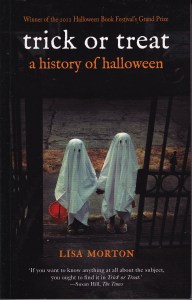
trickortreatComfort may be a strange word to describe Halloween, but it is accurate. I’m no specialist on the holiday, although I’ve read a few books on it—most recently Lisa Morton’s Trick or Treat: A History of Halloween. Growing up in what felt to me like an uncertain environment, holidays—and especially Halloween—have left me with positive impressions. Morton’s book explores this strange combination of fear and fun and suggests that many people of my generation do find comfort in its celebration. I grew up without a father in a conservatively religious home. Yet I loved the escape of putting on a mask and being someone else. Coming home with a bag of candy was a bit like that dream I still have of finding a penny on the ground and then realizing there are thousands of them just beneath the surface. There’s a security in that dream and I always find a tear in my eye when I awake from it.

Halloween is, appropriately, a chimera of holidays. It is solidly pagan. It is equally solidly Christian (specifically Catholic). Perhaps to placate those troublesome Celts, the Roman Church moved its commemoration of All Saints and All Souls to November 1 and 2, allowing for the Eve of what used to be called “All Hallows” as a holdover of Hibernian lore. Morton goes beyond the northern European fascination with the darkening of the year to explore other regions and how they mark the season. The southern hemisphere, obviously, doesn’t have the same pattern of autumn and spring, and the holiday has had less success there. The threat of the light never returning has to be real to make the fear stick. The warmest memories of my childhood seem to come from the days artificially lengthened by electric lights and the holidays they spawned: Halloween, Thanksgiving, Christmas. Comfort.

The air has begun to turn chilly around here. I’ve found myself shivering a morning or two while waiting for the bus. As I pull on my coat and step out into the pre-dawn dark, a stop sign creaks eerily on the deserted street. I’m headed to a long day in a city of stone and glass and warmth will be difficult to find. Halloween decorations get lost in the enormity of New York City and its constant quest for money. So I recall Halloweens of my small-town childhood. I tend not to go out at night, but I haven’t always been this way. When there was an unspoken comfort awaiting at home, no matter how frightening it could be at times, I would brave the dark and ask strangers for candy. Is it any wonder that Halloween still glows in a world somehow grown too cold?


October Weekend

img_2973

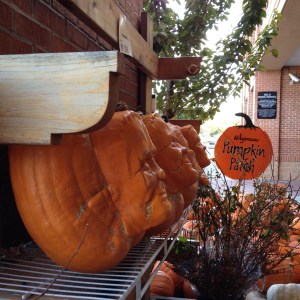
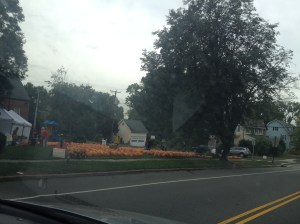
Bright orange pumpkins under a cloudy gray sky. October is surely here. But this is an urban area of the kind in which northeast New Jersey specializes. As I approach I see that it’s a church. A church that has made a truce with Halloween. Judging from the number of people here, it’s a cordial detente. So much of American society lies mired in contradiction that I have to ponder this. Halloween in an age of nones may be simply fun. An opportunity to spend money on pumpkins that won’t be eaten and gourds that can’t be. Decorations for a mildly scary night that somehow makes us feel comfortable and snug at home. October is like that.

Churches have been struggling to maintain active memberships. And although the antagonism has been overblown, Halloween has been an uneasy part of the church calendar. It has, however, become a major commercial opportunity. Depending on the commodity, only Christmas or Easter will draw more lucre from people. The devils and demons and ghosts of Halloween sit awkwardly in the pew next to the victory over death that is the main draw to traditional Christianity. But people will predictably spend their cash for the privilege of carving a pumpkin. Just the memory of the scent, the feel, the contentment of creating a jack-o-lantern makes me want to stop and support whatever denomination this might be.

It is a weekend, however, and I have many errands yet to do. I content myself knowing there are happy people in this temporary pumpkin-patch. The faith of Linus is a powerful thing. To get ready for the week ahead in which I’ll have time only for working, commuting, and sleeping, I keep moving. The orange fades from sight. The cheerful memories of childhood pass. I go on to my next stop. My first errand began at 6 a.m.this morning. Noon is fast approaching. I need a tiny piece of hardware that can only be found in a big box store. I prefer to support the local economy but that shop is all the way across town. Inside the Depot plastic Christmas trees of every description fill the front of the store with winter dreams of even more spending. I forget what I came in here for.


Holiday Weekend

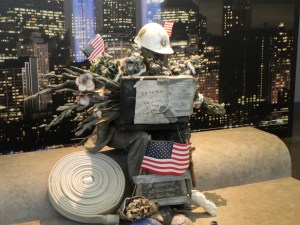
John Seward Johnson II is a sculptor whose work is instantly recognizable by a number of people. Realistic, life-size bronze castings of people doing everyday things, some are painted so as to be difficult to distinguish from quotidian humans. Others are left more abstractly colored or sized so as never to be mistaken. They are, in many ways, explorations of what it means to be human. One of Johnson’s statues, “Double Check” presents a business man sitting on a bench, checking his briefcase. It is most famous for having sat near ground zero and having confused rescuers as a real person traumatized by the events of September 11. Memorial Day seems like a good opportunity to revisit the statue that many thought was human, and which many people still adore.

DSCN6309

While perhaps the most obvious question a sentient being can ponder, what it means to be conscious (and in our case, human) is without an easy answer. We are animals aware of our own mortality in a way that causes many of us angst, or even terror. Humans (and perhaps other conscious animals are) notorious anthropomorphists—we think of other creatures, and even inanimate objects as being like ourselves. We can mistake statues for real people. All too often we treat others as if they were made of cast bronze. Memorial Day is for remembering, but the fallen haven’t only been the victims of the madness we call war. Violence done to others for one’s own gratification is an act of war on a personal scale. Individuals who destroy many others need to stand long before a statue and ponder.

“Double Check” has become an icon of sorts. People left gifts and remembrances for the victims of the attack on the statue. When the real thing isn’t there, sometimes a statue will do. This can teach us something about being human. As we die, at least in this culture, we are buried and a headstone becomes our statue. Our representation for the world to remember that we were here. Our progeny may lay flowers on our grave on this date some day in the future while statues that look just like humans will remain largely unchanged, asking those who remain alive to check again. To think, what does it mean to be human? And when any of us may be tempted to harm anyone else, perhaps we should gaze at a statue and consider the implications.


Literate Madmen

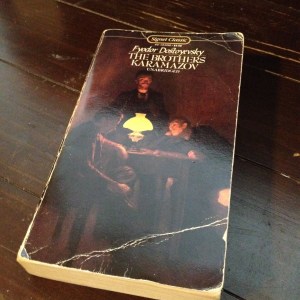
My experience of paternal parents growing up never led me to think Father’s Day was a holiday particularly worth celebrating. (Don’t panic—today’s not Father’s Day!) I do have an ironical sense of humor about the commemoration, though. So the other day when I clicked through one of Amazon’s many daily ads to my email account, I noticed it was for Father’s Day gifts. The first item listed was Fyodor Dostoyevsky’s The Brothers Karamazov. Probably based on my browsing history, I thought. But no, I’ve been looking at non-fiction lately and I bought my well-worn copy of Dostoyevsky before Amazon was a gigabyte in Jeff Bezos’ eye, back when I was in seminary. Then it dawned on me: this is perhaps the most famous patricide novel ever written. Had the Amazon advertisers really thought about what they were recommending? “Here, Dad. It’s a book about sons killing their father.” If marketing is driving America, it may be time to pull over at a rest stop for a coffee break. Or at least read the book first.

IMG_2796

I don’t pay attention to when Father’s Day is. It comes somewhere in that complex of spring holidays that include Passover, Easter, Mother’s Day, and Memorial Day. When my father was alive I sent him a card. It was a card to a stranger, but as Episcopalians know, it’s the done thing. I loved him, but I didn’t know him. Not that I’ve been a parent that deserves a holiday dedicated to my skill either. I confess my fair share of parental failures. They play and replay in my head, in the way the Protestant brain can never quite clear itself of guilt. We, as people, I believe, generally try our best to be good parents. It can be difficult, though. Nothing really prepares you for it.

One of my brothers once told me that, after having a girlfriend with kids from a previous marriage, he better understood how our stepfather viewed us as inherited children. Although I always want to claim the victim role in that scenario (I was only ten, what could I do?, etc.) his insight has stayed with me. It can’t be easy to inherit someone else’s progeny. It’s tricky raising your own child—that new person you want never to experience your own disappointments in life. Even cynics can be sentimental. But then again, I’ve been plowing through The Brothers Karamazov again since January, frequently laying it aside for weeks at a time. It’s not the kind of book I’d give a father on the edge. It’s okay, I think I’m good to drive again. I just won’t pay any attention to the ads I see beside the road.


Riding a Cycle

Spare-ribs and sauerkraut. My step-father always insisted on these for the turning of a new year. The old year was to end on something sour while the new was to begin with something sweet. So his reasoning went. It is this Janus-faced aspect of the new year optimism that we anticipate with such high hopes every twelve months, only to come back to another gray December. Time, since antiquity, was considered something cyclical. Today we think of time as linear—a line stretching from there to here, nobody really knowing where it might end. New Year’s Day reminds us of that obscure hope that things might indeed get better.

Since I’ve been cast into the role of someone dependent on business for a living, I’ve become keenly aware that, although the fiscal year doesn’t end for another three months, and the school year doesn’t begin for about six more after that, we open each year on the hope for better profit than the previous one. In a way that I’ve always felt earned economics its sobriquet of the dismal science, constant increase in a world of limited resources is sure to disappoint. What is really sought, it appears, is more for me, which means less for you. Born an idealist, I find the whole concept baffling. If I have too much to use, shouldn’t I share it with those who don’t have enough? Those who read about the behavior of apes would recognize this basic altruism as deeply embedded in the primate genome. Unless, of course, that primate is a human being.

Janus.xcf

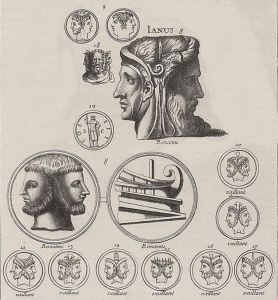
I wish that a New Year celebration could be more universal than just fiscal success. It is always my hope as a new year begins that by the end of it we will all be in a place we would prefer to be. Those of us who live under the law of greed and personal gain have long felt the frowning aspect of Janus’s face. As the year turns over in the month named for this deity of thresholds, we hope that a smile might beam down upon us, and that a new year might truly be new. Knowing this is an election year, however, has come to cause increasing anxiety. Those who can command public attention are those with the deepest coffers. Those most unworthy to lead. We do, however, love our entertainment. The Force has awakened, and what might we anticipate for 2016? For me, no animal has ribs to spare, but the symbol has become increasingly apt. Let’s hope the Force is good and will awaken peace.